Benefits of a BI Center of Excellence for Better Data
Explore the benefits of a BI center of excellence, from trusted data and stronger governance to efficient analytics that align insights with business goals.
- Clear data policies, ownership and lineage help teams understand where information comes from and build confidence in its use.
- A CoE can coordinate shared platform capabilities, consistent metrics and a clear route for analytics requests.
- Standard practices can reduce duplicated effort and help teams move useful insights into business decisions sooner.
- Power BI governance can support self-service analytics while setting practical standards for models, workspaces and report development.
- Business leaders should shape the CoE’s priorities so its work stays connected to organizational goals, not just technology.
A BI Center of Excellence creates value when it solves business problems, not simply when it produces more dashboards. The benefits of a BI Center of Excellence include stronger data quality and governance, more consistent and trusted results, and a clearer path from business priorities to useful analytics.
It’s understandable to expect BI teams to deliver reports quickly, but speed alone is not enough when teams use different definitions or question the numbers. A well-aligned center brings shared standards, expertise and practices together so people can make decisions with greater confidence.
This article explains how a BI Center of Excellence supports data quality, governance and reliable results, and how it can help teams deliver insights more efficiently. It also explores why business leaders must shape priorities, so the center advances organizational goals rather than becoming an IT-only initiative.
Data quality, integrity, governance and lineage
A BI Center of Excellence connects data standards, oversight and business priorities across an organization. Its governance should make trusted intelligence easier to produce while managing risks related to access, inconsistent definitions and sensitive information.
Data Quality and Integrity
Data quality and integrity mean keeping information accurate, consistent and traceable from its source to the report. That matters when teams rely on the same metric to make decisions across departments. A CoE can define shared terms, validation practices and ownership for critical data. For example, finance and sales teams can use one agreed revenue definition instead of reconciling conflicting report totals.
Lineage adds context by showing where data originated and how it was transformed before appearing in a dashboard. A documented path from source system through model to report helps teams investigate unexpected results. Establishing data governance early gives the CoE a foundation for reliable information and better-informed decisions.
Governance, Oversight, and Risk Mitigation
Governance sets the policies, roles and review processes that guide BI work. Oversight matters because unclear ownership can lead to inconsistent reports, duplicated effort or inappropriate access. A CoE can define standards for data handling, model design and workspace use, then review progress through regular steering committee meetings to assess work and approve major initiatives.
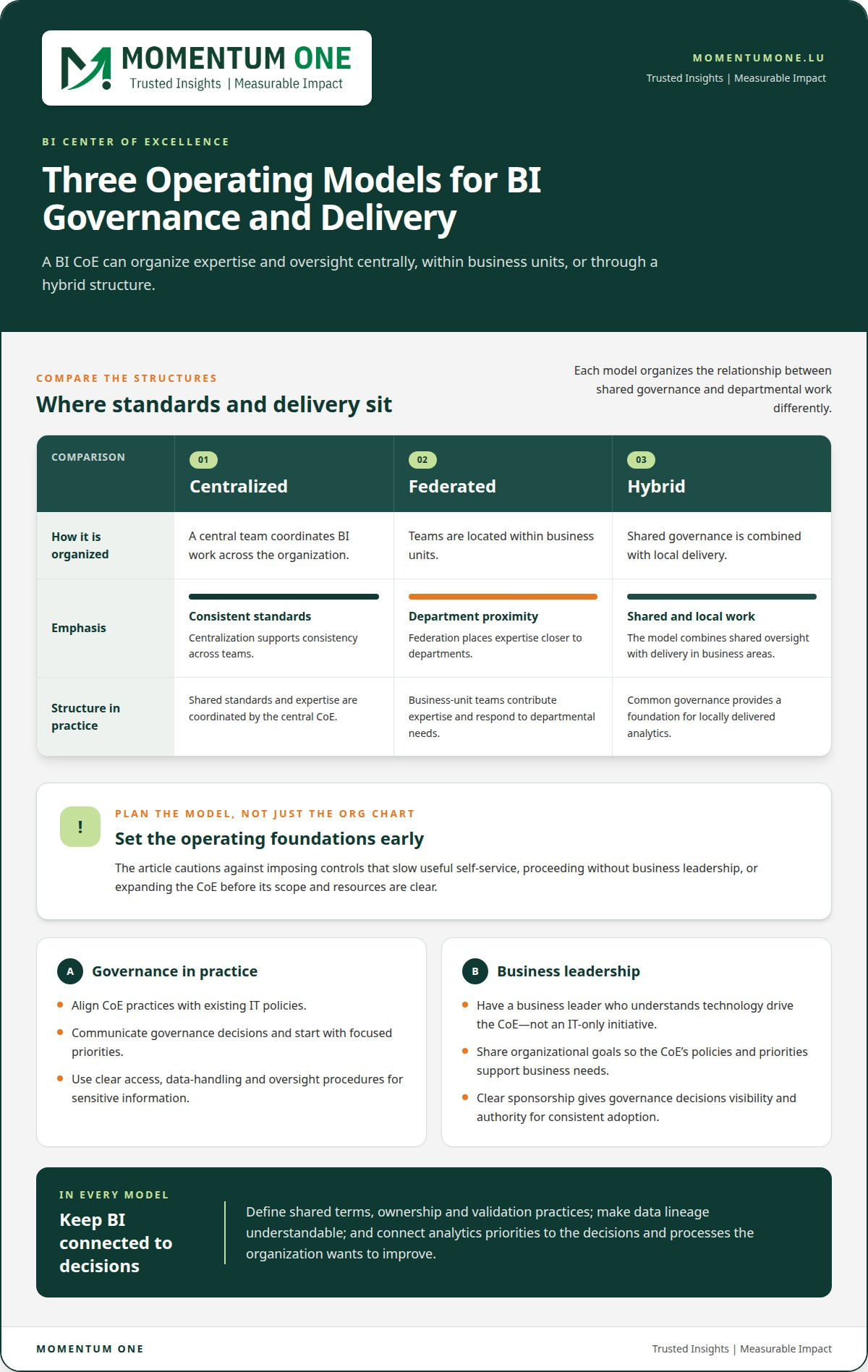
Common challenges include imposing controls that slow useful self-service, failing to secure business leadership, and expanding the CoE before its scope and resources are clear. To mitigate these risks, align practices with existing IT policies, communicate decisions, and start with focused priorities. A Power BI governance framework can help organize those responsibilities.
Operating models: A BI CoE can use a centralized team, a federated model with teams in business units, or a hybrid structure. Centralization supports consistent standards; federation places expertise closer to departments; a hybrid model combines shared governance with local delivery.
Luxembourg privacy and data protection: A BI CoE in Luxembourg should put the organization’s applicable privacy and data protection obligations into practice through defined access, handling and oversight procedures. For example, it can document who may access sensitive datasets and align connector use with existing organizational policies.
Business leadership: The CoE should be driven by a business leader who understands technology, rather than treated as an IT-only project. Leaders should share organizational goals with the CoE so its policies and priorities support business needs. Clear sponsorship also gives governance decisions the visibility and authority needed for consistent adoption.
Purpose and responsibilities of a BI and analytics Center of Excellence
A BI and analytics Center of Excellence brings shared expertise and practices together to support enterprise decisions. Its scope can include platform management, consistent metrics, user adoption, training and advanced analytics.
Centralized Analytics Expertise and Services
A CoE coordinates the capabilities teams need to turn data into useful analytics. It can maintain the BI platform, establish company-wide metrics, manage analytics requests and share guidance across departments. This gives teams a common foundation while leaving room for business-specific scenarios. For example, a central team can support a sales forecast while helping finance apply consistent definitions to its reporting.
Its responsibilities should connect to a clear business vision, not just technology implementation. The organization defines which decisions or processes analytics should improve, then sets priorities accordingly. Shared services can include platform engineering, support, operations and release management. A single entry point for requests also helps teams assign work transparently and focus effort on business priorities.
BI CoE Roles and Skills
A BI CoE combines technical expertise with business knowledge and communication skills. Platform specialists and data analysts can develop reliable analytics, while business stewards clarify definitions and departmental needs. One possible starting approach is to involve a business steward and one or two business and data analysts from each initial line of business. Role-based training can then support viewers, analysts and report creators in different ways.
Collaboration matters as much as technical depth. Business representatives explain the decisions teams need to make; analysts translate those needs into useful models and reports. Platform specialists maintain shared capabilities, while leaders set direction and resolve competing priorities. A CoE can also support a user community through training and knowledge-sharing, encouraging adoption through practical use rather than top-down direction.
CoE Drivers and Return on Investment
Common drivers include duplicated reporting, inconsistent metrics, slow analytics delivery and limited access to specialist skills. A CoE addresses these issues by coordinating expertise and reusable practices. Organizations may report up to a 30% increase in operational efficiency after establishing a data and analytics CoE. Results depend on whether its work addresses meaningful business needs and receives adequate resources.
Return on investment should connect CoE activity to outcomes the organization values. Track whether shared models reduce repeated work, whether request handling supports timely decisions, and whether users adopt the resulting tools. As capabilities mature, the CoE can extend into predictive analytics and machine learning, applying them to defined scenarios rather than technology experiments without a business purpose. To explore which capabilities fit your organization, discuss your analytics priorities.
Reported improvements in time to market and trust in results
Organizations that have implemented an analytics Center of Excellence have reported faster analytics delivery and greater trust. These outcomes are useful signals, but teams should define how they’ll measure progress in their own organization.
Measuring CoE Value
Measuring CoE value means tracking delivery, use and decision outcomes against clear business goals. This helps leaders see whether shared capabilities are improving results, rather than counting reports alone. Companies the author had worked with reported three- to six-fold improvements in time to market after one to two years. They also reported trust in analytics results rising from 10-25% to 80-90% over one to two years.
These reported outcomes are not guaranteed for every organization. To assess progress, define a baseline for request-to-delivery time, report adoption and stakeholder confidence. Then review those measures alongside a concrete business scenario, such as whether a sales team receives useful campaign insights before planning its next activity. Documenting definitions makes comparisons more meaningful.
A CoE can use regular reviews to identify delays, duplicated work and reports that no longer support decisions. If a delivery bottleneck stems from unclear requirements, improve intake and prioritization. If users question results, trace feedback to the underlying data, metric definition or report design. A Power BI Center of Excellence framework can help organizations shape responsibilities and operating practices.
User Feedback and BI Returns
User feedback connects analytics capabilities to everyday work. Collect comments through user sessions, support requests or report reviews, then group recurring issues by cause. For example, if managers interpret a sales measure differently, clarify its definition and explain it in the report. This turns feedback into a practical improvement rather than an untracked complaint.
BI can also help teams assess return on investment in other initiatives and marketing programs. Compare campaign responses with past market scenarios, then use the results to put customer behavior in context. This gives decision-makers evidence for adjusting future activity instead of relying on a headline metric alone. Defining the decision first helps keep analysis focused on what the business can act on.
Continuous improvement depends on closing the feedback loop. Share what changed, why it changed and which decision the updated report supports. When technology changes, reassess whether existing reports and capabilities still serve their purpose. This visible process helps users understand how their input contributes to progress and gives the CoE a clearer basis for prioritizing its next improvements.
Benefits of a Power BI Center of Excellence
A Power BI Center of Excellence can make development more consistent, help people use insights effectively and support better decisions. Its practices can serve an organization with one Power BI developer or several business units, provided its structure matches how teams work.
For internal teams, shared architectural patterns can reduce duplicated development and clarify how reports move from creation into production. A defined workspace structure can separate development, testing, user acceptance testing, production, departmental and personal work. This makes responsibilities easier to understand and helps teams choose the right environment for each task. It also gives decision-makers a clearer view of which reports are ready for business use.
Cost efficiency comes from coordination, not simply cutting tools. A CoE can develop and communicate architecture patterns that help manage licensing, Premium and Azure costs. Organizations with 50 or more Power BI workspaces may need automation to keep administration manageable. A CoE can also review report use: monitoring reports with zero views for 60 days can help identify content for review or retirement.
Setting up shared practices can also address shadow IT. Companies an author had worked with reported eliminating 70-80% of shadow IT staff after implementing an analytics CoE, after 1-2 years. This is a reported experience, not a forecast for every organization. The operational benefit is clearer ownership: teams can bring reporting needs into a governed process rather than creating disconnected solutions.
How much does it cost to establish and run a BI CoE? There is no single cost; it depends on the CoE’s scope, staffing, platform architecture, governance needs and training, with a price determined after a quote request.
Power BI insights are most useful when they connect to a specific business decision. A finance team, for example, can use consistent measures to compare actual performance with plans, while sales teams can focus on high-impact customer or pipeline questions. Starting with a defined priority, such as finance, sales or operations, helps demonstrate value and establish practices that can be reused elsewhere. In specialized sectors such as education, teams often pair core governance principles with purpose-built tools like Rise to track student activity and academic performance through real-time dashboards.
One developer can benefit from shared guidance just as multiple departments can benefit from coordinated delivery. A CoE can provide dedicated expertise for architecture and performance while supporting business self-service within agreed standards. That balance helps teams build reports closer to their needs while reducing avoidable variation in models and measures.
Review the CoE’s scope as Power BI use grows. If workspaces, report requests or support needs increase, adjust its capabilities and automation to match. Regularly reviewing report use, delivery processes and business priorities helps the CoE stay focused on decisions rather than maintaining content that no longer serves internal users.
The business role of a BI center of excellence
A BI Center of Excellence works best as a business-led capability, not an IT project with reports as its only output. Its strategic role is to connect data initiatives to the decisions the organization needs to make.
A business leader with a strong understanding of technology should drive the CoE. That leader can connect platform choices with priorities such as improving sales planning or understanding operational delays. IT specialists still contribute architecture and technical expertise, but business ownership keeps the work focused on outcomes. For example, a request for a new dashboard should begin with the decision it needs to support.
The business defines which areas the CoE should target, then its scope evolves with organizational needs. A finance team might start with consistent performance reporting, while operations later needs analysis of delivery delays. Setting priorities this way helps avoid building a structure around tools alone. The CoE can reassess its goals and activities regularly to keep each initiative aligned with current strategic objectives.
A core-and-satellite structure can balance shared direction with departmental knowledge. The core CoE maintains common capabilities, while a satellite team applies them to local needs. For example, a department may develop a useful metric for its own planning; the core team can later adopt it as a supported enterprise metric. Satellite teams should stay connected to the core rather than develop separate practices in isolation.
That connection requires practical participation from both sides. Departments in an extended model should contribute financially to the core CoE, and business teams should share their priorities and feedback. Regular updates or visual progress reports can make backend work visible to stakeholders. A finance leader, for instance, can see whether a reporting initiative is progressing and understand how it supports an agreed business goal.
Business ownership also shapes how a CoE introduces change. When a new BI tool alters a familiar process, explain its practical value and address users’ concerns about existing workflows. Build adoption gradually through useful examples, shared learning and visible results, rather than imposing a data-driven culture from the top down. This makes the CoE a partner in change, not simply a platform authority.
The key takeaway is that business leaders set the purpose, priorities and measures of success; the CoE provides the structure and expertise to deliver them. To align BI governance and delivery with your organization’s goals, discuss your BI strategy.
Momentum One
Momentum One helps organizations turn BI Center of Excellence priorities into practical data and analytics work. If your platform, models or team capabilities need to support clearer governance and more trusted reporting, Momentum One can help shape the next steps.
That work may involve modernizing a Fabric environment, improving data models and DAX, designing a data warehouse or lakehouse, or building staff capabilities through training. The right focus depends on your organization’s goals and current data setup, so the work addresses the issues that matter most rather than introducing unnecessary complexity.
If you’re ready to discuss how to develop your BI capabilities, contact Momentum One.
Turn your BI priorities into a clear next step
A BI Center of Excellence is most useful when its operating model reflects the decisions your organization needs to make. Start by identifying where teams need clearer governance, more dependable data foundations or stronger analytics skills. Then shape the next initiative around that priority, rather than expanding the platform without a defined business purpose.
The benefits of a BI center of excellence become more tangible when strategy and implementation move together. Momentum One can help organizations connect BI priorities with Power BI Consulting & Governance, Fabric Migration & Modernization, or Data Modeling & DAX Optimization. The right focus depends on the challenge your teams are addressing.
If you’re ready to explore a practical path for your BI needs, contact Momentum One. A focused conversation can help clarify where to begin and how to move forward with confidence.
Frequently Asked Questions
So why are COEIs needed?
A CoE helps organizations coordinate analytics when teams develop separate solutions for similar needs. Without shared direction, one department might define customer churn differently from another, leaving leaders unsure which report to use. A center can connect business priorities with common expertise and practices while keeping analytics work focused on decisions. It also gives teams a place to resolve competing requests and share effective approaches.
What is a business intelligence center of excellence (BI CoE)?
A BI CoE is an organized capability that guides how an organization develops, manages and uses business intelligence. It may be a central team, a network of departmental specialists, or a combination of both. For example, a core group can set platform guidance while business teams contribute domain knowledge. The structure should fit the organization’s scale, skills and analytics demand rather than follow a fixed template.
What are the main benefits of establishing a BI CoE?
The benefits of a BI center of excellence include clearer ownership, reusable analytics work and better coordination between business teams and technology specialists. A CoE can also help people find suitable reports instead of creating new ones for every request. For example, a shared sales analysis can provide a starting point for regional planning, while teams add relevant local context. The value comes from applying shared capabilities to real decisions.
How does a BI CoE improve data quality and governance?
A BI CoE improves quality by assigning ownership for important datasets and defining how teams validate them before use. For example, a sales dataset could be checked for missing customer identifiers before analysts build reports. Governance can clarify who may access data, who approves changes and how definitions are documented. These practices make it easier to investigate a discrepancy and determine whether it came from source data, a transformation or a report.
How can a BI CoE increase BI adoption and user self-service?
A BI CoE can make self-service easier by giving people role-appropriate guidance and clear routes to support. Report viewers need help interpreting visuals, while creators may need practical advice on building and publishing reports. A user group or regular office hours can surface common questions and useful examples. When users can find a suitable existing report and understand its measures, they’re less likely to create conflicting versions.
How does a BI CoE reduce analytics costs and duplicated work?
One practical benefit of a BI center of excellence is reducing duplicated work by helping teams reuse suitable models, definitions and report components. For example, if two departments need the same supplier performance measure, a shared data model can avoid maintaining separate calculations. Reviewing tool usage and retiring content that no longer supports decisions can also limit unnecessary administration. The savings depend on how much work the organization can genuinely consolidate.
How should an organization establish a BI CoE step by step?
Start by defining the business decisions the CoE should support, then identify the teams and data involved. Next, assign clear business and technical responsibilities, choose a central, federated or hybrid structure, and set initial governance practices. Pilot the model in a focused area, gather user feedback and adjust the approach before broadening its scope. For example, a finance pilot can test request handling before other departments join.
What metrics measure the success of a BI CoE?
Measure success with indicators tied to the CoE’s objectives, not report counts alone. Track how long analytics requests take, how often users access priority reports and whether teams reuse shared models. Add qualitative feedback about confidence in results and usefulness for decisions. If the goal is to improve planning, assess whether stakeholders use the analysis during planning discussions and whether its findings inform their choices.