Data modernization in Luxembourg: GDPR and health data examples
See how data modernization luxembourg navigates GDPR and health-data rules, with Dataspace4Health examples and guidance on secure, interoperable sharing.
- Luxembourg’s data ecosystem includes initiatives across health, mobility, industry, energy and public administration, creating practical settings for trusted data sharing.
- Dataspace4Health applies data-space principles to health data and states that it ensures compliance with GDPR and European health-data regulations.
- For data modernization in Luxembourg, costs and timelines depend on data quality, system complexity, integration needs and project scope.
- Assess legacy systems by business value, dependencies, data condition and operational risk, then prioritize work in manageable stages.
- Build security and privacy into modernization decisions. Data modernization in Luxembourg can include a Microsoft Fabric migration supported by Momentum One’s Fabric Migration & Modernization offering.
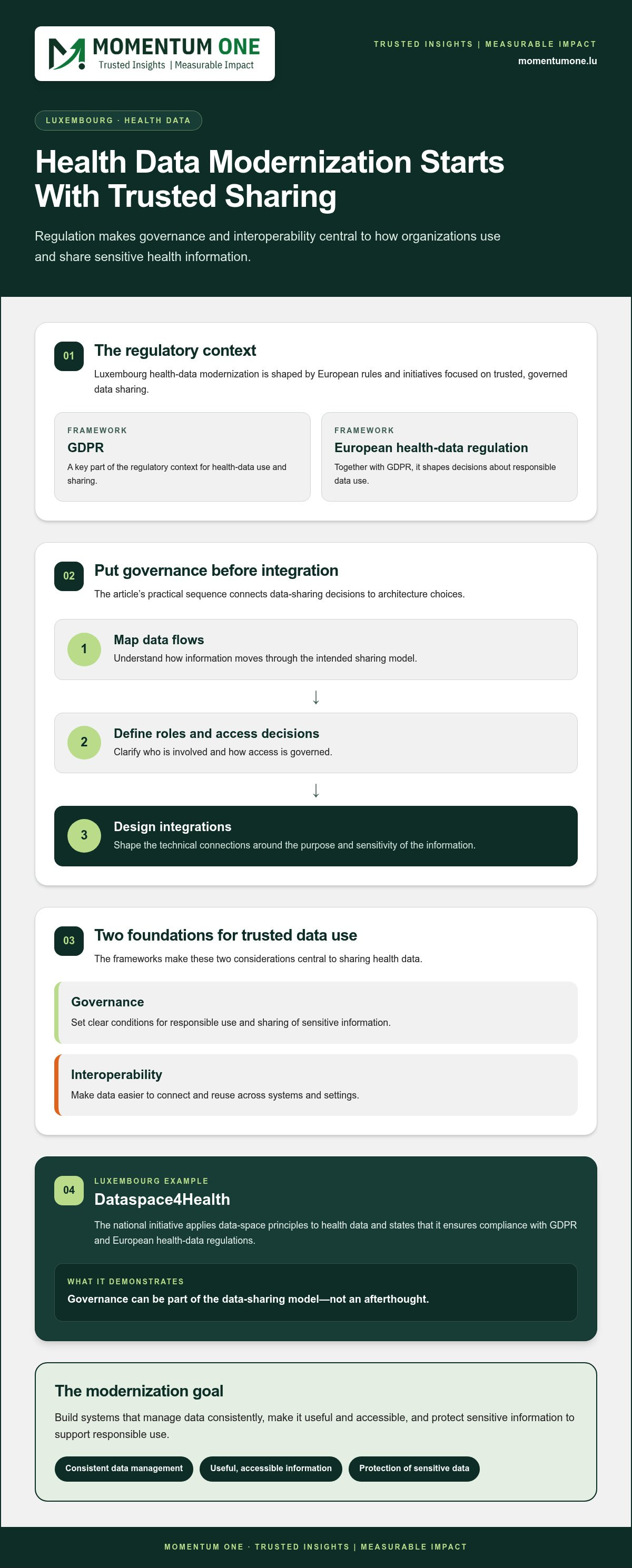
In Luxembourg, modernizing health data is not just a technology decision; it’s a question of trusted, governed sharing. Data modernization in Luxembourg is shaped by GDPR, European health-data regulation and initiatives such as Dataspace4Health. The national initiative applies data-space principles to health data and states that it ensures compliance with GDPR and European health-data regulations. These frameworks make governance and interoperability central to how organizations use and share data.
That can feel complex: modern platforms must make data useful and accessible while protecting sensitive information. The opportunity is to build systems that manage data consistently and support responsible use, rather than leaving information difficult to connect or reuse.
This article explains how GDPR and European health-data regulation shape the decisions, then looks at Dataspace4Health and practical Luxembourg examples. You’ll see what these initiatives mean for data modernization projects, from setting governance foundations to designing architectures that support secure, interoperable use. The aim is to make the regulatory context clearer and show how it connects to real modernization choices.
Which data modernization services and providers operate in Luxembourg?
Luxembourg’s digital environment supports work in data architecture, cloud migration, analytics, integration and governance. The country ranks first in Europe for overall internet take-up and second in the EU for the proportion of ICT specialists. For data modernization in Luxembourg, start by matching a provider’s capabilities to a defined need, such as connecting fragmented systems or building a reliable foundation for reporting.
Public initiatives and research partnerships also contribute to this environment. The Luxembourg National Data Service supports reliable sharing and reuse of public-sector data across domains, while the Luxembourg Data Spaces Hub helps explore sector opportunities. The University of Luxembourg’s Interdisciplinary Centre for Security, Reliability and Trust collaborates with more than 60 partners. These entities help organizations consider how research, public data and industry use cases might inform modernization priorities.
Case: Automotive data exchange
Situation: Automotive manufacturers and suppliers need to exchange information across organizational boundaries. Action: Catena-X enables interoperable, sovereign data exchange across the global automotive value chain. Result: Participants have a framework for trusted collaboration beyond isolated company systems. This example shows why teams pursuing data modernization in Luxembourg should define shared data models, access rules and intended uses before building exchanges.
Case: Mobility and logistics
Situation: Transport services rely on information held across organizations and systems. Action: The Mobility Data Space operates as a marketplace for mobility and logistics data. Result: It supports transport services and cross-sector collaboration. A practical first step is to identify data owners, intended users and exchange requirements. These decisions clarify which integrations and data structures the project needs.
Case: Health research
Situation: Precision-medicine research needs usable data across different settings. Action: CLINNOVA advances data federation, standardisation and interoperability through an international research project. Dataspace4Health applies data-space principles to Luxembourg health data and states that it ensures compliance with GDPR and European health-data regulations. Result: These initiatives demonstrate how governance and shared standards can support responsible data use.
When assessing providers, compare their capabilities with the actual requirement: migration, integration, modeling, analytics or governance. Map data sources, dependencies, access needs and operational ownership before choosing an architecture. For example, organizations consolidating reporting may need a coherent data foundation. The principles behind a single source of truth for enterprise data illustrate one approach. The right fit depends on existing systems and how teams need to use their data.
What are the main data modernization projects and trends in Luxembourg?
Luxembourg’s projects point to a practical shift: organizations increasingly treat data as something that can be shared under defined conditions. The Luxembourg Data Spaces Hub supports exploration across mobility and transport, industry and manufacturing, energy and sustainability, and public administration and smart territories. Organizations can start by identifying a specific shared-data problem, then defining participants, permitted uses and common formats. This scoping turns broad interest in data spaces into a focused modernization initiative.
Case: Digital TER-X 2050 and construction
Situation: Construction-sector organizations need ways to share information for environmental and digital-twin use cases. Action: Digital TER-X 2050 promotes construction data sharing for emission reduction and digital-twin applications. Result: The initiative gives participants a context for aligning data around those purposes. A project team can translate that direction into a data inventory, shared definitions and rules for access. Those foundations help clarify which datasets support the intended use case.
Case: Dataspace4Health and health data
Situation: Health-data initiatives must support useful data collaboration while addressing regulatory expectations. Action: Dataspace4Health applies data-space principles to Luxembourg health data and states that it ensures compliance with GDPR and European health-data regulations. Result: Its approach makes governance part of the data-sharing model, rather than an afterthought. Teams can map data flows, roles and access decisions before designing integrations. That sequence connects modernization choices to the purpose and sensitivity of the information.
Case: Public-sector reuse and Gaia-X
Situation: Public-sector data may create value beyond its original use, while organizations also need trusted ways to exchange data. Action: The Luxembourg National Data Service facilitates value creation through secondary data use and supports reliable sharing and reuse of public-sector data across domains. Luxembourg also participates in Gaia-X, which aims to create an open, secure and sovereign European data infrastructure for trusted exchange. Result: These efforts make data reuse and trusted exchange clear modernization priorities. Teams can begin by documenting data ownership, intended reuse and exchange requirements.
Across these projects, interoperability is a recurring theme: systems and participants need agreed ways to describe, access and exchange data. A practical planning sequence is to select a use case, identify participating organizations, map required datasets, and define governance and technical interfaces. The Luxembourg Data Spaces Hub’s sector range helps teams explore where collaboration could create value, without assuming every dataset belongs in a shared environment.
For a project involving Microsoft Fabric, a focused conversation can help connect modernization goals with a workable migration path. Discuss your data modernization priorities.
What are typical data modernization costs and timelines in Luxembourg?
Data modernization costs and timelines in Luxembourg depend on the scope of work, not simply the platform selected. A Microsoft Fabric migration involving a clean, documented warehouse differs from one that requires source discovery, data cleanup and redesigned reporting. The price is project-specific and provided after a quote request. Key cost factors include source-system complexity, data volumes, integration needs, security requirements, testing and staff training.
Build an estimate around deliverables, not a single platform fee. First define the business outcome, such as consolidating reporting or replacing a legacy warehouse. Then document the systems, data flows, users and dependencies involved. Include design, migration, validation and knowledge transfer in the work plan. This breakdown makes assumptions visible and helps teams separate essential modernization work from optional improvements.
- Discovery: Map systems, owners, data quality and dependencies.
- Design: Set the target architecture, access model and migration approach.
- Delivery: Move data, rebuild transformations and test outputs.
- Adoption: Prepare users and document operational responsibilities.
Illustrative case: consolidating reporting
Situation: A Luxembourg organization draws reports from separate finance and operational systems. Action: The project team inventories data sources, agrees on common definitions and migrates a prioritized reporting workflow. Result: The work has a defined scope, focused on selected data and reports. Adding sources, historical records or complex transformations changes the workload, so the estimate should reflect those decisions.
Timelines follow the same logic. Discovery may uncover missing documentation, unclear ownership or dependencies between scheduled data pipelines. Migration also involves mapping existing transformations, reconciling outputs and resolving data-quality issues. These activities affect sequencing: teams need reliable source access before migration and validated outputs before retiring dependent reports. Approval steps and staff availability can shape the schedule as much as technical implementation.
Illustrative case: modernizing a legacy warehouse
Situation: A company wants to move warehouse workloads while keeping business reporting dependable. Action: The team groups workloads by dependency, migrates a defined data domain, then validates reports before proceeding. Result: Progress can be reviewed at each delivery point, making unresolved issues visible before they affect the wider environment. This approach also gives stakeholders a clearer basis for deciding what to include in the next phase.
For a useful estimate, prepare a source inventory, target outcomes, known integrations, data-quality concerns and acceptance criteria. Make assumptions and exclusions explicit. Projects involving shared or sensitive information in Luxembourg should also account for governance and access design, since these affect architecture and testing effort. A phased scope gives decision-makers a practical way to balance delivery priorities, available resources and operational continuity.
How can Luxembourg companies assess and prioritize legacy data systems for modernization
Start with an inventory, not a platform decision. For each legacy system, record its business purpose, owner, users, data sources, outputs and dependencies. A Luxembourg company might find that one reporting warehouse feeds finance dashboards, regulatory workflows and operational planning. Those connections matter: replacing the warehouse affects more than its infrastructure. Map what depends on it before deciding whether to retain, repair, replace or retire it.
Then assess each system using practical criteria and evidence from documentation, staff interviews, incident records and sample outputs. Apply the same approach across departments, so an older but dependable system is not automatically ranked below a newer, poorly understood one.
- Business value: Identify decisions, services and reporting that depend on the system.
- Data condition: Check completeness, consistency, duplication and documentation.
- Technical fit: Record integration limits, support constraints and dependencies.
- Risk and control: Map sensitive data, access patterns and operational ownership.
- Change readiness: Confirm available expertise, business participation and testable outcomes.
Score each dimension using a shared scale, such as low, medium or high, and record the evidence behind every rating. Avoid reducing the decision to a single technical score. A system with poor documentation may still support a critical process, while a less essential system may be easier to migrate first. Separate business criticality from technical condition, then compare both with the effort and dependencies involved.
Illustrative case: prioritizing a reporting platform
Situation: A Luxembourg organization relies on a legacy platform for finance reports, while teams maintain separate operational extracts. Action: The assessment maps report owners, source definitions, manual adjustments and downstream users. It identifies which reports share data and where definitions diverge. Result: The team can prioritize a defined reporting domain, preserve essential outputs and address data inconsistencies before expanding the migration.
The Luxembourg National Data Service’s focus on reliable sharing and reuse across domains highlights why ownership and intended use belong in a public-sector data inventory. Record who maintains each dataset, which processes depend on it and whether reuse has a defined purpose. These questions help distinguish technical obsolescence from governance or coordination issues that need separate decisions.
Finally, group systems into a clear sequence: address high-value, high-risk dependencies first, schedule lower-impact systems around them, and retire systems only after validating dependent outputs. The Luxembourg Data Spaces Hub spans public administration and smart territories, among other sectors, making cross-domain dependencies relevant to assessment. For each proposed phase, define a business owner, migration boundary, validation evidence and rollback approach. This creates a defensible priority list instead of a modernization queue based on age alone.
What are the key security, privacy, compliance, and operational risks of data modernization
A migration can create new copies, connections and access paths for sensitive information. In Luxembourg, projects involving health data must account for GDPR and European health-data regulation. Dataspace4Health states that it ensures compliance with these frameworks. Treat governance as part of architecture: identify the data, its intended use, who needs access, and how each decision will be recorded. For example, a health-data analytics project needs clear boundaries between source records and approved analytical use.
Access errors can arise when teams copy legacy permissions without reviewing them. A user who could view a source report may not need access to every dataset in a new platform. Before moving data, map roles to business tasks and test access with representative accounts. Identify temporary migration copies, exports and test environments too. Assign owners to remove or protect those copies when the work ends. This reduces exposure from forgotten files and inherited permissions.
- Privacy: Document the data categories, purpose and access groups.
- Security: Review permissions, integrations and migration copies.
- Data quality: Reconcile key fields and report outputs after transfer.
- Operations: Test dependencies, recovery steps and ownership before cutover.
Illustrative case: moving health analytics
Situation: A Luxembourg research team plans to combine health datasets for an analytical use case. Action: The team documents dataset owners, intended use, access groups, transformations and data flows before building connections. It then validates access and output quality using representative scenarios. Result: Governance decisions become visible alongside technical design, and reviewers can trace how data moves through the environment. Dataspace4Health illustrates why interoperability and compliance belong in the same planning conversation.
Operational risks often appear at handover. A pipeline may run successfully in the new environment while a downstream report still expects an older field or schedule. Inventory upstream and downstream dependencies, then test critical outputs against agreed examples. Plan the cutover with named owners, monitoring responsibilities and a rollback approach. Document what happens if a source is delayed or reconciliation fails. These steps help teams catch disruption before retiring the legacy process.
Keep evidence with the project: architecture decisions, access approvals, test results, data mappings and operational procedures. For a Luxembourg organization, that record supports clear accountability across technical and business teams. Review it whenever scope or data use changes. A structured discussion about modernization risks can help teams connect migration planning with governance and operational readiness.
The Mobility Data Space’s marketplace supports mobility and logistics data, transport services and cross-sector collaboration.
Luxembourg’s sovereign cloud solutions are locally hosted, designed for sensitive data and applications, with EU data-regulation compliance built in by design.
Momentum One: Fabric Migration & Modernization
Momentum One supports organizations in Luxembourg planning a Microsoft Fabric migration or modernizing an existing data environment. Its Fabric Migration & Modernization offering addresses the practical work of moving data workloads and shaping a clearer target architecture. Turn to this support when legacy systems, disconnected data flows or migration decisions make the next step difficult to define.
Related needs may include Data Warehouse & Lakehouse Design to structure the data foundation, Data Modeling & DAX Optimization to improve analytics models, and Training Solutions to help teams use their modernized environment effectively. The right starting point depends on your systems, priorities and intended outcomes.
Contact Momentum One to discuss your modernization plans.
Turn your priorities into a practical next step
Choose one modernization decision that can clarify the path ahead. You might define the first dataset to migrate, agree on who owns its quality, or set the outcome a new reporting model must support. A focused starting point connects data modernization in Luxembourg with business priorities, rather than treating platform change as the goal.
Momentum One supports this work through Power BI Consulting & Governance, Fabric Migration & Modernization, and Data Modeling & DAX Optimization. These services help teams connect governance, migration choices and analytical models within a coherent plan. Start with your current environment, the decisions your teams need to make and the outcomes you want your data to support.
Discuss your data plans with Momentum One, and take the next step with a clear direction.
Frequently Asked Questions
What does data modernization mean for organizations in Luxembourg?
Data modernization means improving how an organization collects, organizes, connects and uses its data. A Luxembourg company might, for example, replace scattered spreadsheet extracts with governed datasets and consistent reporting definitions. Modernization can also change how teams access information or maintain analytics workflows. The measure of progress is whether the updated environment supports a clear business need, such as dependable reporting across departments, rather than simply adopting a newer platform.
What Luxembourg and EU laws apply to data modernization, including GDPR and the Data Act?
Consider GDPR and the EU Data Act as part of a project’s legal applicability review. GDPR is relevant where personal data is processed; the Data Act may also matter depending on the data, systems and sharing arrangements involved. For health-data projects, Dataspace4Health states that it ensures compliance with GDPR and European health-data regulations. Teams should map data types, intended uses and participating organizations to frame their compliance review.
What are the steps to migrate data and modernize analytics platforms safely?
Use a controlled sequence: define the outcome, map sources and dependencies, design the target, migrate a limited workload, then validate before expanding. For example, move one reporting domain first and compare key totals and definitions with existing outputs. Document transformation logic and assign owners to resolve mismatches. Once users accept the results and downstream reports work as intended, plan the next migration phase.
How do cloud, hybrid, and on-premises data modernization approaches compare for Luxembourg businesses?
Cloud platforms can simplify access to managed data services, while on-premises environments keep workloads within locally operated infrastructure. Hybrid designs connect the two, supporting phased transitions or workloads with different operating needs. The choice depends on data sensitivity, existing investments, integration requirements, governance and team capabilities. For example, a company could modernize cloud analytics while maintaining selected legacy systems during a phased transition.
What Luxembourg-specific skills, workforce, and language considerations affect data modernization?
Luxembourg has the second-highest proportion of ICT specialists in the EU, supporting access to technical skills. Its legislation accelerates work and residence permit processing for highly skilled non-EU workers and their families. The material gives no specific language considerations.