How to assess skills gaps across your data team
Run a skills gap analysis for data teams with role-based benchmarks, practical assessments, and business priorities to build capabilities your team needs.
- Set proficiency expectations around the work your data team needs to deliver, then compare them with current capability.
- Combine self-ratings and manager input with practical demonstrations to build a more balanced picture of skills.
- Use disagreements between assessment methods as prompts for discussion, not as a reason to rely on one score alone.
- Prioritize gaps by business impact and choose a response that fits, from targeted learning to a change in team capacity.
- Connect findings to data initiatives such as modeling, platform modernization, or training so development supports real delivery needs.
An existing competency framework can make a skills gap analysis for data teams easier to structure, but it won’t prove that people can apply what it measures. Yes, you can use the same framework to assess AI skills, provided its competencies reflect the work your team needs to do. Ratings alone, however, can give an incomplete picture.
Self-assessments and manager evaluations are familiar ways to map strengths and development needs, but each has limits. Self-ratings can reflect confidence as much as capability, manager views may vary, and completing a course does not prove someone can apply a skill effectively on the job.
This guide explains how to define role-relevant competencies, compare required proficiency with current skills, and combine self-ratings and manager input with practical demonstrations. You’ll also learn how to interpret disagreements between assessment methods, prioritize gaps by business impact, and choose a useful next step, whether that’s targeted training, a role adjustment, or additional expertise. The goal is a grounded view of what your data team can do today and what it needs to deliver next.
Skills gaps: what measurement and analysis?
A skills gap analysis for data teams compares the proficiency a role requires with demonstrated capability. Use the results to identify which gaps matter most, then match each priority with a practical response, such as training, internal mobility, or hiring.
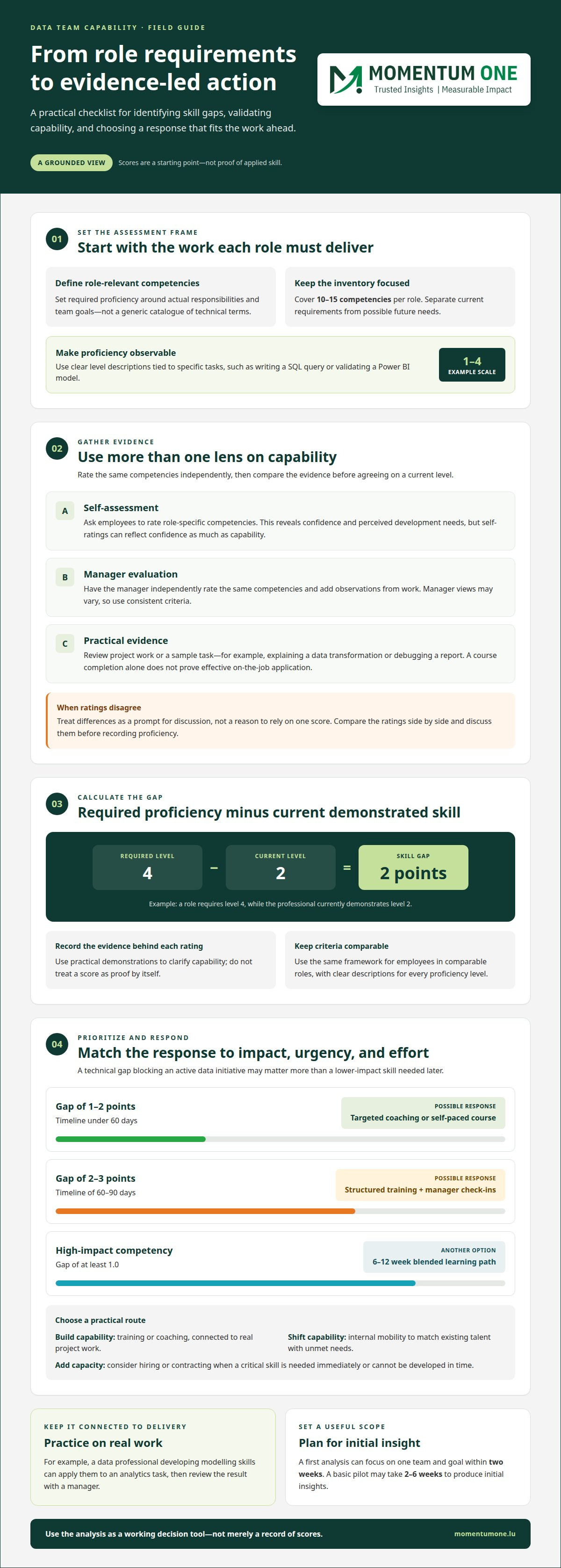
- Assessment and training timelines depend on scope, skill level, delivery format, and time away from project work. Costs depend on the case and are provided after a quote request. A first analysis can focus on one team and goal within two weeks, while a basic pilot may take 2-6 weeks to produce initial insights.
- Build a development plan by defining role requirements, gathering evidence of current capability, identifying gaps, prioritizing actions, and assigning owners. Then choose a response, such as training, coaching, hiring, internal mobility, or temporary talent. To assess training ROI, compare changes in relevant work outcomes with the time and cost invested. For example, track whether a trained analyst applies a new validation approach to project work.
-
Calculate Current Skill Gaps
For a skills gap analysis for data teams, define a proficiency scale and the required level for each role. Subtract the current score from the required score. If a data professional needs level 4 proficiency in a skill but currently demonstrates level 2, the gap is 2 points.
Keep the competency list tied to actual responsibilities. A role assessment should cover 10-15 competencies, separating current requirements from possible future needs. Record the evidence behind each rating, and use practical demonstrations to clarify capability rather than treating a score as proof by itself.
-
Prioritize Gaps by Impact and Urgency
Rank each gap by its effect on business outcomes, the urgency of the work, and the effort needed to address it. A missing technical capability blocking an active data initiative, for example, may matter more than a lower-impact skill needed later. An impact-by-effort comparison helps distinguish immediate action from longer-term development.
For a gap of 1 to 2 points with a timeline under 60 days, targeted coaching or a self-paced course may fit. A gap of 2 to 3 points with a 60-to-90-day timeline may call for structured training and manager check-ins. A 6-12 week blended learning path is another option for high-impact competencies with a gap of at least 1.0.
- Choose a response that fits the urgency and the team’s capacity to develop the skill. Training or coaching can build internal capability; internal mobility can match existing talent with unmet needs. Consider hiring or contracting when a critical skill is needed immediately or cannot be developed in time.
Connect learning with real work. For example, a data professional developing modelling skills can apply them to an analytics task, then review the result with a manager. A structured corporate training approach for data teams can link learning objectives with practical application.
Use the analysis as a working decision tool, not merely a record of scores. A skills gap analysis for data teams can guide which capability to develop first, how to support that development, and what evidence will show progress.
Self-assessment, manager evaluation, and practical demonstrations
Combine structured ratings with evidence from actual work to assess what data professionals can do in practice. Comparing perspectives can reveal skill gaps that a single assessment method might miss.
Assess data team skills by asking employees to rate role-specific competencies, gathering manager observations, and reviewing practical work samples. Compare the evidence and discuss substantial differences before recording a proficiency level.
-
Assess Skills With Structured Tools
Use the same assessment framework for employees in comparable roles, with clear descriptions for every proficiency level. A 1-to-4 scale can run from no working knowledge to consistent high performance without support. Define what each level looks like for specific tasks, such as writing a SQL query or validating a Power BI model.
Build the inventory from current role requirements, not a generic catalogue of technical terms. Include objective tests, completed learning, relevant certifications, project experience, and performance evidence where available. Apply consistent criteria so leaders can compare results without mistaking different interpretations for genuine differences in capability.
-
Gather Assessments and Practical Evidence
Ask each employee to complete a self-assessment, then have their manager independently rate the same competencies. Add observations from project work and a practical sample, such as explaining a data transformation or debugging a report. Compare ratings side by side and discuss differences before agreeing on a current level.
Self-ratings reveal confidence and perceived development needs, while manager observations show performance in context. Neither should stand alone. A 360-degree feedback process can add views from colleagues who work with the employee, but feedback needs to relate to observable tasks rather than general impressions.
- Automate repetitive data collection and initial recommendations, not the final judgment. A skills platform can collate assessment responses, learning records, and project evidence, then flag mismatches between a role profile and reported capability. Have managers review suggested matches against actual work samples, since automated recommendations can miss context, such as a specialist skill used only on a particular project.
Calibrate ratings by comparing employee and manager scores for the same competency. If an employee rates their data modelling highly but a reviewed model lacks clear relationships, discuss the specific evidence and revise the assessment together. Record why the rating changed.
- Adapt the assessment to the work, not just the job title. For data engineering, review pipeline logic, data quality handling, and documentation. For marketing analytics, assess campaign measurement, audience segmentation, and interpretation of performance data. A shared framework can cover communication and data literacy, while role-specific demonstrations test distinct technical skills.
Use the findings to identify focused learning needs and track them through future project reviews. For teams that need ongoing visibility into data capabilities and delivery needs, discuss a structured assessment approach.
Why is conducting a skills analysis relevant for companies?
Compare the capabilities your workforce needs with evidence of what employees can currently do. Assessment criteria for data analysts, engineers, and scientists should reflect their distinct responsibilities and deliverables.
-
Audit and Maintain Skills Records
Start by assembling a workforce skills inventory using self-assessments, manager evaluations, certifications, completed learning, project experience, and career history. Record the evidence for each skill and the role it supports. A completed course, for example, shows learning activity, while a project review may show how an employee applied that knowledge.
Update the inventory after performance cycles, major project changes, and relevant learning. Treat the analysis as ongoing, not as an annual snapshot. Dated records help leaders distinguish current capabilities from older experience and prioritize development using a clearer view of the team.
-
Compare Capabilities With Requirements
Map current abilities against the competencies required for active work, then consider skills needed over the following six to twelve months. A new reporting initiative, for example, may call for stronger data modelling, while a platform change may require experience with different pipelines. Separate immediate requirements from possible future needs.
Use business goals to decide which capabilities matter most. If a team needs to improve report reliability, examine skills related to data quality, modelling, and validation. For emerging technology, compare existing expertise with the work leaders expect the team to undertake rather than adding every new tool to the framework.
-
Consider Skills Across Data Roles
Set role-specific criteria before comparing employees. Data analysts may need to demonstrate query skills, metric definition, and clear communication of findings. Data engineers may need to show pipeline design, data integration, and quality controls. Data scientists may need to demonstrate statistical reasoning, model evaluation, and responsible interpretation.
Some capabilities, such as documentation and collaboration, span all three roles. Keep shared competencies separate from specialist requirements so the framework does not treat different responsibilities as interchangeable. A strong analytical report, for example, does not demonstrate pipeline engineering, even when both roles use the same dataset.
- Gather evidence from several workforce sources and record how recently each item was observed. Project outcomes, performance reviews, completed learning, and manager notes can each add context. Do not treat a job title or certification as proof of every related ability; connect the record to a task or result.
- Use the completed comparison to prioritize capability needs, development opportunities, and potential internal mobility. Review requirements when business goals, team responsibilities, or technology plans change. Skills analysis can guide training investment and career development while showing leaders where existing capabilities align with upcoming work.
What is the difference between skills gap analysis and workforce planning?
A skills gap analysis identifies missing capabilities; workforce planning connects those findings to broader staffing decisions. Use the analysis to clarify needs, then workforce planning to align people and skills with organizational objectives.
- Define the strategic objective before choosing a response. A data platform modernization, for example, may require stronger architecture, migration, and governance capabilities. A gap analysis identifies which skills are missing and where; workforce planning asks how the organization will secure those capabilities through development, internal mobility, hiring, or temporary talent.
Keep the distinction clear: individual ratings alone do not determine future headcount. They give leaders evidence to decide whether the current workforce can meet the objective and which actions belong in a broader plan.
- Connect each priority gap to a specific workforce action. If a current team member can build a needed capability through structured learning and project experience, define a development path with manager check-ins, or consult specialist partners like humanisesolutions.com for bespoke leadership and team development programmes. If expertise is needed sooner, consider hiring or contracting. Internal mobility can also match employees’ existing abilities with roles that have unmet requirements.
For each action, name an owner, the capability to develop or source, and the work that will demonstrate progress. This turns a finding into an operational decision rather than an untracked training recommendation.
- Build skills visibility using sources such as assessment results, project experience, performance reviews, and completed learning. Record the evidence for each capability, then group findings by role, team, function, or business unit. Leaders can then see whether a gap is isolated or affects delivery across the organization.
McKinsey’s 2025 HR Monitor Survey found that 75% of organizations say they do workforce planning, while 12% link it to future skill needs. Use that distinction to test whether your plan connects workforce decisions to capabilities the organization expects to need.
- Align workforce skills with a defined planning horizon and strategic goals. Translate a future objective, such as expanding analytics across departments, into the roles and capabilities needed to deliver it. When leadership teams work to design effective and profitable operating structures, management advisors like StrategyForge Partners can help connect board-level strategy with organizational capabilities. Then compare those requirements with current internal talent and planned development instead of assuming every new technology calls for new hires.
Separate skill shortages from workflow problems. If analysts spend time manually combining recurring data extracts, automation may address the bottleneck more directly than training alone. Assess the task, its process, and the required capability before choosing an intervention.
- Review the plan when business objectives, technology, or team responsibilities change. A gap analysis can surface specific capability needs; workforce planning brings them together with internal supply, development, mobility, and recruitment options. Track whether the chosen action improves the capability required for the objective.
After a data platform change, for example, compare project requirements with available engineering skills and adjust development or staffing plans accordingly. Keep skills records current so decisions reflect present capabilities rather than outdated assumptions.
Limitations of self-reported skills, manager ratings, and completion data
Each assessment source captures one part of capability, not the complete picture. Treat ratings and course records as evidence to investigate, then compare them with observed work before deciding where to invest in targeted development.
- Use self-assessments to surface employees’ confidence, interests, and perceived learning needs, not as definitive proof. An analyst may rate SQL highly after completing familiar queries but struggle to optimize an unfamiliar workload. Another employee may underrate a capability because they have not had a recent opportunity to demonstrate it.
Ask employees to describe a specific task behind each rating. A concrete example, such as resolving an inconsistent metric definition, helps distinguish confidence from applied experience.
- Calibrate manager ratings against observable work and role expectations. A manager who sees an engineer’s pipeline work daily may have useful technical context, while another manager may see only project outcomes. That difference can skew comparisons across teams.
Ask managers to cite recent examples, such as a code review, incident resolution, or documented design decision. Compare those examples with the employee’s account, then discuss mismatches before recording a conclusion.
- Separate learning completion from demonstrated capability. A traditional learning management system can record that 2,000 employees completed a cybersecurity module, but completion alone doesn’t establish what they can do. A data team can also complete 100% of its courses without changing its working practices.
After a course, use a relevant task to test whether the skill transfers to work. For example, ask a team member to apply a newly learned validation method to an active data workflow, then review the result.
- Check whether a work sample reflects the skill you intend to measure. A polished dashboard may demonstrate presentation choices, but not necessarily data modelling or source validation. A pipeline review may reveal technical execution while saying little about stakeholder communication.
Match each sample to a defined competency and record its context, including the task and the employee’s contribution. Do not treat one successful deliverable as evidence of every related ability.
- Combine sources before recommending development. Compare self-ratings, manager observations, and practical evidence; investigate disagreements rather than averaging them into a misleading score. If course completion is high but work practices remain unchanged, target coaching or supervised application instead of assigning another course.
Use this evidence-led approach to direct development toward real needs. Discuss a more evidence-based skills review for your data team.
Momentum One
Momentum One helps organizations connect data-team capability needs with practical technical work and learning. When an assessment points to gaps in data modelling, platform modernization, or team development, its consulting and training services can support the next step. The focus should reflect the capabilities your projects require and the evidence gathered during assessment.
For a team developing skills around Microsoft Fabric, corporate Microsoft Fabric training can connect learning with platform work. Where gaps relate to modelling or architecture, Data Modeling & DAX Optimization and Data Warehouse & Lakehouse Design address those technical areas.
Contact Momentum One to discuss how your data team’s skills assessment can inform its next development steps.
Build capability into the way your team works
A skills gap analysis for data teams is most useful when it shapes how people develop alongside the work itself. Make capability development part of delivery: use emerging project needs to guide learning, give employees opportunities to apply new skills, and revisit priorities as your data environment changes.
The next step might be a focused learning plan, clearer technical ownership, or support for a broader platform initiative. Where assessment findings point to Power BI governance, Fabric modernization, or data modelling, Momentum One can connect those needs with relevant consulting and delivery expertise. The aim is to turn identified gaps into practical progress, not a static skills inventory.
Discuss your skills analysis with Momentum One and explore a suitable next step for your team. With a clear view of the capabilities your work requires, you can make development a purposeful part of moving forward.
Frequently Asked Questions
Can AI skills gap analysis work with an existing competency framework?
Yes, an existing framework can provide a useful structure for assessing AI-related capabilities. Add competencies that reflect how each role uses AI, such as evaluating generated outputs, choosing suitable use cases, or recognizing unreliable results. Keep these distinct from general data skills so the framework shows where capabilities overlap and differ. Human review remains important: a framework can organize evidence, but it cannot interpret every work context.
What are the conclusions and recommendations from Skills Gap Assessment?
A skills gap assessment should lead to clear decisions, not just ratings. Its conclusions can identify strengths to use more widely, capabilities that need development, and roles where responsibilities may need adjustment. If analysts can interpret reports but struggle to explain findings to decision-makers, for example, recommendations could include presentation practice and opportunities to lead stakeholder discussions. Assign an owner to each action and define what evidence will show whether it helped.
Who should read this guide?
This guide is useful for data leaders, team managers, learning and development professionals, and business leaders planning analytics work. Data professionals can also use it to understand how their skills relate to role expectations and future projects. A manager preparing for a cloud migration, for example, can clarify which capabilities the team needs before assigning responsibilities or setting development priorities.
Which technical and business skills should data teams assess?
Assess technical abilities such as SQL, cloud platform use, data governance, security practices, and dashboard design alongside business skills. These may include requirements gathering, explaining uncertainty, prioritizing requests, and communicating insights to non-technical colleagues. Choose competencies based on the team’s actual responsibilities. A data professional who supports finance leaders, for instance, may need to explain how a metric is defined, not just how it is calculated.
What tools and templates are available for data skills gap analysis?
A spreadsheet can serve as a lightweight template if it records role, competency, expected proficiency, evidence, development action, and review status. A workforce skills platform can organize records across teams, while a learning management system can track course activity. These tools serve different purposes: a course record shows participation, while a project deliverable can show how someone applied a skill.
How do you map data skills to roles and business goals?
Start with a business outcome, then identify the work and responsibilities required to achieve it. Translate those responsibilities into role-specific capabilities. Improving executive reporting, for example, may require analysts to define consistent measures, data engineers to maintain dependable data flows, and managers to clarify ownership. Check that every competency supports a real responsibility, and remove skills with no clear connection to the goal.
What risks and common mistakes should organizations avoid?
Do not treat a framework as a fixed catalogue that applies equally to every role. Generic criteria can hide specialist strengths, while outdated records can lead to poor staffing or development decisions. Another risk is using assessment results to label employees instead of guiding growth. Explain how evidence will inform decisions, give employees a chance to discuss context, and tie recommendations to work requirements.