How to Build a Business Case for Data Warehouse Growth
Learn how to build a business case for a data warehouse with measurable benefits, realistic costs, an integration plan, and a focused pilot to guide growth.
- Map the data sources that need to work together and identify where inconsistent information slows reporting or decisions.
- Anchor the investment case in a specific business problem, then define measures that show whether the solution addresses it.
- Compare warehouse, lakehouse, and existing-platform approaches against your data types, workloads, governance needs, and future plans.
- Plan integration around data quality, transformation logic, and refresh requirements so reports are dependable and useful.
- Start with a focused business objective and use the results to guide the next stage of data warehouse growth.
A cloud data warehouse makes strategic sense when fragmented data is slowing decisions, reporting needs keep growing, or operational systems are carrying too much analytical work. To build a business case for a data warehouse, connect those challenges to clear business objectives, measurable benefits, realistic costs, and a practical integration plan.
It’s natural to focus first on technology: the platform needs to fit your data, security requirements, and existing tools. But a strong business case starts with the decisions the business needs to make, such as identifying cross-selling opportunities or reducing risk exposure, then explains how reliable, integrated data can support them.
This guide explains how to assess whether a cloud approach fits your organisation, define objectives and success measures, compare platform capabilities, and plan data integration. You’ll also learn how to build a focused pilot and evaluate its value before expanding, so the investment is grounded in business priorities rather than technology alone.
What is data warehouse development and how does it benefit businesses?
Data warehouse development brings information from separate systems into a consistent structure for analysis. To explain how to build a business case for a data warehouse, connect business outcomes to source requirements, governance, and the work needed to maintain the platform.
-
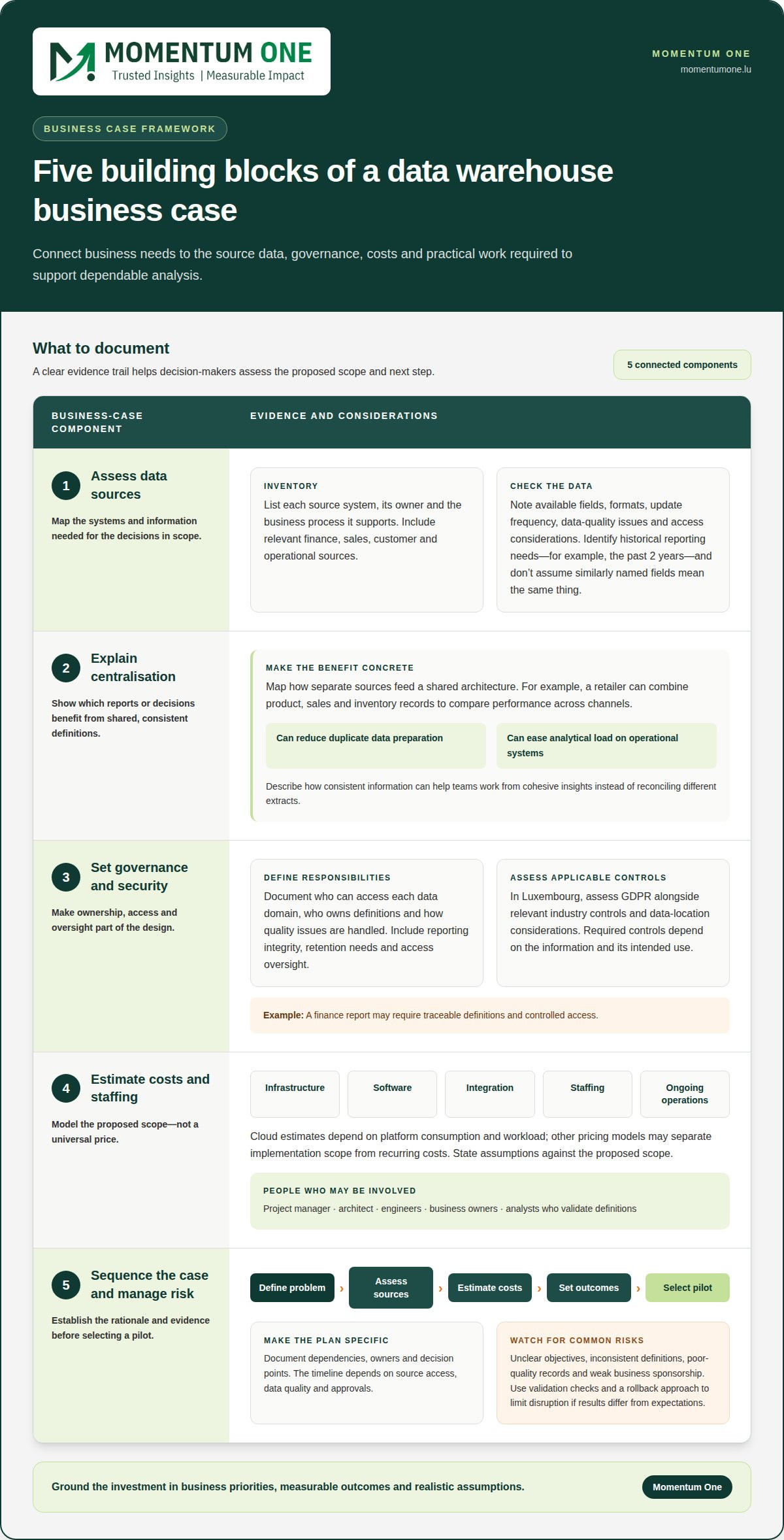
Assess Data Sources and Requirements
Start by listing each source system, its owner, and the business process it supports. Include finance, sales, customer, and operational sources when they affect decisions in scope. It can be useful to note which fields are available, how they are formatted and updated, and any data-quality or access considerations for each source. Then analyse source-system requirements, including whether reports need historical data, such as the past 2 years. Avoid assuming similarly named fields mean the same thing.
-
Explain Data Centralisation Benefits
Map how separate sources can feed a shared architecture, then identify which reports or decisions gain from consistent definitions. A retailer, for example, can combine product, sales, and inventory records to compare performance across channels. Centralisation can reduce duplicate preparation and the load on operational systems. It also helps teams work from cohesive insights instead of reconciling different extracts. Consider how a single source of truth for enterprise data could support those outcomes.
-
Set Governance and Security Requirements
Document who can access each data domain, who owns definitions, and how quality issues are handled. In Luxembourg, assess GDPR alongside relevant industry controls and data-location considerations. Required controls depend on the information and its intended use. Include reporting integrity, retention needs, and access oversight in the architecture. For example, a finance report may need traceable definitions and controlled access. Treat governance as part of design, not as a later infrastructure task.
-
Estimate Costs and Staffing
Build the financial model around infrastructure, software, integration, staffing, and ongoing operations. Cloud estimates depend on platform consumption and workload; other pricing models may separate implementation scope from recurring costs. When working out how to build a business case for a data warehouse, present these categories as assumptions tied to the proposed scope, not as a universal price. Staffing may include a project manager, architect, engineers, business owners, and analysts who validate definitions.
-
Sequence the Business Case and Manage Risk
Define the problem, assess data sources, estimate costs, and set measurable outcomes before selecting a pilot. Document dependencies, owners, and decision points; the timeline will depend on source access, data quality, and approvals. Common risks include unclear objectives, inconsistent definitions, poor-quality records, and weak business sponsorship. Use validation checks and a rollback approach to limit disruption if results differ from expectations. This sequence gives decision-makers a clear basis for approving the next step.
When does a cloud data warehouse make strategic sense?
Start by assessing the business problem, then test whether cloud infrastructure can support the required outcomes. A case for Snowflake, BigQuery, or Redshift should connect a defined need to measurable decisions and realistic operating costs.
-
Identify the Business Problem and Rationale
Describe a decision or workflow that current data environments make slow, inconsistent, or difficult to scale. For example, a finance team may reconcile separate sales and forecasting reports before each planning cycle. Record who is affected, what information they need, and how often they need it. Don’t mistake cloud adoption itself for the business problem.
Connect the issue to a strategic priority, such as improving forecast quality or identifying cross-selling opportunities. Define the evidence that would show progress, such as fewer manual reconciliation steps or more timely analysis. A cloud warehouse makes strategic sense when its ability to address the problem outweighs the complexity of adding another platform.
-
Align the Warehouse with Business Goals
Map the proposed data capability to a business goal and its decision owners. If a retailer wants to improve product planning, for example, bring sales and inventory measures into a consistent format. Define which teams use those measures and what actions they can take. This keeps the central platform focused on decisions, rather than data collection for its own sake.
Assess whether cloud environments support the goal better than the current infrastructure. Consider changing demand, access needs, and the effort required to maintain existing systems. Consistent measures across functions can improve strategic decision-making. Set a success measure before implementation, and don’t promise an outcome the data cannot directly influence.
-
Calculate Cloud Warehouse Costs
Estimate costs by modelling a representative workload for Snowflake, BigQuery, and Redshift. List expected data volume, ingestion frequency, query patterns, retention, user concurrency, and the number of development, test, and production environments. Apply each provider’s current pricing terms to the same assumptions, then compare equivalent workloads rather than headline rates.
Include the recurring work around integration, monitoring, security, and operational support alongside platform charges. Test both typical and peak usage, because a busy reporting period can differ from an average day. Present monthly and annual scenarios, explain the assumptions, and show which usage factors drive the estimate. For a structured review of the architecture and business rationale, discuss your data warehouse plans.
Comparing warehouse, lakehouse, and existing platforms
Compare each option with the workloads, reporting needs, and outcomes set out in your business case. Evaluate your current platform alongside a warehouse and a lakehouse instead of assuming a new system is necessary.
- Define the workloads to support. List the decisions, reports, and data types the platform must handle. A finance team producing consistent monthly management reports may prioritise structured, governed data. A product team analysing transactions alongside documents may need greater data flexibility. Separate current requirements from future possibilities, then assess fit against both. This prevents the architecture choice from being driven solely by a preferred technology or a single data extract.
- Assess the warehouse option. Consider a warehouse when structured, integrated data and repeatable reporting are central requirements. For example, a sales team can use agreed customer and revenue definitions across regional dashboards. Examine how the design handles data models, access controls, refresh patterns, and workloads. Then identify what needs to change in the current infrastructure. A warehouse is a strong candidate when its governed structure directly supports the outcomes measured in your business case.
- Evaluate a lakehouse against data variety. A lakehouse may suit teams that need to work with structured tables and less structured data in a shared platform. Test the actual use case, such as combining sales records with product files for analysis. Consider how teams will organise, govern, and prepare those assets. Don’t choose a lakehouse just because it sounds more flexible. The architecture still needs to support dependable reporting and clear ownership.
- Compare both options with the existing platform. Map current capabilities, limitations, integrations, and maintenance effort before proposing a replacement. For example, an existing Microsoft Fabric environment may already meet some analytics needs, while a legacy warehouse may constrain reporting changes. Distinguish gaps that require new infrastructure from problems caused by inconsistent models or processes. Comparing warehouse and lakehouse architectures can help clarify the trade-offs.
- Score the options using common criteria. Compare each platform against the same requirements: data types, governance, integration, reporting, operational effort, and ability to scale with demand. Record evidence for each assessment, such as a tested report or mapped source connection. Include migration complexity when existing applications depend on current data structures. Choose the approach that can achieve the stated business outcomes with manageable change, not simply the longest feature list.
Data integration and transformations
Design integration around the decisions and reports the warehouse needs to support. Each transformation should preserve meaning, improve data quality, and prepare information for analysis.
- Map each source to a business use. For every system, document the data it supplies, its format, its owner, and the reports that depend on it. For example, a sales source may provide order dates, while a finance system records invoice dates. Define which date each metric uses before combining records. Clear mapping prevents integration rules from changing the meaning of familiar measures.
- Set and test data quality rules. Specify checks for duplicate or null primary keys before records enter trusted storage. Check that date columns contain actual dates rather than text strings, so sorting and time-based calculations work consistently. If duplicate rows share a primary key, apply a defined rule, such as retaining the row with the latest create date. Record rejected rows and the reasons for review.
- Define transformations for historical reporting. Choose how the model should preserve changes to values over time. For example, a retailer can use Slowly Changing Dimension Type 2 for product categories, keeping old category assignments available for historical sales reports. Set each record’s end date to one day before the next record’s start date. This lets reports reflect the category valid when a sale occurred.
- Set integration timing and operational ownership. Agree how quickly each source must appear in the warehouse, then design pipelines around that service need. A data warehouse integration SLA example requires transactions to appear within 10 minutes. Identify who monitors failed loads, investigates unexpected changes, and communicates delays. For repeatable pipeline design, define how data is extracted, transformed, tested, and loaded, then document recovery actions.
- Validate the complete flow before scaling. Trace sample records from source through transformation to the final report. Compare totals at each stage, such as invoice counts before and after filtering, and investigate differences instead of masking them. Test late-arriving records and corrected source values. Streamlined warehouse processes can reduce redundancy and improve collaboration, but only when teams share transformation definitions and resolve quality issues consistently.
Keep these rules aligned: check for duplicate or null primary keys, select the row with the latest create date as the most up-to-date, and set end dates one day before the next record’s start date.
Defining business objectives for data analysis
Define the business decision first, then specify how data analysis should improve it. A useful objective links a business outcome to a measurable indicator, an owner, and an action the team can take.
- Start with a decision, not a dataset. Choose a business question that affects a real process, such as which customers may respond to a relevant cross-selling offer. Identify who owns the decision and when it is made. This keeps the warehouse focused on actionable analysis rather than collecting structured data without a defined purpose.
- Translate the business need into an objective. State the desired change in plain language, then connect it to an observable measure. For example, a customer team could aim to identify cross-selling opportunities using combined purchase and account information. A risk team could use integrated customer history to support reduced risk exposure. Define the starting point and reporting method before building.
- Choose measures that show progress. Select indicators that reflect the intended decision, not merely platform activity. For a sales analysis, track whether teams can identify suitable customer segments and act on them. For reporting performance, a possible KPI is sales dashboards loading in under 3 seconds. Set a clear owner and measurement period so teams interpret results consistently.
- Connect objectives to governance and definitions. Agree on how key measures are calculated, who approves changes, and which data sources support them. If two teams define an active customer differently, their analyses may produce conflicting recommendations. Document the shared definition, access responsibilities, and data quality expectations. Strong governance makes results easier to explain and assumptions easier to revisit when business priorities change.
- Prioritise objectives by decision value. Compare potential use cases by business impact, data readiness, and the effort required to make results actionable. A cross-selling analysis may have value only if customer and product information can be connected reliably. A risk analysis may need a different history and review process. Choose a focused first objective, then expand after the relevant teams use its outputs.
For help aligning analysis objectives with reporting and governance, a scalable Power BI governance framework can clarify ownership and shared definitions. Discuss your data analysis objectives to shape them into a practical warehouse plan.
Momentum One: Data Warehouse & Lakehouse Design
Momentum One’s Data Warehouse & Lakehouse Design translates business objectives into an architecture, integration approach, and data model that support analysis. Turn to this service once you’ve identified the decisions your data should improve and need a practical design that connects those goals to your sources, governance, and reporting needs.
For organisations modernising Microsoft Fabric environments, Microsoft Fabric Migration & Modernization can support the transition. Data Modeling & DAX Optimization can align analytical models with reporting requirements, while corporate training helps teams adopt new ways of working with data. The right next step depends on your platform, requirements, and priorities.
Contact Momentum One to discuss your data warehouse plans.
Turn the Business Case into Your Next Decision
A strong business case should guide more than approval. Use it as a working reference when priorities, data needs, or reporting processes change. Revisit its assumptions as teams use the platform, and use evidence from real decisions to inform what to develop next. This keeps future investment connected to business value rather than platform expansion alone.
If you’re deciding how to build a business case for a data warehouse, Momentum One can help connect your goals with the capabilities needed to act on them. Power BI Consulting, Governance & Performance supports consistent, governed reporting; Microsoft Fabric Migration & Modernization supports platform change; and Data Modeling & DAX Optimization aligns analytical models with business needs.
Discuss your data strategy with Momentum One and take the next step with a clear direction.
Frequently Asked Questions
How do warehouse, lakehouse, and existing-platform paths differ?
A warehouse prioritises structured, governed data for consistent analysis, while a lakehouse can accommodate structured and less structured data. An existing platform may already meet the need, making targeted improvements more suitable than replacement. Compare how each option handles a specific workload, such as joining invoice records with customer service notes. Include migration effort, team skills, and the effect on current reports in the decision.
How should benefits and financial returns be presented?
Present benefits by connecting a business change to its financial or operational effect. For example, show how reducing manual reconciliation could free staff time, then explain how that time would be used or valued. Separate measured benefits from assumptions, and show the calculation behind each estimate. Include ongoing platform and operating costs, not only initial project expenditure, so decision-makers can assess returns over time.
What business problem should the warehouse solve?
Choose a problem that affects a meaningful decision or recurring process, rather than a general desire to modernise technology. For example, a distributor might struggle to explain why sales and finance teams report different margins. Identify who needs the answer, what decision it informs, and why current reporting falls short. A problem with a clear owner is easier to prioritise and evaluate.
What should an executive business-case summary include?
Give executives a concise view of the decision requested, the business problem, the proposed approach, and the expected outcomes. Include the main investment categories, material risks, dependencies, and how progress will be measured. Name the accountable sponsor and affected teams. A useful summary also states what the organisation will defer or stop doing, helping leaders compare the proposal with competing priorities rather than assess it in isolation.
What should happen after the business case is approved?
Turn approval into a delivery plan with a named sponsor, accountable owners, and agreed decision gates. Confirm the first use case, its acceptance criteria, data access needs, and how teams will validate results. Establish how changes to scope or assumptions will be reviewed. Before expanding, compare delivered outcomes with the business case’s original measures. This gives a reasoned basis for continuing, adjusting, or pausing later work.
What’s the main purpose of building a data warehouse?
A data warehouse prepares information from business systems for reliable analysis and decision support. For example, leaders can use a shared view of orders, returns, and customer accounts instead of reconciling separate reports. A well-designed warehouse supports repeatable analysis while keeping analytical workloads separate from routine operational activity. Its value comes from helping people answer specific business questions, not from storing data without a clear use.
What business problems can a data warehouse solve?
A data warehouse can help address inconsistent reporting, slow analysis, disconnected records, and limited historical visibility. A subscription business, for instance, could examine account changes alongside renewal outcomes to understand where retention efforts may help. It can also support cross-selling analysis by combining customer and product information. The platform does not make decisions on its own; teams still need clear definitions, suitable data, and processes for acting on findings.
How can you estimate data warehouse ROI, payback period, and total cost of ownership?
Estimate ROI by comparing expected benefits with total project and operating costs over a defined evaluation period. Estimate payback by determining when cumulative benefits offset cumulative costs. For total cost of ownership, include platform usage, integration, migration, support, governance, and internal staff effort. Build conservative, expected, and higher-use scenarios from documented assumptions, then identify which factors most affect the result. Don’t present projected benefits as guaranteed savings.