Microsoft Fabric for External Customer Analytics Success
Master Microsoft Fabric external customer analytics to securely share insights with your clients. Learn key architecture patterns, governance, and data models.
- Start with a customer question and business decision, then define which insights would help answer it.
- Map how data moves from operational sources through preparation and modeling to customer-facing analytics.
- Compare shared and separated architecture patterns to balance customer-specific needs with maintainability and scale.
- With Microsoft Fabric external customer analytics, treat access, data quality, and governance as part of the design, not add-ons.
- Plan a focused pilot with clear ownership and success measures before expanding the analytics service.
What if customers could act on the same insights your internal teams rely on, without ever seeing another customer’s data? That’s the core challenge behind Microsoft Fabric external customer analytics: customer information is often scattered across operational systems and analytics environments, while external users need useful, relevant views they can trust. And a platform alone won’t solve it. Data boundaries, quality rules, and customer value must work together.
A secure, scalable approach starts by connecting those decisions. This guide explains an end-to-end Fabric pattern, from bringing customer data together and shaping it into reliable analytics to controlling what each audience can access. You’ll also learn how governance and operational practices support trust, and how to choose a focused first use case with a clear measure of success before expanding. By treating data modeling, lakehouse and warehouse design, and Power BI governance as connected disciplines, teams can build toward adoption with greater confidence. Momentum One helps organizations translate analytics goals into workable Microsoft Fabric architecture and delivery plans.
Why Microsoft Fabric external customer analytics starts with customer value
External customer analytics is the governed delivery of relevant insights or data products to customers outside an organization. It’s not simply an internal dashboard shared with a new audience, an operational report sent on request, or unrestricted access to company data. The purpose is to help customers understand information that matters to them while keeping the experience and data access intentional.
That purpose should guide Microsoft Fabric external customer analytics from the start. A customer may want to understand service performance, see order progress, review usage patterns, or compare account-level trends. Each insight should answer a real question and help the customer make a decision. Internal efficiency may also improve, but that is a separate benefit, not a substitute for customer value. To see how specialized platforms automate insights and reporting, visit Nodal AI for an example of modern analytics capabilities.
A shared understanding of customer analytics helps teams distinguish analysis of customer-related data from the design of an external analytics product. The latter also needs a clear audience, defined boundaries, and a useful way to present the insight.
Which customer problems can external analytics solve?
Start with the question a customer needs answered. “Is my order on schedule?” calls for order visibility that supports planning. “How is the service performing for my account?” points to service measures the customer can interpret and discuss. “Which products or features do we use most?” can help a customer assess usage and consider next steps. Account-level trends can reveal changes over time, giving customers context for decisions about their own operations.
These examples are valuable when they help customers act with clearer information. Internal teams may benefit from fewer routine requests, but that efficiency is an operational gain. Keep the product’s purpose anchored in the customer’s question.
What makes customer-facing analytics different from internal BI?
External audiences need a deliberate experience, not a pass-through to internal BI. The design should prioritize relevant measures and understandable language, while access boundaries ensure each customer sees only the information intended for them. Customers also need a reliable way to interpret the content and know where to turn when definitions or figures raise questions.
That means usability, governance, and support expectations belong in the product design alongside the data model. For a related look at the presentation layer, see Power BI Embedded with Microsoft Fabric. The core principle remains broader than any one delivery method: useful insight and controlled access must be designed together.
How Microsoft Fabric can connect customer data to governed insights
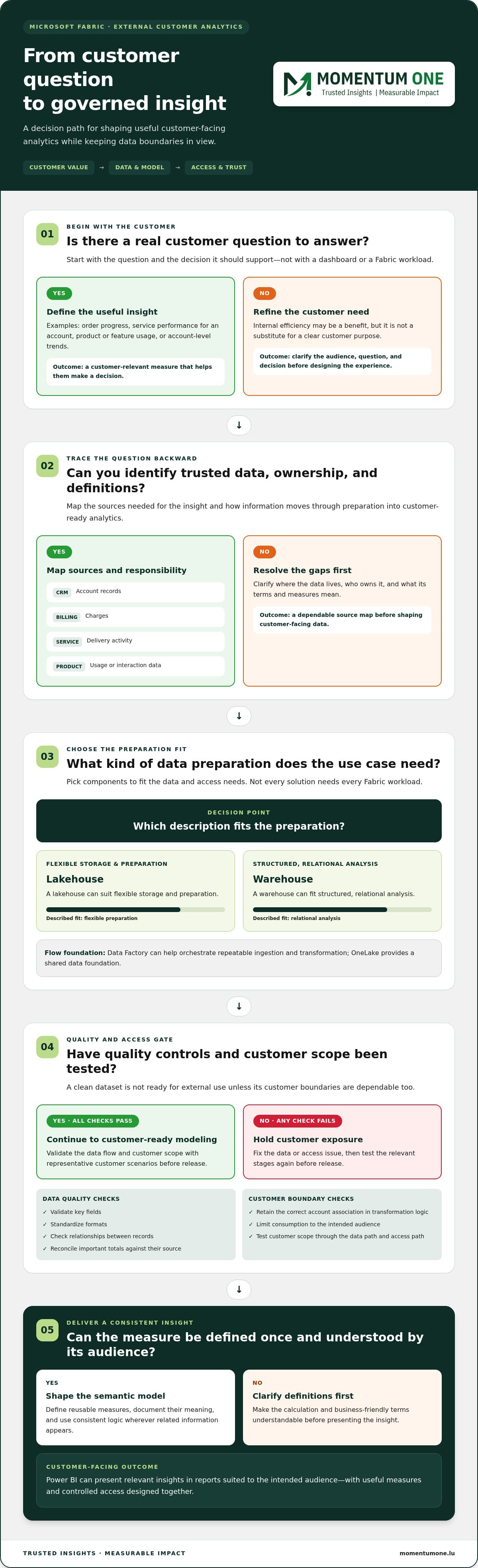
A workable architecture connects source systems to customer-ready information through controlled stages. Microsoft Fabric components can support an end-to-end analytics flow by bringing data into OneLake, preparing it in a lakehouse or warehouse, defining consistent measures, and presenting relevant insights through Power BI. The right design depends on the data, access needs, and delivery approach. Not every solution needs every Fabric workload.
Start with the customer question and trace backward: which measures answer it, which trusted data is required, and which sources hold that information? A CRM may contain account records, billing systems hold charges, service platforms capture delivery activity, and product or interaction data may show how customers use a service. Map ownership and definitions as well as the systems themselves.
Map sources, transformations, and customer-ready data
Data Factory can help orchestrate repeatable ingestion and transformation. OneLake provides a shared data foundation, while a lakehouse can suit flexible storage and preparation; a warehouse can fit structured, relational analysis. Teams can use the pattern that fits their needs rather than adding components by default. See Microsoft Fabric data pipeline automation for a focused discussion of pipeline design.
Quality controls should travel with the data flow. Before customer-ready data is exposed, validate key fields, standardize formats, check relationships between records, and reconcile important totals against their source. Just as important, apply and test customer scope at the relevant stages: transformation logic should retain the correct account association, and consumption rules should limit the view to the intended audience. A clean dataset without dependable customer boundaries is not ready for external use.
This is a practical data analytics architecture concern: how information is organized and connected affects both its usefulness and its control. Plan the data path and the access path together, then test them with representative customer scenarios before release. For organizations seeking specialized support, such as tailored consultoria de análise de dados, consulting partners can help design reliable data paths and ensure governance standards are met from day one.
Shape a semantic layer around customer questions
A semantic model translates prepared data into reusable measures and business-friendly terms. Define calculations such as order status or service-period totals once, document their meaning, and use consistent logic wherever related information appears. This helps customers and internal teams interpret the same metric in the same way. Explore semantic model optimization in Power BI and Fabric for further model performance guidance.
Power BI can present the resulting insights in reports suited to the intended audience. For organizations shaping this flow, Momentum One can help connect data modeling, lakehouse or warehouse design, and Power BI governance into a coherent Fabric approach. Discuss your analytics architecture with the team.
Compare customer analytics architecture choices without weakening data boundaries
There’s no single customer-data pattern that fits every organization. In Microsoft Fabric external customer analytics, architecture depends on the sensitivity of the data, the number of customers, how they access insights, and how much their requirements differ. Define these factors before rollout, then compare patterns against both control needs and the work required to operate them.
How should teams think about customer data separation?
A shared model can serve multiple customers, with customer-level access rules determining which records each audience can see. This can support consistent measures and centralized maintenance, but it puts pressure on accurate customer identifiers, dependable authorization, and careful testing of every access path.
Customer-specific workspaces or separated data structures create clearer boundaries between customers and can suit distinct access or configuration needs. The trade-off is more operational overhead: teams may need to manage repeated models, updates, and monitoring across separate environments. Neither pattern is automatically safest or most cost-effective. Identity-aware authorization and tests using different customer identities should confirm that intended users reach only their permitted data, including through reports and underlying models.
How do governance and data quality support customer trust?
Whichever pattern you choose, assign owners for customer data and business definitions. Record where key fields come from, how measures are calculated, and what changes could affect published insights. Lineage helps teams trace a customer-facing figure back through its preparation, while monitoring can surface refresh or quality issues before they go unnoticed.
Quality checks should reflect the metrics customers rely on. For example, validate required account identifiers, check that records map to the expected customer, and reconcile important totals against trusted sources. If a definition changes, document the change and assess its impact before updating the experience. These controls reduce the chance that customers see inconsistent or misleading figures. For practical quality practices, explore data quality management for trusted analytics.
A useful comparison weighs the whole operating model, not just the data layout:
- Shared model: centralizes definitions and maintenance, but depends on robust customer-level authorization and validation.
- Separated structures: can support distinct customer needs and clearer separation, but may increase duplication and routine administration.
- Hybrid approach: can keep common measures centralized while separating data or delivery where requirements call for it, though it adds design decisions to govern.
Document the chosen boundaries, accountable owners, quality checks, and change process as one design. The Microsoft Fabric governance framework offers broader guidance for structuring those responsibilities.
Plan a Microsoft Fabric customer analytics pilot in practical steps
A focused pilot helps teams test whether an analytics idea is useful to customers and workable to operate before expanding it. For Microsoft Fabric external customer analytics, begin with a specific question, not a platform-wide rollout. Choose a use case with accessible data and an observable customer benefit, then define what evidence would support a decision to refine, continue, or scale it.
Scope the first customer analytics use case
Write a short pilot brief: who will use the insight, what decision it should support, who owns the data, and why the information matters to customers. For example, a service-performance view might help a customer assess progress against agreed measures. Specify permitted data, metric definitions, and the action a user could take. Keep this bounded pilot separate from longer-term platform capacity and licensing decisions.
Validate security, quality, and usability before expansion
Before inviting pilot users, check that the data is complete and the access boundaries match the intended audience. Then test the experience with representative users. Can they find and understand the relevant measures? Does the information refresh in line with the stated expectation? Is there a clear way to share feedback or report an issue?
Use the following ordered checklist, adapting each step to the use case:
- Select one customer question. Name the intended audience, the decision the insight supports, the business purpose, and the accountable data owner.
- Inventory the inputs. Record required sources, field ownership, metric definitions, refresh expectations, access needs, and known data-quality risks.
- Set boundaries and success measures. Document which data pilot users may access and how that access will be tested. Choose observable measures such as adoption, task completion, insight freshness, and support demand, with a baseline or target where practical.
- Review the experience with users. Check whether customers can interpret the metrics, complete the intended task, and understand when information was last updated.
- Record findings and decide what’s next. Track access failures, confusing definitions, quality issues, and user feedback. Use evidence to refine the model and controls before widening the audience or scope.
A pilot is useful even when it exposes gaps. A metric that customers interpret differently than expected, or a source that can’t support the required refresh pattern, gives the team specific design work to address before expansion. Momentum One can help translate customer analytics goals into a practical Fabric design. Discuss your customer analytics pilot.
Turn Microsoft Fabric customer analytics into a maintainable service
Launching customer-facing insights is a milestone, not the finish line. A dependable analytics service needs named owners, routine monitoring, quality controls, and a planned way to manage change. In Microsoft Fabric external customer analytics, the operating model matters as much as the initial data design: customers rely on figures staying understandable and relevant as source systems and business definitions evolve.
Build an operating model for dependable customer insights
Make responsibility clear across the teams involved. Assign owners for source data, metric definitions, access controls, and customer-facing updates. When a measure changes, its business owner should help explain what the change means; technical teams should assess how it affects models, refreshes, and reports. This connection keeps governance grounded in the information customers actually use.
Monitor more than whether a pipeline completed. Track data freshness, quality exceptions, and usage patterns, then establish a review cadence that fits the service and its change rate. Customer feedback and support requests can reveal unclear definitions, missing context, or information that no longer helps users make decisions. Turn those signals into managed updates, with changes assessed and communicated through an agreed process.
Move from architecture decisions to a delivery plan
Carry the key design decisions into an actionable plan: the customer use case, required sources, model and definitions, data boundaries, governance responsibilities, and measures of success. Add operational ownership, monitoring expectations, and a process for customer feedback. This creates a practical bridge from a tested design to a service teams can maintain and improve.
Momentum One brings together Microsoft Fabric migration and modernization, data modeling, warehouse and lakehouse design, Power BI governance, and managed services to help organizations shape and operate analytics solutions. If existing platforms need modernization as part of the journey, read the Microsoft Fabric migration services guide.
Ready to turn your architecture choices into a clear delivery plan? Discuss your Microsoft Fabric analytics initiative with Momentum One.
Build customer analytics that earns confidence
Successful Microsoft Fabric external customer analytics connects a clear customer need with relevant data, carefully defined access boundaries, and reliable ongoing operations. A focused pilot helps teams validate the experience and measure its usefulness before expanding. From there, clear ownership, data quality checks, and planned updates keep insights dependable as requirements evolve.
Momentum One is a certified Microsoft Solutions Partner, bringing together expertise in Fabric migration, data modeling, warehouse and lakehouse design, Power BI governance, and managed services. This connected perspective helps organizations turn architecture decisions into a practical delivery and operating plan.
Your next step can be a focused conversation about the customer question you want to address, the data behind it, and the controls needed to deliver insights with confidence. Discuss your Microsoft Fabric customer analytics goals with Momentum One and start shaping an approach that can grow with your customers’ needs.
Frequently Asked Questions
Which customer problems can external analytics solve?
Start with the question a customer needs answered. “Is my order on schedule?” calls for order visibility that supports planning. “How is the service performing for my account?” points to service measures the customer can interpret and discuss. “Which products or features do we use most?” can help a customer assess usage and consider next steps. Account-level trends can reveal changes over time, giving customers context for decisions about their own operations. These examples are valuable when they help customers act with clearer information. Internal teams may benefit from fewer routine requests, but that efficiency is an operational gain. Keep the product’s purpose anchored in the customer’s question.
What makes customer-facing analytics different from internal BI?
External audiences need a deliberate experience, not a pass-through to internal BI. The design should prioritize relevant measures and understandable language, while access boundaries ensure each customer sees only the information intended for them. Customers also need a reliable way to interpret the content and know where to turn when definitions or figures raise questions. That means usability, governance, and support expectations belong in the product design alongside the data model. For a related look at the presentation layer, see Power BI Embedded with Microsoft Fabric. The core principle remains broader than any one delivery method: useful insight and controlled access must be designed together. A workable architecture connects source systems to customer-ready information through controlled stages. Microsoft Fabric components can support an end-to-end analytics flow by bringing data into OneLake, preparing it in a lakehouse or warehouse, defining consistent measures, and presenting relevant insights through Power BI. The right design depends on the data, access needs, and delivery approach. Not every solution needs every Fabric workload. Start with the customer question and trace backward: which measures answer it, which trusted data is required, and which sources hold that information? A CRM may contain account records, billing systems hold charges, service platforms capture delivery activity, and product or interaction data may show how customers use a service. Map ownership and definitions as well as the systems themselves.
How should teams think about customer data separation?
A shared model can serve multiple customers, with customer-level access rules determining which records each audience can see. This can support consistent measures and centralized maintenance, but it puts pressure on accurate customer identifiers, dependable authorization, and careful testing of every access path. Customer-specific workspaces or separated data structures create clearer boundaries between customers and can suit distinct access or configuration needs. The trade-off is more operational overhead: teams may need to manage repeated models, updates, and monitoring across separate environments. Neither pattern is automatically safest or most cost-effective. Identity-aware authorization and tests using different customer identities should confirm that intended users reach only their permitted data, including through reports and underlying models.
How do governance and data quality support customer trust?
Whichever pattern you choose, assign owners for customer data and business definitions. Record where key fields come from, how measures are calculated, and what changes could affect published insights. Lineage helps teams trace a customer-facing figure back through its preparation, while monitoring can surface refresh or quality issues before they go unnoticed. Quality checks should reflect the metrics customers rely on. For example, validate required account identifiers, check that records map to the expected customer, and reconcile important totals against trusted sources. If a definition changes, document the change and assess its impact before updating the experience. These controls reduce the chance that customers see inconsistent or misleading figures. For practical quality practices, explore data quality management for trusted analytics. A useful comparison weighs the whole operating model, not just the data layout: Document the chosen boundaries, accountable owners, quality checks, and change process as one design. The Microsoft Fabric governance framework offers broader guidance for structuring those responsibilities. A focused pilot helps teams test whether an analytics idea is useful to customers and workable to operate before expanding it. For Microsoft Fabric external customer analytics, begin with a specific question, not a platform-wide rollout. Choose a use case with accessible data and an observable customer benefit, then define what evidence would support a decision to refine, continue, or scale it.
What is Microsoft Fabric external customer analytics?
Microsoft Fabric external customer analytics is the governed delivery of useful insights or data products to customers outside an organization. It combines customer-relevant data, clear business definitions, and a deliberate way to present information while controlling who can access it. Examples include an account-level service summary or a view of product usage. The aim is to help customers understand information relevant to them, not expose internal dashboards or unrestricted source data.
Can Microsoft Fabric be used to share analytics with external customers?
Yes. Fabric can support the data preparation, modeling, and analytics behind customer-facing insights, with Power BI used to present reports where appropriate. The design must account for the intended audience, access approach, data boundaries, and customer experience. Sharing an internal report as-is may not meet external users’ needs. Plan how customers will access relevant information, how access will be governed, and who will maintain the experience.
How does Microsoft Fabric support customer analytics?
Fabric can connect data from operational sources, prepare and organize it, and make it available for analysis. Data Factory can support ingestion and transformation, while OneLake provides a shared data foundation. Depending on the use case, teams may shape data in a lakehouse or warehouse, create a semantic model with consistent measures, and use Power BI for reporting. Select components to fit the use case rather than adding every workload by default.
How do you keep external customers from seeing each other’s data?
Define customer boundaries and access rules before rollout, then validate them across the full path from data preparation to customer-facing reports. Authorization should reflect the identity and intended access of each user. Test with representative customer identities, including scenarios where a user attempts to reach information outside their permitted scope. Review data relationships and access paths after changes, too. The architecture and controls should be assessed together, not treated as separate tasks.
What data sources can be used for external customer analytics in Fabric?
Suitable sources depend on the customer question and the quality and permitted use of the data. Common categories include CRM records, billing data, service activity, product usage, and customer interactions. Before connecting a source, identify its owner, key fields, definitions, refresh expectations, and known quality issues. Then standardize and validate relevant data so customer-facing measures are consistent and account information is mapped to the intended customer.
How should a company measure the success of customer analytics?
Measure whether the analytics helps customers complete a useful task, not just whether a report has been published. Choose indicators tied to the pilot’s purpose, such as customer adoption, task completion, insight freshness, and support demand. Set a baseline or practical target where possible, and gather feedback to understand confusing metrics or missing information. Review both customer value and operational reliability before deciding whether to refine or expand the experience.
Is Microsoft Fabric enough to create a customer-facing analytics product?
Fabric can provide important data and analytics capabilities, but a complete customer-facing product also needs decisions about user experience, access, business definitions, support, and ongoing ownership. Power BI can present analytics, and Power BI Embedded may be relevant to embedded scenarios. The right delivery approach depends on the audience and requirements. Treat governance, quality monitoring, and customer feedback as part of the product plan, not work to add after launch.