Microsoft Fabric vs Snowflake: Which Fits Enterprise Costs
Compare Microsoft Fabric vs Snowflake for enterprise costs across cloud fit, workloads, governance, and sovereignty to better control total costs at scale.
- Match the platform to where your data and existing cloud commitments already sit, then weigh how much your teams rely on Microsoft tools.
- Assess sovereignty requirements alongside cloud flexibility, because platform hosting options can shape where workloads can run.
- Build a total-cost view that accounts for storage, compute use, idle capacity, and how workloads may compete for shared resources.
- Choose based on the work your teams need to do, from analytics and reporting to data engineering and AI, rather than platform features alone.
- Use governance needs and internal expertise to guide the rollout, and identify where migration, data modelling, or training can help.
The platform with the lower price on paper isn’t always the more cost-effective fit in practice. Microsoft Fabric can suit enterprises already invested in Microsoft and Azure, while Snowflake’s availability across Azure, AWS, and Google Cloud may better fit a multicloud strategy. Choosing Microsoft Fabric vs Snowflake for enterprise data involves more than comparing rates: integration, workload patterns, data sovereignty, and governance all matter.
It’s tempting to focus on platform pricing first, especially since both options can support demanding analytics workloads. But the total cost also depends on how storage and compute are used, how existing tools connect, and how teams manage security and workloads over time.
This comparison explains how the platforms differ, from Fabric’s unified Microsoft environment and OneLake to Snowflake’s cloud flexibility, and outlines the trade-offs that affect enterprise costs. It also offers a practical way to assess your organization’s cloud footprint, internal expertise, compliance priorities, and use cases, so your decision reflects how the data platform needs to work.
Microsoft ecosystem integration
Microsoft Fabric launched in 2023 as a SaaS platform combining Azure Synapse, Power BI, Data Factory, and Data Activator. That combination brings data engineering, analytics, and reporting into one Microsoft environment. For organizations already using Power BI and Azure services, Fabric can reduce the number of platform boundaries teams manage. The practical advantage depends on how deeply those tools already support the enterprise data warehouse and its daily workflows.
OneLake provides a single logical data lake for an entire organization. Teams can use it as a shared foundation for data across Fabric workloads, rather than treating each workload as an isolated store. OneLake shortcuts can point to data in place without copying it. This can help avoid unnecessary duplication when teams need to use existing data across analytics workflows. The OneLake shared data approach is especially relevant when departments need access to common information.
Fabric is a natural ecosystem fit when Microsoft services already play a central role in data operations. A team using Power BI for reporting and Azure Synapse for warehouse workloads, for example, can assess whether Fabric’s combined environment would simplify its architecture. Data Factory and Data Activator are also part of the platform, making it possible to plan ingestion, analytics, and action workflows together. Careful design of data models and workload responsibilities is still essential.
Snowflake presents a different integration choice: it runs on Azure, AWS, and Google Cloud, while Fabric is Azure-only. This distinction matters when an organization’s data platforms or cloud commitments span providers. Snowflake’s cloud options can fit a multicloud estate; Fabric can fit an Azure-centred one. Neither platform eliminates integration work. Teams still need to map data movement, access patterns, reporting tools, and ownership across systems.
Compare the integration dimensions that affect everyday work:
- Microsoft services: Fabric combines Azure Synapse, Power BI, Data Factory, and Data Activator.
- Shared data foundation: OneLake gives an organization a single logical data lake, with shortcuts for accessing data in place.
- Cloud environment: Fabric runs on Azure; Snowflake runs on Azure, AWS, and Google Cloud.
- Operating model: Assess which platform best fits existing skills, data locations, and reporting workflows.
| Option | Ecosystem fit | Cloud footprint | Integration consideration |
|---|---|---|---|
| Microsoft Fabric | Azure Synapse, Power BI, Data Factory, Data Activator | Azure | OneLake provides a shared logical lake |
| Snowflake | Enterprise data platform across supported cloud environments | Azure, AWS, Google Cloud | Can fit multicloud environments |
Choose Fabric when Microsoft integration and OneLake fit your target architecture; choose Snowflake when flexibility across cloud providers matters more. Compare pricing alongside data location, team skills, and the integration work each platform requires.
Data sovereignty and compliance considerations
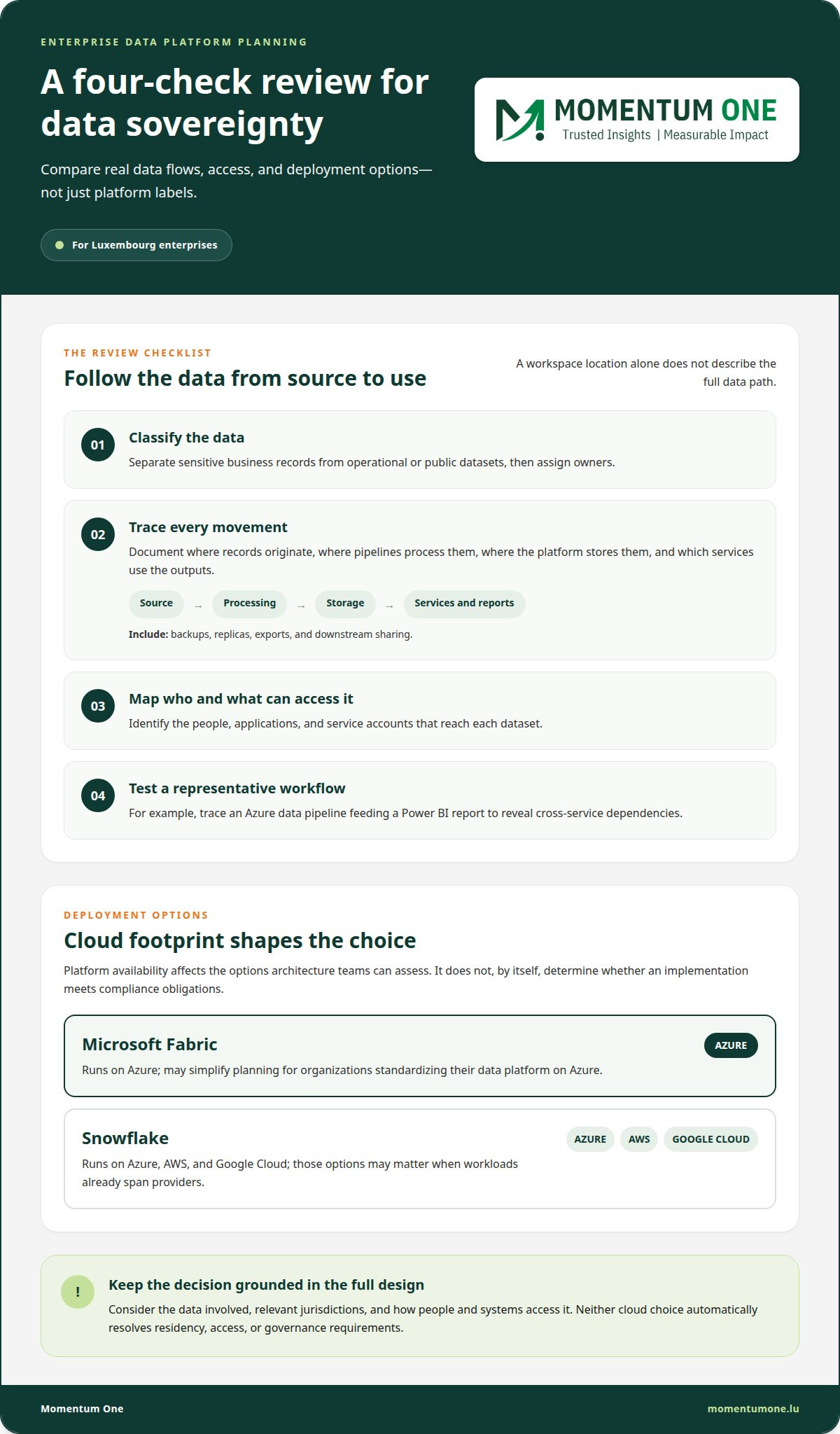
For Luxembourg enterprises, data sovereignty decisions begin with location, access, and operational control. Microsoft Fabric runs on Azure, while Snowflake runs on Azure, AWS, and Google Cloud. This difference shapes the deployment options available to architecture teams, but doesn’t establish whether a particular implementation meets an organization’s compliance obligations. The decision needs to account for the data involved, relevant jurisdictions, and how people and systems access that data.
Start by mapping the complete data path. Identify where source records originate, where pipelines process them, where the platform stores them, and which services use the outputs. For example, a team in Luxembourg might trace a customer dataset from ingestion through transformation to a Power BI report. Include backups, replicas, exports, and downstream sharing. A platform decision is more useful when it reflects these end-to-end flows, not just the location of a primary workspace.
Cloud choice is one architectural consideration, not the whole sovereignty assessment. Fabric’s Azure-only environment can simplify planning for organizations standardizing their data platform on Azure. Snowflake’s availability across Azure, AWS, and Google Cloud offers flexibility that can matter when workloads already span those environments. In either case, teams need to understand how each workload is deployed and which data it uses. Don’t assume that one platform automatically resolves residency, access, or governance requirements.
Use a structured review before choosing:
- Classify the data: Separate sensitive business records from operational or public datasets, then assign owners.
- Trace movement: Document ingestion, transformation, storage, reporting, and external data sharing.
- Map access: Identify the people, applications, and service accounts that reach each dataset.
- Test the design: Use a representative workflow, such as an Azure data pipeline feeding Power BI, to expose cross-service dependencies.
These steps help teams compare real architectures rather than product labels. A group with Azure-based data engineering may value a consistent Azure environment. A group operating across cloud providers may prioritize Snowflake’s deployment options. Both still need clear data ownership, access controls, retention practices, and documented sharing patterns, designed and operated across the chosen platform and its connected services.
For Luxembourg organizations, keep the assessment tied to applicable obligations and internal policies, without assuming that a cloud region alone settles compliance. Record why each workload belongs in its chosen environment, who can access it, and how data moves to reporting or partners. A focused discussion about your data-sovereignty architecture can help turn those requirements into a platform design.
Data storage, compute, and total cost of ownership
Fabric combines storage and compute through capacity, OneLake, and shared workloads. Snowflake separates cloud data storage from compute resources in its warehouse architecture. Both can connect with wider data estates, but Fabric OneLake shortcuts can access data in place without copying it. This affects data movement, storage planning, and analytics or data science workflows. A Microsoft Fabric vs Snowflake for enterprise cost comparison should account for these architectural differences.
Fabric’s cost model combines capacity consumption with OneLake storage charges. OneLake storage is charged per gigabyte, while Fabric capacity supports processing across workloads. Fabric capacity charges can depend on whether capacity is paused, so teams should account for idle periods when estimating costs. Reserved capacity pricing is available for reservations of 1, 3, or 5 years. These mechanisms make actual usage patterns central to estimating total cost.
Storage details can change the comparison. Fabric mirroring storage is free up to 64 TB on an F64 capacity. Teams should still account for retained data, duplicated copies, and expected growth. OneLake shortcuts may reduce copying when data remains in its existing location. In the Microsoft Fabric vs Snowflake for enterprise cost comparison, distinguish storage charges from compute use, rather than treating platform spend as one undifferentiated figure.
Capacity design also affects performance and concurrency. Fabric capacity is shared across workloads, so a demanding engineering job can reduce resources available to reporting or data science. Snowflake’s separate warehouse compute model lets teams assess compute allocation by workload. On either platform, concurrency depends on demand, workload design, and available resources. Test a representative peak period, including overlapping warehouse queries and scheduled refreshes, before sizing production.
For a practical comparison, model the same workload on both platforms. Include ingestion, transformations, reporting, storage growth, and periods of low activity. Record where usage is steady, when jobs peak, and whether teams can pause or schedule capacity. A lower apparent cost at one usage level may change when jobs run longer or overlap. A Fabric cost optimization approach should account for these operating patterns.
- Storage: Include OneLake per-gigabyte charges, retained data, and avoided copies.
- Compute: Track workload demand, idle periods, and Fabric capacity sharing.
- Commitment: Compare pay-as-you-go usage with 1-, 3-, or 5-year reservations.
- Concurrency: Test whether simultaneous warehouse, reporting, and engineering tasks affect service levels.
Compare total usage patterns rather than a single capacity or storage line. For Fabric, consider pause policies and shared workloads; for Snowflake, assess compute and storage against the same workload profile.
Treat that figure as a reference point for a modeled workload, not a complete estimate. Storage, usage patterns, and operating choices still shape the total.
A platform that is 20% cheaper but has unpredictable billing can be worse than one with a slightly higher price and fixed monthly spend. For procurement, compare expected spend alongside variance and the effort required to manage it. Review whether demand can be forecast reliably, whether capacity can be controlled during quiet periods, and whether the resulting bill aligns with budget expectations. This makes predictable operations part of total cost of ownership, rather than judging the decision by a headline rate alone.
Enterprise use cases
Choose a platform by matching its strengths to the work your teams do. Microsoft Fabric can suit organizations seeking analytics, data engineering, and reporting in a connected Microsoft environment. Snowflake can suit enterprises that need a data platform across cloud providers. A company already using Microsoft tools for business reporting, for example, may prioritize Fabric. A group with workloads distributed across cloud environments may value Snowflake’s flexibility. The Microsoft Fabric vs Snowflake for enterprise decision should reflect operational priorities, not just feature lists.
Fabric can fit teams seeking connected workflows for data preparation and business intelligence. Consider a retailer bringing sales data into analysis and Power BI reporting. Its architecture can connect data engineering tasks with business-facing analytics. Teams still need to plan capacity so processing jobs and reports work effectively together. This approach suits organizations that value a unified operating model alongside workload controls.
Snowflake may suit organizations that treat cloud data warehousing as a distinct enterprise capability. A multinational with analytics workloads across Azure, AWS, and Google Cloud, for example, may value Snowflake’s availability across those environments. Separate compute resources can help teams organize workloads around different needs. This approach can fit organizations that want to manage warehouse operations separately from business reporting tools.
AI projects add another use-case lens. Between 2023 and 2025, RAG and vector search moved from experimental approaches toward table-stakes capabilities. Enterprises considering these workloads should assess how data preparation, retrieval, analytics, and governance connect in their chosen platform. A prototype searching internal knowledge differs from a production workflow serving business users. Evaluate the full path, including source data, refresh operations, user access, and how results reach applications.
Use these patterns to narrow the decision:
- Microsoft-centered analytics: Consider Fabric when Power BI and connected data workflows are core to the operating model.
- Multicloud data operations: Consider Snowflake when cloud-provider flexibility is central to workload placement.
- Shared capacity needs: Test Fabric with overlapping engineering and reporting jobs before production rollout.
- Distinct workload management: Assess Snowflake when teams want to organize warehouse compute separately.
- AI delivery: Compare how each platform supports the path from prepared data to retrieval and user-facing results.
For a grounded comparison, choose a representative use case, such as a finance dashboard or internal knowledge search. Map its source systems, transformations, access needs, and operational handoffs. Then assess both platforms against the same workflow. A useful Microsoft Fabric vs Snowflake for enterprise comparison connects priority workloads to team skills and the operating model, rather than scoring isolated features.
Governance, security, and compliance
Governance depends on how teams assign ownership, control access, and monitor data throughout its lifecycle. In Fabric, teams can connect data engineering, transformation, notebooks, and analytics within their operating environment. Snowflake also requires clear policies across data products and consuming teams. Either platform needs defined responsibilities for data owners, platform administrators, and report creators. Clear roles help teams manage access reviews and resolve data issues consistently.
Build governance around actual workflows. For example, trace a finance dataset from ingestion through transformation to a Power BI report. Record who owns the source, who can change the model, and which users consume the output. Apply the same review to machine learning notebooks and shared data products. Documented responsibilities make permissions and accountability easier to assess across technical and business teams.
For Luxembourg organizations, align platform controls with applicable obligations and internal policies. Assess the data, deployment choices, access paths, and operational processes rather than treating a platform name as proof of compliance. Review how information is collected, transformed, stored, and shared, and how teams handle access changes or incidents. Include these considerations in the architecture and operating procedures from the outset.
Operational risks can arise from weak ownership, unclear permissions, undocumented transformations, or dependencies on platform-specific workflows. Lock-in can grow when teams build extensive data engineering processes, notebooks, and semantic models around one platform. Moving later may require redesigning those assets and developing new team skills. Both Fabric and Snowflake create dependencies through their tools, expertise, and data architecture, so portability deserves attention during design.
A practical governance review can cover these areas:
- Ownership: Assign a business owner and technical steward to each important dataset.
- Access: Map users and applications to the data and reports they need.
- Lineage: Document how transformations affect dashboards and machine learning outputs.
- Change control: Define how teams test and release notebook, model, and pipeline updates.
- Portability: Identify platform-specific dependencies and document how critical data products could be reconstructed.
Fabric’s connection with Azure Synapse and Microsoft tools can support a Microsoft-centred operating model. Snowflake can suit teams whose governance spans cloud environments. Compare which team can consistently maintain access rules, lineage, release practices, and incident ownership. A structured Fabric governance framework can turn responsibilities into repeatable controls.
For a governance model aligned with your data architecture, discuss your platform and governance requirements.
Microsoft Fabric on Azure Government regions has FedRAMP Moderate/High authorization. Teams evaluating that deployment can treat the authorization as one input to a controls review, then verify that the selected region, services, data flows, and operational responsibilities meet their requirements. Keep evidence of these decisions in the platform’s governance records, and revisit it when the architecture or access patterns change.
Distinguish an environment’s authorization from the organization’s own duties: document which controls are inherited, which remain team responsibilities, and how exceptions are approved. Apply the same evidence-based process to both candidate platforms, so security decisions reflect workload needs, ownership, and operating practices rather than assumptions based on product branding. Clear records support consistent reviews as data products evolve.
Momentum One: Fabric Migration & Modernization
Momentum One helps organizations turn a platform decision into a workable Fabric roadmap through Fabric Migration & Modernization. This support fits when moving from an existing data platform, modernizing workloads, or aligning Fabric with enterprise reporting and governance needs. Data Warehouse & Lakehouse Design can shape the target architecture, while Data Modeling & DAX Optimization can strengthen models and reporting logic. Training Solutions can help teams build the skills to operate the environment.
The next step is to clarify your current architecture, priority workloads, and migration goals. That creates a practical basis for planning the transition and identifying the design work involved. Contact Momentum One to discuss your Fabric migration or modernization needs.
Set a clear direction for your data platform
Choosing between Microsoft Fabric and Snowflake for enterprise data is most useful when it leads to a practical operating plan. First set priorities: which teams need access, which workloads matter most, and how governance will support reliable use. This gives the platform decision a clear purpose beyond selecting technology.
Momentum One can help translate that direction into delivery through Power BI Consulting & Governance, Fabric Migration & Modernization, and Data Modeling & DAX Optimization. These services support organizations refining governance, planning a Fabric transition, or improving the models behind business reporting. Take the next step with a focused discussion of your architecture, priorities, and intended outcomes.
Discuss your data platform with Momentum One, and move forward with a plan grounded in your organization’s needs.
Frequently Asked Questions
What are the migration steps, timelines, and costs for moving from Snowflake to Fabric or vice versa?
Plan the move in stages: inventory tables, pipelines, reports, permissions, and dependencies; design the target architecture; migrate a representative workload; validate the results; then schedule cutover and monitor operations. Timelines depend on data volume, transformation complexity, integrations, and testing requirements. Migration pricing depends on the project and is provided after a quote request. Key cost factors include scope, legacy workload redesign, validation effort, and the transition plan. Momentum One supports Fabric Migration & Modernization.