Optimize Data with Microsoft Fabric Medallion Architecture
Master the Microsoft Fabric medallion architecture to streamline Bronze, Silver, and Gold layers for reliable Power BI analytics and clear data governance.
- Define each layer by its purpose, data readiness, and intended consumers, not by a requirement to create extra copies.
- Use the Microsoft Fabric medallion architecture to set clear data contracts, naming conventions, and quality expectations for Bronze, Silver, and Gold.
- Choose lakehouses, warehouses, and other Fabric components to match workload needs, team skills, and operating requirements.
- Design backwards from analytics and reporting needs, then implement, govern, and monitor each stage of the data flow.
- Limit unnecessary copies and transformations, and assign clear ownership for data products.
What if three data layers could make analytics more trustworthy without creating unnecessary copies or processing? That’s the promise of the Microsoft Fabric medallion architecture, but only when each layer has a clear purpose and data contract. If you’re unsure what belongs in Bronze, Silver, or Gold, or how those layers should serve Power BI, start by defining what “ready to use” means for each stage.
It’s reasonable to worry that adding layers will add overhead. The goal isn’t to move data around for its own sake. It’s to make data progressively more reliable and useful while keeping its quality, ownership, and lineage visible. If a layer doesn’t improve trust, reuse, or a specific workload, it may not need to exist.
This guide explains what data should look like in each layer and how to choose a practical Fabric implementation pattern, including when a lakehouse or warehouse may suit Gold. You’ll also see how data modeling and governance connect curated data to Power BI reporting. Clear boundaries help teams build maintainable data products and trace reported figures back to their sources.
What Is Microsoft Fabric Medallion Architecture, and What Problem Does It Solve?
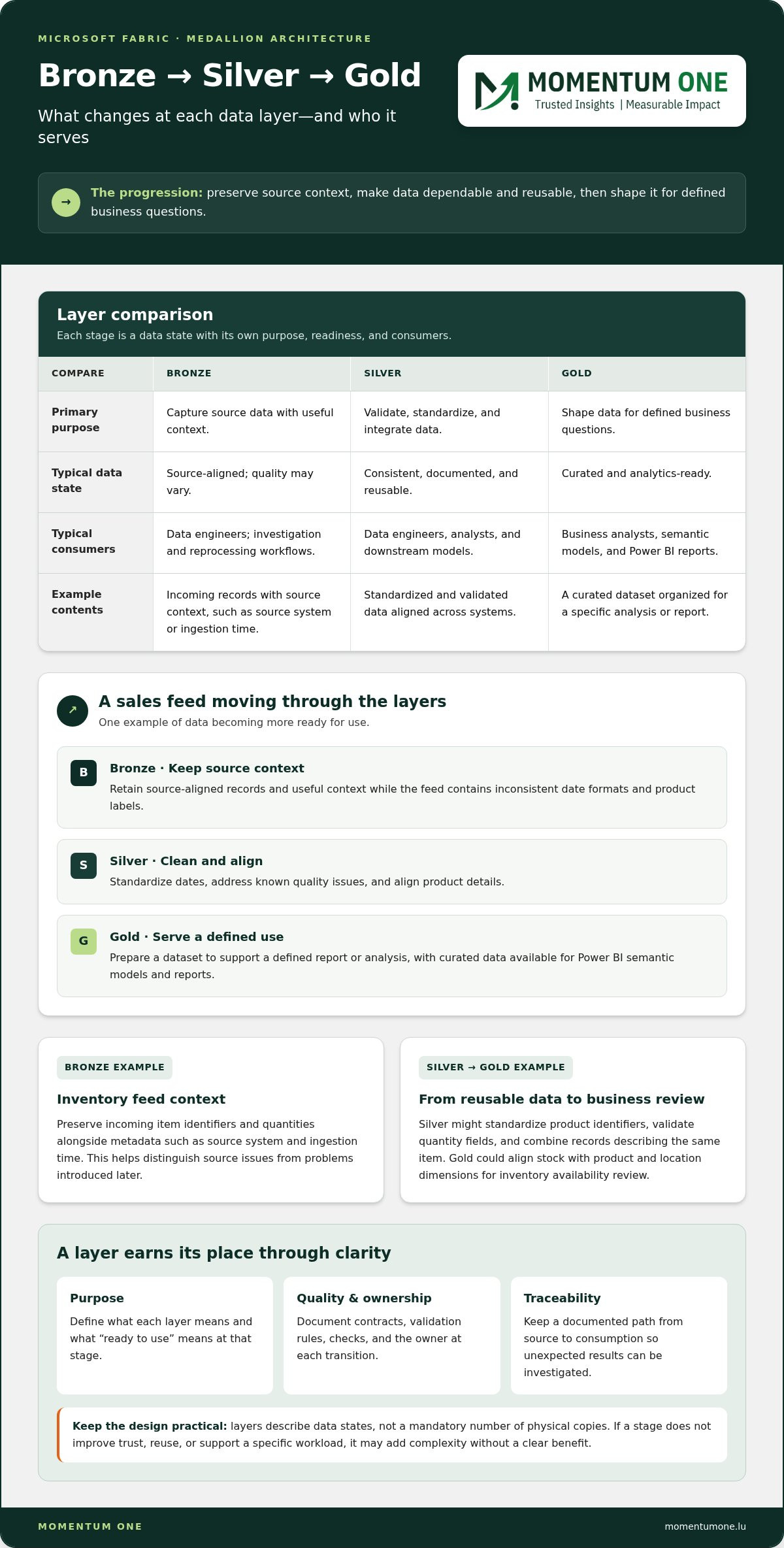
The Microsoft Fabric medallion architecture organizes data into Bronze, Silver, and Gold stages. Each stage represents a higher level of refinement and readiness for use. Bronze stays close to its source, Silver is cleaned and aligned, and Gold is shaped for analytics and business use. These stages describe data states, not a mandatory number of physical copies. Teams can decide how to store, transform, or reference data according to their needs.
The pattern addresses a common problem: source data can be inconsistent, difficult to interpret, or risky to use directly in reports. Clear layer boundaries give engineers, analysts, and business teams a shared way to describe what data means, who owns it, and whether it is ready for a particular use. That makes it easier to trace how a reported figure was produced, apply quality checks at the right point, and reuse prepared data across analytical workloads.
How does the medallion pattern organize data?
Imagine a sales feed arriving with inconsistent date formats and product labels. Bronze retains the source-aligned records and useful context. In Silver, transformations standardize dates, address known quality issues, and align product details. A Gold dataset can then support a defined report or analysis. The exact contents depend on the team’s data contracts, but each transition should have a clear purpose, validation rules, and an owner. A documented path from source to consumption makes it easier to investigate unexpected results.
In short, medallion architecture organizes data into progressively refined Bronze, Silver, and Gold stages, with explicit quality expectations and ownership at each stage.
Why use medallion architecture in Microsoft Fabric?
Fabric Lakehouse provides a place to organize data, while Fabric’s data engineering workflows can support movement and transformation between stages. The architecture is the design approach; a Lakehouse, pipeline, or notebook is a tool that may help implement it. These tools don’t automatically create a sound medallion design. Teams still need to define quality checks, document transformations, and decide what is suitable for downstream use.
Once curated data is available, different consumers can use it for reporting, analysis, or further modeling without rebuilding the same preparation logic. The Data Lakehouse concept provides broader context for combining data lake flexibility with analytical workloads. For an overview of how OneLake fits into Fabric’s data foundation, see this guide to OneLake and enterprise data.
Layering is useful when it clarifies trust, reuse, and responsibility. If each stage simply duplicates data or repeats transformations without improving readiness, it adds complexity. Aim for a traceable route from source to dependable analytics, designed around the decisions the data needs to support.
How Bronze, Silver, and Gold Layers Work in Microsoft Fabric
In the Microsoft Fabric medallion architecture, Bronze preserves source context, Silver prepares trusted and reusable data, and Gold presents curated data for specific analytical needs. The labels are conventions, not fixed technical requirements. Adapt the implementation to the workload, but document what each layer means, who owns it, and which checks data must pass before moving forward.
| Layer | Purpose | Typical data state | Typical consumers |
|---|---|---|---|
| Bronze | Capture source data with useful context | Source-aligned; quality may vary | Data engineers, investigation and reprocessing workflows |
| Silver | Validate, standardize, and integrate | Consistent, documented, reusable | Data engineers, analysts, downstream models |
| Gold | Shape data for defined business questions | Curated and analytics-ready | Business analysts, semantic models, Power BI reports |
What belongs in the Bronze layer?
Bronze should retain enough source context to show where records came from and, where useful, support investigation or reprocessing. For an inventory feed or complex engineering data—where industrial digitalization consultancies like PLM-Sme FZC help align product lifecycle management sources—that might mean preserving incoming item identifiers and quantities alongside metadata such as source system and ingestion time. These details help teams distinguish a source issue from a problem introduced by a later transformation.
Bronze doesn’t have to mean untouched forever. Retention periods, formats, and preservation needs depend on source constraints, recovery goals, and the workload. Record what has changed, and avoid discarding context that downstream teams need to investigate or reproduce results.
How do Silver and Gold layers differ?
Silver applies the checks and transformations needed to make data dependable across use cases. For the inventory example, a team might standardize product identifiers, validate quantity fields, and combine records from systems that describe the same item differently. Silver is a reusable foundation, not just a staging area for one report.
Gold organizes trusted data around a defined analytical purpose. An inventory availability model, for example, could align stock with product and location dimensions for business review. Gold outputs can feed a Power BI semantic model and reports, with measures and business definitions shaped for their intended audience. Not every source needs the same transformations, and not every use case needs a separate Gold dataset.
Agree on layer conventions as a team. Define quality gates, ownership, naming, and the point at which data is ready for reuse or reporting. This helps prevent inconsistent meanings across workspaces and teams. Momentum One supports teams with data architecture planning and implementation. Explore your data architecture requirements.
Which Microsoft Fabric Components Fit Each Medallion Layer?
The medallion pattern defines how data becomes more useful; Fabric components provide ways to store, transform, orchestrate, and serve it. Match tools to workload requirements and team skills rather than assigning a different product to every layer by default. One Fabric Lakehouse may support several stages, while a Warehouse may fit Gold when its SQL serving needs call for it.
When should teams use a Fabric Lakehouse for medallion layers?
A Lakehouse can fit when teams need to combine data engineering with lake-based storage. Its tables use the Delta table format and reside in OneLake, Fabric’s unified logical data lake. Teams can organize Bronze, Silver, and Gold data through their own conventions, then use engineering workflows to transform it or make it available to downstream workloads. This doesn’t mean each layer needs a separate physical copy.
Consider the operating model as well as the storage choice. A Lakehouse-centred design may suit teams comfortable with data engineering workflows and open table formats. Review this lakehouse versus warehouse architecture comparison to weigh wider design trade-offs, including how analytics teams will query and consume curated data.
How should teams choose pipelines, notebooks, and serving models?
Use Data Factory pipelines when the priority is to orchestrate repeatable steps, such as running ingestion and transformation activities in sequence. Notebooks can suit flexible transformations, complex logic, or engineering work that benefits from code. Choose based on who will maintain the process, how it should be tested, and whether the team can support its dependencies. A technically powerful approach isn’t automatically the most maintainable one.
- Pipelines: Coordinate activities and dependencies across a repeatable workflow.
- Notebooks: Handle code-driven transformation where flexibility and engineering control matter.
- Warehouse: Serve curated Gold data when a SQL-oriented analytical layer fits consumption needs.
Gold doesn’t have to be a Warehouse. A Lakehouse may remain appropriate, or curated data may support a Power BI semantic model directly, depending on how it needs to be queried and governed. Choose the serving model around reporting requirements, expected reuse, and team expertise, not a rigid layer-to-tool rule. For orchestration patterns, see the Microsoft Fabric data pipelines guide.
Momentum One helps organizations weigh Lakehouse and Warehouse choices alongside data modeling, governance, and maintainability. Review your Fabric architecture needs.
How to Implement a Microsoft Fabric Medallion Architecture Step by Step
Start with the decisions people need to make, not with three empty layers. A practical Microsoft Fabric medallion architecture connects source constraints to a trusted data product, with clear checks and ownership along the way.
- 1. Define the consumption need. Identify the report, analysis, or operational question the data must support. Clarify its audience, required level of detail, expected freshness, and how users will consume it.
- 2. Assess the source. Document available data, update patterns, identifiers, known inconsistencies, and access constraints. This helps determine what to capture and whether each layer adds value.
- 3. Select a representative domain. Begin with a manageable subject, such as product sales or inventory, that has a clear business owner and useful reporting outcome. Avoid modeling the entire enterprise at once.
- 4. Define layer contracts. Specify what each stage contains, who owns it, naming conventions, permitted access, expected schema, and the conditions data must meet before moving forward.
- 5. Build and validate transformations. Use checks tied to business rules, such as valid identifiers, permitted status values, or reconciled totals. Decide how to handle failed records and whether a failed load stops, retries, or isolates affected data.
- 6. Deliver a usable Gold product. Shape validated data for a defined analytical purpose, then connect it to an appropriate semantic model or reporting experience. Confirm that business users can interpret measures and definitions consistently.
- 7. Automate repeatable work. Orchestrate recurring ingestion and transformation steps where the workload supports automation. Document dependencies and make failures visible to the people responsible for recovery.
- 8. Monitor in production. Track pipeline outcomes, data freshness, validation failures, and changes in expected volumes. Review whether the product still meets reporting needs as sources and business rules evolve.
How should teams define layer contracts and quality checks?
A useful contract makes expectations testable. For each transition, record the expected schema, required fields, validation rules, freshness target, and failure response. Measure quality against agreed business rules rather than a vague goal of “complete” data. For example, a sales dataset might require a recognized product identifier and a valid transaction date before records are used in reporting.
Document lineage and ownership alongside those rules. If a reported total changes, teams should be able to trace the source, transformations, and accountable owner without relying on individual memory. These reusable principles also support a scalable data architecture framework; organizations seeking to align tech infrastructure with broader corporate strategy can learn more about enterprise architecture consulting.
How can teams deliver the pattern incrementally?
Release one useful Gold data product for the chosen domain, then use feedback and production monitoring to refine its contracts and workflow before extending the design. This keeps architecture decisions grounded in actual consumption and operational experience. Momentum One provides data modeling, Fabric migration, and governance support to help teams plan and implement their data platform. Discuss your Fabric architecture needs.
How to Keep a Fabric Medallion Architecture Reliable as It Scales
Layering can improve traceability and reuse, but it doesn’t guarantee either. As datasets and consumers grow, the Microsoft Fabric medallion architecture needs ongoing ownership, access controls, quality checks, and performance reviews. Each layer should continue to earn its place by making data more dependable or useful for a defined purpose.
What are common medallion architecture mistakes?
Creating layers without distinct consumers, quality rules, or owners turns a helpful pattern into overhead. Copying every dataset at every stage can also increase storage use and leave teams maintaining multiple versions that add little value. Define why data is transformed or separately stored, and keep shared, validated Silver data distinct from Gold outputs shaped for specific business questions.
Transformations can add complexity, too. Repeating the same cleanup in several pipelines makes results harder to reconcile and updates harder to govern. Prefer transformations with clear business or operational value, and make their inputs, owners, and downstream dependencies visible.
What should teams monitor as usage grows?
Monitor whether pipelines complete as expected, whether data meets agreed freshness and quality targets, and whether workloads continue to perform for their consumers. Review access as new teams and products use the platform, applying permissions that fit each dataset’s sensitivity and purpose. Maintain lineage and ownership records so teams can assess the impact of source or transformation changes before those changes disrupt reporting.
These controls are ongoing responsibilities, not one-time setup tasks. For example, a Gold dataset may gain new consumers over time. Revisit its definitions, access, and performance when that happens rather than assuming its original design still fits.
How can expert architecture support improve Fabric outcomes?
Architecture support can connect Fabric migration and modernization decisions with data modeling, Power BI consumption, and the choice between Lakehouse and Warehouse designs. Momentum One is a certified Microsoft Solutions Partner and provides consulting for Fabric and analytics architecture, implementation, and governance. The focus is a maintainable design aligned with business needs, not adding layers for their own sake.
Momentum One also offers managed services and training to support corporate analytics teams. Talk with Momentum One about Microsoft Fabric.
Build a Fabric Architecture Your Teams Can Trust
A reliable Microsoft Fabric medallion architecture depends on clear layer responsibilities, useful quality rules, and defined ownership. Bronze, Silver, and Gold should make data easier to trace and reuse, not add copies and transformations without a purpose. Choose Fabric components around the workload and the people who will maintain them, then monitor quality, access, lineage, and performance as usage grows.
Start with a business need and deliver a focused data product people can use. From there, refine the architecture based on real consumption and operational feedback. This practical approach helps keep analytics dependable while allowing the platform to evolve.
Momentum One provides Fabric migration and modernization, data modeling, governance, and lakehouse and warehouse design. Discuss your Microsoft Fabric architecture with Momentum One and take a considered next step toward trusted, maintainable analytics.
Frequently Asked Questions
How does the medallion pattern organize data?
Imagine a sales feed arriving with inconsistent date formats and product labels. Bronze retains the source-aligned records and useful context. In Silver, transformations standardize dates, address known quality issues, and align product details. A Gold dataset can then support a defined report or analysis. The exact contents depend on the team’s data contracts, but each transition should have a clear purpose, validation rules, and an owner. A documented path from source to consumption makes it easier to investigate unexpected results. In short, medallion architecture organizes data into progressively refined Bronze, Silver, and Gold stages, with explicit quality expectations and ownership at each stage.
Why use medallion architecture in Microsoft Fabric?
Fabric Lakehouse provides a place to organize data, while Fabric’s data engineering workflows can support movement and transformation between stages. The architecture is the design approach; a Lakehouse, pipeline, or notebook is a tool that may help implement it. These tools don’t automatically create a sound medallion design. Teams still need to define quality checks, document transformations, and decide what is suitable for downstream use. Once curated data is available, different consumers can use it for reporting, analysis, or further modeling without rebuilding the same preparation logic. The Data Lakehouse concept provides broader context for combining data lake flexibility with analytical workloads. For an overview of how OneLake fits into Fabric’s data foundation, see this guide to OneLake and enterprise data. Layering is useful when it clarifies trust, reuse, and responsibility. If each stage simply duplicates data or repeats transformations without improving readiness, it adds complexity. Aim for a traceable route from source to dependable analytics, designed around the decisions the data needs to support. In the Microsoft Fabric medallion architecture, Bronze preserves source context, Silver prepares trusted and reusable data, and Gold presents curated data for specific analytical needs. The labels are conventions, not fixed technical requirements. Adapt the implementation to the workload, but document what each layer means, who owns it, and which checks data must pass before moving forward.
What belongs in the Bronze layer?
Bronze should retain enough source context to show where records came from and, where useful, support investigation or reprocessing. For an inventory feed, that might mean preserving incoming item identifiers and quantities alongside metadata such as source system and ingestion time. These details help teams distinguish a source issue from a problem introduced by a later transformation. Bronze doesn’t have to mean untouched forever. Retention periods, formats, and preservation needs depend on source constraints, recovery goals, and the workload. Record what has changed, and avoid discarding context that downstream teams need to investigate or reproduce results.
How do Silver and Gold layers differ?
Silver applies the checks and transformations needed to make data dependable across use cases. For the inventory example, a team might standardize product identifiers, validate quantity fields, and combine records from systems that describe the same item differently. Silver is a reusable foundation, not just a staging area for one report. Gold organizes trusted data around a defined analytical purpose. An inventory availability model, for example, could align stock with product and location dimensions for business review. Gold outputs can feed a Power BI semantic model and reports, with measures and business definitions shaped for their intended audience. Not every source needs the same transformations, and not every use case needs a separate Gold dataset. Agree on layer conventions as a team. Define quality gates, ownership, naming, and the point at which data is ready for reuse or reporting. This helps prevent inconsistent meanings across workspaces and teams. Momentum One supports teams with data architecture planning and implementation. Explore your data architecture requirements. The medallion pattern defines how data becomes more useful; Fabric components provide ways to store, transform, orchestrate, and serve it. Match tools to workload requirements and team skills rather than assigning a different product to every layer by default. One Fabric Lakehouse may support several stages, while a Warehouse may fit Gold when its SQL serving needs call for it.
When should teams use a Fabric Lakehouse for medallion layers?
A Lakehouse can fit when teams need to combine data engineering with lake-based storage. Its tables use the Delta table format and reside in OneLake, Fabric’s unified logical data lake. Teams can organize Bronze, Silver, and Gold data through their own conventions, then use engineering workflows to transform it or make it available to downstream workloads. This doesn’t mean each layer needs a separate physical copy. Consider the operating model as well as the storage choice. A Lakehouse-centred design may suit teams comfortable with data engineering workflows and open table formats. Review this lakehouse versus warehouse architecture comparison to weigh wider design trade-offs, including how analytics teams will query and consume curated data.
How should teams choose pipelines, notebooks, and serving models?
Use Data Factory pipelines when the priority is to orchestrate repeatable steps, such as running ingestion and transformation activities in sequence. Notebooks can suit flexible transformations, complex logic, or engineering work that benefits from code. Choose based on who will maintain the process, how it should be tested, and whether the team can support its dependencies. A technically powerful approach isn’t automatically the most maintainable one. Gold doesn’t have to be a Warehouse. A Lakehouse may remain appropriate, or curated data may support a Power BI semantic model directly, depending on how it needs to be queried and governed. Choose the serving model around reporting requirements, expected reuse, and team expertise, not a rigid layer-to-tool rule. For orchestration patterns, see the Microsoft Fabric data pipelines guide. Momentum One helps organizations weigh Lakehouse and Warehouse choices alongside data modeling, governance, and maintainability. Review your Fabric architecture needs. Start with the decisions people need to make, not with three empty layers. A practical Microsoft Fabric medallion architecture connects source constraints to a trusted data product, with clear checks and ownership along the way.
How should teams define layer contracts and quality checks?
A useful contract makes expectations testable. For each transition, record the expected schema, required fields, validation rules, freshness target, and failure response. Measure quality against agreed business rules rather than a vague goal of “complete” data. For example, a sales dataset might require a recognized product identifier and a valid transaction date before records are used in reporting. Document lineage and ownership alongside those rules. If a reported total changes, teams should be able to trace the source, transformations, and accountable owner without relying on individual memory. These reusable principles also support a scalable data architecture framework.
How can teams deliver the pattern incrementally?
Release one useful Gold data product for the chosen domain, then use feedback and production monitoring to refine its contracts and workflow before extending the design. This keeps architecture decisions grounded in actual consumption and operational experience. Momentum One provides data modeling, Fabric migration, and governance support to help teams plan and implement their data platform. Discuss your Fabric architecture needs. Layering can improve traceability and reuse, but it doesn’t guarantee either. As datasets and consumers grow, the Microsoft Fabric medallion architecture needs ongoing ownership, access controls, quality checks, and performance reviews. Each layer should continue to earn its place by making data more dependable or useful for a defined purpose.
What are common medallion architecture mistakes?
Creating layers without distinct consumers, quality rules, or owners turns a helpful pattern into overhead. Copying every dataset at every stage can also increase storage use and leave teams maintaining multiple versions that add little value. Define why data is transformed or separately stored, and keep shared, validated Silver data distinct from Gold outputs shaped for specific business questions. Transformations can add complexity, too. Repeating the same cleanup in several pipelines makes results harder to reconcile and updates harder to govern. Prefer transformations with clear business or operational value, and make their inputs, owners, and downstream dependencies visible.
What should teams monitor as usage grows?
Monitor whether pipelines complete as expected, whether data meets agreed freshness and quality targets, and whether workloads continue to perform for their consumers. Review access as new teams and products use the platform, applying permissions that fit each dataset’s sensitivity and purpose. Maintain lineage and ownership records so teams can assess the impact of source or transformation changes before those changes disrupt reporting. These controls are ongoing responsibilities, not one-time setup tasks. For example, a Gold dataset may gain new consumers over time. Revisit its definitions, access, and performance when that happens rather than assuming its original design still fits.
How can expert architecture support improve Fabric outcomes?
Architecture support can connect Fabric migration and modernization decisions with data modeling, Power BI consumption, and the choice between Lakehouse and Warehouse designs. Momentum One is a certified Microsoft Solutions Partner and provides consulting for Fabric and analytics architecture, implementation, and governance. The focus is a maintainable design aligned with business needs, not adding layers for their own sake. Momentum One also offers managed services and training to support corporate analytics teams. Talk with Momentum One about Microsoft Fabric. A reliable Microsoft Fabric medallion architecture depends on clear layer responsibilities, useful quality rules, and defined ownership. Bronze, Silver, and Gold should make data easier to trace and reuse, not add copies and transformations without a purpose. Choose Fabric components around the workload and the people who will maintain them, then monitor quality, access, lineage, and performance as usage grows. Start with a business need and deliver a focused data product people can use. From there, refine the architecture based on real consumption and operational feedback. This practical approach helps keep analytics dependable while allowing the platform to evolve. Momentum One provides Fabric migration and modernization, data modeling, governance, and lakehouse and warehouse design. Discuss your Microsoft Fabric architecture with Momentum One and take a considered next step toward trusted, maintainable analytics.
What is Microsoft Fabric medallion architecture?
Microsoft Fabric medallion architecture organizes data into progressively refined layers, commonly called Bronze, Silver, and Gold. Bronze typically preserves source-aligned data, Silver standardizes and validates it, and Gold shapes it for defined analytical needs. Fabric provides components teams can use to implement the pattern, but it doesn’t create a sound design automatically. Teams still need to define layer responsibilities, quality expectations, ownership, and how data will serve its consumers.
What is the difference between Bronze, Silver, and Gold in Fabric?
Bronze is generally the ingestion layer, Silver holds cleaned and integrated data, and Gold presents curated data for specific analytical uses. These names describe responsibilities, not fixed Fabric products. For example, a team may standardize customer identifiers in Silver, then shape Gold data for a defined sales analysis. Document what qualifies data to move between layers, who owns each dataset, and which consumers rely on it.
Do I need to create three separate Lakehouses for medallion architecture?
No, a separate Lakehouse for each layer isn’t required in every implementation. Teams can organize data around security boundaries, workload scale, operational needs, and ownership. Before creating separate workspaces or Lakehouses, clarify what each boundary is meant to achieve and how it affects access and maintenance. Choose a layout that fits the environment and the way the team operates.
Can Microsoft Fabric medallion architecture use a Warehouse for the Gold layer?
Yes, a Fabric Warehouse can serve Gold data when structured, SQL-oriented analytical access fits the workload. Lakehouse tables may suit other data engineering or analytics patterns, while a semantic model can provide a governed structure for Power BI reporting. Choose based on the shape of the data, transformation needs, expected consumers, team skills, and operating requirements. Treat Bronze, Silver, and Gold as logical responsibilities, then select components to fit.
Does medallion architecture require copying data into every layer?
No, the pattern doesn’t require a separate physical copy at every stage. Some designs persist transformed outputs to support reprocessing, isolation, or performance; others may use references or shortcuts where suitable. Don’t copy data just to match a diagram. Consider governance, lineage, workload needs, and recovery requirements when choosing how to represent each stage.
How do you maintain data quality across Bronze, Silver, and Gold?
Define measurable checks for each transition, such as schema validity, business-rule compliance, freshness, and duplicate handling. For instance, a business rule might require every transaction to have a valid identifier before it enters a reporting dataset. Record failed checks and make ownership clear so the right team can investigate. A successful pipeline run alone doesn’t prove that data is accurate or useful for its intended consumers.
Is medallion architecture suitable for every Microsoft Fabric project?
No, medallion architecture isn’t automatically beneficial for every Fabric project. It can help when teams need progressive refinement, reusable data, and traceable transformations. A small workload with few sources and limited analytical needs may gain little from extra layers. Start by identifying business requirements, source constraints, quality needs, and downstream consumers. Add boundaries only when they improve reliability, reuse, or operational clarity, and review their value as the workload changes.