Advanced DAX Training for Analysts: Mastering Corporate Power BI in 2026
Unlock high-performance Power BI reports with our advanced DAX training for analysts. Master complex logic, optimize code, and eliminate slow-loading dashboa...
- Master custom time intelligence and advanced filtering techniques to handle complex fiscal calendars and precise business logic with ease.
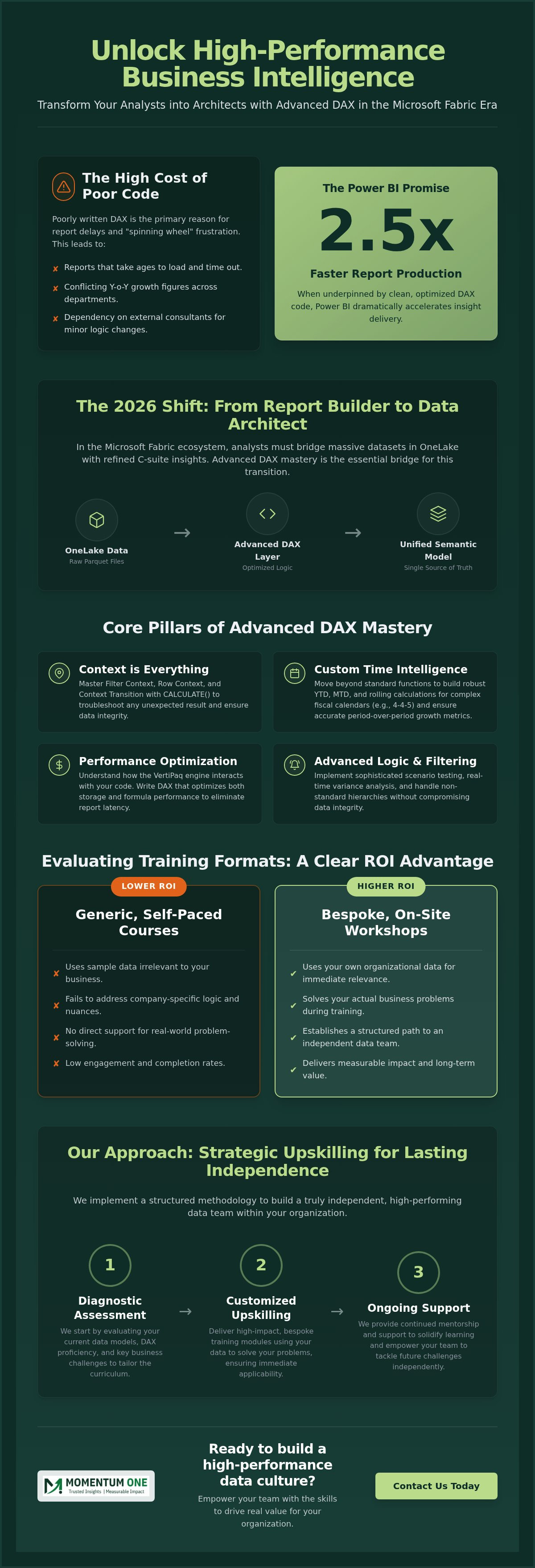
- Discover why bespoke advanced DAX training for analysts using your own organizational data delivers a significantly higher ROI than generic, self-paced courses.
- Eliminate report latency by understanding how the VertiPaq engine interacts with your code to optimize both storage and formula performance.
- Transition from siloed report development to a unified Microsoft Fabric environment, establishing a single source of truth for your entire enterprise.
- Implement a structured upskilling methodology that includes diagnostic assessments and ongoing support to build a truly independent, high-performing data team.
Did you know that while Power BI can make report production 2.5 times faster, poorly written code remains the primary reason for "spinning wheel" delays in 2026 enterprise environments? You've likely felt the frustration of a report that takes ages to load or, worse, provides conflicting year-over-year growth figures across different departments. It's exhausting when your internal team remains tethered to external consultants for minor logic changes because the semantic model feels like a fragile black box. We understand that you need more than just basic formulas; you need a team that can architect high-performance solutions within the Microsoft Fabric ecosystem.
By prioritizing advanced DAX training for analysts, you empower your staff to solve complex business logic independently while optimizing report performance for the June 2026 Power BI update. This article will show you how to leverage new features like DAX user-defined functions and unified semantic models to create a single source of truth. You'll learn how to move beyond simple calculations to build a reliable, high-ROI analytics culture where reports are both fast and accurate. We'll outline the path to turning your analysts into proactive strategists who drive real value for your organization in Luxembourg and beyond.
What is Advanced DAX Training for Analysts in the Microsoft Fabric Era?
We've moved past the era where Power BI Desktop lived as a siloed application on an analyst's laptop. Today, it's a vital component of the Microsoft Fabric ecosystem. This shift means analysts must now bridge the gap between massive datasets in OneLake and the refined insights required by the C-suite. The 2026 analyst profile is no longer just a report builder. They're data architects who turn raw lakehouse tables into high-value business intelligence, ensuring that the logic they write today won't break under the weight of tomorrow's data.
The 2026 Shift: DAX in the Age of Microsoft Fabric
The introduction of DirectLake mode has fundamentally changed the rules of engagement for data professionals. Analysts no longer need to choose between the speed of Import mode and the real-time nature of DirectQuery. Instead, they write DAX that interacts directly with Parquet files in OneLake. This requires a deeper understanding of how DAX expressions impact memory and processing power. For organizations currently undergoing a Fabric Migration & Modernization, mastering these nuances is the difference between a seamless transition and a performance bottleneck. The journey from a raw Lakehouse to a polished Semantic Model relies entirely on the quality of the DAX layer.
Core Pillars of Advanced Technical Training
True expertise begins with a rock-solid grasp of Filter Context and Row Context. These aren't just academic concepts; they're the primary tools for troubleshooting why a calculation isn't behaving as expected. Our advanced DAX training for analysts dives deep into Context Transition, specifically how the CALCULATE() function transforms row-level data into filterable insights. This mastery allows analysts to handle complex relationships and non-standard hierarchies without compromising data integrity. Ultimately, the Semantic Model serves as the central nervous system of corporate BI, providing a unified and governed foundation for every decision your business makes.
The Advanced DAX Curriculum: High-Impact Modules for Enterprise Teams
A professional curriculum goes far beyond basic syntax. It focuses on solving real-world business problems that standard tutorials often ignore. High-quality advanced DAX training for analysts ensures your team can handle the specific nuances of your industry while maintaining report integrity. We believe that mastery is achieved when an analyst stops guessing and starts architecting logic with intent. This transition requires a deep dive into the specific modules that drive enterprise value.
Time Intelligence and Comparative Analytics
Standard time intelligence functions often fail when faced with custom fiscal years or non-standard 4-4-5 calendars. Our approach focuses on building robust YTD, MTD, and rolling average calculations that remain resilient even when data gaps occur. We emphasize why custom date tables are non-negotiable for national-scale corporate reporting in Luxembourg. Without them, period-over-period growth metrics lose accuracy the moment a user applies a complex slicer selection. Mastering these logic patterns allows analysts to provide reliable comparative insights that drive executive decision-making. They'll learn to handle leap years, partial months, and shifting holidays without breaking the underlying model.
The Power of CALCULATE and Filter Manipulation
CALCULATE is the heart of DAX, yet it remains one of the most misunderstood functions. Advanced training demystifies how it interacts with the filter context to produce dynamic results. We explore precise filter control using KEEPFILTERS, ALLSELECTED, and REMOVEFILTERS to ensure report behavior matches business requirements exactly. To improve readability and debugging, we teach the consistent use of variables (VAR). This isn't just about clean code; it's about performance. A practical exercise we often implement involves building a "Dynamic Top N" report that updates instantly based on user selection, showcasing the immediate impact of advanced logic on user experience.
Complexity often arises from many-to-many relationships or the need for inactive connections. Using USERELATIONSHIP allows analysts to toggle between different date paths, such as "Order Date" versus "Ship Date," without cluttering the model with redundant tables. Additionally, we cover virtual table functions like SUMMARIZE, ADDCOLUMNS, and GENERATE. These tools enable complex aggregations that simply aren't possible with standard measures. If your team is struggling with these advanced concepts, exploring our Training Solutions can provide the structured guidance they need to succeed. By mastering these pillars, your analysts move from being report creators to becoming indispensable data strategists.
Evaluating Training Formats: Bespoke Workshops vs. Generic Courses
Choosing the right educational path for your data team is a decision that directly impacts your technical debt and long-term agility. While self-paced video libraries offer a low barrier to entry, they often lack the depth required for complex enterprise environments. Professional advanced DAX training for analysts should move beyond generic syntax to focus on the specific business logic your organization uses daily. Expert-led, interactive workshops provide a feedback loop that pre-recorded content simply can't match, allowing for real-time troubleshooting of your team's most persistent modeling hurdles.
The most effective results come from "Project-Based Coaching." This methodology involves training your staff using your own organizational data rather than sanitized examples. When analysts work with familiar schemas, the transition from theory to application happens instantly. We find that a hybrid learning model works best for national leaders. This combines foundational theory with hands-on labs tailored to the specific industry regulations and data privacy standards prevalent in Luxembourg. To see how this structured approach fits your team, you can explore our Corporate Power BI Training solutions.
The Hidden Cost of Generic Training
Generic "one-size-fits-all" courses often fail because they rely on simplistic scenarios, like tracking sales for a fictional "widget" company. These examples don't translate well to the intricate financial instruments or multi-layered tax structures found in the LU market. When analysts can't bridge that gap, they resort to inefficient workarounds that slow down reports. Bespoke training eliminates this friction by addressing your specific pain points, such as improving report accuracy through tailored logic. Investing in specialized knowledge prevents the accumulation of technical debt that occurs when teams "guess" their way through a semantic model.
Building an Internal Center of Excellence (CoE)
Strategic upskilling is the cornerstone of a sustainable data culture. By providing advanced DAX training for analysts, you're doing more than teaching a language; you're cultivating "Power BI Champions." These lead analysts become internal mentors who can troubleshoot issues and enforce governance standards across departments. This reduces the burden on your IT help desk and diminishes your reliance on external consultants for routine maintenance. We measure the success of these programs through tangible metrics: faster report load times, higher user engagement, and a significant drop in support tickets. This proactive approach ensures your investment in Microsoft Fabric delivers a high ROI by fostering a team that is both independent and high-performing.
DAX Optimization for High-Performance Power BI Reports
The most frequent complaint we hear from stakeholders isn't about the data itself, but about the time it takes to see it. When a report is slow, user adoption drops instantly. This is where advanced DAX training for analysts proves its worth by moving beyond functional code to performant code. Optimization isn't just a final step; it's a fundamental part of the development process that ensures your Power BI environment remains responsive even as your data grows. We've seen that high-performing teams don't just write measures that work; they write measures that fly.
To write fast DAX, your team must understand the VertiPaq engine. This in-memory columnar database uses a storage engine for simple scans and a formula engine for complex logic. Slow reports often happen when the formula engine is forced to do work that the storage engine should handle. Training your analysts to recognize these "callback dataids" and other bottlenecks allows them to rewrite measures that slash load times from seconds to milliseconds. It's about working with the engine, not against it, to ensure a smooth user experience even with millions of rows.
Professional analysts also need the right toolkit to maintain high standards. We introduce teams to DAX Studio for tracing queries and Tabular Editor for advanced model management. These tools are essential for identifying high-cardinality columns that bloat your memory footprint. By reducing the granularity of unnecessary columns, your team can significantly improve calculation speed across large datasets. This technical depth is what separates a standard report builder from a true data architect.
Identifying and Fixing Performance Bottlenecks
Pinpointing a slow measure is the first step toward a faster report. Power BI's built-in Performance Analyzer is a great starting point, but the real solution often lies in the underlying structure. We always emphasize that a proper Star Schema is 50% of the optimization battle. If your model is a "flat table" or a "snowflake," even the best DAX will struggle to perform. For organizations handling high-scale environments, implementing Advanced Data Modeling Techniques is critical to maintaining a lean and efficient architecture that scales with your business needs.
DAX Governance and Security
Performance is only half the story; security and consistency complete it. Training your analysts in Row-Level Security (RLS) ensures that sensitive data remains private across different levels of the organization. This is a non-negotiable requirement for the Luxembourg financial sector and other regulated industries. Standardizing naming conventions and documentation within the code makes team handovers seamless and reduces the risk of logic errors. These practices directly support our broader Power BI Consulting & Governance initiatives, creating a unified standard for your entire BI landscape.
If your reports are struggling to keep up with your business's pace, our experts can help you streamline your environment through targeted Power BI Consulting & Governance services.
The Momentum One Approach: Strategic Upskilling for National Leaders
Our methodology is built on three distinct pillars designed to ensure a high return on your educational investment. We begin with a comprehensive diagnostic assessment to identify current skill gaps and performance issues within your existing reports. From there, we develop a customized curriculum that targets your specific industry challenges, whether you're in finance, logistics, or the public sector. Finally, we provide post-training support to ensure that the new techniques are successfully integrated into your daily workflows. This structured path ensures that the knowledge sticks and the technical debt stays low.
As a dedicated partner, we stay at the forefront of the Microsoft ecosystem. Our training incorporates the latest June 2026 features, such as the general availability of DAX user-defined functions and the enhanced AI-assisted development tools within Microsoft Fabric. By aligning our sessions with these cutting-edge capabilities, we help your analysts transition from legacy methods to modern, high-performance modeling. We don't just teach the language; we help you architect a future-proof data culture.
Expert Facilitation for Corporate Excellence
The strength of our program lies in our facilitators. Our trainers aren't just lecturers; they're active consultants who solve complex DAX and Fabric problems for national leaders every day. This real-world experience means they can provide practical answers to the "what if" questions that arise during deep-dive sessions. We view our relationship with clients as a supportive partnership. We're committed to your growth and dedicated to helping you build a roadmap that turns data proficiency into a competitive advantage in the LU market.
Next Steps: Launching Your Team Roadmap
The journey toward a high-performing data team starts with a clear understanding of where you stand today. We invite you to book a discovery call to evaluate your analysts' current skill levels and discuss your organizational objectives. Whether you're in the middle of a migration or looking to optimize a mature environment, we'll help you create a 2026 training plan that aligns perfectly with your Microsoft Fabric strategy. You can contact Momentum One for customized training sessions to begin this transformation. Let's move beyond basic reporting and start building a unified, high-performing semantic model together.
Empower Your Team for the Future of Analytics
Mastering the intricacies of Microsoft Fabric and the VertiPaq engine is the only way to ensure your organization remains agile as data volumes grow. We've explored how moving beyond basic formulas to architecting context-aware logic can transform slow reports into high-performance assets. By choosing a bespoke training path rather than a generic course, you ensure your team can handle the specific financial and regulatory nuances of the Luxembourg market with absolute confidence.
Strategic advanced DAX training for analysts provides the foundation for a sustainable data culture where your internal staff becomes the primary driver of insight. As a Certified Microsoft Solutions Partner with over 8 years of expertise in DAX optimization, Momentum One is ready to help you bridge the gap between raw data and executive action. We develop a bespoke curriculum based on your real-world business data to ensure every lesson is immediately applicable.
Book a Discovery Call for Advanced DAX Training today. We're here to help you turn your analysts into independent, high-performing strategists who drive your business forward.
Frequently Asked Questions
The 2026 Shift: DAX in the Age of Microsoft Fabric
The introduction of DirectLake mode has fundamentally changed the rules of engagement for data professionals. Analysts no longer need to choose between the speed of Import mode and the real-time nature of DirectQuery. Instead, they write DAX that interacts directly with Parquet files in OneLake. This requires a deeper understanding of how DAX expressions impact memory and processing power. For organizations currently undergoing a Fabric Migration & Modernization, mastering these nuances is the difference between a seamless transition and a performance bottleneck. The journey from a raw Lakehouse to a polished Semantic Model relies entirely on the quality of the DAX layer.
Core Pillars of Advanced Technical Training
True expertise begins with a rock-solid grasp of Filter Context and Row Context. These aren't just academic concepts; they're the primary tools for troubleshooting why a calculation isn't behaving as expected. Our advanced DAX training for analysts dives deep into Context Transition, specifically how the CALCULATE() function transforms row-level data into filterable insights. This mastery allows analysts to handle complex relationships and non-standard hierarchies without compromising data integrity. Ultimately, the Semantic Model serves as the central nervous system of corporate BI, providing a unified and governed foundation for every decision your business makes. A professional curriculum goes far beyond basic syntax. It focuses on solving real-world business problems that standard tutorials often ignore. High-quality advanced DAX training for analysts ensures your team can handle the specific nuances of your industry while maintaining report integrity. We believe that mastery is achieved when an analyst stops guessing and starts architecting logic with intent. This transition requires a deep dive into the specific modules that drive enterprise value.
Time Intelligence and Comparative Analytics
Standard time intelligence functions often fail when faced with custom fiscal years or non-standard 4-4-5 calendars. Our approach focuses on building robust YTD, MTD, and rolling average calculations that remain resilient even when data gaps occur. We emphasize why custom date tables are non-negotiable for national-scale corporate reporting in Luxembourg. Without them, period-over-period growth metrics lose accuracy the moment a user applies a complex slicer selection. Mastering these logic patterns allows analysts to provide reliable comparative insights that drive executive decision-making. They'll learn to handle leap years, partial months, and shifting holidays without breaking the underlying model.
The Power of CALCULATE and Filter Manipulation
CALCULATE is the heart of DAX, yet it remains one of the most misunderstood functions. Advanced training demystifies how it interacts with the filter context to produce dynamic results. We explore precise filter control using KEEPFILTERS, ALLSELECTED, and REMOVEFILTERS to ensure report behavior matches business requirements exactly. To improve readability and debugging, we teach the consistent use of variables (VAR). This isn't just about clean code; it's about performance. A practical exercise we often implement involves building a "Dynamic Top N" report that updates instantly based on user selection, showcasing the immediate impact of advanced logic on user experience. Complexity often arises from many-to-many relationships or the need for inactive connections. Using USERELATIONSHIP allows analysts to toggle between different date paths, such as "Order Date" versus "Ship Date," without cluttering the model with redundant tables. Additionally, we cover virtual table functions like SUMMARIZE, ADDCOLUMNS, and GENERATE. These tools enable complex aggregations that simply aren't possible with standard measures. If your team is struggling with these advanced concepts, exploring our Training Solutions can provide the structured guidance they need to succeed. By mastering these pillars, your analysts move from being report creators to becoming indispensable data strategists. Choosing the right educational path for your data team is a decision that directly impacts your technical debt and long-term agility. While self-paced video libraries offer a low barrier to entry, they often lack the depth required for complex enterprise environments. Professional advanced DAX training for analysts should move beyond generic syntax to focus on the specific business logic your organization uses daily. Expert-led, interactive workshops provide a feedback loop that pre-recorded content simply can't match, allowing for real-time troubleshooting of your team's most persistent modeling hurdles. The most effective results come from "Project-Based Coaching." This methodology involves training your staff using your own organizational data rather than sanitized examples. When analysts work with familiar schemas, the transition from theory to application happens instantly. We find that a hybrid learning model works best for national leaders. This combines foundational theory with hands-on labs tailored to the specific industry regulations and data privacy standards prevalent in Luxembourg. To see how this structured approach fits your team, you can explore our Corporate Power BI Training solutions.
The Hidden Cost of Generic Training
Generic "one-size-fits-all" courses often fail because they rely on simplistic scenarios, like tracking sales for a fictional "widget" company. These examples don't translate well to the intricate financial instruments or multi-layered tax structures found in the LU market. When analysts can't bridge that gap, they resort to inefficient workarounds that slow down reports. Bespoke training eliminates this friction by addressing your specific pain points, such as improving report accuracy through tailored logic. Investing in specialized knowledge prevents the accumulation of technical debt that occurs when teams "guess" their way through a semantic model.
Building an Internal Center of Excellence (CoE)
Strategic upskilling is the cornerstone of a sustainable data culture. By providing advanced DAX training for analysts, you're doing more than teaching a language; you're cultivating "Power BI Champions." These lead analysts become internal mentors who can troubleshoot issues and enforce governance standards across departments. This reduces the burden on your IT help desk and diminishes your reliance on external consultants for routine maintenance. We measure the success of these programs through tangible metrics: faster report load times, higher user engagement, and a significant drop in support tickets. This proactive approach ensures your investment in Microsoft Fabric delivers a high ROI by fostering a team that is both independent and high-performing. The most frequent complaint we hear from stakeholders isn't about the data itself, but about the time it takes to see it. When a report is slow, user adoption drops instantly. This is where advanced DAX training for analysts proves its worth by moving beyond functional code to performant code. Optimization isn't just a final step; it's a fundamental part of the development process that ensures your Power BI environment remains responsive even as your data grows. We've seen that high-performing teams don't just write measures that work; they write measures that fly. To write fast DAX, your team must understand the VertiPaq engine. This in-memory columnar database uses a storage engine for simple scans and a formula engine for complex logic. Slow reports often happen when the formula engine is forced to do work that the storage engine should handle. Training your analysts to recognize these "callback dataids" and other bottlenecks allows them to rewrite measures that slash load times from seconds to milliseconds. It's about working with the engine, not against it, to ensure a smooth user experience even with millions of rows. Professional analysts also need the right toolkit to maintain high standards. We introduce teams to DAX Studio for tracing queries and Tabular Editor for advanced model management. These tools are essential for identifying high-cardinality columns that bloat your memory footprint. By reducing the granularity of unnecessary columns, your team can significantly improve calculation speed across large datasets. This technical depth is what separates a standard report builder from a true data architect.
Identifying and Fixing Performance Bottlenecks
Pinpointing a slow measure is the first step toward a faster report. Power BI's built-in Performance Analyzer is a great starting point, but the real solution often lies in the underlying structure. We always emphasize that a proper Star Schema is 50% of the optimization battle. If your model is a "flat table" or a "snowflake," even the best DAX will struggle to perform. For organizations handling high-scale environments, implementing Advanced Data Modeling Techniques is critical to maintaining a lean and efficient architecture that scales with your business needs.
DAX Governance and Security
Performance is only half the story; security and consistency complete it. Training your analysts in Row-Level Security (RLS) ensures that sensitive data remains private across different levels of the organization. This is a non-negotiable requirement for the Luxembourg financial sector and other regulated industries. Standardizing naming conventions and documentation within the code makes team handovers seamless and reduces the risk of logic errors. These practices directly support our broader Power BI Consulting & Governance initiatives, creating a unified standard for your entire BI landscape. If your reports are struggling to keep up with your business's pace, our experts can help you streamline your environment through targeted Power BI Consulting & Governance services. Choosing a training partner is about more than just checking a box for professional development. While standardized training factories offer volume, they often lack the nuance required to solve the specific bottlenecks of a Luxembourgish enterprise. Momentum One operates as a boutique consultancy, which means we prioritize depth over breadth. We believe that advanced DAX training for analysts should be a tailored experience that reflects your unique data architecture and business goals. Our role is to act as a steady hand, guiding your team through the complexities of modern business intelligence with a focus on long-term self-sufficiency. Our methodology is built on three distinct pillars designed to ensure a high return on your educational investment. We begin with a comprehensive diagnostic assessment to identify current skill gaps and performance issues within your existing reports. From there, we develop a customized curriculum that targets your specific industry challenges, whether you're in finance, logistics, or the public sector. Finally, we provide post-training support to ensure that the new techniques are successfully integrated into your daily workflows. This structured path ensures that the knowledge sticks and the technical debt stays low. As a dedicated partner, we stay at the forefront of the Microsoft ecosystem. Our training incorporates the latest June 2026 features, such as the general availability of DAX user-defined functions and the enhanced AI-assisted development tools within Microsoft Fabric. By aligning our sessions with these cutting-edge capabilities, we help your analysts transition from legacy methods to modern, high-performance modeling. We don't just teach the language; we help you architect a future-proof data culture.
Expert Facilitation for Corporate Excellence
The strength of our program lies in our facilitators. Our trainers aren't just lecturers; they're active consultants who solve complex DAX and Fabric problems for national leaders every day. This real-world experience means they can provide practical answers to the "what if" questions that arise during deep-dive sessions. We view our relationship with clients as a supportive partnership. We're committed to your growth and dedicated to helping you build a roadmap that turns data proficiency into a competitive advantage in the LU market.
Next Steps: Launching Your Team Roadmap
The journey toward a high-performing data team starts with a clear understanding of where you stand today. We invite you to book a discovery call to evaluate your analysts' current skill levels and discuss your organizational objectives. Whether you're in the middle of a migration or looking to optimize a mature environment, we'll help you create a 2026 training plan that aligns perfectly with your Microsoft Fabric strategy. You can contact Momentum One for customized training sessions to begin this transformation. Let's move beyond basic reporting and start building a unified, high-performing semantic model together. Mastering the intricacies of Microsoft Fabric and the VertiPaq engine is the only way to ensure your organization remains agile as data volumes grow. We've explored how moving beyond basic formulas to architecting context-aware logic can transform slow reports into high-performance assets. By choosing a bespoke training path rather than a generic course, you ensure your team can handle the specific financial and regulatory nuances of the Luxembourg market with absolute confidence. Strategic advanced DAX training for analysts provides the foundation for a sustainable data culture where your internal staff becomes the primary driver of insight. As a Certified Microsoft Solutions Partner with over 8 years of expertise in DAX optimization, Momentum One is ready to help you bridge the gap between raw data and executive action. We develop a bespoke curriculum based on your real-world business data to ensure every lesson is immediately applicable. Book a Discovery Call for Advanced DAX Training today. We're here to help you turn your analysts into independent, high-performing strategists who drive your business forward.
What is the difference between basic and advanced DAX training?
Basic DAX training covers the "how-to" of standard aggregations like SUM and simple filter functions. In contrast, advanced DAX training for analysts focuses on the "why" behind context transition and complex logic. We dive into performance tuning, virtual tables, and sophisticated time intelligence. This higher level of training ensures your team can handle intricate business requirements that go far beyond standard out-of-the-box reporting features.
Can advanced DAX training be customized to our specific corporate data?
Yes, we believe that training is most effective when it uses your own organizational data. We work with your team to integrate real-world schemas and business KPIs into the curriculum. This approach eliminates the gap between theoretical learning and practical application. By using familiar datasets, your analysts can immediately solve existing bottlenecks and implement high-performance measures that are relevant to your specific industry in Luxembourg.
How long does it take for an analyst to master advanced DAX calculations?
Mastery is a journey that typically involves three to five days of intensive, expert-led instruction followed by several weeks of hands-on project work. While an analyst can learn the syntax quickly, understanding context transition and engine optimization requires consistent application. Our goal is to move your team from basic proficiency to architectural independence as quickly as possible through structured, project-based coaching and ongoing support.
Is Microsoft Fabric training included in your advanced DAX courses?
Microsoft Fabric is a core component of our modern curriculum. We ensure your analysts understand how Power BI fits into the broader Fabric environment, including OneLake and DirectLake mode. This integration is essential for teams looking to future-proof their skills in 2026. Our sessions explain how to write DAX that performs optimally within this unified data architecture, bridging the gap between data engineering and business intelligence.
Do you provide training on DAX optimization for very large datasets?
We provide dedicated modules focused specifically on optimizing DAX for massive enterprise datasets. This includes a deep dive into the VertiPaq storage engine and the use of professional tools like DAX Studio and Tabular Editor. Your team will learn how to reduce memory footprints and eliminate "callback dataids" that slow down performance. These skills are vital for maintaining responsive reports as your data scales to millions of rows.
What are the prerequisites for analysts attending an advanced workshop?
Analysts should have a solid foundation in Power BI Desktop and a basic understanding of star schema data modeling. Familiarity with Excel’s advanced formulas or SQL can also be beneficial. We typically conduct a diagnostic assessment before the workshop to ensure the curriculum matches the participants' current skill levels. This preparation ensures that everyone can keep pace with the advanced logic and technical concepts we cover.
Do you offer onsite training sessions for national organizations?
We offer flexible onsite training sessions designed specifically for national organizations and corporate headquarters across Luxembourg. Onsite workshops facilitate better collaboration and allow our consultants to address your internal infrastructure and governance rules directly. If your team is distributed, we also provide interactive, live-remote sessions that maintain the same level of technical depth and engagement as our in-person offerings.
How do we measure the ROI of advanced technical upskilling for our team?
Measuring the return on investment involves tracking tangible improvements in report performance and team independence. You'll notice a reduction in the time it takes to produce complex reports and a significant drop in help desk tickets related to data accuracy. Additionally, advanced DAX training for analysts reduces your long-term reliance on external consultants for routine logic changes, leading to substantial cost savings for your BI department.