Azure Synapse to Fabric Migration: The Strategic Enterprise Roadmap for 2026
Master your Azure Synapse to Fabric migration with our strategic 2026 roadmap. Unify data with OneLake, cut costs, and ensure a smooth, risk-free transition.
- Understand how shifting from PaaS to a SaaS-based architecture with OneLake eliminates data silos and reduces management overhead.
- Evaluate the technical pathways for your Azure Synapse to Fabric migration, including how to use "No-Copy" shortcuts to connect existing data.
- Decide between a rapid lift-and-shift or deep architectural modernization to ensure long-term performance through Delta-based Lakehouses.
- Follow a risk-mitigated roadmap that starts with a thorough audit of your Synapse footprint before launching a high-visibility pilot project.
- Discover how a structured assessment can remove the guesswork from your ROI and provide a clear path toward managed governance.
The most successful Azure Synapse to Fabric migration isn't a technical "lift and shift"; it's a fundamental architectural evolution from siloed pools to a unified lakehouse. You've likely spent years perfecting your dedicated SQL pools and complex Spark pipelines, so the prospect of refactoring T-SQL code or risking legacy Power BI reports feels daunting. It's natural to feel uncertain about how Fabric's Capacity Units (CUs) will compare to your current Data Warehouse Units (DWUs) or how to realize the 40% to 70% cost savings possible through platform consolidation..
We understand that your data infrastructure is the heartbeat of your enterprise. This guide provides the steady hand you need to navigate this transition without disrupting your business operations. We'll explore a strategic roadmap for 2026 that utilizes the latest Migration Assistant features to modernize your architecture. You'll learn how to achieve a unified OneLake environment, reduce management overhead with a SaaS model, and leverage Direct Lake mode to ensure your data engineering and Power BI layers work in perfect harmony.
Why Azure Synapse to Fabric Migration is the Standard in 2026
By 2026, the transition from Azure Synapse Analytics to Microsoft Fabric has moved beyond a mere trend; it's now a necessity for enterprises seeking to remain competitive. The fundamental shift involves moving from a Platform-as-a-Service (PaaS) model, where teams manually manage SQL pools and Spark clusters, to a Software-as-a-Service (SaaS) architecture. This evolution within the broader Microsoft Azure ecosystem simplifies the data stack by unifying disparate services into a single, cohesive environment. Azure Synapse to Fabric migration allows organizations to shed the burden of infrastructure maintenance and focus entirely on extracting value from their data.
At the heart of this shift is OneLake, often described as the "OneDrive for Data." OneLake eliminates the silos that naturally formed in Synapse by providing a single logical data lake for the entire organization. Instead of managing separate storage accounts and security layers for every department, Fabric uses a universal Delta Parquet format. This standardization leads to a significantly reduced Total Cost of Ownership (TCO). In fact, consolidating separate services like Data Factory and Synapse into Fabric can result in cost savings between 40% and 70% for many organizations.
The urgency for migration in 2026 is driven by the lifecycle of legacy components. With the retirement of specific Spark runtimes and the strategic pivot of Microsoft’s engineering toward Fabric, staying on Synapse creates growing technical debt. We see this as a pivotal year to modernize your data architecture modernization strategy to ensure long-term support and access to AI-driven features like Copilot.
The Evolution of Data Warehousing
The traditional boundary between data warehouses and data lakes has dissolved. While Synapse relied on Dedicated SQL Pools with proprietary storage formats, Fabric introduces the Lakehouse pattern. This approach allows you to run SQL queries directly against open Delta tables, removing the need for complex ETL (Extract, Transform, Load) processes to move data between layers. This shift boosts developer productivity by allowing data engineers and data scientists to work on the same physical copy of the data, fostering a culture of cross-team collaboration that was previously hindered by data duplication.
Performance and Scalability in 2026
Scaling in Fabric is handled through Capacity Units (CUs), a more flexible alternative to the rigid Data Warehouse Units (DWUs) found in Synapse. This granular control helps teams avoid over-provisioning and allows for smoother scaling during peak demand. For Power BI users, the introduction of "Direct Lake" mode is a game-changer; it provides the speed of Import mode with the real-time capabilities of DirectQuery by reading Delta tables directly from OneLake. Fabric handles multi-cloud data across platforms like AWS and Google Cloud through OneLake shortcuts, enabling a unified view without the cost or latency of moving data. If you're ready to start this transition, our Fabric migration and modernization services provide the expertise needed to navigate these technical shifts safely.
Technical Migration Pathways: Data, Pipelines, and SQL Pools
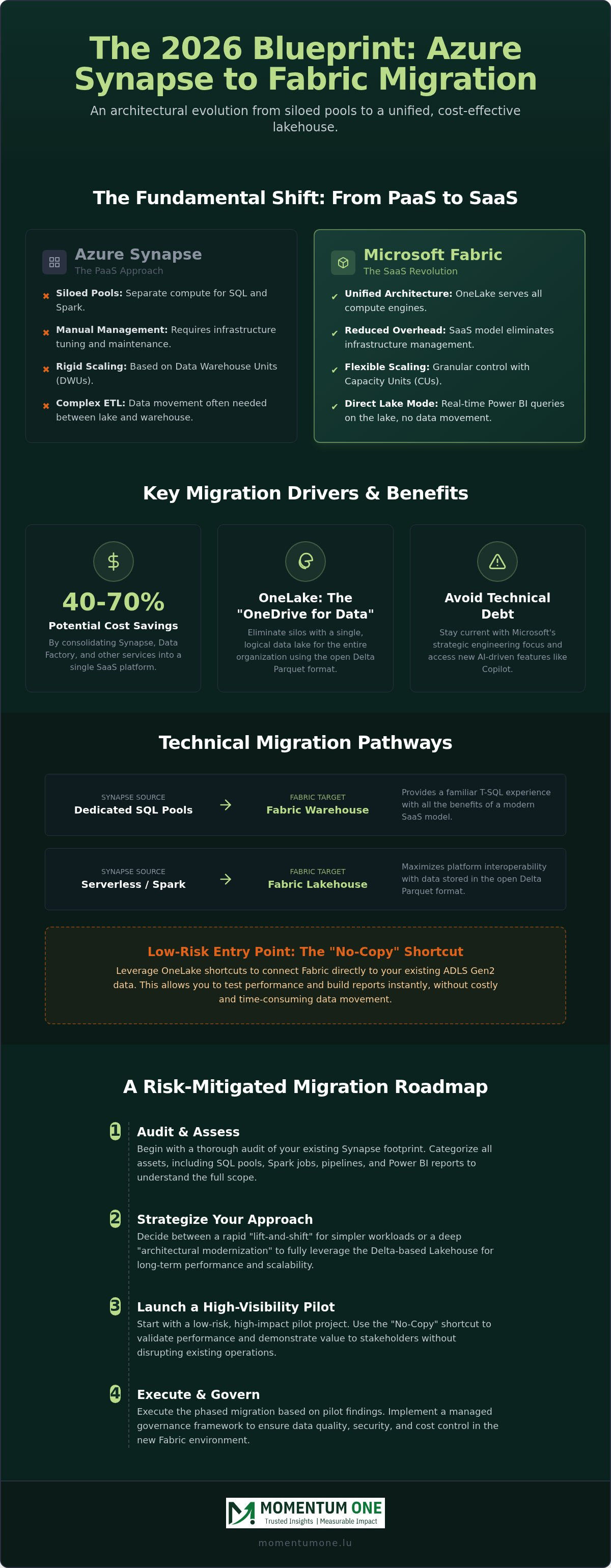
Executing a successful Azure Synapse to Fabric migration requires a granular audit of your existing infrastructure. We start by categorizing your assets into two main buckets: Dedicated SQL Pools and Serverless/Spark workloads. For Dedicated SQL Pools, the primary target is the Fabric Warehouse, which offers a familiar T-SQL experience but with the benefits of a SaaS model. For Serverless and Spark workloads, the transition typically leads toward a Fabric Lakehouse, where data is stored in open Delta Parquet format to maximize interoperability across the platform.
One of the most effective, low-risk entry points often overlooked in standard documentation is the "No-Copy" approach. By leveraging OneLake shortcuts, you can connect Fabric directly to your existing ADLS Gen2 containers. This strategy allows you to surface your Synapse data within the Fabric environment instantly, without the cost or time associated with massive data movements. It provides a safe sandbox to test performance and build new reports while your legacy systems continue to run undisturbed. If you're looking for a partner to guide this initial phase, our Fabric migration and modernization experts can help you map out these shortcuts to ensure immediate value.
Schema and Code (DDL/DML) Transition
Moving your SQL code isn't always a one-to-one swap. While Fabric Warehouse supports a vast majority of T-SQL, certain legacy features or specific index types from Synapse Dedicated Pools may require refactoring. The March 2026 update to the Fabric Migration Assistant has significantly streamlined this process, automating much of the schema conversion. However, complex stored procedures and views still require a human touch to ensure they align with Fabric's distributed query engine. We recommend a phased approach: automate the bulk of the DDL, then manually optimize high-priority business logic to prevent performance regressions.
Data Ingestion and Pipeline Modernization
Your Data Factory pipelines are the engine of your data estate. When moving to Fabric, you'll need to transition from Synapse Linked Services to Fabric Connections. This shift simplifies credential management but requires a methodical remapping of your ingestion flows. For Spark users, migrating data and notebooks involves more than just copying code; it's about adapting to Fabric's managed Spark runtime. Utilizing tools like mssparkutils and fastcp can drastically accelerate data movement between environments. If the complexity of these technical pathways feels overwhelming, Momentum One provides the steady hand needed to navigate these refactoring challenges with confidence.
Choosing Between Lift and Shift or Architectural Modernization
Deciding on the right path for your Azure Synapse to Fabric migration is a strategic pivot point that determines your long term data efficiency. You essentially face two choices: a rapid lift and shift or a deep architectural modernization. While the first option prioritizes speed, the second focuses on maximizing the performance benefits of a unified SaaS environment. We often find that the most successful transitions involve a calculated blend of both, depending on the specific needs of each workload.
A primary concern for many enterprises is minimizing downtime. We address this by running environments side by side, ensuring business continuity while validating data integrity. Choosing to refactor legacy code might seem like a larger upfront investment, but it eliminates the cost of maintaining inefficient SQL patterns in a platform designed for a lakehouse first approach. Analyzing your current Synapse footprint through Microsoft's Migration Guide can help you identify which components are ready for a direct move and which require a modern touch.
When to Lift and Shift
The lift and shift approach is ideal for organizations facing tight deadlines, such as expiring contracts or legacy hardware decommissioning. It allows you to maintain business continuity for mission critical SQL workloads by moving them into the Fabric Warehouse with minimal changes to existing logic. However, it's important to remember that this is often just the beginning. Once the data is in Fabric, you can implement post migration optimization strategies to right size your Fabric capacity spend and slowly pay down the technical debt inherited from your old Synapse pools.
The Case for Modernization
True modernization involves shifting from traditional SQL tables to a Delta based architecture. By converting legacy Parquet or CSV files into the Delta format, you unlock the full performance potential of Fabric's Direct Lake mode. This process also provides a perfect opportunity to consolidate multiple, fragmented SQL pools into a single, governed Fabric workspace. Moving toward a modern data lakehouse design ensures your architecture is future proof and ready for AI integration. This path requires more refactoring of T-SQL and Spark code, but it results in a cleaner, more scalable data estate that is significantly easier to manage than a collection of legacy PaaS services.
A Risk-Mitigated Roadmap for Enterprise Fabric Deployment
A successful Azure Synapse to Fabric migration requires a structured, phased approach to ensure stability and minimize business disruption. Moving an entire enterprise data estate is a significant undertaking. Jumping straight into the technical execution without a plan often leads to cost overruns and performance bottlenecks. We recommend a four-phase roadmap that prioritizes visibility and control at every step.
- Phase 1: Discovery and Baseline. You can't modernize what you haven't measured. Start by auditing your current Synapse usage, identifying active dedicated pools, serverless query volumes, and storage costs to establish a clear ROI baseline.
- Phase 2: Pilot and Proof of Value. Select a low-risk, high-visibility workload to migrate first. This pilot allows your team to validate the "No-Copy" shortcuts mentioned earlier and build confidence with the Fabric SaaS environment.
- Phase 3: Core Migration. Once the pilot is successful, execute the broader data and code transition. This is the stage where you apply modernization strategies to refactor legacy T-SQL and Spark notebooks for optimal performance.
- Phase 4: Governance and Training. Finalize your deployment by ensuring adoption across the business. Training your users on the unified interface is essential for long-term success.
Executing a core Azure Synapse to Fabric migration involves more than just data movement; it's about aligning your team with a new way of working. This methodical progression ensures that each step builds on the last, reducing the risk of downtime for mission-critical reports.
Establishing the Governance Framework
Fabric introduces a "Domain" concept that allows for decentralized data management while maintaining centralized oversight. Setting up your workspaces and domain structures correctly from day one prevents the workspace sprawl often seen in legacy environments. You must also configure robust security measures, ranging from Row-Level Security (RLS) to Sensitivity Labels, to ensure data remains protected in the lakehouse. For a deeper look at managing these environments, we recommend reviewing our best practices for Power BI governance.
Capacity Planning and Cost Management
Right-sizing your Fabric F-SKUs is critical to maintaining a predictable budget. We analyze your Synapse performance data to map your current DWUs to the appropriate Fabric Capacity Units, ensuring you don't over-provision. The Fabric Capacity Metrics app is an essential tool here, providing proactive monitoring of your compute consumption. To optimize licensing costs in 2026, organizations should utilize annual capacity reservations and target the F64 SKU or higher to eliminate individual Power BI Pro license requirements for report viewers. If you're ready to define your technical requirements, our team can help you through a Fabric migration and modernization assessment to remove the guesswork.
Accelerating Your Fabric Journey with Momentum One
Momentum One acts as the steady hand for enterprises facing the complexities of an Azure Synapse to Fabric migration. We recognize that moving to a SaaS platform requires more than just technical execution; it demands a partner who understands the strategic implications for your entire data estate. Our fixed-fee migration assessment removes the guesswork from your ROI by providing a clear, documented roadmap before you commit to a full deployment. This upfront clarity ensures that your transition is grounded in realistic performance expectations and cost projections.
Beyond the initial move, we specialize in DAX optimization to ensure your new Fabric reports are lightning-fast. Migrating data is only half the battle. If your Power BI layers aren't optimized for the new architecture, you won't realize the full benefits of the Direct Lake mode we discussed earlier. Our managed service offerings provide continuous support, handling post-migration governance so your internal teams can focus on driving business value. We don't just deliver a project; we build a foundation for long-term growth.
Why Choose a Certified Microsoft Solutions Partner?
As a Certified Microsoft Solutions Partner, we bring a wealth of technical expertise to national-scale enterprises in Luxembourg and beyond. Our proven frameworks for Fabric migration and modernization are designed to handle high-stakes transformations with precision. We understand the local market needs and the specific regulatory requirements that come with large-scale data modernization. This deep industry knowledge allows us to navigate complex refactoring challenges that standard guides often overlook, ensuring your architecture remains both robust and compliant.
Training and Empowerment
Empowering your internal team is a core part of our philosophy. Transitioning to the SaaS data era requires new skills in data engineering and BI governance. We offer customized workshops and corporate data fabric training to help your staff master the unified Fabric interface. By upskilling your workforce, we ensure that your organization can maintain and evolve its new architecture long after the initial migration is complete. This collaborative approach turns a technical upgrade into a sustainable business advantage, positioning your team as leaders in the modern data landscape.
Securing Your Data Future in the SaaS Era
The window for maintaining legacy infrastructure is closing, and the move toward a unified, AI-ready data estate is no longer optional. Successfully executing an Azure Synapse to Fabric migration requires more than just technical scripts; it demands a strategic vision that prioritizes long-term scalability and reduced management overhead. By embracing the lakehouse architecture and OneLake integration, your organization can finally eliminate data silos and unlock the full potential of real-time analytics.
As a Certified Microsoft Solutions Partner with over 8 years of enterprise data experience, Momentum One serves as your steady hand through this transition. Our team of national-scale implementation experts is dedicated to ensuring your journey is seamless and risk-mitigated. We specialize in turning complex technical debt into streamlined, high-performance architectures that drive genuine growth. It's time to build a foundation that supports your ambitions for 2026 and beyond.
Ready to define your path forward? Book a Fabric Migration Readiness Assessment today to remove the uncertainty from your modernization journey. We look forward to helping you build a faster, more resilient data future.
Frequently Asked Questions
Why Choose a Certified Microsoft Solutions Partner?
As a Certified Microsoft Solutions Partner, we bring a wealth of technical expertise to national-scale enterprises in Luxembourg and beyond. Our proven frameworks for Fabric migration and modernization are designed to handle high-stakes transformations with precision. We understand the local market needs and the specific regulatory requirements that come with large-scale data modernization. This deep industry knowledge allows us to navigate complex refactoring challenges that standard guides often overlook, ensuring your architecture remains both robust and compliant.
Is Azure Synapse being retired in favor of Microsoft Fabric?
Microsoft hasn't announced a formal end of life date for the entire Synapse service, but strategic engineering has clearly shifted toward Fabric. Specific components like older Spark runtimes and compute optimized data flows are already being retired. Organizations should treat Fabric as the successor platform for all new development and modernization efforts to avoid building further technical debt on legacy infrastructure.
Can I use my existing Azure Synapse Spark notebooks in Fabric?
You can migrate your existing notebooks, though they require some refactoring to align with the Fabric Spark runtime. While the core logic in PySpark or Scala remains the same, you'll need to update how your code references data. This involves switching from legacy linked services and ADLS paths to Fabric Lakehouse or Warehouse items to ensure seamless integration within the new environment.
How does Fabric capacity pricing compare to Synapse dedicated SQL pools?
Fabric uses Capacity Units (CUs) starting at $262.80 per month for an F2 SKU, providing more granular scaling than Synapse's DWU model. This shift allows for better pay as you go flexibility and significant savings through annual reservations. For many enterprises, an Azure Synapse to Fabric migration results in cost savings between 40% and 70% by consolidating disparate services into a single capacity.
What happens to my Power BI reports when I migrate from Synapse to Fabric?
Your reports will continue to work, but you should update their connections to unlock the performance of Direct Lake mode. This feature allows Power BI to read Delta tables directly from OneLake, providing the speed of Import mode without the need for manual refreshes. Transitioning your reports ensures they take full advantage of the unified architecture and reduced latency offered by the Fabric platform.
Do I need to copy all my data from ADLS Gen2 to OneLake?
No, you don't need to move all your data immediately thanks to OneLake shortcuts. These shortcuts create a logical link to your existing storage, allowing Fabric to treat external data as if it were native to the lakehouse. This approach simplifies your Azure Synapse to Fabric migration by enabling a phased transition and avoiding the time and cost associated with massive data movement.
How long does a typical enterprise Synapse to Fabric migration take?
A typical enterprise migration usually spans three to nine months depending on the volume of SQL pools and Spark pipelines. We recommend starting with a four to six week pilot project to validate your architecture and migration path. The total timeline depends on the amount of T-SQL refactoring required and the complexity of your existing Power BI report ecosystem.
What are the most common T-SQL incompatibilities when moving to Fabric Warehouse?
Most standard operations translate easily, but certain legacy index types and specific cross database query patterns may require refactoring. Fabric Warehouse uses a cloud native distributed query engine that prioritizes open data formats. The Fabric Migration Assistant can automate the identification of these gaps, helping your team focus their efforts on high priority business logic rather than manual syntax checking.
Is Microsoft Fabric secure enough for highly regulated industries in 2026?
Fabric meets the strict security requirements of regulated sectors by integrating natively with Microsoft Purview for advanced governance. It supports essential features like Row Level Security, Column Level Security, and Sensitivity Labels to protect data at every layer. Because it's a SaaS platform, security patches and compliance updates are managed automatically, maintaining a robust defense posture throughout your modernization journey.