Building a Robust Data Foundation for Enterprise AI
Learn how building the data foundation for enterprise AI is critical. Our 5-step guide using Microsoft Fabric helps you unify data and avoid project failure.
- Understand why Building the Data Foundation for Enterprise AI is the critical first step to prevent project abandonment and ensure your models receive high-quality, context-rich data.
- Discover how Microsoft Fabric and OneLake simplify your architecture by centralizing storage and eliminating the need for costly data duplication.
- Learn to leverage a modern lakehouse environment that treats unstructured data, such as PDFs and transcripts, as a first-class citizen for AI processing.
- Establish robust governance and semantic mapping to ensure your AI agents operate with reliable, trustworthy information that reflects your business logic.
- Follow a structured five-step roadmap to transition from fragmented legacy silos to a scalable, AI-ready infrastructure that delivers immediate business value.
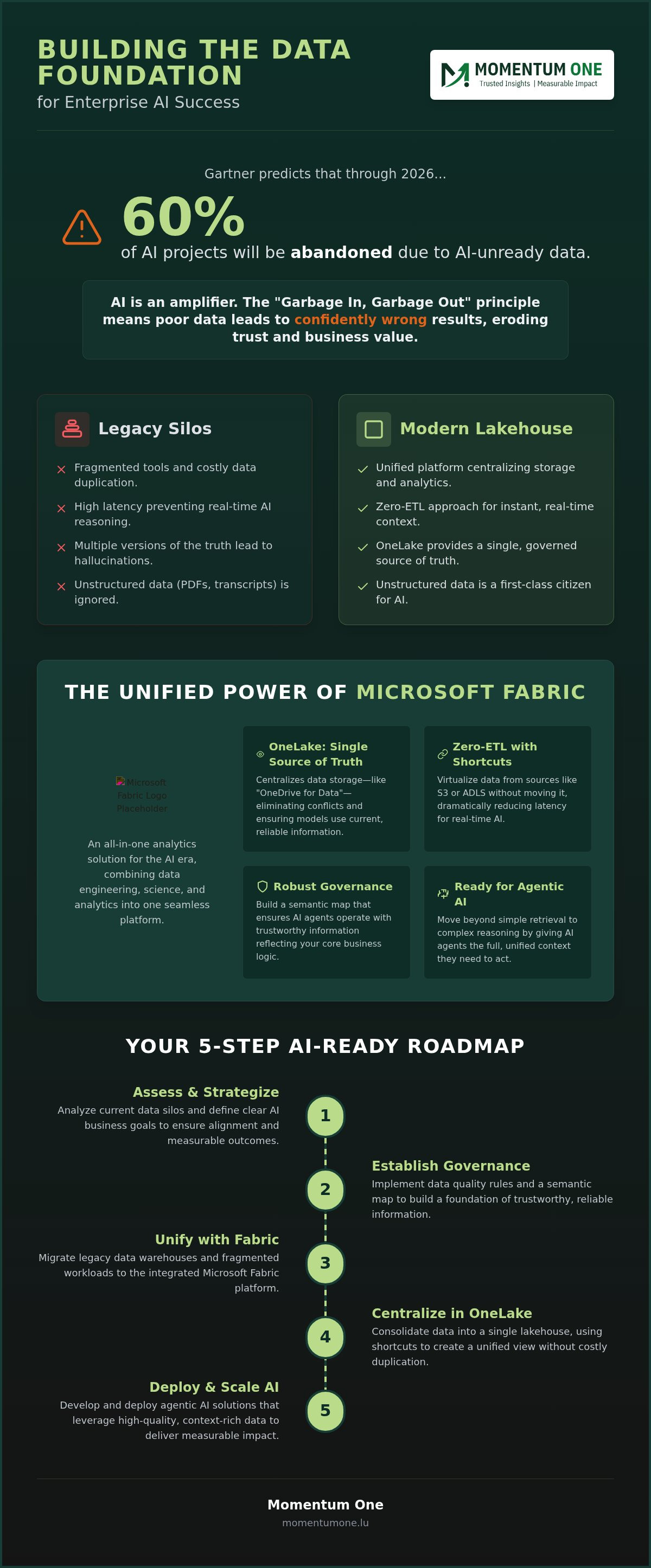
Gartner predicts that through 2026, 60% of AI projects unsupported by AI-ready data will be abandoned. It's a sobering reality for leaders investing in a global AI market projected to reach €2.3 trillion this year. You likely feel the pressure to innovate while your teams struggle with data silos that prevent a unified AI context. Building the Data Foundation for Enterprise AI is the only way to ensure your pilots don't just survive but thrive. We recognize the challenge of balancing these goals with the EU AI Act's transparency obligations that became effective in August 2026.
We're committed to being your steady hand through this transition. This article outlines how to architect a unified, governed, and scalable data foundation using Microsoft Fabric. You'll gain a clear roadmap to AI-readiness, from migrating legacy warehouses to establishing a high-performance lakehouse. We'll show you how to reduce fragmentation and build a system that delivers measurable business value and long-term growth for your organization.
AI Readiness Gap: Models Are Only as Good as Their Data
AI success isn't about the model you choose; it's about the data you feed it. Building the Data Foundation for Enterprise AI means establishing the infrastructure, governance, and quality layers that turn raw information into a business asset. Without this foundation, the "Garbage In, Garbage Out" (GIGO) principle takes over. Large Language Models (LLMs) are exceptionally good at finding patterns. However, if those patterns are based on fragmented or inaccurate data, the results will be confidently wrong. This isn't just a technical hurdle. It's a fundamental barrier to delivering measurable business value.
A common misconception is that AI can fix bad data on its own. In reality, AI acts as an amplifier. A minor inconsistency in a legacy warehouse becomes a significant error when an AI agent uses it to make a decision. To achieve scalable enterprise-wide AI capabilities rather than just isolated short-term wins, you need a robust data warehouse and lakehouse design. This structural clarity ensures that your data is reliable, accessible, and ready for high-performance reasoning.
Understanding the Agentic AI Era
We're moving beyond simple chatbots into the era of agentic AI. These systems don't just answer questions; they perform tasks and make autonomous decisions. This shift requires moving from simple "retrieval" to complex "reasoning." For an agent to function effectively, it needs real-time access to a unified data environment. If the agent can't see the full context because of silos, its reasoning fails. Building the Data Foundation for Enterprise AI ensures your agents have the unified context they need to act reliably.
The True Cost of Poor Data Quality
Industry reports indicate that 50% of AI pilots fail at the proof-of-concept stage due to data silos. These failures often stem from a lack of "mise-en-place"-the concept of having everything in its place before you start. In a data context, this means ensuring your data governance principles are active before the first model is deployed. Poor data quality creates hidden costs through hallucinations. When a model encounters inconsistent sources, it fills the gaps with fabricated information. In Luxembourg's highly regulated market, where transparency is paramount, these errors can lead to regulatory friction and lost trust.
Architecting for Intelligence: The Unified Power of Microsoft Fabric and OneLake
Microsoft Fabric isn't just another data tool. It's an all-in-one analytics solution built specifically for the AI era. Most enterprises struggle with fragmented tools that don't speak the same language. Fabric simplifies this by combining data engineering, science, and analytics into one platform. This integration is vital for Building the Data Foundation for Enterprise AI because it removes the friction between data storage and AI modeling. By unifying your environment, you ensure that every part of your architecture supports the high-level reasoning your AI agents require.
At the heart of this ecosystem sits OneLake. Think of it as "OneDrive for Data." It centralizes storage without the need for constant duplication. One of its most powerful features is the shortcut capability. Shortcuts allow you to virtualize data from other sources like Amazon S3 or Azure Data Lake without moving it. This Zero-ETL approach significantly reduces latency. For AI agents that require real-time context, this speed is a competitive advantage. If you're looking to modernize your stack, exploring Microsoft Fabric migration services is a strategic move to leave legacy limitations behind.
OneLake: The Single Source of Truth
Conflicting AI insights usually stem from multiple versions of the same truth. OneLake solves this by providing a unified logical layer. When your data resides in a single, governed location, your AI models don't have to guess which dataset is current. This logical unification is a cornerstone of Building the Data Foundation for Enterprise AI. OneLake acts as the central nervous system for enterprise data in 2026.
Integrating Power BI for AI Visualization
Power BI functions as the eyes of your AI foundation. It provides the visualization layer where AI-driven insights become actionable. Integrating Copilot within this ecosystem allows users to query data using natural language, turning complex reports into conversational answers. However, security remains paramount. Implementing robust Power BI consulting and governance ensures that sensitive data is exposed only to authorized users and models. This balance between accessibility and security is what makes an AI foundation truly robust.
We can help you navigate this transition. Consider a data architecture modernization to see how these tools fit your specific business goals.
Legacy Silos vs. Modern Lakehouse: Choosing the Right AI Infrastructure
Traditional data warehouses served us well for decades. They provided a structured environment for financial reports and sales dashboards. However, the requirements for Building the Data Foundation for Enterprise AI have shifted significantly. Today's AI models, especially Large Language Models, thrive on unstructured data like PDF contracts, customer service transcripts, and internal documentation. A traditional warehouse often ignores these files or requires complex, time-consuming ETL processes to make them readable. This creates a disconnect between your data and your AI ambitions.
This is where the modern Data Lakehouse shines. It merges the governance and performance of a warehouse with the vast, low-cost storage of a data lake. By adopting a lakehouse architecture, you gain a scalable platform that handles massive enterprise datasets without the rigid constraints of legacy systems. It allows you to store all your data in its native format while maintaining the structure needed for high-performance analytics. For a deeper dive into these technical differences, see our Data Lakehouse vs Warehouse design guide.
Why Lakehouses Win for Enterprise AI
Lakehouses are designed for agility. They allow machine learning libraries to run directly on the data lake, which eliminates the need to move data back and forth. This architecture is also highly cost-efficient because it separates compute from storage. You only pay for the processing power you use, while storage remains inexpensive. In the Luxembourg market, storage for hot data in OneLake is priced at approximately €0.02 per GB per month. Our Data Warehouse & Lakehouse Design services help businesses bridge the gap between their current capabilities and future AI needs, ensuring your infrastructure is both powerful and budget-friendly.
Modernizing Legacy Environments
Your current warehouse might be an AI bottleneck if your teams spend more time cleaning data than using it. Signs of friction include high latency in AI responses or the inability to integrate real-time data streams. We recommend a clear roadmap for Data Architecture Modernization that prioritizes a phased migration. This approach allows you to move critical workloads first, ensuring business continuity while you build your new foundation. It's about evolving your infrastructure at a pace that matches your growth, rather than forcing a risky transition that disrupts your daily operations.
Governance and Quality: Building Trustworthy Data for Agentic AI
Governance isn't a collection of restrictions; it's a strategic enabler for innovation. Building the Data Foundation for Enterprise AI requires a focus on quality that extends beyond simple row-and-column accuracy. You need to provide your AI models with a deep understanding of what your data actually represents. This process starts with semantic mapping, where you define the relationships and logic that give your data meaning. Without this layer, AI agents struggle to interpret conflicting signals, leading to hallucinations that can derail an entire project.
Metadata management plays a vital role in this ecosystem. It provides the "source of truth" that grounds Large Language Models in reality. When an AI agent knows the lineage and quality score of a dataset, it can decide whether to trust that information for a high-stakes decision. To maintain this level of precision, many organizations rely on DAX optimization experts. These specialists ensure that your underlying calculations are both accurate and performant, preventing the logic errors that often lead to poor AI outcomes.
Semantic Layer: The AI Translator
A well-defined semantic layer is the bedrock of "On-Demand BI." It functions as the dictionary for enterprise AI agents, translating technical table names into clear business definitions. When your AI model asks for "quarterly growth," it shouldn't have to guess which date column or calculation to use. By optimizing your DAX logic, you improve the speed and reliability of these natural language queries. This structural clarity allows your team to move from asking "what happened" to "what should we do next" with complete confidence.
Security and Compliance in the AI Era
In Luxembourg, the regulatory landscape is shifting rapidly. As of August 2, 2026, the transparency obligations of the EU AI Act are officially in effect. This means your AI-generated content and data usage must be documented and disclosed. Non-compliance can result in fines of up to €15 million or 3% of worldwide annual turnover. Microsoft Fabric supports these requirements through Role-Based Access Control (RBAC), ensuring that LLMs only access data relevant to their specific task. Effective Workspace and Capacity Management is essential to balance these security needs with the compute power required for modern AI workloads.
Ready to secure your AI future? Explore our Power BI Consulting and Governance services to build a framework that lasts.
From Strategy to Execution: Building Your AI-Ready Roadmap
Building the Data Foundation for Enterprise AI isn't a one-time project; it's a strategic evolution. We understand that the transition from fragmented legacy systems to a unified Fabric environment can feel daunting. Success requires a balance between long-term architectural goals and immediate business value. By focusing on high-impact "quick wins" through focused pilots, you can demonstrate the ROI of your AI initiatives while the broader infrastructure matures. This iterative approach builds confidence across the organization and provides the momentum needed for full-scale modernization.
Technology alone isn't enough to sustain this transformation. Your people need the skills to interact with these new systems effectively. Investing in Corporate Power BI training is a vital step in building internal data literacy. When your team understands how to navigate the semantic layer and interpret AI-driven insights, the data foundation becomes a living asset. We position ourselves as your proactive ally, simplifying the technical complexity so your team can focus on what they do best: driving growth.
The 5-Step Foundation Roadmap
We recommend a structured path to ensure no critical governance or performance layer is overlooked. This roadmap provides a clear sequence for your transition:
- Step 1: Readiness Assessment & Gap Analysis. We audit your current silos and identify quality issues that could hinder AI performance.
- Step 2: Pilot Implementation. We select a single, high-value AI use case to prove the concept and deliver immediate value.
- Step 3: Fabric Migration & OneLake Consolidation. We move your workloads into the unified Microsoft Fabric ecosystem.
- Step 4: Governance Framework & Semantic Layer Optimization. We establish clear rules and optimize your DAX logic for accuracy.
- Step 5: Scaling & Managed Performance Tuning. The final stage of Building the Data Foundation for Enterprise AI is about scaling these capabilities across every department.
Sustaining Performance with Managed Services
An AI-ready foundation requires constant attention to stay performant. Data environments are dynamic; new sources are added, and user requirements change. This is why Continuous Support and Monitoring is essential. Our managed services provide the steady hand needed to maintain peak performance and ensure your governance remains compliant with shifting regulations. By choosing a partnership approach to your long-term data strategy, you gain access to expert facilitators who are as invested in your success as you are. We're here to ensure your architecture remains a scalable, reliable engine for enterprise intelligence.
Secure Your Strategic Advantage in the AI Era
Success in the age of agentic AI depends on the structural integrity of your data. We've explored how Microsoft Fabric and OneLake serve as the backbone for this new era, turning fragmented silos into a unified logical layer. By prioritizing governance and semantic clarity, you ensure your models reason accurately and stay compliant with evolving regulations like the EU AI Act. Building the Data Foundation for Enterprise AI is the most critical investment you can make to move beyond fragile pilots into production-ready intelligence.
As a Certified Microsoft Solutions Partner with over 8 years of data architecture expertise, we're here to be your steady hand in this complex field. We specialize in high-performance Fabric and Power BI implementations that transform data into a scalable business asset. Ready to build your AI foundation? Explore our Microsoft Fabric Migration Services and take the first step toward a future-proof architecture. We're dedicated to your success and ready to help you navigate every step of the journey.
Frequently Asked Questions
What is a data foundation for enterprise AI?
A data foundation is the integrated layer of infrastructure, governance, and quality controls that makes your information accessible to AI models. It acts as the structural base that ensures Large Language Models receive clean, relevant, and context-rich data. Building the Data Foundation for Enterprise AI is essential to move beyond simple chatbots into complex autonomous agents that can reason across your entire organization's history and current operations.
How does Microsoft Fabric simplify building an AI-ready data stack?
Microsoft Fabric simplifies the process by unifying diverse analytics tools into a single logical environment. It eliminates the friction of moving data between separate systems through its Zero-ETL capabilities and the OneLake storage layer. This integration allows your data engineers and AI scientists to work on the same governed datasets, reducing the time from raw data ingestion to AI-driven insight while maintaining a single source of truth for the organization.
Why is data governance critical for AI agents and LLMs?
Governance ensures that AI agents operate within safe, accurate, and ethical boundaries. Without clear rules, LLMs can access sensitive information or use outdated datasets, leading to hallucinations and security breaches. In Luxembourg, robust governance is also a regulatory necessity. The EU AI Act requires transparency and documentation of data used to train and run high-risk systems, making governance the primary enabler of legal and trustworthy AI deployments.
Can we build an AI foundation without migrating our legacy data warehouse?
You can begin building your foundation by using Microsoft Fabric's "shortcuts" feature to virtualize data from legacy warehouses without immediate migration. This allows you to leverage modern AI capabilities while your existing systems remain in place. However, long-term scalability and cost-efficiency often require a phased migration to a modern lakehouse. This transition eventually removes the performance bottlenecks and high maintenance costs associated with outdated on-premise or siloed infrastructure.
What is the difference between structured and unstructured data in an AI context?
Structured data consists of organized information in tables and spreadsheets, while unstructured data includes PDFs, transcripts, and emails. In an AI context, unstructured data is often where the most valuable business context resides. Modern architectures like the Microsoft Fabric lakehouse allow AI models to process both types simultaneously. This capability enables your AI agents to read contracts and understand customer sentiment just as easily as they analyze financial spreadsheets.
How long does it typically take to build a scalable data foundation?
A pilot-scale data foundation typically takes three to six months to establish, depending on your current data maturity and the complexity of your silos. This timeframe includes the initial readiness assessment, a focused AI use case implementation, and the setup of basic governance. While Building the Data Foundation for Enterprise AI is a continuous journey, this initial phase provides the necessary infrastructure to start delivering measurable business value and internal confidence.
How do we ensure data privacy when using enterprise AI models?
Data privacy is maintained through a combination of Role-Based Access Control (RBAC) and private AI instances that don't train on your proprietary data. Within the Microsoft Fabric ecosystem, you can set granular permissions to ensure that AI models only see the data relevant to the specific user's role. This approach protects sensitive information while allowing the AI to provide personalized, context-aware responses without the risk of data leakage or unauthorized access.
What role does DAX optimization play in AI-driven analytics?
DAX optimization ensures that the calculations within your semantic layer are both fast and accurate. When an AI agent queries your data using natural language, it relies on these underlying DAX expressions to return the correct figures. If your DAX logic is unoptimized, the AI's response will be slow or potentially incorrect. High-performance reporting is the translator that allows AI to interpret complex business metrics with total precision and speed.