Cloud Modernization in Luxembourg: Strategic Data Growth
Unlock strategic growth with cloud modernization in Luxembourg. Turn NIS2/DORA compliance hurdles into a unified data platform with Microsoft Fabric & Power BI.
- Transition from simple "lift and shift" methods to cloud-native data strategies that prioritize long-term scalability and performance.
- Discover how a structured roadmap for cloud modernization luxembourg ensures a smooth migration from legacy SQL systems to a unified Microsoft Fabric Lakehouse.
- Learn to navigate complex regulatory landscapes by integrating DORA and NIS2 compliance directly into your cloud architecture.
- Master the art of DAX optimization and data modeling to turn your modernized infrastructure into high-performance Power BI insights.
- Foster a data-driven culture by addressing the human side of technology transitions to ensure full organizational alignment.
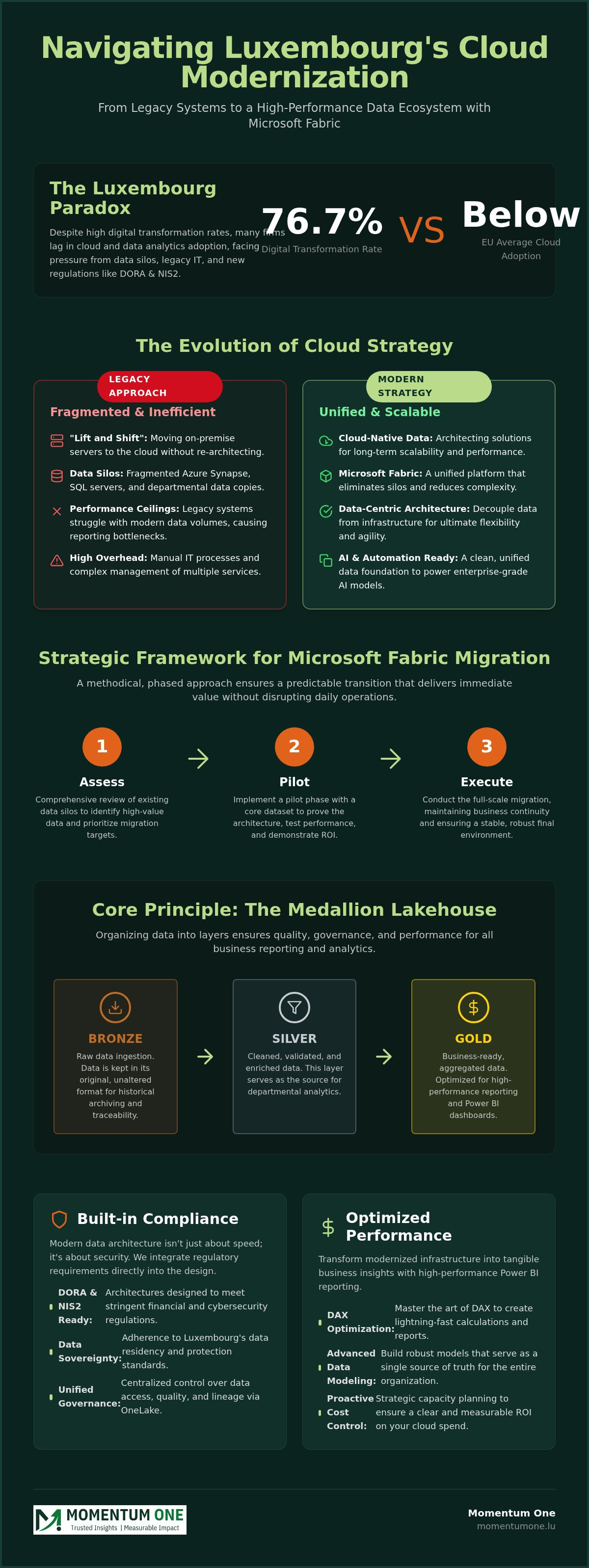
With Luxembourg's digital transformation rate hitting 76.7% last year, why does cloud and data analytics adoption still trail the EU average for many local firms? It's a frustrating paradox. You've likely invested heavily in technology, yet your team still struggles with fragmented data silos and the weight of legacy IT infrastructure. With the July 2026 NIS2 registration deadline now behind us and DORA requirements in full swing, the pressure to maintain a secure, compliant, and cost-effective environment has never been higher.
We understand that cloud modernization in Luxembourg often feels like a balancing act between escalating costs and the need for a clear ROI. It's time to shift that perspective. You can transform these regulatory and technical hurdles into a high-performance data ecosystem that serves as your single source of truth. This article explores how to leverage Microsoft Fabric and strategic modernization to deliver fully optimized Power BI reporting and a compliance-ready architecture. We'll walk through the practical steps to move from fragmented legacy systems to a unified, scalable platform that drives real growth.
The Evolution of Cloud Modernization in Luxembourg (2026)
In 2026, the definition of cloud modernization luxembourg has fundamentally shifted. It's no longer just about "Lift and Shift" where you move virtual machines from a local server room to the cloud. Instead, forward-thinking firms are embracing "Cloud Native Data." This means moving away from aging on-premise SQL servers that struggle to keep pace with modern demands. For Luxembourg's financial sector, the sheer volume of data has made traditional reporting methods obsolete. Legacy systems often hit performance ceilings just when they're needed most. This year marks a definitive tipping point for Microsoft Fabric migration as organizations seek a unified platform to handle these massive datasets with agility.
From Infrastructure to Data-Centric Architecture
Modernizing the data layer provides a far greater return on investment than simply swapping out hardware. Many local IT teams are moving away from fragmented Azure Synapse setups in favor of unified Fabric environments. This consolidation eliminates data silos and reduces the complexity of managing multiple services. We focus on maintaining business continuity during this transition. A steady hand ensures that your daily operations remain stable while we implement a robust data architecture modernization. By decoupling the data from the underlying infrastructure, you gain the flexibility to scale without the friction of traditional migration projects.
The Role of AI and Automation in Modern Cloud Stacks
A modernized cloud stack is the essential foundation for enterprise-grade AI. You can't run sophisticated models on messy, disconnected data. By automating data pipelines, we help reduce manual IT overhead, allowing your team to focus on strategic growth rather than maintenance. In the context of 2026 Luxembourgish business needs, a "Data Fabric" is a unified architecture that connects disparate data sources into a single, accessible layer while strictly adhering to data sovereignty principles. This approach ensures your information remains secure and compliant with national standards. Modernization isn't just a technical upgrade; it's a strategic move to unlock the full potential of your corporate intelligence. We act as your proactive ally, simplifying these complex transitions so you can focus on what matters most: your performance.
Strategic Framework for Microsoft Fabric Migration
Successful cloud modernization luxembourg isn't a single event; it's a methodical progression that transforms how your business interacts with its most valuable asset. We've seen many organizations struggle because they treat migration as a simple technical task rather than a strategic shift. Our framework starts with a comprehensive assessment of your existing silos to identify high-value data. We then move into a pilot phase to prove the architecture before full-scale execution. This phased approach provides a steady hand, ensuring that your transition is predictable and delivers immediate value without disrupting daily operations.
One of the most significant shifts in 2026 is the move from traditional, fragmented storage to OneLake. Think of OneLake as the "OneDrive for data." Instead of maintaining separate copies of information for different departments, OneLake provides a single, unified repository. This consolidation naturally reduces storage costs and simplifies governance. It also ensures your organization remains fully aligned with the latest data protection regulations in Luxembourg. By centralizing your data, you eliminate the "version hell" that often plagues legacy systems, creating a reliable foundation for all corporate reporting.
Controlling cloud spend is a top priority for local firms this year. We focus heavily on capacity planning from day one. By evaluating your specific workload patterns, we help you select the right Fabric capacity to avoid the common pitfall of escalating costs. This proactive management ensures that your Fabric migration and modernization project delivers a clear and measurable ROI.
Designing a Scalable Lakehouse Architecture
A high-performance data warehouse and lakehouse design relies on the medallion architecture. This structure organizes data into three distinct layers: Bronze for raw ingestion, Silver for cleaned and validated data, and Gold for business-ready aggregates. This logical flow ensures data quality at every stage. We also implement advanced partitioning and indexing strategies. These technical optimizations are essential for maintaining fast query times as your data volumes grow, keeping your decision-makers productive and informed.
Automating the Migration Path
Manual data movement is too slow and prone to error for modern business needs. We leverage pipeline and dataflow automation to accelerate the entire migration process. These tools ingest and transform data automatically, significantly reducing the time required to move from legacy SQL environments to the cloud. This automation is critical for minimizing downtime. It ensures that your business intelligence reports remain active and accurate throughout the transition. If you're ready to see how these tools can streamline your journey, we can help you design a tailored migration roadmap that fits your unique requirements.
Navigating Regulatory Compliance: DORA, NIS2, and Data Residency
In the Luxembourgish financial landscape of 2026, regulatory adherence is a competitive advantage rather than a burden. As the NIS2 Directive became part of national law on May 5, 2026, and DORA requirements reached full maturity, the stakes for data security have never been higher. Effective cloud modernization luxembourg involves building compliance directly into your architecture. Microsoft Fabric supports these mandates by providing a unified environment where security protocols are consistent across every dataset, preventing the gaps often found in fragmented legacy systems.
DORA places heavy emphasis on digital operational resilience and the management of third-party ICT risks. By migrating to a modernized cloud stack, you gain access to Microsoft's extensive security infrastructure, which is designed to meet these rigorous EU standards. At the same time, we help you address data residency concerns. We ensure your data remains within the appropriate geographic boundaries while still benefiting from the scalability of the global cloud. This balanced approach satisfies both local CSSF expectations and your need for high-performance analytics.
Governance Frameworks for Modern Analytics
A robust Power BI consulting and governance strategy is essential for maintaining corporate security. We implement advanced Row-Level Security (RLS) and Object-Level Security (OLS) to ensure that sensitive information is only accessible to authorized personnel. These controls are not just technical settings; they're the pillars of a secure data culture. In 2026, these granular permissions allow you to share insights across the organization without compromising the integrity of your underlying data or violating privacy mandates.
Auditability and Transparency in the Cloud
Satisfying national audit requirements from the CSSF requires clear visibility into how data moves through your organization. We focus on tracking data lineage within Fabric to provide a transparent view of every transformation. This automated lineage reduces compliance risk by providing an immutable record of data origins and modifications, making audit preparations significantly faster. Automated reporting on data access and security logs further strengthens your position. It gives you the evidence needed to prove that your cloud modernization luxembourg project isn't just about speed, but about building a trustworthy and resilient data ecosystem.
Optimizing Performance: The DAX and Data Modeling Pillar
Even the most advanced infrastructure can't rescue a poorly designed report. We often see organizations invest heavily in cloud modernization luxembourg, only to find their executive dashboards are sluggish and unresponsive. This usually happens because the semantic layer was ignored during the migration. A modernized cloud stack isn't just about where your data lives; it's about how quickly that data turns into a decision. Without an optimized semantic layer, your high-performance cloud environment becomes a bottleneck for the very leaders who need it most.
The transition from "flat tables" to an optimized Star Schema is the most critical step in this process. Legacy systems often rely on wide, cumbersome tables that force Power BI to work harder than necessary. By restructuring your data into facts and dimensions, we reduce report latency and ensure that DAX calculations run at peak efficiency. With the general availability of DAX User-Defined Functions as of July 2026, your team now has even more powerful tools to streamline complex logic. However, these tools require a steady hand to implement correctly without creating technical debt.
Advanced Data Modeling for 2026 Enterprise Needs
Proper data modeling isn't just a performance choice; it's a financial one. In Microsoft Fabric, inefficient models consume more capacity, which directly increases your monthly costs. By implementing a robust data architecture modernization, we help you handle large enterprise datasets while keeping your Fabric consumption lean. This is particularly vital in Luxembourg's financial sector, where data volumes are expanding rapidly. Since Microsoft implemented a 7.4% price decrease for Commercial Cloud services in February 2026, optimizing your model allows you to stretch your budget even further and maximize your ROI.
Managed Services for Continuous Performance
Performance isn't a "set and forget" metric. As your data grows, even the best models can develop bottlenecks. Our approach includes proactive troubleshooting of DAX logic to catch issues before they impact your users. Through workspace and capacity management, we provide continuous monitoring and tuning to keep your environment healthy. This ensures that your executive dashboards remain fast and reliable, regardless of how much data you add to the system. We act as your dedicated ally, managing the technical complexity so your team can focus on the insights that drive growth.
If your current reports are struggling to keep pace with your business, it's time to refine your approach. Let's discuss how our DAX and data modeling optimization services can transform your report performance today.
Building a Data-Driven Culture through Modernization
Successful cloud modernization luxembourg depends as much on your people as it does on your technology stack. In our experience, roughly 50% of a project's success hinges on organizational change and user adoption. It's natural for teams to feel some resistance when moving away from familiar legacy systems. We focus on bridging this gap by acting as a supportive partner rather than just a technical provider. By addressing the human element early, we help your staff see the cloud not as a threat to their routines, but as a powerful tool for their daily success.
Empowering business users with self-service BI is a core objective of any modern data strategy. However, this empowerment must happen under a governed umbrella to prevent data chaos. We help you establish the right guardrails so your team can explore data safely and confidently. This approach increases data literacy across the entire organization, leading to more informed decision-making at every level. When employees understand how to interpret and use data, the business impact is immediate and measurable.
Corporate Training as a Modernization Catalyst
We believe that education is the fastest way to overcome internal friction and accelerate ROI. Our corporate Power BI training and Microsoft Fabric workshops are designed to turn your staff into proficient data users. These tailored sessions focus on practical application rather than abstract theory. We also help you identify and develop internal "Data Champions." These individuals act as local experts within their departments, driving adoption and helping their colleagues navigate the new platform. This bottom-up approach ensures that the benefits of your modernization project reach every corner of your business.
Establishing a Single Source of Truth
Centralized cloud analytics is the only way to escape the cycle of "Excel Hell." When different business units rely on their own disconnected spreadsheets, accuracy suffers and trust in the numbers erodes. By migrating to a unified environment, you ensure that every report across the organization reflects the same reality. This consistency is vital for maintaining report accuracy and operational efficiency. A unified data ecosystem provides a clear ROI by enabling leadership to make strategic moves based on a single, indisputable source of truth. We're here to help you build that foundation and foster a culture where data is a shared, trusted language for growth.
Securing Your Future in the Luxembourgish Data Economy
The path to a resilient data ecosystem requires more than just new software. It demands a strategic shift from legacy infrastructure to a unified, cloud-native architecture. By embracing Microsoft Fabric, your organization can turn the complexities of DORA and NIS2 into a streamlined framework for growth. We've explored how high-performance DAX optimization and a strong data-driven culture are the final catalysts for turning raw information into executive-level insights. These elements ensure that your technology investments translate into measurable business value.
Your journey toward cloud modernization luxembourg doesn't have to be a solitary climb. As a certified Microsoft Solutions Partner with specialized Luxembourgish regulatory expertise, we provide the steady hand needed for outcome-focused project delivery. We're committed to simplifying these technical transitions so you can focus on your core business goals. We've helped numerous firms navigate this evolving landscape, and we're ready to do the same for you.
Ready to transform your legacy systems into a competitive advantage? Modernize your data stack with Momentum One's expert guidance. We look forward to partnering with you on your next phase of strategic growth.
Frequently Asked Questions
What is the difference between cloud migration and cloud modernization?
Cloud migration refers to the basic process of moving existing infrastructure or applications to the cloud without significant changes. In contrast, cloud modernization luxembourg involves re-architecting your data ecosystem to leverage cloud-native features like Microsoft Fabric. This shift allows you to move beyond simple storage toward high-performance analytics and integrated AI. It's about transforming legacy silos into a unified, scalable environment that supports strategic growth rather than just changing where your data lives.
How does Microsoft Fabric simplify the data stack for Luxembourgish companies?
Microsoft Fabric simplifies the stack by unifying disparate services like data engineering, warehousing, and analytics into a single platform. Instead of managing separate licenses and connections for various tools, companies use OneLake as their Single Source of Truth. This consolidation eliminates data duplication and reduces the overhead of maintaining complex integrations. It creates a streamlined workflow where your team spends less time on technical maintenance and more time delivering actionable business insights.
Is cloud modernization compliant with CSSF and DORA regulations?
Modernized cloud architectures are fully compliant with CSSF and DORA regulations when implemented with a robust governance framework. Microsoft’s EU Data Boundary and Fabric's built-in auditing features provide the transparency required for national audits. We focus on implementing precise security controls and data lineage tracking to satisfy these rigorous financial standards. This ensures your data residency and operational resilience requirements are met while still benefiting from the scalability of a global cloud platform.
How long does a typical Microsoft Fabric migration take in 2026?
A typical Microsoft Fabric migration in 2026 varies based on the complexity of your legacy systems. Smaller projects or pilot phases often conclude within 4 to 6 weeks, while full-scale enterprise transitions may take 3 to 9 months. We prioritize a phased approach to ensure business continuity throughout the process. This methodical progression allows your organization to realize value early while we steadily modernize your most critical data assets without disrupting daily operations.
Why should we choose a boutique consultancy over a large global firm?
Choosing a boutique consultancy offers a collaborative partnership that larger, detached firms often lack. We provide a steady hand with senior experts who are deeply invested in your specific journey, rather than assigning junior staff to your account. Our boutique model allows for greater agility and a tailored approach that aligns with the unique nuances of the Luxembourgish market. You receive dedicated attention and high-level technical expertise focused entirely on your long-term success.
What are the hidden costs of delaying cloud modernization?
Delaying cloud modernization luxembourg leads to escalating maintenance costs for aging on-premise hardware and manual reporting processes. These legacy systems often require significant IT overhead to remain functional, draining resources that could be used for innovation. Additionally, the risk of non-compliance with evolving regulations like NIS2 can result in heavy penalties. You also miss out on the performance gains and cost efficiencies provided by modern, automated data pipelines and AI-driven analytics.
Can we modernize our data stack without replacing our existing ERP?
You don't need to replace your existing ERP to modernize your data stack. Microsoft Fabric uses powerful connectors and shortcuts to ingest data directly from your current systems, such as SAP or Oracle, into a unified Lakehouse. This allows you to build a high-performance analytics layer on top of your existing operational tools. You gain the benefits of modern reporting and AI without the massive disruption and cost of a full ERP overhaul.
How does DAX optimization impact our cloud licensing costs?
DAX optimization directly impacts your cloud licensing costs by reducing the compute power required to run your reports. In Microsoft Fabric, your expenses are tied to capacity consumption; inefficient calculations force you into more expensive tiers. By refining your measures and semantic models, we ensure your reports run faster while consuming fewer resources. This proactive tuning allows you to stay within a lower capacity SKU, significantly maximizing your ROI on cloud investments.