Cloud Sovereignty in Luxembourg: A Strategic Guide
Master cloud sovereignty in Luxembourg. This strategic guide shows how to balance CSSF/DORA compliance with high-performance analytics for a competitive edge.
- Distinguish between data, operational, and infrastructure sovereignty to ensure your strategy covers every layer of regulatory compliance.
- Explore how to integrate modern Microsoft Fabric and Power BI architectures within the strict framework of Luxembourgish Tier IV data centers.
- Gain a clear roadmap for cloud sovereignty luxembourg that balances the need for high-performance analytics with the requirements of CSSF and DORA.
- Identify the strategic advantages of Microsoft's local disconnected operations for mission-critical workloads that require maximum autonomy.
- Learn how to conduct a comprehensive data audit to classify assets and define jurisdictional requirements before beginning your migration.
By January 2027, the EU Data Act will officially ban cloud switching fees, yet waiting until that deadline to address vendor lock-in is a strategic gamble you cannot afford. In the 2026 landscape, achieving true cloud sovereignty luxembourg means looking beyond the physical location of your servers to the governance of the data itself. You might worry that strict CSSF or DORA compliance will inevitably throttle your system performance, or that moving to the cloud means losing the "kill switch" over your most sensitive assets.
We recognize that the distinction between infrastructure and data sovereignty is often unclear, leaving many IT leaders hesitant to fully modernize. This guide offers a practical roadmap for a sovereign migration, demonstrating how to balance rigorous security with the high-performance capabilities of tools like Microsoft Fabric. We'll walk through the strategic advantages of Microsoft's local disconnected operations and explain how to choose a partner who understands the specific regulatory pulse of the Grand Duchy. By focusing on governance as your foundation, you can build a data architecture that is both compliant and competitive.
What is Cloud Sovereignty in Luxembourg in 2026?
In 2026, cloud sovereignty luxembourg has matured into a comprehensive strategy rather than a mere technical checkbox. It's no longer just a question of data residency. Instead, it's a multi-layered approach involving three essential pillars: data, operations, and infrastructure. Luxembourg remains a global trailblazer in this field. The nation's journey from establishing the first e-embassy to the launch of the "Accelerating Digital Sovereignty 2030" initiative in May 2025 has set a high standard for digital autonomy.
Distinguish between standard public cloud services and sovereign disconnected clouds to ensure your architecture matches your risk profile. While public clouds offer massive scale, sovereign options like Azure Local disconnected operations, available since February 2026, provide the isolation required for mission-critical tasks. This evolution is supported by the Law of 19 December 2025, which provides the legal foundation for secure data sharing within the Grand Duchy.
The Regulatory Landscape: DORA and CSSF Requirements
Financial institutions must navigate a dense thicket of regulations to maintain their licenses. CSSF circulars continue to influence how firms approach outsourcing, but the Digital Operational Resilience Act (DORA) has shifted the focus toward proactive risk management. DORA demands that organizations maintain high levels of resilience against cyber threats and third-party failures. With the regulation now fully operational, 2026 has become a pivotal year for compliance audits. Firms must demonstrate that their cloud architecture supports rapid recovery and maintains operational control during provider-level disruptions.
Infrastructure vs. Data Sovereignty: What Matters Most?
Grasp the difference between where data lives and who controls it to lead a modern IT department effectively. Jurisdictional sovereignty ensures that your hardware is subject to Luxembourgish and EU laws, protecting it from foreign subpoenas. However, Data Sovereignty focuses on the legal authority over the data itself, regardless of the underlying hardware. Cloud sovereignty is the ability to maintain total authority over data life cycles within a specific jurisdiction.
Operational autonomy is the final piece of this puzzle. It's about ensuring your team retains exclusive access to business intelligence processing. By leveraging Power BI Consulting & Governance, you can build frameworks that enforce these boundaries. This ensures that even in a hybrid environment, your data remains under your thumb, meeting the strict standards required for modern digital excellence.
The Architecture of a Sovereign Data Ecosystem
Luxembourg's digital autonomy relies heavily on its dense network of Tier IV data centers. These facilities provide the highest level of fault tolerance, ensuring that mission-critical data remains available even during major infrastructure failures. When building a strategy for cloud sovereignty luxembourg, these physical locations serve as the primary anchor for jurisdictional control. They offer the baseline security needed to satisfy both local regulators and international partners.
Securing this ecosystem requires more than just high-quality hardware. Technical guardrails like end-to-end encryption and a Zero Trust security model are mandatory. In a Zero Trust environment, no user or device is trusted by default, regardless of their location inside or outside the network. This approach ensures that data access is continuously verified, which is a key requirement for modern compliance under DORA and CSSF guidelines.
Portability and reversibility are also critical factors in a 2026 strategy. The EU Data Act has set a clear path toward eliminating switching fees by January 2027, which encourages organizations to design for flexibility from the start. By choosing open data formats and modular architectures, you avoid the trap of vendor lock-in. This ensures you maintain the freedom to move workloads if your sovereign requirements or business needs change.
Sovereign Lakehouse Design: Merging Performance and Security
Integrating a modern data lakehouse into a sovereign environment requires a careful balance between accessibility and isolation. You can structure a OneLake environment within a sovereign boundary by ensuring that metadata stays within your controlled jurisdiction. This setup allows you to leverage the performance of a unified data layer while strictly adhering to local data residency rules. For a deeper look at how this compares to traditional setups, explore our guide on Data Lakehouse vs Warehouse Design.
Governance Frameworks for Sovereign Analytics
True sovereignty is often managed at the data governance layer. Implementing Row-Level Security (RLS) and Object-Level Security (OLS) allows you to control exactly who sees what, down to the specific data point. This granularity is vital for meeting the resilience standards of DORA and the strict oversight of the CSSF. It ensures that sensitive business intelligence is only accessible to authorized personnel within the correct jurisdiction.
Automated audit trails provide the proof regulators need during a compliance check. By generating consistent, tamper-proof reports on data access and processing, you simplify the reporting process. Managing tenant administration in a hybrid environment can be complex, but establishing clear governance rules makes it manageable. If you're looking to refine your internal structures, our Power BI Consulting & Governance team can help you build a framework that scales with your business while maintaining total authority over your data.
Microsoft Fabric and Power BI in a Sovereign Context
Many organizations assume that adopting a SaaS-heavy platform like Microsoft Fabric means compromising on their commitment to cloud sovereignty luxembourg. This isn't the case. As of February 2026, the availability of Microsoft 365 Local and Azure Local has redefined the boundaries of what's possible. These services allow core productivity and data workloads to run within a customer's sovereign boundary, providing a credible path for those who require disconnected operations. It's about leveraging the innovation of the cloud without surrendering control over the technology stack.
Regional data residency for Power BI in Europe is a standard feature, but true sovereignty requires a deeper look at the hybrid model. You can keep your most sensitive data in local, on-premise storage while still utilizing cloud-based compute for advanced analytics. This approach ensures that your raw data remains under Luxembourgish jurisdiction, while your teams benefit from the performance of modern business intelligence tools. It's a balance that satisfies both the data scientists and the compliance officers.
Migrating to Microsoft Fabric Under Sovereign Constraints
Successful migration starts with meticulous capacity planning. You need to ensure that your Fabric tenants are correctly aligned with your jurisdictional requirements from day one. Managing data movement is equally vital. We focus on strategies that ensure sensitive traffic stays within the Grand Duchy, utilizing private links and dedicated connectivity. For a detailed roadmap on how to execute this transition, see our guide on Microsoft Fabric Migration Services.
Power BI Governance for Regulated Industries
Establishing a Power BI Center of Excellence (CoE) is the most effective way to manage self-service analytics in a regulated environment. This isn't just about technical support; it's about creating a governance framework that prioritizes sovereignty. By managing gateways effectively, you can bridge the gap between your Tier IV on-premise storage and your cloud reporting layer. This setup allows for a high degree of self-service while maintaining the strict regulatory oversight required by the CSSF. Our Power BI Consulting & Governance service is designed to help you build these exact structures, ensuring your data remains your own.
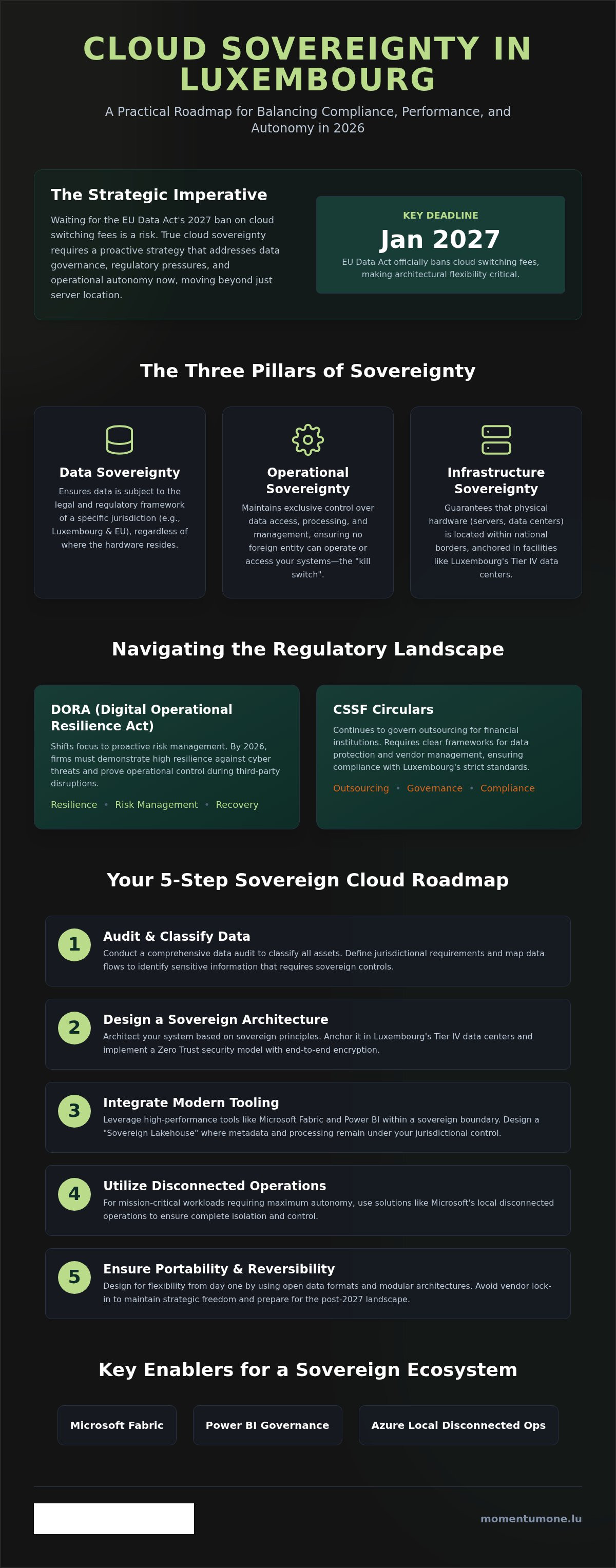
5 Steps to Implementing a Sovereign Cloud Strategy
Executing a strategy for cloud sovereignty luxembourg requires moving from abstract policy to concrete action. It's about creating a resilient foundation that supports growth while satisfying the strict expectations of the CSSF and DORA. This process isn't a one-time project but a structural shift in how your organization handles its most valuable asset: its data. We've identified five essential steps to ensure your migration is both compliant and high-performing.
- Step 1: Conduct a Comprehensive Data Audit and Classification. You can't protect what you haven't identified. Start by categorizing your data based on sensitivity and regulatory requirements.
- Step 2: Define Your Jurisdictional and Operational Requirements. Determine exactly which laws apply to your data and what level of operational control your team needs to maintain.
- Step 3: Select the Right Sovereign Infrastructure Partner. Evaluate local providers like DEEP or the Clarence project to find the physical and legal environment that matches your risk profile.
- Step 4: Design a Governed Data Architecture. Build a modern warehouse or lakehouse that incorporates the security guardrails discussed in previous sections.
- Step 5: Establish a Continuous Compliance and Monitoring Cycle. Implement automated tools to ensure your sovereign boundaries remain intact as your data ecosystem evolves.
Auditing Your Data: What Stays and What Moves?
Identifying 'Sensitive Workloads' is the first hurdle in any sovereign journey. These are the processes that require the maximum level of isolation, often necessitating disconnected sovereignty to prevent any potential extraterritorial access. Mapping your data flows allows you to identify where information might cross jurisdictional lines, exposing you to risks from foreign legal frameworks. Data classification is the prerequisite for all sovereign cloud deployments.
Selecting Partners: The Role of an Implementation Specialist
Choosing a cloud host is only half the battle; the implementation gap is where most sovereign projects stumble. You need a partner who does more than just provide a server. They must understand how to configure modern analytics tools within those strict boundaries. Look for implementation specialists who hold certified Microsoft Solution Partner status, as this ensures they have the technical depth to manage complex Fabric and Power BI environments.
A reliable strategist will help you bridge the gap between sovereign infrastructure and the high-value insights your business needs. If you're ready to define your governance framework, our team at Momentum One Power BI Consulting can provide the expertise needed to align your technical setup with Luxembourg's unique regulatory landscape.
Momentum One: Your Partner for Sovereign Data Excellence
Momentum One serves as a reliable strategist for organizations seeking to master cloud sovereignty luxembourg. With over 8 years of experience in the Grand Duchy, we've developed a deep understanding of the local regulatory pulse. We don't just provide technical fixes; we act as a proactive ally, helping you navigate the delicate balance between high-performance analytics and strict data governance. Our approach ensures that your move to the cloud isn't just a migration, but a strategic evolution that strengthens your digital autonomy.
We specialize in bridging the gap between sovereign infrastructure and advanced Microsoft tools. By focusing on the data governance layer, we ensure your corporate intelligence remains under your exclusive control. This dedication to client success means we stay with you throughout the journey, providing the steady hand needed to manage complex hybrid architectures. Our goal is to empower your business with the clarity and capability required to thrive in a regulated landscape. We simplify the complexity of Microsoft Fabric and Power BI, making these powerful tools accessible within restricted environments.
Maintaining long-term scalability without sacrificing compliance is a core pillar of our strategy. We build frameworks that grow with your business, ensuring that as your data volume increases, your sovereign boundaries remain intact. This methodical pace avoids high-pressure tactics in favor of a structured, transparent presentation of expertise. We position ourselves as a steady hand in a complex field, focusing on practical benefits like efficiency and accuracy. By aligning our goals with yours, we foster mutual progress and shared success in the Luxembourgish market.
Technical Implementation and Migration Services
Our team delivers high-value technical implementations through structured, outcome-focused projects. We provide expert Fabric Migration & Modernization support, helping you transition to a modern lakehouse design while maintaining jurisdictional integrity. We also focus on DAX optimization to keep your reporting responsive within sovereign environments. This methodical approach reduces project risk and ensures your architecture is built for long-term reliability.
Building Internal Expertise: Sovereign Data Training
A sovereign ecosystem requires a team that understands the reasoning behind security protocols. We address the human element through specialized Corporate Power BI Training designed for analysts in the Luxembourgish market. These workshops improve data literacy, reducing the risk of accidental compliance breaches. By empowering your staff with technical mastery and a governance-first mindset, we ensure your internal culture supports your broader sovereignty goals.
Mastering Your Sovereign Data Future
Achieving cloud sovereignty luxembourg is no longer a theoretical goal; it's a practical necessity for any organization operating within the Grand Duchy. By shifting your focus from physical server locations to robust data governance, you unlock the ability to innovate without compromising on security. You've seen how integrating Microsoft Fabric with local disconnected operations provides the resilience required by CSSF and DORA. Now, the challenge lies in flawless execution.
As a Certified Microsoft Solutions Partner with over 8 years of local enterprise experience, Momentum One acts as your steady hand in this complex landscape. We specialize in CSSF and DORA-compliant implementations, ensuring your transition is both smooth and legally sound. Modernize your data stack with our sovereign-aligned Microsoft Fabric services today to build an architecture that is as compliant as it is high-performing. Your journey toward digital autonomy starts with a single, well-governed step, and we're ready to help you lead with confidence.
Frequently Asked Questions
Infrastructure vs. Data Sovereignty: What Matters Most?
Grasp the difference between where data lives and who controls it to lead a modern IT department effectively. Jurisdictional sovereignty ensures that your hardware is subject to Luxembourgish and EU laws, protecting it from foreign subpoenas. However, Data Sovereignty focuses on the legal authority over the data itself, regardless of the underlying hardware. Cloud sovereignty is the ability to maintain total authority over data life cycles within a specific jurisdiction. Operational autonomy is the final piece of this puzzle. It's about ensuring your team retains exclusive access to business intelligence processing. By leveraging Power BI Consulting & Governance, you can build frameworks that enforce these boundaries. This ensures that even in a hybrid environment, your data remains under your thumb, meeting the strict standards required for modern digital excellence. Luxembourg's digital autonomy relies heavily on its dense network of Tier IV data centers. These facilities provide the highest level of fault tolerance, ensuring that mission-critical data remains available even during major infrastructure failures. When building a strategy for cloud sovereignty luxembourg, these physical locations serve as the primary anchor for jurisdictional control. They offer the baseline security needed to satisfy both local regulators and international partners. Securing this ecosystem requires more than just high-quality hardware. Technical guardrails like end-to-end encryption and a Zero Trust security model are mandatory. In a Zero Trust environment, no user or device is trusted by default, regardless of their location inside or outside the network. This approach ensures that data access is continuously verified, which is a key requirement for modern compliance under DORA and CSSF guidelines. Portability and reversibility are also critical factors in a 2026 strategy. The EU Data Act has set a clear path toward eliminating switching fees by January 2027, which encourages organizations to design for flexibility from the start. By choosing open data formats and modular architectures, you avoid the trap of vendor lock-in. This ensures you maintain the freedom to move workloads if your sovereign requirements or business needs change.
Auditing Your Data: What Stays and What Moves?
Identifying 'Sensitive Workloads' is the first hurdle in any sovereign journey. These are the processes that require the maximum level of isolation, often necessitating disconnected sovereignty to prevent any potential extraterritorial access. Mapping your data flows allows you to identify where information might cross jurisdictional lines, exposing you to risks from foreign legal frameworks. Data classification is the prerequisite for all sovereign cloud deployments.
What is the difference between a sovereign cloud and a regular public cloud?
A sovereign cloud provides legal and operational control within a specific jurisdiction, whereas a public cloud operates on a global scale with data often crossing borders. For cloud sovereignty luxembourg, this means ensuring your data is subject only to local and EU laws. Public clouds offer massive scalability, but sovereign clouds add essential layers of isolation and jurisdictional protection that satisfy strict national regulatory requirements.
Is Microsoft Fabric compliant with Luxembourg's CSSF regulations?
Yes, Microsoft Fabric can be configured to meet CSSF regulations through a combination of data residency settings and robust governance frameworks. While the platform is a SaaS offering, implementing it within a sovereign boundary involves using Private Links and strict access controls. We focus on building these compliant architectures, ensuring your analytics environment adheres to the specific circulars issued by Luxembourg's financial regulator.
How does the 'disconnected cloud' partnership with Clarence affect private businesses?
The partnership with Clarence enables private businesses to access disconnected cloud operations that were previously reserved for the public sector. This allows organizations to run mission-critical workloads on Azure Local without a constant connection to the public internet. It's a significant shift for firms with high-security needs, providing the benefits of cloud innovation while maintaining the ultimate "kill switch" over their data and operations.
Can I use Power BI if my data must remain in a sovereign Luxembourgish data center?
You can certainly use Power BI while keeping your raw data in a local, Tier IV data center. This is achieved through the On-Premises Data Gateway, which creates a secure bridge between your sovereign storage and the Power BI service. This hybrid model ensures your sensitive information never leaves Luxembourgish soil, while your teams still benefit from industry-leading visualization and reporting capabilities.
What are the primary benefits of NIS2 compliance for my data strategy?
NIS2 compliance strengthens your data strategy by enforcing higher standards for cyber hygiene and supply chain security. It reduces the risk of operational disruptions and ensures your organization is resilient against large-scale cyber threats. By aligning with these standards, you demonstrate a commitment to digital excellence that builds trust with partners and satisfies the rigorous oversight of European regulators.
How do I start a Microsoft Fabric migration in a highly regulated environment?
Start your migration by conducting a thorough data classification audit to identify which workloads require sovereign protection. Once you've mapped your data flows, you can design a landing zone that incorporates jurisdictional guardrails. Partnering with a specialist for cloud sovereignty luxembourg ensures your capacity planning and tenant administration are aligned with regulatory expectations from the very first day of the project.
What is the role of a Microsoft Solutions Partner in cloud sovereignty?
A Microsoft Solutions Partner acts as an expert facilitator, bridging the gap between complex sovereign infrastructure and your business goals. We don't just provide licenses; we design the governance frameworks and technical architectures needed for compliance. Our role is to simplify the migration process, ensuring your implementation of tools like Microsoft Fabric is secure, high-performing, and fully aligned with local laws.
How does cloud sovereignty prevent vendor lock-in?
Cloud sovereignty prevents vendor lock-in by mandating the use of open data formats and ensuring data portability. Regulations like the EU Data Act support this by removing technical and financial barriers to switching providers. By building a sovereign architecture, you maintain the freedom to move your workloads between different local or international providers without losing authority over your data life cycle or facing exorbitant fees.