Data Lakehouses vs Data Lakes: Choosing Your Architecture
Struggling with data lakehouses vs data lakes? Learn how to unify your data, reduce costs, and boost BI performance with a modern lakehouse architecture.
- Understand the evolution of data storage and why moving away from disconnected silos is essential for modern business intelligence.
- Compare data lakehouses vs data lakes to see how metadata layers provide the governance of a warehouse with the flexibility of a lake.
- Learn to evaluate your architectural needs based on data maturity, cost efficiency, and your team's specific performance requirements.
- Discover a clear migration roadmap for modernizing your stack, starting with a comprehensive audit of your existing data landscape.
- Explore how a lakehouse foundation supports Microsoft Fabric implementation to ensure your data is AI-ready and optimized for Power BI.
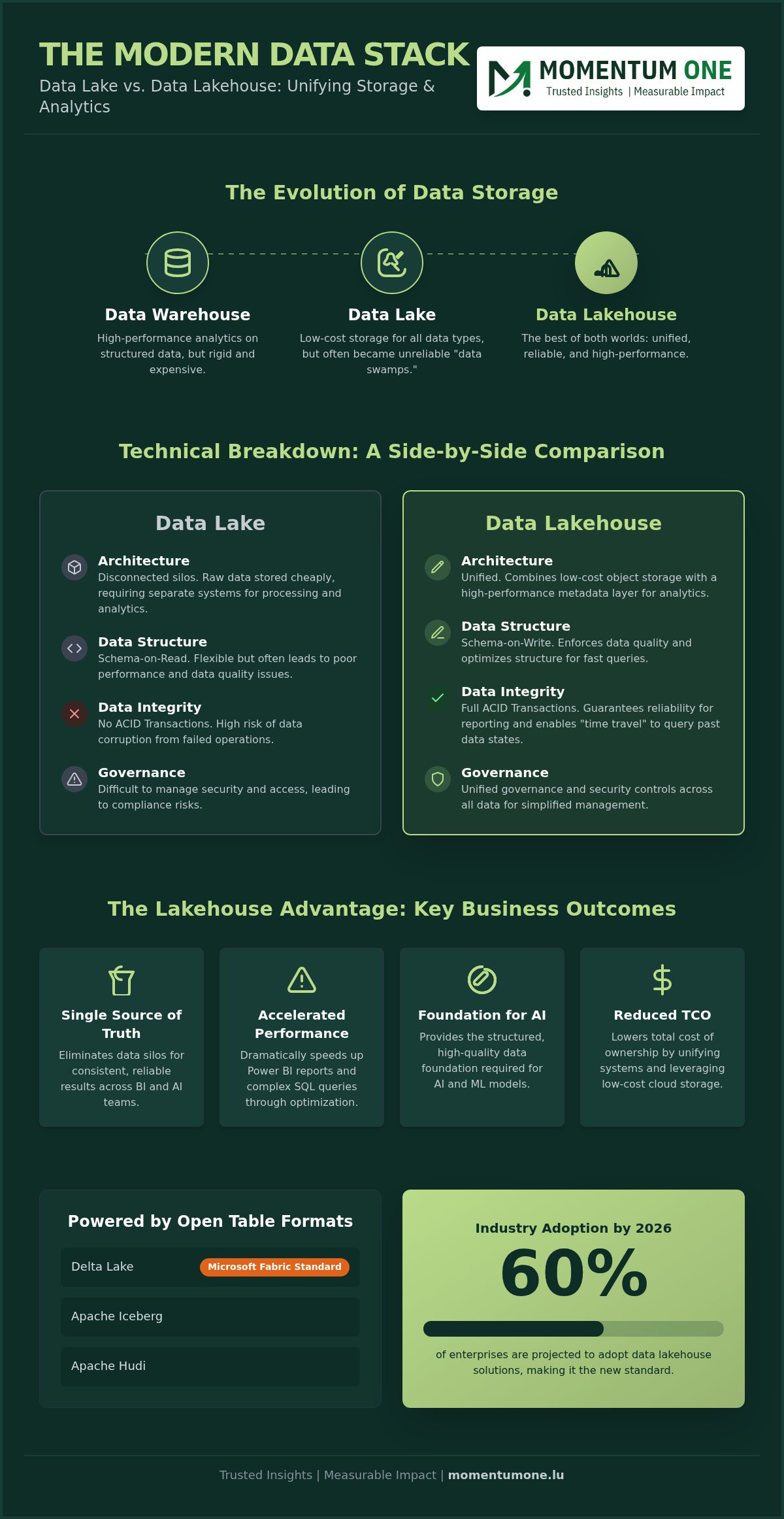
By 2026, 60% of enterprises are projected to adopt data lakehouse solutions according to recent industry forecasts. This rapid shift highlights a critical realization for modern organizations: the traditional divide between storage and analytics is no longer sustainable. When evaluating data lakehouses vs data lakes, the choice often comes down to whether you want to continue managing expensive, disconnected silos or move toward a unified environment. You've likely experienced the frustration of your BI team waiting for structured data while your Data Science team explores raw files in a completely different system.
Maintaining two separate architectures is both costly and inefficient, often leading to poor query performance and inconsistent results across the business. You deserve a streamlined architecture that provides a single source of truth for every department without the overhead of legacy systems. This article explores the technical differences, performance trade-offs, and strategic advantages of migrating to a lakehouse model. We'll show you how this transition reduces architectural complexity, accelerates Power BI report performance, and builds the essential foundation for AI-readiness in a modern data environment.
The Evolution of Data Storage: From Silos to Lakehouses
For decades, the Data Warehouse was the gold standard for corporate reporting. It provided high-performance analytics on structured data but lacked the flexibility to handle the modern influx of semi-structured and unstructured information. As data volumes exploded, these legacy systems became prohibitively expensive and created rigid silos that blocked innovation. This friction led organizations to explore the differences between data lakehouses vs data lakes to find a more scalable and cost-effective path forward.
The Data Lake emerged as the next step, promising a "capture everything, analyze later" philosophy by storing massive amounts of raw data at a low cost. However, without strict management or schema enforcement, these lakes quickly turned into "Data Swamps." Business users couldn't find what they needed, and data scientists spent the majority of their time cleaning messy files instead of building predictive models. This lack of structure meant that despite having more data than ever, organizations actually had less actionable insight.
The Limitations of Traditional Data Lakes
Traditional lakes lack ACID (Atomicity, Consistency, Isolation, Durability) transactions. This means if a write operation fails halfway through, your data remains in a corrupted, inconsistent state. Performance is another major barrier; running SQL queries directly on raw files is notoriously slow compared to optimized warehouse tables. Finally, governance often becomes a nightmare. Managing security at the individual file level across thousands of folders is nearly impossible to scale, leading to significant compliance risks. This friction makes the debate of data lakehouses vs data lakes a top priority for teams struggling with data reliability and speed.
The Lakehouse Value Proposition
The data lakehouse architecture bridges the gap by implementing a transactional metadata layer on top of low-cost cloud storage. It gives you the high-performance indexing and schema enforcement of a warehouse while keeping the flexibility of a lake. A Data Lakehouse is the architectural foundation for modern data engineering. By unifying these worlds, you create a single source of truth that serves both BI analysts and AI researchers. It's about moving from simply storing data to executing a clear data strategy. If you're looking to modernize, our Data Warehouse & Lakehouse Design services can help you build this foundation correctly from day one, ensuring your architecture is ready for the demands of 2026 and beyond.
Technical Breakdown: Data Lake vs. Data Lakehouse
The technical shift from a standard data lake to a lakehouse is driven by the metadata layer. This layer acts as a management interface that brings warehouse-like rigor to low-cost storage. When comparing data lakehouses vs data lakes, the most immediate difference is how they handle data structure. Traditional lakes rely on "schema-on-read," which offers flexibility but often leads to performance bottlenecks and data quality issues. In contrast, lakehouses utilize a "schema-on-write" approach similar to a warehouse, ensuring that data is validated and optimized before it's even stored.
This optimization is made possible by open table formats that have seen significant advancement as of mid-2026. Delta Lake 4.0, Apache Iceberg 1.10/1.11, and Apache Hudi 1.1 are the primary drivers of this evolution. These formats enable performance features like indexing, caching, and data skipping. By keeping track of statistics about the data in the metadata layer, the engine can skip over irrelevant files during a query. This significantly reduces I/O and speeds up Power BI report performance. In the Microsoft Fabric ecosystem, Delta Lake serves as the standard, providing the foundation for a unified, high-performance environment.
ACID Transactions and Data Integrity
ACID transactions are the backbone of data integrity in a lakehouse. They ensure that your corporate financial reporting remains accurate even during complex, concurrent operations. If a data pipeline fails halfway through an update, the system automatically rolls back to the last known good state, preventing the corruption that often plagues traditional lakes. This transactional layer also enables "time travel." You can query historical versions of your data to perform audits or recover from accidental deletions, providing a level of reliability that was previously exclusive to expensive warehouses.
Unified Governance and Security
Governance in a traditional lake is often a fragmented nightmare, with security managed at the individual file or folder level. A lakehouse simplifies this by centralizing security models. You can implement row-level and column-level security directly on the tables, ensuring that sensitive information is only accessible to authorized users. This unified approach is essential for maintaining compliance in a scalable way. Our team provides expert Power BI Consulting & Governance to help you design a security framework that protects your assets while empowering your analysts. If your current lake feels like a bottleneck, our Fabric Migration & Modernization services can help you transition to a more secure, high-performance architecture.
Choosing Your Architecture: When to Use Which?
Deciding on data lakehouses vs data lakes requires a honest look at your current data maturity and long-term strategy. If your team is primarily composed of SQL experts, a lakehouse offers a familiar interface with the scalability of a lake. Conversely, if you rely heavily on Python or Spark for deep data science on massive datasets, a traditional lake might seem sufficient; however, it often lacks the governance required for corporate reporting. Don't just look at storage. While data lakes offer the lowest storage costs, they often lead to high compute expenses because engines have to scan raw files repeatedly. A lakehouse improves compute efficiency through metadata-driven data skipping, which typically leads to lower total cost of ownership (TCO) over time.
Data Lakehouse vs Warehouse Design: A Comparison
The lakehouse is rapidly becoming the default for new cloud implementations because it eliminates the need to maintain two separate systems. It offers a balanced approach that serves both BI and AI needs without the architectural overhead of legacy silos.
| Criteria | Data Lake | Data Warehouse | Data Lakehouse |
|---|---|---|---|
| Cost | Low (Storage focused) | High (Compute & Storage) | Optimal (Balanced) |
| Performance | Variable (Slow for SQL) | High (Optimized) | High (Metadata-driven) |
| Flexibility | High (All data types) | Low (Structured only) | High (All data types) |
| Governance | Basic (File level) | Advanced (Table level) | Advanced (Unified) |
| AI-Readiness | High | Limited | Native |
For a deeper dive into these nuances, refer to our detailed guide on Data Lakehouse vs Warehouse Design.
Identifying the Right Use Cases
A simple Data Lake remains a valid choice for archival storage or as a landing zone for raw telemetry data where immediate query performance isn't a priority. However, modern BI and real-time analytics demand the structured performance of a Lakehouse. When evaluating data lakehouses vs data lakes for your reporting layer, consider the end-user experience. This architecture directly impacts Power BI report speed by providing a clean, modeled layer that reduces the heavy lifting required during data refresh cycles. It ensures your analysts spend more time discovering insights and less time troubleshooting data quality issues.
The Migration Roadmap: Moving to a Lakehouse Architecture
Moving from a legacy setup to a modern architecture requires a structured approach. When organizations weigh data lakehouses vs data lakes, the implementation phase is where the most significant risks and rewards lie. A successful migration isn't just about moving files; it's about realigning your data strategy to support both high-speed reporting and advanced analytics. We recommend following a five-step roadmap to ensure your transition is seamless and provides immediate value to your stakeholders.
- Audit your existing data landscape: Identify where data silos are currently slowing down your BI and Data Science teams.
- Choose your platform: Select an environment like Microsoft Fabric that integrates storage and compute into a single, cohesive experience.
- Define your metadata and governance strategy: Establish clear rules for how data is tagged, secured, and managed at the table level.
- Implement automated data pipelines: Move data from source systems to your lakehouse using tools that minimize manual intervention.
- Validate and optimize: Ensure data quality remains high and use indexing techniques to maximize query performance.
Modernising Legacy Data Warehouses
Many businesses fall into the trap of a "lift and shift" approach. Simply moving old, poorly modeled tables to a new environment often replicates existing inefficiencies. Re-architecting your data models during migration allows you to take full advantage of the performance benefits inherent in the lakehouse model. You can handle historical data by moving it into the delta format within the lakehouse storage layer. This ensures your history remains accessible for long-term trend analysis without the high costs of legacy warehouse storage. If you're looking for technical support during this shift, our Data Architecture Modernization services provide the expertise needed to build a future-proof foundation.
Automating the Flow with Microsoft Fabric
Microsoft Fabric simplifies the migration journey through OneLake, which acts as a centralized "OneDrive for data." This unified storage layer eliminates the need to manage multiple storage accounts or complex permissions across different services. Implementing automated data pipelines in Fabric reduces manual engineering overhead by streamlining the ingestion and transformation process through a low-code, high-performance interface. You can also leverage "Shortcut" features to link to external data sources without actually duplicating the files. This avoids data redundancy and ensures your teams are always working with a single source of truth. If you're ready to modernize your stack, our Fabric Migration & Modernization experts can help you accelerate the process and reduce architectural complexity.
Momentum One: Your Partner in Lakehouse Modernisation
Choosing between data lakehouses vs data lakes is a significant strategic move, but the real value lies in how you execute that choice. Momentum One acts as your steady hand through this transition. We bridge the gap between raw data storage and meaningful business impact by ensuring your architecture is not just functional but optimized for growth. Our team understands that a migration is more than a technical task; it's a step toward becoming a truly data-driven organization. We simplify the complexity, allowing you to focus on strategy while we handle the underlying structural shifts.
We offer specialized Microsoft Fabric Migration Services that align with the latest industry standards. Beyond the initial setup, we provide tailored training solutions to improve internal data literacy. This ensures your team can confidently navigate the new environment. Our managed services offer ongoing performance tuning and governance, so your system remains efficient long after the migration is complete. We stay invested in your progress, providing the proactive support needed to maintain a high-performance analytics stack.
Why a Microsoft Solutions Partner Matters
As a certified Microsoft Solutions Partner, we bring over 8 years of expertise in data modeling and warehouse design to every project. This partnership gives us deep access to the evolving Fabric ecosystem, allowing us to implement features that others might overlook. We specialize in Data Warehouse & Lakehouse Design that prioritizes scalability and reliability. When you work with us, you aren't just getting a service provider; you're gaining a dedicated ally focused on your long-term success. We ensure your architecture is ready for the demands of 2026 and whatever comes next.
Next Steps for Your Data Strategy
The best way to start is with a clear understanding of your current state. We offer comprehensive architectural reviews to identify the specific friction points in your current stack. For many organizations, the comparison of data lakehouses vs data lakes is best understood through a pilot project. This allows you to see the performance gains and cost efficiencies of Microsoft Fabric in a controlled, low-risk environment. It's a structured way to prove value before committing to a full-scale rollout. If you're ready to modernize your data landscape and unlock faster reporting, consult with our experts today to begin your journey.
Build Your Future on a Unified Data Foundation
The choice between data lakehouses vs data lakes represents a fundamental shift in how your business handles its most valuable asset. Adopting a lakehouse architecture isn't just a technical upgrade; it's a strategic commitment to clarity and speed. By combining the governance of a warehouse with the flexibility of a lake, you remove the silos that prevent your teams from working in harmony. This unified approach ensures your data remains clean, reliable, and ready for the AI-driven demands of 2026.
Momentum One stands ready to facilitate this journey as your dedicated ally. As a Certified Microsoft Solutions Partner, we specialize in Fabric Migration and Modernization. We provide the expert DAX and data modeling support required to optimize your environment. Our team builds scalable systems that simplify complexity. You can modernise your data architecture with Momentum One to unlock the full potential of your analytics stack. Your path to a more efficient, high-performance future starts today.
Frequently Asked Questions
What is the main difference between a data lake and a data lakehouse?
A data lake is a repository for raw data in its native format, whereas a data lakehouse adds a transactional metadata layer to provide warehouse-like features. When comparing data lakehouses vs data lakes, the primary distinction is the ability to support ACID transactions and schema enforcement on low-cost cloud storage. This allows your team to perform high-performance analytics and machine learning on a single, unified platform without moving data between disparate systems.
Can a data lakehouse completely replace a traditional data warehouse?
Yes, for most modern organizations, a data lakehouse can serve as a complete replacement for a traditional warehouse. It provides the structured performance and governance required for business intelligence while maintaining the flexibility to store unstructured data for AI projects. By unifying these capabilities, you eliminate the need to maintain two separate architectures. This reduction in complexity lowers your operational costs and ensures a single source of truth across all your reporting tools.
Is a data lakehouse more expensive than a data lake?
While the initial setup of a lakehouse involves a metadata layer, it's often more cost-effective than a traditional lake in the long run. Standard lakes frequently incur high compute costs because query engines must scan massive amounts of raw data. A lakehouse uses indexing and data skipping to improve compute efficiency. This optimization reduces the total cost of ownership by preventing the "data swamp" effect that leads to expensive manual cleaning and slow query times.
How does Microsoft Fabric implement the lakehouse concept?
Microsoft Fabric implements the lakehouse through its OneLake storage layer and the use of the Delta Lake open table format as a standard. It allows you to create a Lakehouse item that combines the ease of use of a folder-based lake with the power of a SQL-based warehouse. This integration ensures that data is accessible to Power BI, Data Factory, and Spark engines simultaneously without the need for data duplication or complex ETL pipelines.
What are the most common challenges when migrating to a lakehouse?
The most common challenges include managing the cultural shift from rigid warehouses and ensuring proper data modeling during the transition. Many teams struggle with "lift and shift" mentalities that fail to leverage the performance benefits of open table formats. You'll also need to establish clear governance and security protocols early on. Working with a partner to design your metadata strategy helps avoid these pitfalls and ensures your new architecture scales effectively for future needs.
Do I need a data lakehouse for Power BI reporting?
You don't strictly need one, but a lakehouse significantly improves Power BI report performance and reliability. It provides a clean, governed layer that optimizes data refresh cycles and enables faster DAX calculations. Without a lakehouse, your reports might rely on messy raw data from a lake, leading to slow load times and inconsistent results. Implementing this architecture ensures your business users always have access to accurate, high-speed insights for their decision-making process.
What is the role of Delta Lake in a lakehouse architecture?
Delta Lake is the open-source storage layer that brings ACID transactions and time travel capabilities to your data lakehouse. It uses versioned Parquet files to ensure data integrity during concurrent read and write operations. By tracking metadata about your tables, Delta Lake enables the engine to skip irrelevant data, which is essential for high-performance analytics. It serves as the bridge that allows raw storage to behave like a sophisticated relational database.
How does a lakehouse improve data governance for corporate users?
A lakehouse improves governance by centralizing security and access controls at the table and column level. In traditional data lakehouses vs data lakes comparisons, the lakehouse wins on governance because it moves beyond simple file-level permissions. You can implement fine-grained security policies that follow the data across different analytical engines. This ensures that sensitive information remains protected while providing your analysts with the transparency and auditability required for corporate compliance standards.