Effective Corporate Training: A Guide for Data-Driven Teams
Bridge the data skills gap with effective corporate training. Learn to master Microsoft Fabric, optimize DAX, and build a self-sufficient, data-driven team.
- Understand why data literacy is the foundational skill for the AI era and how to move beyond simple reporting toward robust technical governance.
- Master the essential pillars of Microsoft Fabric, including DAX optimization and Lakehouse design, to create high-performance data environments.
- Learn why outcome-led corporate training provides superior ROI compared to standard certifications by addressing your specific technical bottlenecks.
- Build a sustainable upskilling roadmap by defining clear KPIs for success, such as increased report accuracy and faster user adoption.
- Discover how a consultant-led approach bridges the gap between complex technical architecture and everyday business decision-making.
Nearly 60% of enterprise leaders report a significant data or AI skills gap within their organizations. You've likely felt this friction firsthand while watching your team struggle with the sheer complexity of Microsoft Fabric or seeing reports lose credibility due to inaccurate DAX logic. It's frustrating when you're forced to rely on expensive external consultants for basic data tasks that your team should be able to handle in-house. Effective corporate training isn't just about checking a box; it's about empowering your people to work with confidence and precision.
We understand that the goal isn't just to learn a tool, but to drive real business outcomes. This guide will show you how to transform your workforce into a data-driven powerhouse through strategic technical workshops and literacy programs. We'll explore how to build a self-sufficient team, optimize your reporting performance, and cultivate a culture where data informs every major decision. By the end, you'll have a clear roadmap to reduce long-term consulting costs and turn your data architecture into a true competitive advantage.
The State of Corporate Training: Closing the Data Literacy Gap
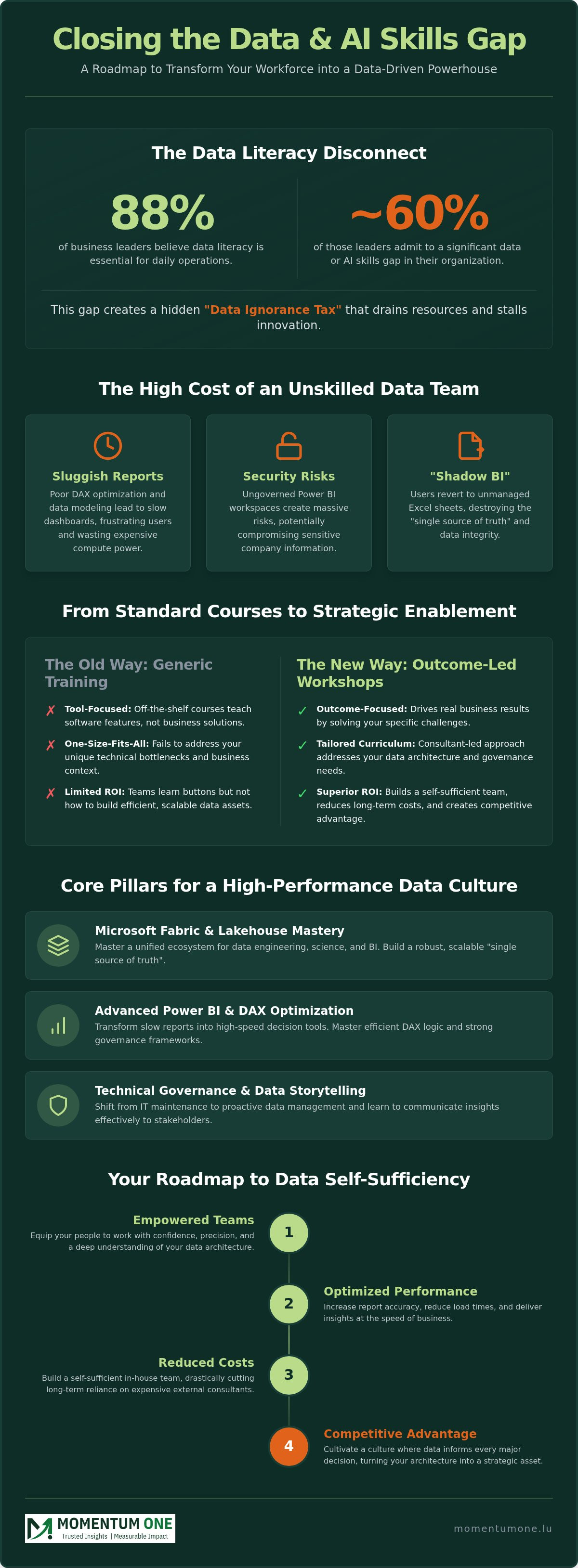
The modern enterprise is at a crossroads. While 88% of business leaders believe data literacy is essential for daily operations, nearly 60% admit to a significant skills gap in their organization. This disconnect creates a "data ignorance" tax that drains resources and stalls innovation. Effective corporate training has evolved beyond simple software tutorials. It now focuses on bridging the gap between technical architecture and business decision-making. We're seeing a fundamental shift where traditional IT skills are taking a backseat to data storytelling and technical governance. Without this transition, your investment in high-end tools will never reach its full potential.
Defining Data Literacy in a Corporate Context
Data literacy isn't a binary skill; it's a spectrum. It ranges from data consumers who need to interpret a dashboard to power users and architects who design the underlying Lakehouse. In 2026, this definition has expanded to include data lineage and security. Understanding where data comes from and how it's protected is no longer just a job for the IT department. A robust program for corporate training and development must prioritize these elements to ensure teams don't just see numbers, but understand the narrative behind them. This requires a level of empathy where technical teams build with the end-user's needs in mind, and stakeholders learn to ask the right questions of their data.
The Hidden Costs of Unskilled Data Teams
When teams lack proper guidance, the financial impact is often hidden but severe. Poor DAX optimization leads to sluggish reports that frustrate users and waste expensive compute power. Even worse, ungoverned Power BI workspaces create massive security risks that can compromise sensitive company information. When users find corporate tools too complex, they often revert to "Shadow BI," pulling data into unmanaged Excel sheets. This fragmentation destroys the "single source of truth" that modern platforms like Microsoft Fabric are designed to provide. Standardized, off-the-shelf courses often fail because they don't address these real-world bottlenecks. Our corporate data fabric training and corporate power BI training are designed to solve these specific pain points by focusing on your unique environment rather than a generic curriculum.
The transition from simple IT maintenance to proactive technical governance is the "final mile" of a successful digital transformation. Traditional training models often treat software as a static tool. However, in the age of AI, data is a living asset. Teams must learn to manage data pipelines with the same rigor they apply to financial audits. This shift ensures that every insight is accurate, every report is high-performing, and every decision is backed by verified logic. By investing in tailored workshops, you're not just buying a course; you're building a sustainable foundation for future growth.
Technical Specialization: Power BI and Microsoft Fabric Mastery
Microsoft Fabric has rapidly become the standard for organizations seeking a unified data ecosystem. It integrates data engineering, data science, and business intelligence into a single, cohesive platform. However, the complexity of this "all-in-one" solution can overwhelm teams that are still operating on legacy mindsets. Specialized corporate training acts as the bridge between having the technology and actually deriving value from it. By focusing on the specific mechanics of the Fabric environment, you ensure that your Fabric Migration & Modernization efforts are supported by a capable, confident workforce. This isn't just about learning new buttons; it's about mastering a new way of architecting data.
Advanced Power BI Training for Teams
High-performance reporting is built on a foundation of DAX optimization and clean data modeling. Many organizations suffer from "slow report fatigue," where users abandon dashboards because they take too long to load. This is usually a sign of inefficient DAX logic or a poorly structured star schema. Training your team to handle complex, high-volume datasets ensures that insights are delivered at the speed of business. Beyond the technical code, education is the most effective way to implement a Power BI governance framework. When your power users understand the relationship between data modeling and report performance, they naturally build more scalable solutions. This proactive approach reduces the need for constant troubleshooting and manual oversight.
Fabric Enablement: From Data Lakes to Business Insights
Transitioning to a Lakehouse-centric architecture requires a new set of skills for data developers. They must learn to manage OneLake, build resilient data pipelines, and utilize Spark for large-scale processing. Our Corporate Data Fabric Training focuses on these high-value technical implementations. We empower developers to automate data flows while ensuring business users can access real-time analytics without compromising security. A critical part of this process is measuring training effectiveness to confirm that these new skills are being applied to your specific projects. This ensures that the upskilling translates directly into improved system performance and reduced technical debt.
The goal of technical specialization is to create a team that can solve its own problems. When your internal developers can optimize a Lakehouse or fix a broken pipeline without calling an external consultant, you've achieved true data independence. If you're ready to move beyond the basics, a tailored technical workshop can provide the specific guidance your team needs to master the Microsoft stack.
Certification vs. Capability: Choosing Your Training Model
Many leaders fall into the "Certification Trap." They assume a digital badge automatically guarantees a high-performing data environment. While certifications prove a baseline of knowledge, they don't always translate into a more accurate report or a faster data pipeline. Effective corporate training should focus on functional capability rather than just exam preparation. As a Microsoft Solutions Partner, we've observed that the most successful teams are those that prioritize solving real-world technical bottlenecks over simply collecting certificates. You need a team that can navigate the nuances of your specific architecture, not just one that can pass a standardized test.
Choosing the right delivery format is a critical part of this strategy. On-site workshops offer high-intensity, face-to-face collaboration that is perfect for tackling complex architectural shifts. Virtual sessions provide flexibility for distributed teams without sacrificing interactive learning. Some organizations even opt for managed upskilling, where training is woven into the daily workflow. The goal is to move from passive consumption of information to active implementation. When your team learns by doing, they retain more and deliver results faster.
When to Prioritize Official Certifications
Certifications like the PL-300 or DP-600 are valuable for setting a standard baseline across your organization. They are particularly useful for junior staff who need a structured introduction to the Microsoft ecosystem. In some industries, these badges are even a regulatory requirement to prove technical competency. However, standardized testing has its limits. It often ignores the unique data security needs or the specific legacy systems your company might be integrating. Use certifications as a foundation, but don't let them be the ceiling of your team's development.
The Power of Tailored Technical Workshops
Tailored workshops are where real transformation happens. By using your own company's data and environment, the training becomes immediately relevant. Instead of generic exercises, your team works on actual pain points, such as DAX optimization or Lakehouse design. This collaborative approach helps build an internal "Center of Excellence" where knowledge is shared and standardized. This model of corporate training ensures your team is ready for the "final mile" of your digital transformation.
- Solve specific architectural bottlenecks during the actual session.
- Establish clear internal governance standards that everyone understands.
- Improve user adoption through hands-on problem-solving with familiar datasets.
- Reduce long-term reliance on external support by building deep internal expertise.
This approach transforms training from a cost center into a strategic investment. When your developers and analysts can optimize their own models and secure their own workspaces, you've achieved true data independence. It's about building a team that doesn't just know the tools but knows how to use them to drive your specific business goals forward.
Building a Sustainable Upskilling Roadmap
Developing a sustainable upskilling roadmap is the only way to ensure your corporate training investment yields long-term results. It starts with a hard look at your existing technical debt and the specific literacy gaps within your departments. Without a structured plan, even the most advanced tools will fail to deliver value. We recommend a methodical four-step approach that moves your organization from reactive troubleshooting to proactive data mastery. By implementing Managed Power BI services, you can ensure this growth remains continuous rather than a one-off event.
Assessment and Persona Mapping
Identify your "Data Champions" early. These are the individuals who naturally gravitate toward analytics and can serve as internal mentors for their peers. It's also vital to separate the training needs of different personas. C-suite consumers need high-level insights and the ability to interpret trends, while technical developers require deep-dive architectural skills. Conducting a Power BI Best Practices Audit is a practical first step to uncover hidden training gaps. This audit reveals where reports are failing and where your team needs the most supportive guidance to reach peak performance.
Measuring Training ROI
Tracking the success of your corporate training requires more than just attendance sheets. You should monitor specific KPIs that reflect real business impact. Track the reduction in internal support tickets and the total hours spent on manual troubleshooting. A successful program also leads to a measurable increase in self-service BI report creation, which frees up your core data team for high-value strategic tasks. You'll see these efficiencies reflected in your Data Warehouse & Lakehouse Design projects as your team builds more resilient, optimized structures from the start. Companies with comprehensive programs often report significantly higher revenue per employee because their teams make faster, more accurate decisions.
This roadmap isn't just about technical proficiency; it's about building a culture where data is a shared language. When every department understands how to access and interpret their own metrics, the entire organization gains momentum. You'll spend less time debating the accuracy of a report and more time acting on the insights it provides. Start building your team's future today by exploring our tailored technical workshops.
Momentum One: Your Partner in Technical Data Enablement
Momentum One isn't a traditional training center. We are active consultants who live in the trenches of data architecture every day. This means our corporate training isn't based on a static manual, but on the real-world challenges we solve for our clients daily. As a certified Microsoft Solutions Partner, we combine local expertise with global implementation standards to ensure your team is prepared for the complexities of modern data stacks. We don't just teach the tools; we help you master the environment you've already built. Our goal is to simplify the complexity of the Microsoft ecosystem so your team can focus on driving business value.
Our Training Philosophy: Authority through Experience
We believe that the best teachers are those who actually do the work. Our instructors spend 80% of their time on high-value technical implementations, such as Fabric migrations and DAX optimizations. They spend the remaining 20% passing that hard-earned knowledge on to your team. This ensures our Corporate Power BI Training remains grounded in practical, current best practices rather than theoretical concepts. We focus on training that sticks by addressing the specific bottlenecks your developers face in their current projects. This proactive support model allows your internal data teams to grow steadily, moving away from a reliance on external help for basic daily tasks.
Next Steps: Launching Your Data Literacy Initiative
The journey toward a data-driven culture doesn't end when the workshop concludes. Many of our partners choose to transition from initial upskilling into long-term Managed BI Services. This provides a safety net of expert governance and ongoing optimization as your data volume grows and your requirements evolve. Whether you are navigating a complex Fabric migration or refining your Power BI environment, we stay by your side as a dedicated ally. This steady hand ensures that your architecture remains high-performing and your reports stay accurate over the long term.
Launching a data literacy initiative starts with a clear understanding of your current technical landscape. We begin every partnership with a discovery session to map your technical requirements and identify specific skill gaps across your departments. From there, we often develop a pilot workshop focused on your most critical ongoing data project. This ensures immediate ROI and builds the internal momentum needed for wider adoption across the organization. It's time to stop fighting your data and start letting it work for you. Take the first step toward a more capable, self-sufficient team today.
Empower your team with professional corporate training.
Your Roadmap to Data Independence
Transforming your workforce into a data-driven powerhouse requires more than just new software; it demands a shift from passive learning to active, functional capability. We've discussed how bridging the data literacy gap reduces your reliance on external consultants and turns your data architecture into a true competitive advantage. By focusing on outcome-led corporate training, you ensure your team can navigate the complexities of Microsoft Fabric and Power BI with precision and confidence.
As a certified Microsoft Solutions Partner specializing in DAX optimization and Fabric migration, Momentum One acts as your supportive guide throughout this journey. We provide workshops tailored to your actual company data, ensuring that every session solves a real-world bottleneck rather than just checking a box. This methodical approach builds a sustainable culture where data informs every major decision and drives measurable growth.
Are you ready to turn your technical debt into business momentum? Book a Discovery Session for Your Corporate Training Roadmap. We look forward to partnering with you to unlock your team's full potential.
Frequently Asked Questions
What is the difference between data literacy and technical tool training?
Data literacy focuses on the ability to read, interpret, and communicate data insights, while technical tool training teaches the specific mechanics of software like Power BI. A team might know how to click buttons but still fail to ask the right questions of the data. Literacy ensures that every department can interpret reports accurately to drive business value, while tool training provides the "how-to" for building those reports.
How do I know if my team needs Power BI training or a full architectural review?
If your reports are consistently slow or data is inaccurate despite your team's best efforts, you likely need an architectural review. However, if your team struggles to build new dashboards or isn't using advanced features, corporate training is the better solution. We often perform a quick audit during our discovery sessions to help you decide which path offers the best ROI for your current situation.
Can corporate training help reduce our Power BI Premium licensing costs?
Better DAX optimization and efficient data modeling directly reduce the compute power required to run your reports. When your team learns how to build high-performance models, they consume fewer resources within your Power BI Premium capacity. This efficiency can delay the need for expensive tier upgrades or even allow for a reduction in total capacity spend by streamlining how data is processed.
Is Microsoft Fabric training necessary if we already know Power BI?
Microsoft Fabric is a significant expansion that introduces OneLake, Lakehouse design, and real-time analytics. While Power BI remains the visualization layer, Fabric requires a deeper understanding of unified data engineering and end-to-end governance. Transitioning to this ecosystem without specialized training often leads to poorly structured data lakes that are difficult to manage and optimize over time.
How long does it typically take to see a measurable ROI from data training?
Technical ROI is often visible immediately after a workshop, particularly when teams apply new DAX optimization techniques to existing reports. Broader business outcomes, such as improved decision-making and increased self-service adoption, typically manifest within three to six months. Success is best measured by tracking the reduction in support tickets and the increased speed of report delivery across the organization.
Does Momentum One provide tailored workshops using our own company data?
Yes, we prioritize using your own datasets and environment to ensure the training is immediately applicable. This boutique approach allows us to solve real-world technical bottlenecks during the workshop itself. It's far more effective than using generic samples because your team learns how to handle the specific nuances and complexities of your own company's data architecture.
What is the role of a Microsoft Solutions Partner in corporate upskilling?
A Microsoft Solutions Partner provides access to verified technical expertise and the latest ecosystem updates. Our role in corporate training is to act as a supportive strategist, moving beyond generic slide decks to provide consultant-led instruction. We bring years of implementation experience to the classroom, helping you avoid common pitfalls in Power BI and Fabric architecture while ensuring your team follows global standards.
How do we handle training for teams with widely varying technical backgrounds?
We address varying skill levels through persona mapping and tiered learning paths. By separating data consumers from technical developers, we ensure that every participant receives content relevant to their daily role. This structured approach prevents senior architects from becoming bored while ensuring business users aren't overwhelmed by deep-dive technical logic they don't need for their specific jobs.