From Microsoft Fabric to AI Agents: A Strategic Guide
Move from Fabric to AI Agents with our strategic guide. Learn to build reliable, compliant AI on your Microsoft Fabric data to automate insights and reduce r...
- Understand why Microsoft Fabric’s OneLake provides the essential "single source of truth" required to build reliable, high-performance AI agents.
- Learn the strategic differences between standard Microsoft 365 Copilots and custom Fabric Data Agents to select the right tool for your specific business goals.
- Discover how expert data modeling and DAX optimization act as the steering wheel for your AI, preventing hallucinations and ensuring conversational accuracy.
- Follow a structured 4-step roadmap to move From Fabric to AI Agents while maintaining full compliance with the latest EU AI Act transparency obligations.
- Explore how managed services and professional governance frameworks keep your AI fleet accurate, secure, and ready to scale within the Luxembourg market.
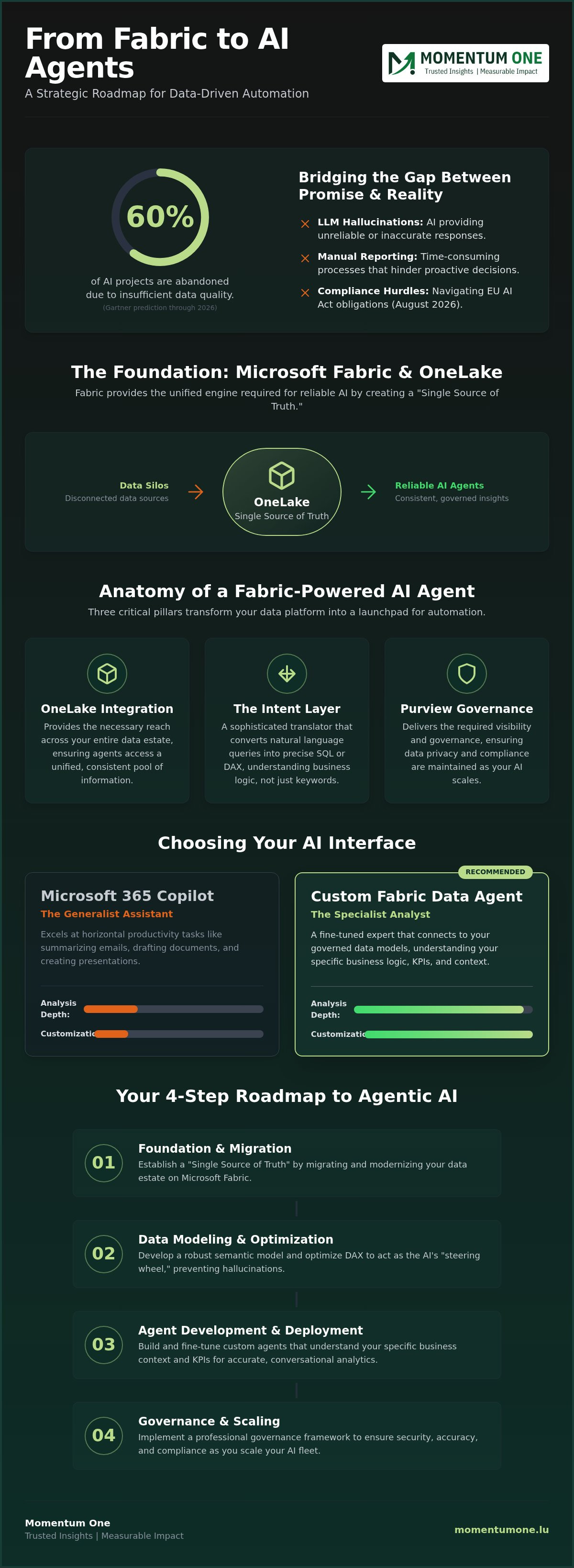
Gartner predicts that through 2026, 60% of AI projects will be abandoned due to insufficient data quality. It's a sobering reality for leaders who want to move From Fabric to AI Agents but struggle with the complexity of integrating these tools into existing Power BI models. You've likely felt that gap between the promise of "intelligent insights" and the reality of manual reporting and concerns over LLM hallucinations. It's a common frustration, especially as the August 2026 transparency obligations of the EU AI Act add new layers of governance to your data strategy in Luxembourg.
This guide provides the clarity you need to bridge that gap with confidence. We'll show you how to transform your Microsoft Fabric data foundation into a fleet of intelligent, governed agents that turn conversational queries into business action. You'll discover a clear roadmap from your data lake to agentic AI, learning how to reduce manual reporting time while maintaining a steady hand over data security. We'll explore how a well-structured semantic model acts as the steering wheel for your AI engine, ensuring your journey toward automation is both profitable and compliant.
The Evolution of Intelligence: Why Fabric is the Engine for AI Agents
The transition From Fabric to AI Agents represents a fundamental shift in how businesses interact with their data. For years, organizations relied on passive dashboards that required manual interpretation and constant monitoring. Today, we're seeing the rise of intelligent agents that don't just display numbers but understand and act upon them. Microsoft Fabric serves as the essential engine for this evolution, providing the unified infrastructure that turns static information into a conversational analytics layer. This shift From Fabric to AI Agents isn't just a technical upgrade; it's a strategic move toward proactive decision-making.
Before Fabric, AI initiatives often stalled because data was trapped in disconnected silos. OneLake solves this by creating a "Single Source of Truth." When your data lives in a unified environment, AI agents can access a consistent, governed pool of information. This eliminates the conflicting "versions of the truth" that lead to unreliable AI responses and costly hallucinations. It's no longer just about storage; it's about creating a cohesive data environment where AI can thrive without the friction of complex, manual integrations.
From Raw Data to Actionable Insights
The journey begins within the Lakehouse. By centralizing your assets, you provide the high-quality fuel these agents require. Microsoft Fabric's unified metadata allows generative AI to understand the context of your business, not just the raw numbers. This context is what makes an agent "smart." Real-time data availability ensures that when a user asks a question, the agent responds based on the latest transactions, not last week's batch upload. For many organizations, the first step is a strategic Fabric Migration & Modernization to ensure their foundation is ready for this level of responsiveness.
The Core Components of a Fabric-Powered Agent
Building an effective agent requires three critical pillars. First, OneLake integration provides the necessary reach across your entire data estate. Second, the "Intent Layer" acts as a sophisticated translator. It takes natural language queries from your team and converts them into precise SQL or DAX queries. This layer ensures that the agent understands business logic, not just keywords, which is vital for Natural Language to DAX (NL2DAX) performance.
Finally, integration with Microsoft Purview provides the visibility and governance required in the modern regulatory environment. In Luxembourg, where data privacy and compliance are paramount, knowing exactly how your AI agents use sensitive information is non-negotiable. This combination of unified access, logical translation, and strict governance transforms Microsoft Fabric from a simple data platform into a powerful launchpad for agentic workflows.
Data Agents vs. Copilots: Choosing Your AI Interface
Deciding how your team interacts with intelligence is a pivotal step in your modernization journey. While many organizations start with standard assistants, the strategic move From Fabric to AI Agents allows for a much more tailored approach. It's the difference between a general office assistant and a dedicated data scientist who knows your specific business logic, KPIs, and historical context inside and out. Choosing the right interface depends on whether you need a broad productivity boost or a deep, specialized analytical partner.
Copilot: The Generalist Assistant
Microsoft 365 Copilot excels at horizontal productivity. It's the perfect tool for summarizing a long thread in Teams, drafting a project plan in Word, or cleaning up a presentation. However, it often hits a ceiling when asked to perform deep, domain-specific data analysis. Because it's designed for a wide range of tasks, its customization options are standardized. It relies on per-user licensing, which typically costs about €28 per user per month. For general tasks, it's an excellent entry point, but it lacks the specialized "brain" required for complex conversational analytics.
Custom Data Agents: The Specialist Analyst
This is where custom agents prove their value. Unlike general assistants, these are fine-tuned with your organization’s specific examples and guidance. They connect directly to your governed Semantic Models to ensure 100% accuracy in every response. If you need an agent to monitor inventory levels in OneLake and automatically trigger a purchase order when stock is low, a custom agent is the only choice. They don't just "chat"; they understand the underlying DAX measures that define your success.
Cost structures also differ significantly between these two paths. While Copilot follows a per-user model, Fabric Data Agents leverage your existing F-SKU capacity. As of July 2026, pay-as-you-go pricing for an F2 SKU starts at approximately €242 per month. For larger operations, an F64 SKU costs about €7,750 per month, but a one-year reservation can slash these rates by roughly 41%. This capacity-based model often proves more cost-effective for Luxembourgish enterprises looking to scale their AI footprint across the entire workforce.
The real "agentic" advantage lies in autonomy. We're moving beyond simple Q&A interfaces. According to Gartner's 2026 Hype Cycle, over 60% of organizations plan to deploy agentic AI within two years. These systems don't just answer questions; they execute tasks. They navigate your data, identify trends, and take action without constant manual prompts. This proactive capability is what truly defines a successful transition From Fabric to AI Agents, turning your data foundation into a proactive business partner.
Bridging the Gap: Why Data Modeling is the Secret to AI Accuracy
The "Garbage In, Garbage Out" rule remains the absolute law of analytics, even as we move into the era of autonomous intelligence. When transitioning From Fabric to AI Agents, many organizations assume the Large Language Model (LLM) will magically decipher messy data. It won't. Without a clean, governed structure, your agent will confidently deliver incorrect answers that can lead to poor business decisions. High-quality Data Modeling services are the essential bridge between raw storage and reliable, conversational intelligence.
The Role of the Semantic Layer
Think of the semantic layer as a sophisticated translator. It converts technical database columns into business concepts the AI can interpret correctly. If your columns are named with cryptic codes, the AI is lost. If they are named "Gross Profit Margin" and include a clear description, the agent knows exactly how to respond. Flat tables are the enemy of conversational analytics; they lack the relationships and context an agent needs to navigate complex queries. By using synonyms and detailed metadata, you provide the LLM with the reasoning it needs to distinguish between "Revenue" (the total) and "Revenue" (the specific region).
Optimization for Speed and Precision
Speed is a critical feature, not a luxury. If your DAX measures take too long to calculate, your AI agent will likely time out, leaving users frustrated. DAX optimization is essential for Natural Language to DAX (NL2DAX) performance. Simple, efficient measures allow the agent to generate and execute queries in real-time. Complexity often leads to logic errors in the agent's reasoning, which results in "hallucinations" where the AI makes up a plausible but wrong answer. A well-structured Star Schema provides a clear, logical map that reduces AI hallucinations by 40% by providing unambiguous paths for data retrieval.
Our team at Momentum One specializes in this exact refinement. We don't just move your data; we optimize the entire logic layer to ensure your transition From Fabric to AI Agents is successful. We focus on naming conventions, description fields, and DAX efficiency to create an "AI-Ready" model. This approach ensures that your conversational interface is fast, accurate, and trustworthy for corporate decision-makers in Luxembourg. By prioritizing these foundational steps, you reduce the risk of project abandonment and ensure your AI initiatives deliver measurable value.
The 4-Step Roadmap: From Fabric Migration to AI Deployment
The journey From Fabric to AI Agents isn't just about turning on a feature; it's a methodical process of building trust in your data. We've identified four critical steps to ensure your deployment delivers immediate value without compromising security. Success depends on moving away from fragmented legacy systems toward a unified environment where intelligence can scale. By following a structured path, you avoid the common pitfalls that lead to abandoned AI projects and wasted investment.
Phase 1: Modernizing the Data Stack
Your journey starts by assessing legacy environments like Synapse or SQL Server for Fabric readiness. We help you determine the most efficient path for Migrating to Microsoft Fabric, ensuring all assets are centralized in OneLake. This isn't just a copy-paste operation. It's about setting up the right capacity for your ambitions. For instance, starting with an F2 SKU at approximately €242 per month allows for cost-effective testing, while an F64 SKU at €7,750 per month supports enterprise-wide rollouts. We focus on automating pipelines to create a continuous data flow, so your agents always have the latest information.
Phase 2: Governance and Security
Data security is the most significant concern for Luxembourgish enterprises. We implement Row-Level Security (RLS) that your AI agent respects, ensuring users only see the data they're authorized to access. By using Microsoft Purview, we establish sensitivity labels and track the history of every AI prompt and response. This level of visibility is essential for meeting the transparency obligations of the EU AI Act by August 2026. We also advocate for a 'human-in-the-loop' verification process for critical decisions, providing a steady hand over autonomous actions.
Once the governance framework is solid, we move to Step 3: Modeling. This involves refining the semantic layer as discussed earlier to ensure the agent understands your business logic perfectly. Finally, Step 4 is Prototyping. We build and test your first Fabric Data Agent against specific use cases, like conversational sales reporting or inventory alerts. This structured approach moves you From Fabric to AI Agents with minimal risk and maximum impact. If you're ready to begin your modernization, our experts can guide you through every phase of a Fabric Migration & Modernization project.
Future-Proofing Your Strategy with Momentum One
The technical journey From Fabric to AI Agents requires more than just a successful initial migration; it demands a commitment to long-term governance and accuracy. As a certified Microsoft Solutions Partner, Momentum One serves as a proactive ally in this complex field. We help you move beyond the initial setup by ensuring your data remains clean, your models remain optimized, and your AI outputs remain trustworthy. This is where the real business value of agentic AI is realized, turning a technical investment into a sustainable competitive advantage.
Maintaining AI accuracy is a continuous effort. Our Managed BI Services provide the steady hand needed to monitor your environment for data drift or performance bottlenecks. If your underlying data changes, your AI agents must adapt immediately to avoid hallucinations. We also close the loop by turning AI-generated insights back into automated pipeline and dataflow automation, creating a self-improving ecosystem that reduces manual overhead while accelerating growth.
Tools are only effective if your team knows how to use them. Adoption is often the biggest hurdle in any AI initiative. Our customized Corporate Training programs are designed to bridge the skills gap, empowering your staff to interact with AI agents confidently. We focus on practical application, showing your team how conversational analytics can simplify their daily workflows and improve decision-making speed across the organization.
A Partnership for Long-Term Success
We believe in a collaborative approach that prioritizes your unique goals. As a boutique consultancy, we offer the dedicated expertise that enterprise AI requires, avoiding the detached nature of traditional corporate service providers. Our quarterly architectural reviews ensure your Fabric environment scales efficiently as your data volume grows. We don't just deliver a project; we facilitate a transformation that keeps you ahead of market conditions and regulatory changes in Luxembourg, such as the evolving requirements of the EU AI Act.
Next Steps for Your Organization
Ready to evolve? The first step is a comprehensive 'Fabric Readiness' audit to assess your current infrastructure and identify potential gaps. From there, we'll work together to pinpoint a high-impact use case for your first Data Agent, ensuring a quick win that demonstrates clear ROI to your stakeholders. Contact Momentum One today for a strategic consultation and let's begin your journey From Fabric to AI Agents with confidence.
Empower Your Business with Conversational Intelligence
Transitioning From Fabric to AI Agents is no longer a futuristic concept; it's a strategic necessity for organizations looking to scale their decision-making capabilities. By centralizing your data in OneLake and refining your semantic layer, you create an environment where AI doesn't just chat; it acts. We've explored how proper data modeling and a structured roadmap eliminate the risks of hallucinations and security breaches, especially within the regulatory landscape of Luxembourg. Your data foundation is the engine, but your governance and logic layers are what ensure you reach your destination safely.
As a certified Microsoft Solutions Partner specializing in Fabric and DAX optimization, Momentum One provides the boutique expertise needed to deliver enterprise-grade results. We're dedicated to being your steady hand in this complex field, helping you move from manual reporting to proactive, agentic workflows. We don't just set up tools; we partner with you to ensure long-term accuracy and adoption. Ready to build your AI-driven data future? Book a Fabric Strategy Session with Momentum One.
Your journey toward a more intelligent, automated future starts with a single strategic step. Let's work together to turn your data into your most proactive business partner and drive real action across your organization.
Frequently Asked Questions
What is the difference between a Fabric Data Agent and a standard Copilot?
Fabric Data Agents are specialized, task-oriented tools built on your specific organizational data in OneLake, while standard Copilots are horizontal productivity assistants. Unlike the general Copilot, these agents can trigger specific business processes based on data triggers you define. They offer deeper customization for domain-specific analysis, making them the superior choice for teams moving From Fabric to AI Agents to drive actual business action.
Do I need a specific Microsoft Fabric capacity to run AI Agents?
Yes, you need a Fabric capacity (F-SKU) to run and manage these agents effectively within your workspace. As of July 2026, entry-level F2 SKUs start at approximately €242 per month for pay-as-you-go users. For larger enterprise deployments, an F64 SKU is typically required to support broader user access without needing individual Power BI Pro licenses for every viewer in the organization.
How do AI agents in Fabric ensure data security and privacy?
Fabric agents inherit the robust security framework of the Microsoft ecosystem, including Row-Level Security (RLS) and Microsoft Purview policies. These agents respect the same permissions as a standard report, ensuring users only see data they're authorized to access. Additionally, they comply with the transparency obligations of the EU AI Act, which became enforceable on August 2, 2026, for systems interacting with individuals.
Can Fabric Data Agents work with data stored outside of OneLake?
They can, provided the data is accessible via Shortcuts or integrated into the Fabric environment. OneLake acts as a virtualization layer, allowing agents to query data in Azure Data Lake Storage or Amazon S3 without moving physical files. This capability is essential for organizations moving From Fabric to AI Agents while maintaining a multi-cloud or hybrid data strategy across different regions.
What is the role of DAX in making AI agents more accurate?
DAX provides the precise mathematical definitions that prevent AI agents from guessing how to calculate your complex KPIs. By using optimized DAX measures in your semantic model, you provide the agent with a reliable logic layer to translate natural language into accurate results. Well-defined measures reduce the risk of the LLM creating its own incorrect calculation logic during a conversation with a business user.
How long does a typical migration from Power BI to Fabric-powered AI take?
A standard migration typically takes between three to six months depending on the complexity of your existing environment. This timeline includes infrastructure setup, data centralization in OneLake, and the refinement of the semantic model for AI readiness. Smaller pilot projects focused on a single high-impact use case can often be deployed in as little as six to eight weeks to show immediate value.
What are the common pitfalls when building AI agents on Fabric?
The most common pitfall is neglecting data quality and semantic modeling, which leads to inaccurate responses and user distrust. Organizations often underestimate the importance of clear naming conventions and metadata, assuming the AI will figure it out. Another risk is ignoring the 60% of AI projects that Gartner predicts will be abandoned through 2026 due to insufficient data quality and poor governance.