How to Break Down Data Silos for Better Business Insights
Unlock powerful business insights by breaking down data silos. Learn to unify your analytics with a modern Lakehouse strategy and reduce operational overhead.
- Identify the warning signs of data silos within your organization, such as conflicting KPI metrics between departments and growing IT request backlogs.
- Assess the operational impact of information isolation to reclaim the time and resources currently lost to manual data preparation.
- Implement a strategic roadmap that combines leadership-driven cultural shifts with a robust technical foundation for long-term scalability.
- Leverage modern architecture like Microsoft Fabric’s OneLake to create a single source of truth that simplifies your entire data estate.
- Establish unified governance and managed services to prevent fragmentation from returning and ensure consistent data quality across the business.
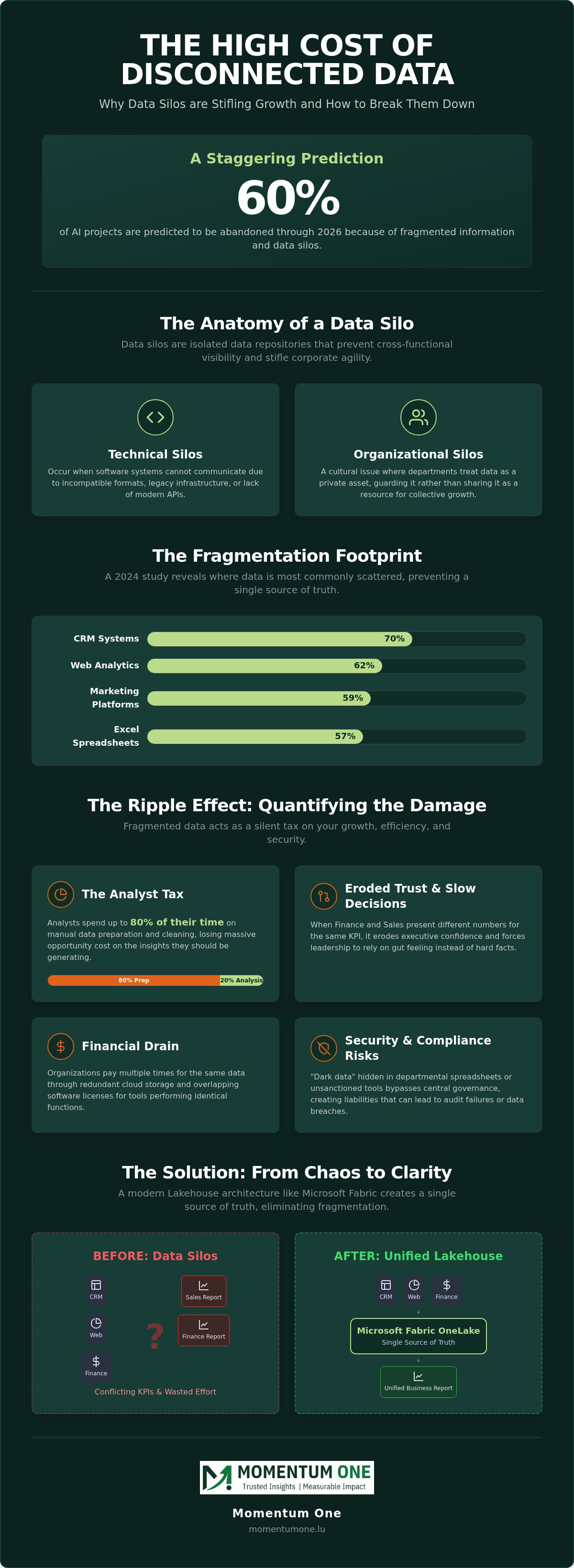
Did you know that organizations are predicted to abandon 60% of their AI projects through 2026 because of fragmented information? It's a staggering figure that highlights a hard truth in modern business. While you're investing in the latest tools, your progress is likely being throttled by data silos that keep critical insights locked away in departmental vacuums. This fragmentation doesn't just slow you down; it creates a persistent disconnect between your technical capabilities and your actual business goals.
We understand the frustration of walking into a board meeting only to find that different departments are presenting conflicting versions of the same KPI. You shouldn't have to watch your analysts spend 80% of their time on manual data preparation or carry the weight of redundant storage costs. This guide shows you how to identify, dismantle, and prevent these barriers to build a unified, high-performance analytics environment. We'll explore how a modern Lakehouse strategy and Microsoft Fabric can establish a single source of truth, helping you accelerate executive decision-making and reduce operational overhead through smart automation.
What Are Data Silos? Understanding the Architecture of Isolation
To solve a problem, you first need to define it with precision. A data silo is a repository of fixed data that remains under the control of one department and is isolated from the rest of the organization. While the term sounds industrial, the reality is digital isolation. When we look at What Are Data Silos? in a corporate context, we're looking at the invisible walls that prevent your finance team from seeing what marketing is spending in real-time. Data silos are isolated repositories of fixed data controlled by individual departments, creating structural barriers that prevent cross-functional visibility and stifle corporate agility.
We often see two distinct types of isolation during our consulting engagements. Technical silos occur when software systems simply can't talk to each other because of incompatible formats. Organizational silos are more cultural; they happen when departments treat data as a private asset to be guarded rather than a shared resource for growth. In 2026, application sprawl has made this issue more prevalent than ever. Research from 2024 showed that organizations had data scattered across CRM systems (70%), web analytics (62%), and marketing platforms (59%), with 57% still relying on manual Excel sheets. This fragmentation makes it nearly impossible to maintain a single source of truth.
How Data Silos Form in Modern Enterprises
Silos don't appear overnight; they grow through specific organizational habits. Legacy infrastructure often plays a major role, as older systems lack the modern API or integration capabilities needed for fluid communication. Departmental autonomy also contributes when teams choose niche SaaS tools without IT oversight, prioritizing local speed over global visibility. Additionally, mergers and acquisitions often create a "Frankenstein" data stack. This happens when companies bolt disparate systems together without a unifying strategy, leading to deep-seated technical debt and duplicated efforts.
The Difference Between a Silo and a Data Lake
The goal of modern architecture isn't just to move data; it's to change how it's accessed. While silos are designed for containment, a well-governed data lake is built for sharing and scalability. However, a lake without a strategy quickly becomes a "data swamp," which is effectively another type of silo where information is lost in a disorganized mess. Professional Data Warehouse & Lakehouse Design focuses on interoperability. By using open formats like Delta Lake, we ensure your data remains accessible, searchable, and future-proof, preventing the return of isolated pockets of information.
The Hidden Costs of Information Isolation: Why Silos Stifle Growth
The consequences of fragmented information extend far beyond simple inconvenience. They act as a silent tax on your growth potential. The Hidden Costs of Information Isolation often manifest as executive mistrust when Finance and Sales present different numbers for the same month. This inconsistency erodes confidence in the company's data-driven strategy and forces leadership to rely on gut feeling rather than hard facts. When leaders can't trust the reports on their screens, the speed of the entire business slows down.
In the context of Luxembourgish data protection standards, data silos pose a significant security and compliance risk. When data is hidden in departmental spreadsheets or unsanctioned SaaS tools, it bypasses central governance and security protocols. This dark data makes it nearly impossible to ensure compliance with strict privacy regulations or financial sector requirements. It creates a liability that could lead to audit failures or data breaches that a unified, governed architecture would have easily prevented.
The Financial Impact: Redundant Storage and Licensing
Organizations often find themselves paying multiple times for the same information. This happens through redundant storage across different cloud providers and overlapping software licenses for tools that perform identical functions. Then there's the Analyst Tax. Internal data suggests that analysts often spend up to 80% of their time on manual data preparation and cleaning rather than actual analysis. If you're paying high-level professionals to manually reconcile spreadsheets, you're losing the massive opportunity cost of the insights they should be generating for your leadership team.
Fragmented Customer Insights
Silos create a blind spot problem that directly impacts your bottom line. When your sales team doesn't have visibility into support tickets, or marketing can't see real-time purchase behavior, the customer experience suffers. This fragmentation prevents a true 360-degree view of the customer journey, leading to lower Customer Lifetime Value (CLV) and higher churn rates. It's predicted that organizations will abandon 60% of AI projects through 2026 due to issues related to data silos, proving that fragmented data is the primary barrier to using predictive AI and real-time forecasting.
If these challenges sound familiar, exploring a tailored data architecture modernization can help you reclaim lost time and secure your information assets against future fragmentation.
Identifying the Symptoms: How to Audit Your Organization for Data Silos
Auditing for data silos requires looking beyond the IT department and into the daily habits of your teams. Start with the "Conflicting Reports" test. If your Finance and Sales teams arrive at the same board meeting with different numbers for a shared KPI like "Gross Margin," you have a silo problem. This usually happens when departments use different logic or disconnected data sources to calculate the same metric. When these discrepancies become the norm, executive trust in the company's analytics foundation begins to crumble.
Another clear symptom is a growing IT request backlog. When departments have to wait weeks for simple data exports, they stop asking and start building their own workarounds. This leads to "Shadow BI," where critical business logic lives in Excel-based databases stored on local drives. These files are invisible to the rest of the organization and impossible to govern or secure. You should also track the "hoops" an analyst must jump through to get raw data. If it takes multiple emails and manual downloads to access a single table, your architecture is designed for containment rather than insight.
The Power BI Shadow Silo
Self-service tools are powerful, but they often create a paradox where ease of use leads to more data silos. Without proper oversight, unmanaged Power BI workspaces become isolated islands of information. We frequently see "Personal BI" evolve into "Departmental BI," where a single employee’s local data model becomes the unofficial truth for an entire team. You can stop this fragmentation by Establishing an Effective Power BI Governance Framework to ensure reports remain accurate, visible, and aligned with corporate standards.
Technical Red Flags in Your Architecture
Your technical setup often reveals isolation before the business teams even notice. A major red flag is the lack of a centralized Data Lakehouse or Warehouse. If your systems rely on "Point-to-Point" integrations, you’re creating a fragile web of connections that are difficult to maintain and scale. Instead, a hub-and-spoke model allows for a single point of ingestion and controlled distribution. High latency in data synchronization is another warning sign; if it takes 24 hours for a CRM update to appear in your analytics dashboard, your leadership is making decisions based on yesterday’s news.
A Strategic Roadmap for Breaking Down Silos in 2026
Breaking down data silos is a phased journey, not a single event. It requires a deliberate blend of cultural shifts and technical modernization to ensure the walls stay down once they're dismantled. In 2026, the roadmap to unification starts with leadership and ends with a self-sustaining ecosystem of shared insights.
Step 1 involves cultural alignment. Leadership must incentivize data sharing across departments, especially in high-stakes environments where transparency is a regulatory necessity. Step 2 focuses on establishing a Single Source of Truth (SSOT). This centralized architecture ensures every business unit works from the same verified dataset. Step 3 introduces robust data governance, defining exactly who owns the data and how it's utilized to maintain integrity. Step 4 shifts the burden from humans to machines by implementing automated data flows. Finally, Step 5 ensures long-term health through continuous monitoring, often achieved by partnering with Managed BI Services to prevent the regrowth of isolated pockets of information.
Centralizing Your Business Intelligence
Consolidating your insights means moving away from fragmented, departmental reporting. We help organizations transition toward a unified Power BI Consulting & Governance model that provides visibility across the entire enterprise. This process involves moving legacy systems into a Modern Data Architecture designed for scalability. Within this framework, Master Data Management (MDM) plays a critical role. It ensures that a customer ID in your CRM matches the customer ID in your billing system, removing the friction that traditionally fuels data silos.
Empowering Teams Through Data Literacy
Technology alone won't solve the problem if your team doesn't feel confident navigating the new environment. Silos often persist because employees revert to familiar, isolated tools like local spreadsheets when they find centralized systems too complex. Providing Corporate Data Training is essential for bridging this gap. This education empowers business users to extract their own insights safely, fostering a "Data-First" culture where information is shared by default rather than hidden by habit.
If you're ready to dismantle your organizational barriers and build a unified analytics foundation, our team at Momentum One can guide you through every step of a Fabric Migration & Modernization project.
Modernizing with Microsoft Fabric: The Ultimate Silo-Killer
Microsoft Fabric represents a fundamental shift in how organizations manage their data estate. Instead of managing dozens of disparate services that naturally create data silos, Fabric provides a single, SaaS-based platform. Central to this is OneLake, which functions as a "OneDrive for Data." It provides a single logical location for all organizational data, regardless of where it physically resides. This architecture ensures that data is stored once and used everywhere, effectively ending the cycle of duplication and fragmented storage.
One of the most significant breakthroughs in this ecosystem is Direct Lake Mode. This feature allows Power BI to query data directly from the Lakehouse without the need to move or duplicate it into a separate model. By eliminating the "refresh" lag and the need for multiple copies, organizations can achieve real-time insights with significantly reduced complexity. Fabric also centralizes security and compliance. You can manage access across the entire data estate from one place, ensuring that your governance standards are applied consistently to every file and table, preparing you for the next generation of AI-driven business intelligence.
Why Microsoft Fabric is Different
Most legacy solutions focus on "integration," which involves moving data between engines. Fabric focuses on "unification." It brings together data engineering, data science, and business intelligence into one cohesive environment. This shift reduces the total cost of ownership (TCO) by eliminating redundant storage costs. With OneLake storage priced at approximately $23 per terabyte per month, the financial benefits of consolidation are clear. For a detailed roadmap on making the switch, check out our Microsoft Fabric Migration Services.
Getting Started with a Fabric Migration
The transition begins with a comprehensive Power BI Architectural Review. This audit identifies your most critical migration priorities and highlights where data silos are currently causing the most friction. Once the groundwork is laid, we help you set up your first Lakehouse environment within the Fabric ecosystem. Partnering with Microsoft Fabric Migration Experts ensures that your transition is smooth, secure, and optimized for performance from day one. This methodical approach ensures that your new architecture isn't just a new tool, but a permanent solution to information isolation.
Building Your Unified Data Future
Breaking down data silos is more than a technical project; it's a strategic commitment to organizational clarity. By moving from fragmented spreadsheets to a unified Lakehouse architecture, you reclaim the 80% of analyst time currently lost to manual cleanup. This transition ensures that your leadership team makes decisions based on a single source of truth, reducing operational overhead and accelerating your time-to-insight. When your data flows freely across departments, you unlock the ability to use predictive AI and real-time forecasting with absolute confidence.
As a Certified Microsoft Solutions Partner, we specialize in navigating these complex transitions. Our expertise in complex Lakehouse design and a proven track record in Power BI governance ensure that your modernization journey is secure, scalable, and aligned with your specific business goals. We don't just provide tools; we act as a dedicated ally in your pursuit of technical excellence.
Ready to transform your analytics environment? Unlock your data's potential with a free Microsoft Fabric assessment from Momentum One. The path to a high-performance data culture is within reach, and we're here to help you take that first step with confidence.
Frequently Asked Questions
What is the primary cause of data silos in large organizations?
Data silos often stem from a combination of structural hierarchy and the rapid adoption of niche SaaS tools. When departments choose software independently to meet immediate goals, they inadvertently create isolated repositories that don't communicate with the rest of the company. This application sprawl, coupled with a lack of central oversight, ensures that information remains trapped within departmental walls, making it impossible to achieve a unified view of the business.
How do data silos affect business decision-making?
Information isolation forces executives to rely on fragmented reports that often contradict one another. When Finance and Sales present different versions of the same KPI, leadership loses confidence in the data and often reverts to gut-feeling decisions. This lack of a single source of truth slows down response times and prevents the organization from identifying market trends or operational inefficiencies until it's too late to act effectively.
Can AI help in breaking down existing data silos?
AI is a powerful tool for accelerating the unification process by automating complex data mapping and cleansing tasks. Advanced algorithms can identify relationships between disparate datasets that manual audits might miss, significantly reducing the time required for reconciliation. However, technology alone isn't a silver bullet. AI projects are predicted to fail at a rate of 60% through 2026 if the underlying architecture remains fragmented and lacks proper governance.
Is it possible to integrate legacy systems into a modern data lakehouse?
You can absolutely integrate legacy infrastructure into a modern Lakehouse design using automated data pipelines. These pipelines act as a bridge, extracting information from older on-premise systems and transforming it into open formats like Delta Lake for cloud-based analysis. This approach allows you to preserve the value of your historical data while gaining the scalability and performance of a modern environment without needing to replace every core system at once.
What is the difference between a data silo and a data warehouse?
The primary difference lies in intentionality and accessibility. A silo is an accidental repository of fixed data that remains isolated under one department's control. In contrast, a data warehouse is a purposefully designed, centralized system built to consolidate information from across the entire organization. While data silos are built for containment and local use, warehouses are engineered for sharing, governance, and providing a consistent foundation for enterprise-wide business intelligence and reporting.
How can we prevent new data silos from forming after a migration?
Prevention requires a mix of cultural alignment and ongoing technical oversight. Establishing a robust governance framework ensures that every new data source is integrated into your central architecture rather than living in a local spreadsheet. Many organizations find that Managed Services provide the steady hand needed to monitor the environment and enforce standards. This proactive approach stops fragmentation before it starts, ensuring your single source of truth remains intact as the business grows.
What role does data governance play in dismantling silos?
Data governance provides the rules of engagement that make unification possible. It defines who owns specific datasets, how metrics are calculated, and who has permission to access information. By standardizing these processes, governance removes the ambiguity that often leads to "Shadow BI" workarounds. It transforms data from a guarded departmental asset into a transparent corporate resource, allowing teams to collaborate with the confidence that they're all using the same verified numbers.
Why is Microsoft Fabric considered a solution for information isolation?
Microsoft Fabric solves isolation by providing a unified, SaaS-based platform where all data engines work from a single logical location called OneLake. This "OneDrive for Data" concept eliminates the need to move or duplicate information between different tools. By allowing Power BI to query data directly via Direct Lake mode, Fabric ensures that every business unit is looking at the exact same data in real-time, effectively removing the technical barriers that traditionally create silos.