How to Build and Run Efficient ETL Pipelines in Databricks
Learn how to build and run ETL pipelines in Databricks efficiently. Master the Medallion architecture to reduce errors and deliver reliable data for analytics.
- Understand how the Medallion Lakehouse framework organizes data into Bronze, Silver, and Gold layers to ensure high quality and governance.
- Learn the modern techniques to build and run tel pipelines in databrics by shifting from manual Spark scripts to intelligent, declarative architectures.
- Determine the best approach for your team by comparing SQL for democratized engineering against Python for complex machine learning tasks.
- Achieve operational excellence by automating job schedules and configuring proactive alerts to manage pipeline latency and failure risks.
- Explore the strategic synergy between Databricks and Microsoft Fabric, using OneLake to create a unified storage layer for enterprise reporting.
Why do most data teams spend 80% of their time fixing broken ingestion logic instead of delivering the insights their stakeholders actually need? It’s a frustrating reality when you’re managing the high complexity of batch and streaming data, often leading to quality issues that undermine your entire reporting suite. We understand that high operational overhead can make your data environment feel more like a burden than an asset. This guide is designed to change that narrative by showing you how to build and run tel pipelines in databrics with precision and reliability.
You’ll master the architecture and execution of high-performance data pipelines specifically designed to drive enterprise-grade analytics. We provide a clear roadmap for implementing the Medallion architecture, helping you reduce manual intervention through sophisticated orchestration. By the end of this article, you’ll know how to ensure a seamless data flow into Power BI, turning your Databricks environment into a steady, reliable engine for business growth in 2026. We’ll move through the technical requirements of the latest runtimes and explore how to maintain peak performance without the constant need for manual troubleshooting.
Understanding the Databricks ETL Ecosystem in 2026
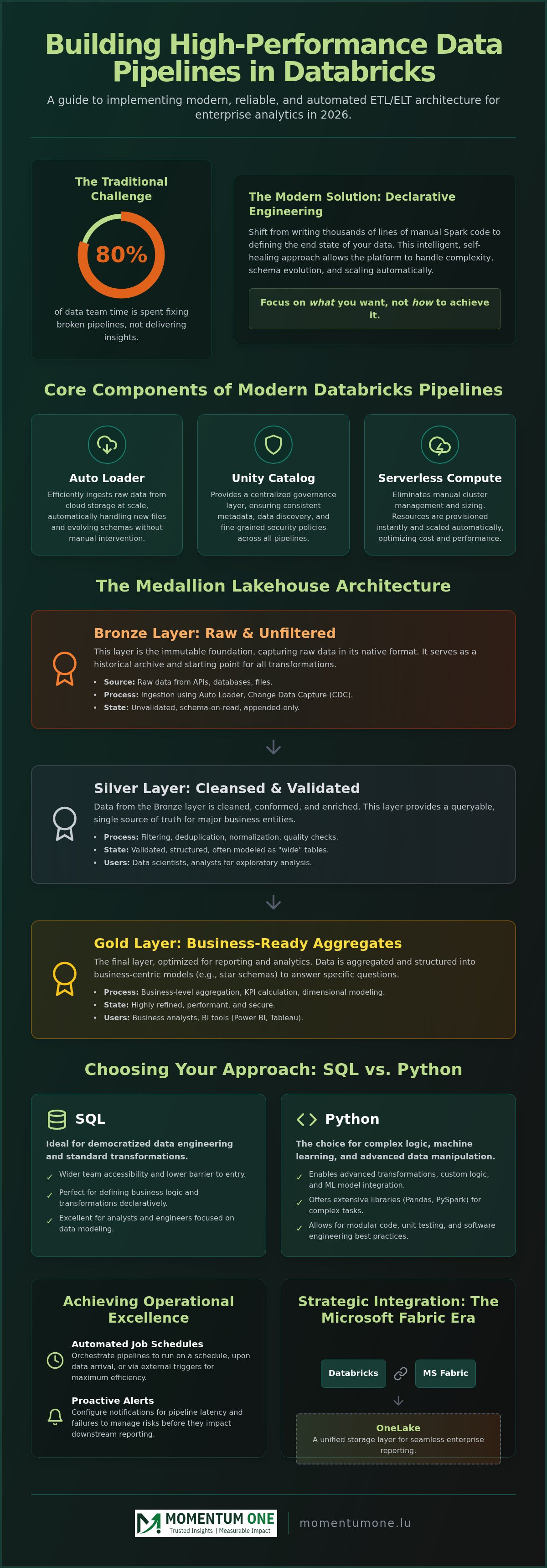
The traditional approach to Extract, transform, load (ETL) has undergone a radical transformation. In 2026, we've moved away from the heavy lifting of writing thousands of lines of manual Spark code. Instead, the ecosystem has evolved into a declarative, intelligent process where the platform itself understands the intent of your data movements. When you build and run tel pipelines in databrics today, you aren't just moving data; you're orchestrating a self-healing environment that adapts to changing schemas and fluctuating volumes without constant human intervention.
This shift is most visible in the transition to Spark Declarative Pipelines, previously known as Delta Live Tables (DLT). This framework allows data engineers to focus on defining the end state of their data. For organizations in Luxembourg dealing with high-volume datasets, Databricks has become the preferred engine because it handles the underlying complexity of distributed computing automatically. Much of this simplicity comes from Lakeflow, which streamlines the entire lifecycle from raw ingestion to final delivery, acting as a unified orchestrator for the modern lakehouse.
Key Components of Modern Databricks Pipelines
To achieve high performance, three components are essential. Auto Loader is your first line of defense, efficiently ingesting raw data from cloud storage at scale while managing schema evolution. To maintain control, Unity Catalog provides a centralized governance layer, ensuring metadata and security policies are consistent across every pipeline. Finally, Serverless Compute has revolutionized how we manage infrastructure. It eliminates the need for manual cluster sizing, allowing your team to focus on pipeline and dataflow automation rather than hardware maintenance.
The Business Case for Declarative Data Engineering
Adopting a declarative approach isn't just a technical upgrade; it's a strategic business move. By automating dependency management, businesses can significantly reduce their time-to-insight, getting critical data to stakeholders faster than ever before. Reliability is another cornerstone; built-in quality expectations ensure that only clean, verified data reaches your downstream applications. From a financial perspective, these optimizations lower the total cost of ownership (TCO) by ensuring compute resources are used with maximum efficiency, preventing the idle cluster waste that often plagued earlier cloud data projects.
Architecting for Success: The Medallion Lakehouse Framework
Success in modern data engineering depends on a structured approach to data quality and flow. The Medallion architecture is the industry standard for this, organizing data into Bronze, Silver, and Gold layers. This framework is a core part of the Lakehouse design, which effectively replaces traditional, siloed data warehouses by combining the low cost of data lakes with the performance of relational databases. When you choose your architecture in 2026, moving toward a Lakehouse model ensures that dimensional modeling remains at the heart of your strategy without the overhead of legacy infrastructure. To build and run tel pipelines in databrics effectively, your team must treat these architectural stages as non-negotiable milestones for data maturity.
Bronze Layer: Raw Ingestion and CDC
The journey begins at the Bronze layer, where we capture raw data in its native format. This layer serves as an immutable foundation, ensuring we never lose the original context of our sources. For many enterprises, capturing Change Data (CDC) from transactional databases using tools like Debezium is a priority. This allows for real-time synchronization without taxing the source systems. With Lakeflow Connect, handling schema evolution becomes an automated task, preventing pipeline breaks when source tables change. This reliability is why many organizations seek expert Data Warehouse & Lakehouse Design to ensure their foundation is scalable from day one.
Silver Layer: Cleansing and Validation
Once data is ingested, the Silver layer focuses on normalization and quality. Here, we apply "expectations" to filter out corrupt records and deduplicate entries. This process aligns with Microsoft's documentation on ETL, which emphasizes the need for a clean, intermediate state before business logic is applied. By establishing a single source of truth at this stage, you ensure that every downstream report is based on verified, consistent data. It's about turning raw noise into a reliable asset that your analysts can trust.
Gold Layer: Aggregation and Business Logic
The Gold layer is where data becomes actionable. This stage is dedicated to high-performance reporting, utilizing materialized views and complex business rules to calculate specific KPIs. We optimize these datasets for seamless integration with Power BI, ensuring that the end user experiences lightning-fast response times. By the time data reaches the Gold layer, it's fully refined and ready to power enterprise-grade analytics. This methodical progression ensures that your pipelines aren't just moving data; they're delivering strategic value at every step of the lifecycle.
Building and Running Pipelines: SQL vs. Python Approaches
Choosing the right development language is a pivotal decision for any data team. In 2026, we see a significant democratization of data engineering, where SQL has become the primary language for many enterprise-grade projects. This shift allows a broader range of analysts to contribute directly to production environments. However, the choice isn't always binary. To build and run tel pipelines in databrics successfully, architects must balance the simplicity of SQL with the deep flexibility of Python, especially when integrating machine learning or complex transformations.
Developing with SQL in Databricks
SQL is no longer just for querying; it's a powerful tool for building robust data structures. By leveraging Data Definition Language (DDL), teams can declare tables and views with the same syntax they use for standard relational databases. This approach simplifies complex joins and window functions, making the logic transparent for stakeholders. For teams looking to upskill, corporate data fabric training can help bridge the gap between basic querying and advanced pipeline development. Best practices now emphasize modularity. Key strategies include:
- Breaking logic into small, testable views.
- Using descriptive aliases for complex calculations.
- Documenting business logic directly within the SQL scripts.
Advanced Python Transformations
Python remains the gold standard when your logic exceeds the capabilities of standard SQL. Using PySpark, engineers can build custom transformations that handle non-linear data structures or specialized file formats. This is particularly vital for organizations in Luxembourg that are integrating third-party libraries for specialized data processing or advanced machine learning models. Beyond just writing code, Python enables rigorous unit testing and debugging. This level of control ensures that your pipeline logic is resilient and capable of handling edge cases that might break simpler SQL-based workflows.
Operationalizing Declarative Pipelines
Moving from a notebook to a production-grade system requires discipline. Modern Databricks environments utilize Git integration to manage pipeline versions and deployments, ensuring every change is tracked and reversible. We can now automate restarts and error handling, which significantly reduces the need for manual intervention during the "extract, transform, load" cycle. Spark Declarative Pipelines serve as the definitive bridge between development and production. Whether you're running batch processing for nightly reports or real-time streaming for immediate insights, these declarative frameworks ensure your execution mode is optimized for both performance and cost.
Operational Excellence: Monitoring and Automating Jobs
Constructing a high performance data environment is only half the battle. To truly build and run tel pipelines in databrics that scale, your team must shift its focus toward long term operational health. This involves moving beyond manual execution and embracing a structured four step roadmap for automation. First, define your job schedules and triggers directly within the Databricks UI to ensure consistent processing. Second, configure granular alerts for pipeline failures or latency spikes, allowing your team to respond before stakeholders notice a delay. Third, utilize Unity Catalog to monitor data quality metrics in real time. Finally, implement strict cost controls and budget alerts for compute resources to prevent unexpected cloud expenditure. This comprehensive approach is essential, and many organizations find that Managed Power BI Services are vital for maintaining end to end environment health.
Data Quality Monitoring and Expectations
Data quality is a non negotiable governance requirement in 2026. Within your declarative pipelines, you can define specific "expectations" that trigger "FAIL", "DROP", or "WARN" actions based on the severity of the data issue. For instance, a missing primary key might trigger a "FAIL" to stop the pipeline, while a formatting error might simply "DROP" the record. You can visualize this health through the Databricks dashboard, providing a clear view of your data integrity. For businesses operating in Luxembourg, conducting regular audits ensures compliance with national data standards and internal security protocols. Maintaining this level of oversight is easier with dedicated incident and support services that keep your operations running smoothly.
Performance Tuning and Cost Optimization
Efficiency directly impacts your bottom line. Optimizing file sizes and partitioning strategies for Delta tables is a fundamental step in reducing query latency. By using the Photon engine, you can achieve accelerated query performance for even the most complex transformation logic. We recommend identifying and resolving bottlenecks early by analyzing Spark UI metrics and execution plans. This proactive tuning ensures that your compute resources are used effectively, keeping your total cost of ownership low while delivering the high speed insights your business demands. When you build and run tel pipelines in databrics, these performance gains translate into more responsive reporting and a more agile data team.
Strategic Integration: Databricks in the Microsoft Fabric Era
The synergy between Databricks and Microsoft Fabric represents a significant shift in how enterprises approach data strategy in 2026. While some viewed these platforms as competitors, the reality for high performing data teams is one of powerful collaboration. OneLake acts as the unified storage layer, allowing Databricks to write data into open Delta tables that Fabric can access instantly via shortcuts. This eliminates the need for expensive and redundant data movement. When you build and run tel pipelines in databrics, you're essentially fueling the high performance engine that powers your Fabric Lakehouse. At Momentum One, we specialize in this cross platform harmony, helping you navigate the complexities of Microsoft Fabric Migration Services to ensure your architecture is future proof.
Connecting Databricks to Power BI
Delivering insights to stakeholders requires a robust connection between your processed data and your reporting layer. For executive dashboards that require real time updates, DirectQuery provides a live link to your Databricks tables. However, for the fastest user experience in complex reports, Import mode remains a strong choice. We recommend a hybrid approach to balance latency and performance. To truly maximize your report speed, it's often necessary to engage DAX Optimization Experts who can refine your measures and ensure your Power BI environment scales alongside your data growth. This ensures that the heavy lifting done in your pipelines translates into a smooth, responsive experience for every end user.
Managed Services for the Modern Data Stack
Building a sophisticated data environment is a milestone, but maintaining its peak performance requires ongoing dedication. We've seen that the most successful organizations in Luxembourg transition from project based builds to recurring managed governance. This shift ensures that as your data volume increases, your pipelines don't become a bottleneck. Momentum One provides the steady hand needed to manage these complex environments, offering proactive support that prevents issues before they impact your business. By leveraging our Pipeline and Dataflow Automation Services, you can reduce manual overhead and focus your internal team on strategic initiatives. We act as your reliable strategist, ensuring that every step to build and run tel pipelines in databrics contributes to long term accuracy and organizational growth.
Future-Proofing Your Data Architecture in 2026
Building a high-performance data environment is about more than just moving bits; it's about establishing a framework that supports long-term enterprise goals. We've explored how the Medallion architecture ensures data quality while the choice between SQL and Python allows your team to balance simplicity with complex logic. Integrating these processes with Microsoft Fabric and Power BI ensures that your technical efforts translate directly into business value. When you build and run tel pipelines in databrics with this level of strategic oversight, you eliminate operational overhead and drive better insights.
As a Certified Microsoft Solutions Partner, we bring years of expertise in Databricks and Fabric integration to help you scale. Our customized managed services are designed for long-term scalability and environment health, ensuring your data remains a reliable asset. Automate your data pipelines with Momentum One today to secure your competitive edge. Your journey toward a more efficient, automated data future starts now.
Frequently Asked Questions
What is the difference between ETL and ELT in a Databricks environment?
ETL transforms data before it reaches the target, while ELT loads raw data first and performs transformations directly on the lakehouse compute. Databricks favors the ELT approach because it allows you to preserve original datasets in the Bronze layer. This provides the flexibility to reprocess information as business logic evolves without needing to re-extract data from the source systems.
How much does it cost to run data pipelines in Databricks in 2026?
Databricks uses a pay-per-use model based on Databricks Units (DBUs), with rates starting at $0.15 per DBU for data engineering and $0.22 per DBU for data warehousing. These costs are billed per second of processing time. You'll also incur separate infrastructure and storage fees from your cloud provider. Managing these variables effectively is a core part of our managed services for long-term efficiency.
Can I build Databricks pipelines using only SQL?
Yes, you can build and run tel pipelines in databrics using only SQL. Databricks SQL and Spark Declarative Pipelines allow analysts to define tables, views, and data quality expectations using familiar DDL and DML commands. This democratization of data engineering means your team doesn't need to master Python to create robust, production-grade pipelines that handle complex enterprise workloads with ease.
What is the Medallion architecture and why is it recommended for Databricks?
The Medallion architecture organizes data into three logical layers: Bronze for raw ingestion, Silver for cleansed data, and Gold for business-ready aggregates. It's recommended because it provides a structured roadmap for data quality and maturity. By separating raw data from refined insights, teams ensure a single source of truth and high-performance reporting while maintaining the ability to audit data lineage at every stage.
How does Databricks integrate with Microsoft Fabric and OneLake?
Integration is achieved through OneLake shortcuts, which allow Microsoft Fabric to access Databricks Delta tables without moving or copying data. This synergy lets you use Databricks as your high-performance engineering engine while leveraging Fabric for unified BI and reporting. It's a strategic approach that combines the best of both worlds, creating a seamless experience for data engineers and business analysts alike.
Is Databricks suitable for real-time streaming data pipelines?
Databricks is exceptionally well-suited for real-time streaming through Spark Structured Streaming. This framework treats streaming data like a continuous table, making it simple to build and run tel pipelines in databrics that handle both batch and live data. Features like Auto Loader and low-latency triggers ensure your dashboards reflect the most current information without the complexity of managing separate streaming architectures.
What are the security best practices for Databricks pipelines in Luxembourg?
Security starts with Unity Catalog for centralized access control and data lineage tracking across all workspaces. In Luxembourg, businesses should prioritize data residency and ensure encryption is active both at rest and in transit. Implementing fine-grained permissions ensures only authorized users access sensitive datasets. Regular audits and automated monitoring through our managed services help maintain strict compliance with national standards and internal protocols.
How do I monitor the performance and cost of my Databricks jobs?
Use the Databricks Jobs UI and the Spark UI to identify bottlenecks and monitor execution plans in real time. For cost tracking, Unity Catalog provides system tables that log DBU consumption and compute usage details. Setting up budget alerts and utilizing serverless compute can help prevent unexpected cost spikes. Proactive monitoring ensures your pipelines remain efficient and cost-effective as your data volume grows over time.