Leveraging Apache Spark in Modern Lakehouse Architectures
Learn how Apache Spark in lakehouses solves high latency and complexity. Unify your data warehouse and data lake for real-time analytics and faster insights.
- Understand how the lakehouse architecture eliminates data silos by combining the flexibility of a data lake with the performance of a structured warehouse.
- Discover why Apache spark in lakehouses is the essential engine for high-scale, in-memory processing and real-time analytics in 2026.
- Master technical optimization techniques to resolve high latency and manage operational costs by addressing common bottlenecks like data shuffling.
- Explore the seamless integration of Spark within the Microsoft Fabric ecosystem to create a unified "One Source of Truth" across your organization.
- Gain a clear roadmap for migrating legacy pipelines into a modern, managed environment that scales effortlessly with your growing enterprise datasets.
If your data strategy still forces you to choose between the speed of a data warehouse and the scale of a data lake, you're likely paying a "complexity tax" that's stalling your growth. It's a common frustration for enterprise leaders who find themselves managing separate, disconnected silos for business intelligence and machine learning. You've probably noticed that high latency in traditional ETL pipelines often means your reports are outdated by the time they reach the decision-makers. We agree that scaling data processing shouldn't feel like an uphill battle against your own infrastructure.
This article shows you how leveraging Apache spark in lakehouses solves these challenges by providing a unified engine for every workload. You'll discover how the latest advancements in Spark 4.2.0 and Microsoft Fabric's Runtime 2.0 accelerate your time-to-insight while reducing architectural complexity. We'll explore the path to a single source of truth that powers both real-time analytics and robust enterprise governance. By the end of this guide, you'll understand how to position your data platform to meet the high-performance demands of 2026 and beyond with confidence.
Understanding the Synergy: Why Apache Spark Defines the Lakehouse Era
The modern data stack is moving away from the rigid boundaries that once separated data lakes from data warehouses. This convergence is known as the data lakehouse architecture, a framework designed to provide the performance of a warehouse with the massive scale of a lake. At the center of this revolution lies Apache Spark. As a distributed compute engine, Spark provides the muscle required to process petabytes of data across clusters of machines. It's the engine that makes the lakehouse viable by allowing organizations to apply structure and governance directly to raw data stored in open formats.
By 2026, the reliance on rigid ETL (Extract, Transform, Load) processes has shifted toward more flexible, schema-on-read Spark processing. This approach lets you store data in its native format and apply structure only when you're ready to analyze it. Using open standards like Delta Lake and Parquet, Apache spark in lakehouses ensures that your data remains accessible, interoperable, and future-proof. You aren't locked into a proprietary vendor format; instead, you're building on a foundation that supports every modern analytical tool.
The Death of Data Silos
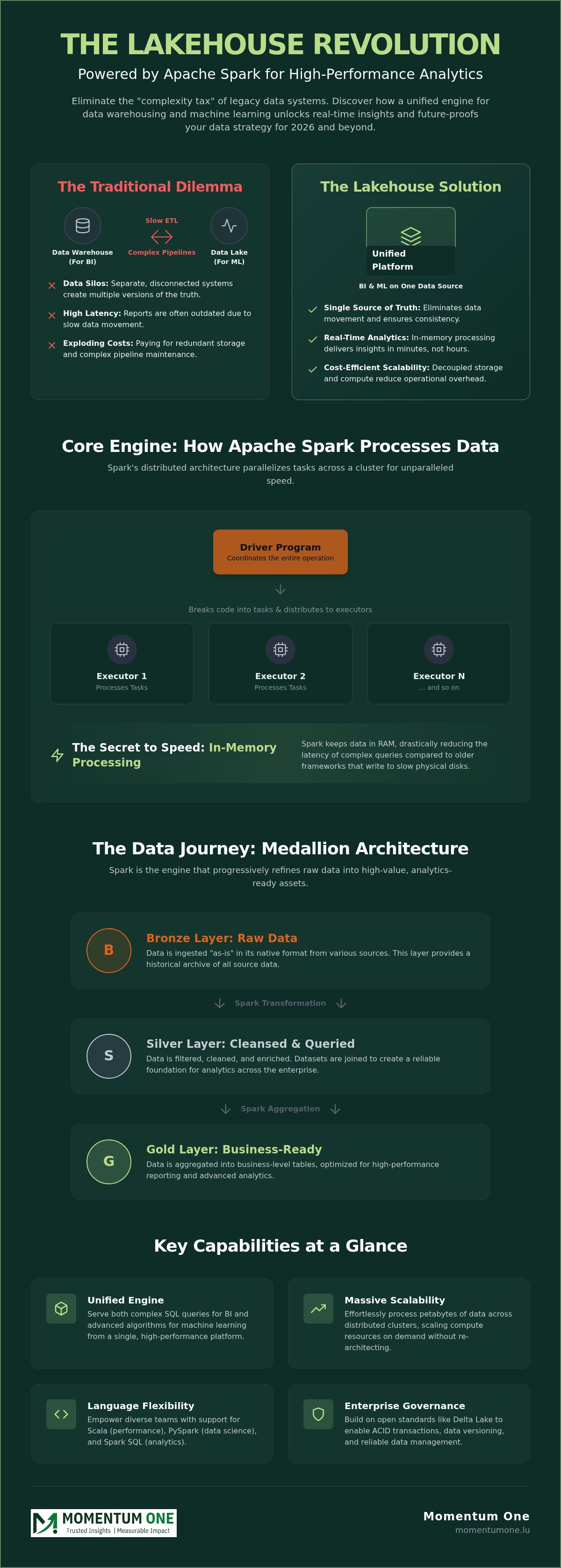
Traditional architectures often require you to move data between a lake for machine learning and a warehouse for business intelligence. This movement is slow, expensive, and creates multiple versions of the truth. Spark eliminates this friction by serving as a single engine for both workloads. Whether you're running a complex SQL query for a monthly report or training a predictive model, you're working from the same underlying dataset. A unified engine is the technical heart of 2026 architecture that consolidates all compute requirements into one scalable platform.
Scalability for Luxembourg Enterprises
For enterprises across Luxembourg, managing growing datasets requires a platform that scales without exploding costs. Distributed processing is no longer a luxury; it's a necessity for handling national-scale operations efficiently. Spark achieves this by decoupling storage from compute, meaning you only pay for the processing power you use while your data sits cost-effectively in cloud storage. If you're weighing your options, exploring data warehouse and lakehouse design can help you determine the best path for your specific infrastructure needs. Apache spark in lakehouses provides the steady hand required to manage this transition, ensuring your architecture remains lean and high-performing.
Core Mechanisms: How Spark Processes Data Within a Lakehouse
To understand why Apache spark in lakehouses delivers such high performance, we have to look at its distributed execution model. Spark operates using a master-slave architecture where a central Driver program coordinates the entire operation. This Driver breaks your code into Tasks and distributes them across multiple Executors. These executors are the workers that perform the actual data processing on individual nodes in a cluster. This parallelization is what allows a lakehouse to process terabytes of data in minutes rather than hours.
The real secret to Spark's speed is its in-memory processing capability. Unlike older frameworks that constantly write intermediate data back to slow physical disks, Spark keeps as much data as possible in RAM. This drastically reduces the latency of complex, multi-stage analytical queries. It's also a highly versatile tool for diverse teams. Data engineers can leverage Scala for high-performance pipelines, while data scientists use PySpark for machine learning, and analysts use Spark SQL to query datasets with familiar syntax. To maintain order over these operations, Spark interacts with metadata layers like Delta Lake or Apache Hudi. These layers provide the necessary governance, allowing Spark to perform ACID transactions and data versioning on top of standard cloud storage.
The Medallion Architecture Engine
Spark is the primary engine used to implement the Medallion Architecture, which organizes data into Bronze, Silver, and Gold layers. In the Bronze layer, Spark ingests raw data "as-is" from various sources. It then moves data to the Silver layer by filtering, cleaning, and joining datasets to create a reliable foundation. Finally, Spark aggregates this data into the Gold layer for business-ready consumption. For instance, Spark can ingest millions of messy IoT sensor signals, remove duplicates, and transform them into a refined dataset that powers a clean Power BI report. If you're ready to move beyond fragmented data, our experts can guide your data architecture modernization to ensure every layer of your lakehouse is optimized for performance.
Batch vs. Real-Time Streaming
Modern enterprises no longer rely solely on nightly batch jobs. Spark Structured Streaming allows for low-latency ingestion, bringing data into the lakehouse in near real-time. The beauty of this approach is the unified API; you can use the same code logic for both historical batch processing and live data streams. This consistency simplifies your codebase and reduces the chance of errors. Effectively managing these transitions requires robust pipeline and dataflow automation to ensure data moves reliably from source to insight without manual intervention. Apache spark in lakehouses provides the technical flexibility to handle these diverse workloads under a single, manageable umbrella.
Apache Spark in Microsoft Fabric: Orchestrating the OneLake Environment
Microsoft Fabric has fundamentally redefined how we interact with big data. In this ecosystem, Spark isn't just an add-on; it's a first-class citizen designed to work seamlessly with OneLake, often described as the "OneDrive for data." One of the most significant advantages for teams in 2026 is the serverless nature of Fabric Spark. You don't need to spend hours managing clusters or worrying about manual infrastructure scaling. Instead, you focus on the logic of your data transformations while the platform handles the underlying compute resources automatically.
The real magic happens when Apache spark in lakehouses meets the presentation layer. By processing and storing data in the Delta Parquet format, you enable "Direct Lake" mode in Power BI. This allows the reporting engine to query the data directly from OneLake without the need for traditional data movement or time-consuming dataset refreshes. It effectively bridges the gap between raw data and business insights, providing sub-second performance on massive datasets that were previously too large or complex to handle without high latency.
Spark Notebooks vs. Data Factory
Choosing between Spark Notebooks and Data Factory pipelines is a strategic decision about balancing pro-code power with low-code speed. Notebooks are the primary choice for complex data engineering tasks that require the fine-grained control of Python, Scala, or R. They allow for Mastering Modern Data Engineering techniques, such as custom library integration and sophisticated data cleaning logic. Conversely, Data Factory offers a visual interface for straightforward ingestion and orchestration. For organizations planning a move, our Fabric migration and modernization services help you strike the ideal balance between these tools to maximize developer productivity while maintaining architectural control.
OneLake Integration Benefits
OneLake serves as a single, unified logical lake for the entire organization. By utilizing "Shortcuts," Spark can process data residing in different cloud locations or accounts without actually duplicating the physical files. This approach significantly reduces storage costs and minimizes the risk of data drift. This is particularly valuable for Luxembourgish firms that must maintain strict data sovereignty while benefiting from global-scale analytics. Unified governance ensures that security policies applied at the lake level persist throughout the entire lifecycle. If you're looking for a structured approach to this transition, our Microsoft Fabric migration services provide a comprehensive roadmap for 2026. Utilizing Apache spark in lakehouses within the Fabric environment ensures your data is not just stored; it's strategically orchestrated for long-term growth.
Optimizing Spark Performance for Scalable Lakehouse Analytics
A common objection heard in boardrooms is that Spark is too expensive or slow for enterprise workloads. This perception usually stems from misconfiguration rather than a limitation of the engine itself. High operational costs are often the result of "Data Shuffling," a process where data is moved across the network between different nodes in a cluster. Because network I/O is significantly slower than in-memory processing, minimizing shuffles is the first step toward efficiency. By utilizing broadcast joins for smaller tables and ensuring your data is partitioned correctly, you can drastically reduce this overhead. In 2026, leveraging Apache spark in lakehouses requires a proactive approach to monitoring; the Spark UI remains your most powerful ally for identifying these bottlenecks before they impact your budget.
Partition sizing is another critical factor. If partitions are too small, you'll face the "Small File Problem," where the overhead of managing metadata outweighs the actual processing time. Conversely, partitions that are too large lead to memory pressure and "spilling" to disk. We typically recommend a target file size between 128MB and 1GB depending on the specific workload and cluster configuration. Achieving this balance ensures that every executor is working at peak capacity without being starved or overwhelmed by administrative tasks.
CBO and Adaptive Query Execution (AQE)
Modern versions of Spark, including the 4.x series found in Microsoft Fabric Runtime 2.0, feature sophisticated optimization layers like Cost-Based Optimization (CBO) and Adaptive Query Execution (AQE). CBO uses table statistics to choose the most efficient join strategies in your Gold layer before the query even starts. AQE goes a step further by re-optimizing query plans at runtime based on the actual size of the data being processed. Adaptive Query Execution significantly improves resource utilization by automatically coalescing shuffle partitions and handling data skew without requiring manual code changes.
File Compaction and Z-Ordering
Even the best-written code can't overcome a fragmented storage layer. The "Small File Problem" is a performance killer in any lakehouse environment. To combat this, you should regularly perform file compaction using the "OPTIMIZE" command in Delta Lake. In the Microsoft Fabric ecosystem, utilizing "V-Order" can further accelerate read performance by reorganizing data within Parquet files for faster scanning. Implementing Z-Ordering on frequently filtered columns allows Spark to skip irrelevant data entirely, reducing I/O costs and speeding up business reports. If you're struggling to keep your cloud costs under control, our workspace and capacity optimization services provide the technical oversight needed to maintain a lean, high-speed environment. Let us help you refine your lakehouse design to ensure peak efficiency from day one.
Implementing a Spark-Driven Lakehouse Strategy with Momentum One
Moving from technical theory to real-world deployment requires a steady hand and a clear roadmap. While understanding the mechanics of Apache spark in lakehouses is essential, the actual implementation must align with your specific business objectives to be successful. As a certified Microsoft Solutions Partner based in Luxembourg, Momentum One acts as your reliable strategist and expert facilitator. We don't just build technical pipelines; we architect environments where Spark serves as the foundational engine for a "Single Source of Truth." Our approach ensures that your architecture is secure, scalable, and fully integrated with your existing enterprise governance frameworks.
Our managed services provide the ongoing technical oversight needed to keep your environment performant as your datasets grow. We focus on outcome-driven implementations that reduce architectural complexity while increasing the accuracy of your business reports. By partnering with us, you gain access to high-level technical expertise without the cold, detached nature of traditional corporate consulting. We're deeply invested in your journey, ensuring that every Spark-driven transformation supports your long-term growth and operational efficiency.
From Legacy Warehouse to Modern Lakehouse
Many Luxembourgish firms are currently navigating the transition from rigid, siloed legacy systems to fluid, high-performance environments. This migration phase is often where the most significant pitfalls occur, ranging from misconfigured compute clusters to fragmented data security. To bridge the internal skills gap, we provide Corporate Data Fabric Training. These customized workshops empower your technical team to master the nuances of Spark development within the Microsoft Fabric ecosystem. We focus on practical, pro-code education that turns technical hurdles into tangible growth opportunities for your organization.
Strategic Partnership for Long-Term Growth
Choosing a boutique consultancy like Momentum One provides a level of agility and dedication that global giants often struggle to match. We prioritize a supportive partnership, moving steadily from broad value propositions to specific technical capabilities that solve your unique audience pains. Our focus on data architecture modernization ensures that your Spark-driven transformations directly support high-level BI through expert Power BI consulting and governance. If you're ready to solidify your data strategy for 2026, you can schedule a Lakehouse Architecture Review today. We'll help you refine your implementation of Apache spark in lakehouses to ensure it delivers faster time-to-insight and reduced complexity for years to come.
Building a Resilient Data Future
The transition toward a unified data platform is no longer a luxury for growing enterprises; it's a strategic necessity. By integrating Apache spark in lakehouses, you've seen how organizations can finally eliminate the friction between massive data lakes and high-performance warehouses. This synergy provides the technical foundation needed to power real-time analytics while maintaining strict governance across your entire organization. Whether you're optimizing shuffle partitions or orchestrating complex workloads in Microsoft Fabric, the goal remains clear: faster time-to-insight with significantly reduced architectural complexity.
Momentum One is here to serve as your steady hand in this evolving landscape. As a Certified Microsoft Solutions Partner with Luxembourg national coverage, we specialize in expert Spark performance tuning and outcome-driven implementations. We don't just provide technical fixes; we build lasting partnerships that simplify your journey toward a single source of truth. It's time to stop fighting your infrastructure and start leveraging it for growth. Modernize your data architecture with a custom Lakehouse design and position your business for success in 2026 and beyond.
Frequently Asked Questions
What is the difference between Apache Spark and traditional SQL in a Lakehouse?
Spark is a distributed, general-purpose compute engine, while traditional SQL engines are primarily designed for structured data queries. In a lakehouse, Spark handles non-linear transformations and machine learning that go beyond standard SQL capabilities. Using Apache spark in lakehouses allows you to process unstructured data and complex logic at scale. While SQL is excellent for reporting, Spark provides the flexibility needed for sophisticated data engineering and advanced analytics across diverse datasets.
Is Apache Spark necessary for small-scale Lakehouse implementations?
It isn't always strictly necessary for small datasets, but it provides a foundation that won't break as your data volume increases. You can manage minor workloads with Power BI Dataflows or standard SQL; however, Spark ensures you won't need a complete redesign later. It's about future-proofing your platform so your team can handle national-scale datasets without technical debt. Starting with Spark allows for an easier transition as your enterprise data needs grow.
How does Microsoft Fabric simplify Apache Spark management?
Microsoft Fabric eliminates the burden of manual infrastructure management by offering a fully serverless environment. You don't have to configure clusters or manage virtual machines; the platform handles scaling automatically based on your specific workload requirements. With the inclusion of Runtime 2.0 and Spark 4.1 in 2026, you get optimized performance right out of the box. This allows your team to focus on delivering business value rather than spending hours on tedious administrative tasks.
Can I use Apache Spark for real-time data ingestion in a Lakehouse?
Yes, Spark Structured Streaming is the standard for low-latency data ingestion. It allows you to process live data streams using the same logic you'd apply to batch processing. This unified approach simplifies your development lifecycle and ensures your Gold layer remains up to date. Integrating Apache spark in lakehouses for real-time ingestion helps your business react faster to market changes by providing near-instant access to fresh, actionable data for your reports.
What are the cost implications of using Spark in a cloud Lakehouse?
Costs are generally tied to compute capacity and duration rather than fixed hardware investments. Decoupling storage and compute means you only pay for processing when your Spark jobs are active. However, poor configuration can lead to unnecessary expenses through excessive data shuffling or idle resources. We recommend monitoring your Fabric capacity usage closely to ensure your pipelines remain cost-effective while delivering the high performance required for your complex enterprise analytical workloads.
Do I need to know Python or Scala to use Spark in a Lakehouse?
You don't need to be a programmer to benefit from Spark's power. Spark SQL allows analysts to perform complex transformations using the SQL syntax they already know. While PySpark and Scala offer deeper control for specialized data engineering, the low-code options in Microsoft Fabric make Spark accessible to a wider range of users. This flexibility ensures that your entire team can contribute to the lakehouse architecture regardless of their specific technical or coding background.
How does Spark ensure data quality within the Medallion architecture?
Spark acts as the gatekeeper for quality by enforcing schemas and performing ACID transactions at every stage. During the transition from the Bronze to Silver layer, Spark jobs filter out duplicates and correct data types to ensure a clean foundation. This automated cleaning process prevents "data swamp" scenarios from occurring. By the time data reaches the Gold layer, it's refined and validated, providing a reliable source of truth for your critical Power BI reports.
What is the role of Delta Lake when using Apache Spark?
Delta Lake provides the storage framework that Spark uses to manage data with warehouse-like reliability. It adds a versioned metadata layer on top of your Parquet files, enabling features like time travel and audit logs. Spark interacts with this layer to ensure that concurrent reads and writes don't cause data corruption. This combination turns a standard data lake into a robust lakehouse that supports enterprise-grade governance and high-speed analytical queries for your organization.