Microsoft Fabric Governance Model: Navigating the Era of Data Agents in 2026
Master the Microsoft Fabric governance model for 2026. Learn to manage autonomous data agents, ensure EU AI Act compliance, and optimize your analytics estate.
- Learn how to adapt your Microsoft Fabric governance model to manage the shift from reactive Copilots to proactive, autonomous data agents.
- Discover how to leverage OneLake as a single source of truth while implementing automated guardrails for your data pipelines and flows.
- Understand the human-on-the-loop model to ensure your agentic AI actions remain compliant with the EU AI Act and CNPD guidelines.
- Identify the critical role of star schema modeling in improving the reasoning accuracy and reliability of your autonomous analytics.
- Access a strategic roadmap for auditing and modernizing your Fabric estate to ensure your infrastructure is ready for 2026 agentic features.
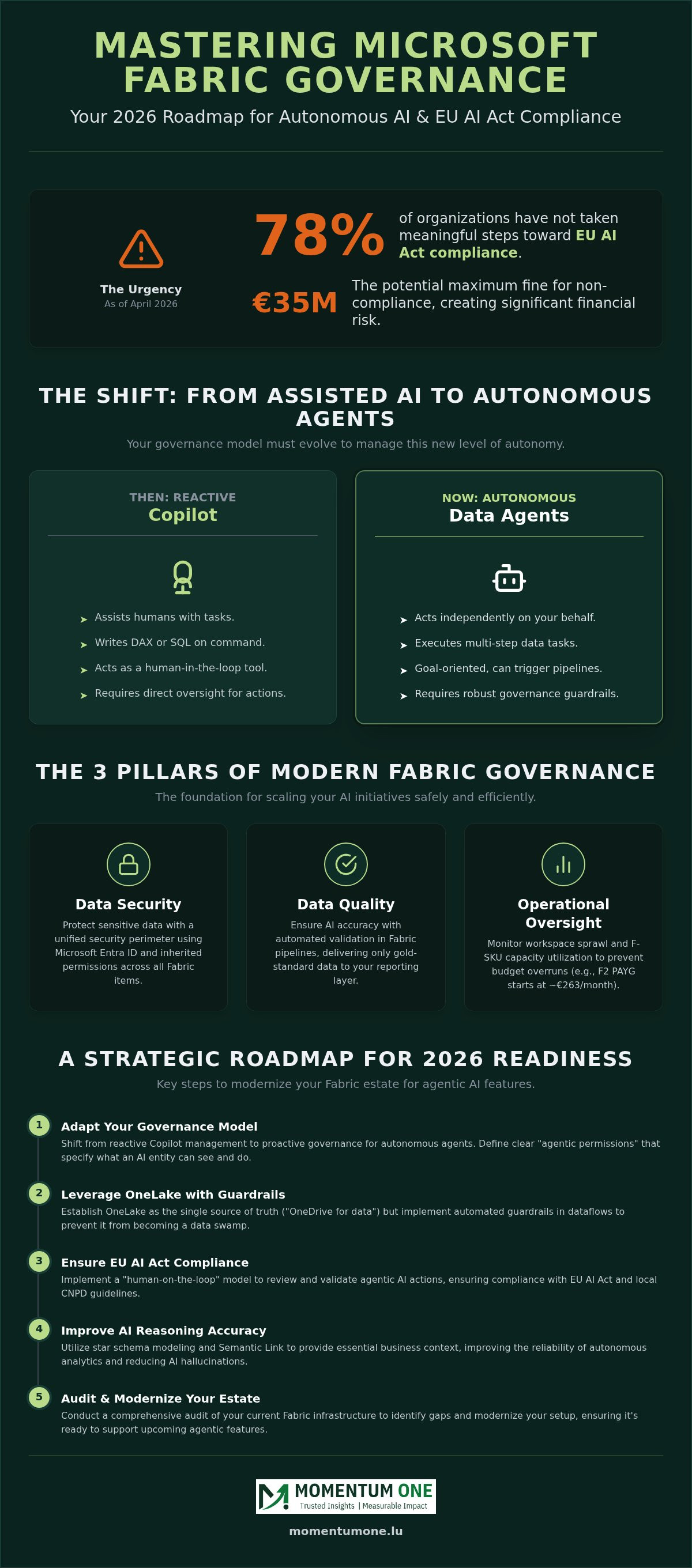
As of April 2026, 78% of organizations had yet to take meaningful steps toward EU AI Act compliance, even though maximum fines now reach a staggering €35 million. You likely recognize the tension of trying to foster innovation in OneLake while keeping a tight grip on data security and unpredictable capacity costs. It's a constant challenge to empower your team without risking AI hallucinations in your executive reports or overspending on your F-SKU units. Establishing a modern Microsoft Fabric governance model is the only way to turn these risks into a competitive advantage.
We believe that governance should be a business enabler rather than a bottleneck. This guide helps you master the evolution of Fabric governance to secure and scale autonomous data agents within your enterprise analytics estate. We'll provide a clear roadmap for agentic AI integration, covering everything from automated compliance monitoring to practical strategies for optimizing capacity utilization. By the end, you'll have the framework needed to build a secure, scalable environment that meets the latest CNPD guidelines here in Luxembourg.
What is a Microsoft Fabric Governance Model? The 2026 Definition
To understand What is a Microsoft Fabric Governance Model? in 2026, we must look beyond traditional data management. It's no longer just a set of restrictive rules; it's the unified orchestration of your entire analytics estate, including OneLake storage, compute resources, and autonomous AI entities. Unlike legacy systems that treated security and quality as separate silos, Fabric centralizes these controls within the Admin portal. This allows your team to apply tenant-wide policies that protect data while still encouraging the self-service freedom that drives business growth.
The biggest change we've seen this year is the shift from assisted AI to autonomous agents. While Copilot was designed to help humans write DAX or SQL, 2026 introduces Data Agents that act on your behalf. A Data Agent is a goal-oriented AI that executes multi-step data tasks independently. This autonomy requires a more robust Microsoft Fabric governance model than we used previously, as these agents can now trigger pipelines or modify models without direct human oversight. We believe that managing this autonomy is the next frontier for Luxembourgish enterprises aiming for AI maturity.
Your governance strategy also dictates your technical foundation. It directly impacts your data lakehouse vs warehouse design choice. For instance, a lakehouse architecture offers immense flexibility for data science, but it requires stricter schema-on-read governance to prevent OneLake from becoming an unmanaged data swamp. Centralizing these decisions in the Fabric Admin portal ensures that every workspace follows your corporate standards from day one.
The Three Pillars of Modern Fabric Governance
Effective governance rests on three critical foundations that ensure your F-SKU capacity remains an investment rather than a runaway cost. These pillars provide the stability needed to scale safely.
- Data Security: We use Microsoft Entra ID to manage identities and access. This creates a unified security perimeter across all Fabric items, ensuring that sensitive data in OneLake remains protected by inherited permissions.
- Data Quality: Accuracy is the bedrock of AI. By implementing automated validation within your Fabric pipelines, you ensure that only gold-standard data reaches your reporting layer.
- Operational Oversight: Monitoring workspace sprawl and capacity utilization is vital. With PAYG F2 starting at approximately €263 per month, keeping a close eye on compute consumption prevents unexpected budget hits.
The Evolution of the Data Steward in the Age of AI
The role of the Data Steward has transformed from manual metadata entry to high-level strategic oversight. Stewards now use AI-assisted labeling to classify thousands of tables in seconds, ensuring compliance with the latest CNPD guidelines. They rely on the Semantic Link to provide essential business context, bridging the gap between raw Python logic and Power BI's business-friendly measures. This ensures that when a Data Agent queries your estate, it understands the nuances of your specific market operations and delivers reliable insights.
Architecting Autonomy: Governing OneLake and Data Agents
OneLake acts as the logical center of your estate, often described as the "OneDrive for data." By centralizing information in a single SaaS environment, you eliminate the friction of moving files between disparate systems while maintaining a clear audit trail. However, this centralization requires a sophisticated Microsoft Fabric governance model to ensure that your single source of truth doesn't turn into a chaotic data swamp. When you grant autonomous agents access to this unified store, the stakes for data security and regulatory compliance become significantly higher, especially under the scrutiny of the EU AI Act.
Success in this era requires integrating pipeline and dataflow automation with strict governance guardrails. You don't want an agent to trigger a massive data ingestion task that bypasses your quality checks or security protocols. We recommend building "agentic permissions" that define exactly what an AI entity can see and do. This includes enforcing Row-Level Security (RLS) so that an agent querying executive reporting data only retrieves insights relevant to the specific user's permission level. This prevents sensitive payroll or strategic data from leaking into general AI responses.
Grounding Agents in the Semantic Model
A certified Power BI semantic model serves as the ultimate truth layer for your AI agents. By using Retrieval-Augmented Generation (RAG), you can ground your agents in Lakehouse metadata, ensuring they interpret technical columns through the lens of your business logic. We use Object-Level Security (OLS) to hide specific tables or columns from autonomous discovery, ensuring that even the most curious agent stays within its defined boundaries. This precision is what separates a reliable enterprise assistant from a liability that might hallucinate based on raw, uncurated data.
Capacity Governance: Controlling F-SKU Consumption
Autonomous agents are powerful, but they can be compute-intensive. Since Fabric uses capacity smoothing and bursting, a sudden surge in agentic queries can quickly exhaust your available Capacity Units (CUs). We suggest setting up proactive alerts in the Capacity Metrics app to identify runaway processes before they impact your monthly bill. If you're looking to optimize your environment, our team can assist with workspace and capacity management to ensure your AI agents don't exceed your budget. Monitoring these metrics ensures that your F64 or F2 capacity remains performant for all users, keeping your operational costs predictable and your ROI high.
Data Agents vs. Copilot: Governance Challenges and Frameworks
The distinction between Microsoft's Copilot and autonomous Data Agents is fundamental to your 2026 strategy. While Copilot operates reactively by responding to specific user prompts, Data Agents take a proactive stance. They don't just wait for a question; they monitor data streams and execute complex workflows based on high-level objectives. This shift requires an evolution of your Microsoft Fabric governance model to move from simple input-output filtering to sophisticated goal-based oversight.
We recommend a "human-on-the-loop" model for all agentic actions. This framework ensures that while an agent can perform the heavy lifting of data analysis, a human expert must provide the final approval before any significant change is pushed to production. This is particularly important for Luxembourgish firms navigating the transparency obligations of the EU AI Act. You need to maintain a clear audit trail that tracks not just the result, but the entire "thought process" or kernel record of the agent.
Legacy managed Power BI services must now expand their scope to include this level of agent monitoring. It's no longer enough to govern reports and datasets; you must govern the entities that create them. Tracking these kernel records allows your team to understand why an agent chose a specific data source or calculation, which is vital for troubleshooting and regulatory compliance.
Framework for AI Interaction Models
Governing these interactions requires a two-tiered approach. For Copilot, the focus is on preventing sensitive data from appearing in chat responses. For Data Agents, you must manage "Tool-Use" permissions. This defines whether an agent is allowed to write its own SQL queries or modify DAX measures. While Copilot writes the formula, the Agent builds the entire report architecture based on a goal. This level of autonomy necessitates strict boundaries on which workspaces and capacities the agent can utilize to prevent resource exhaustion.
Risk Mitigation in Autonomous Analytics
The rise of autonomous entities introduces the risk of "shadow BI" at scale. If an agent can create reports independently, your estate could quickly become cluttered with unverified insights. We mitigate this by setting strict boundaries for agent-driven Data Activator triggers. You don't want an AI-generated alert sending incorrect financial warnings to your board. Preventing data leakage between different agentic sessions is also crucial. By ensuring that one agent's learned context doesn't bleed into another's, you maintain the integrity of your multi-tenant or multi-departmental Fabric environment.
Strategic Implementation: A Roadmap for Luxembourgish Enterprises
Moving from a legacy Synapse or Power BI setup to a unified environment requires more than just technical migration. It demands a shift in how you perceive data ownership and risk. For organizations in Luxembourg, this transition is often driven by the need to meet strict local regulations while staying competitive in a fast-moving AI market. A successful Microsoft Fabric governance model starts with a comprehensive Fabric migration and modernization audit. This assessment identifies which parts of your legacy architecture are ready for the cloud and which require restructuring to support autonomous agents.
We advocate for a "Governance by Design" approach. This means security and compliance aren't added at the end; they're baked into every workspace and pipeline from the start. Standardizing your data on Star Schemas is a vital part of this process. While humans can often navigate messy snowflake schemas, autonomous agents require the clear, logical paths provided by a well-modeled star schema to reason accurately. Without this foundation, the risk of AI hallucinations increases, potentially leading to flawed executive insights. Cultivating a data-literate culture through corporate Power BI training ensures your team can effectively manage these new governed workflows.
Building the Guardrails: Step-by-Step
Implementing your roadmap should follow a logical progression to ensure stability. We recommend a three-step approach to establish your initial guardrails.
- Step 1: Tenant-level security and domain organization. Group your workspaces into logical domains (e.g., Finance, HR, Operations) to apply granular policies that align with departmental needs.
- Step 2: Metadata enrichment. Document your semantic models thoroughly. High-quality metadata acts as the "grounding" for AI agents, allowing them to understand the business context of every column.
- Step 3: Establishing the Agentic Sandbox. Create a dedicated environment for testing agentic workflows. This allows you to monitor F-SKU consumption and agent behavior without risking your production estate.
DAX and Modeling: The Governance Secret Weapon
Precision in your calculations is the best defense against unreliable AI. This is why DAX optimization experts are essential in an agent-driven world. If your DAX measures are inefficient or poorly documented, an agent might misinterpret the logic or trigger expensive, long-running queries that spike your capacity costs. High-performance modeling ensures that agent-driven queries remain snappy and cost-effective, keeping your F-SKU utilization within budget. By documenting business logic directly within the semantic layer, you provide a clear "source of truth" that agents can rely on for every calculation.
If you're ready to modernize your analytics estate, our Power BI consulting and governance services provide the technical depth and strategic guidance needed for a secure, AI-ready transition.
Scale Securely: How Momentum One Empowers Your Fabric Journey
Success in the era of autonomous data agents requires more than just high-level software; it demands a partner who understands the technical nuances of your specific enterprise analytics estate. We specialize in bridging the gap between raw, siloed data and the autonomous insights that drive competitive growth. By implementing a robust Microsoft Fabric governance model, we ensure your transition to agentic AI is both secure and scalable. Our approach focuses on turning governance from a perceived bottleneck into a strategic business enabler.
Our team provides tailored corporate data fabric training designed to empower your technical staff with the skills needed to manage a modern Fabric environment. Beyond initial setup, we offer managed services that provide continuous oversight of your governance policies and capacity optimization. This ensures your F-SKU utilization remains efficient, preventing the "runaway" costs often associated with unmanaged AI workloads. We help you build a strategic roadmap that prepares your infrastructure for the 2026 feature set, including the latest GPT-powered data agents.
The Momentum One Governance Framework
We've developed a methodical three-phase framework to guide your enterprise through the complexities of modern data management. This structured approach ensures every technical detail is addressed before you scale.
- Phase 1: Architectural Review and Security Audit. We conduct a deep dive into your existing environment to identify security gaps and align your domain organization with best practices.
- Phase 2: Semantic Model Hardening and DAX Optimization. Our experts refine your data models and optimize DAX measures to ensure your AI agents have a precise, high-performance foundation.
- Phase 3: Agent Deployment and Team Enablement. We assist in the safe rollout of autonomous agents while training your team to maintain the "human-on-the-loop" oversight model.
Why Partner with a Microsoft Solutions Partner in Luxembourg?
Choosing a local partner with deep technical expertise offers significant advantages for your compliance journey. As a certified Microsoft Solutions Partner, we provide direct access to Microsoft roadmap insights and early-release features, giving you a head start on the latest innovations. We understand the specific requirements of the CNPD and the EU AI Act, ensuring your Microsoft Fabric governance model adheres to national data standards and regulations. Momentum One serves as the steady hand for navigating Fabric’s complex AI evolution, providing the reliability and dedication your business deserves.
Future-Proof Your Analytics Estate
The transition toward autonomous analytics is a journey that requires both technical precision and strategic foresight. You've seen how a well-structured Microsoft Fabric governance model acts as the bedrock for this evolution, balancing the freedom of self-service with the necessity of EU AI Act compliance. By prioritizing semantic model hardening and proactive capacity monitoring, you protect your enterprise from unpredictable costs and unreliable insights. These steps aren't just about restriction; they're about creating a reliable environment where innovation can flourish.
Momentum One is here to support you as a dedicated ally. As a certified Microsoft Solutions Partner, we provide the expert Fabric migration strategy and technical consultancy needed to navigate these complex changes. Our Luxembourg-based team is ready to help you bridge the gap between raw data and agentic intelligence. Contact Momentum One for a Microsoft Fabric AI Readiness Audit today to ensure your estate is fully optimized for the challenges of 2026. Your path to a secure, AI-driven future starts with a single, well-governed step.
Frequently Asked Questions
Why Partner with a Microsoft Solutions Partner in Luxembourg?
Choosing a local partner with deep technical expertise offers significant advantages for your compliance journey. As a certified Microsoft Solutions Partner, we provide direct access to Microsoft roadmap insights and early-release features, giving you a head start on the latest innovations. We understand the specific requirements of the CNPD and the EU AI Act, ensuring your Microsoft Fabric governance model adheres to national data standards and regulations. Momentum One serves as the steady hand for navigating Fabric’s complex AI evolution, providing the reliability and dedication your business deserves. The transition toward autonomous analytics is a journey that requires both technical precision and strategic foresight. You've seen how a well-structured Microsoft Fabric governance model acts as the bedrock for this evolution, balancing the freedom of self-service with the necessity of EU AI Act compliance. By prioritizing semantic model hardening and proactive capacity monitoring, you protect your enterprise from unpredictable costs and unreliable insights. These steps aren't just about restriction; they're about creating a reliable environment where innovation can flourish. Momentum One is here to support you as a dedicated ally. As a certified Microsoft Solutions Partner, we provide the expert Fabric migration strategy and technical consultancy needed to navigate these complex changes. Our Luxembourg-based team is ready to help you bridge the gap between raw data and agentic intelligence. Contact Momentum One for a Microsoft Fabric AI Readiness Audit today to ensure your estate is fully optimized for the challenges of 2026. Your path to a secure, AI-driven future starts with a single, well-governed step.
What is the main difference between a Microsoft Fabric Copilot and a Data Agent?
The distinction lies in autonomy and initiative. Copilot is a reactive assistant that responds to specific user prompts, such as writing a DAX measure or summarizing a specific report. In contrast, a Data Agent is a proactive entity that executes multi-step workflows independently to achieve a high-level goal. While Copilot helps you do the work, an agent does the work for you by orchestrating various Fabric items without constant human intervention.
How does Microsoft Purview integrate with the Fabric governance model?
Microsoft Purview acts as the overarching compliance and data protection layer within the Microsoft Fabric governance model. It allows you to apply sensitivity labels, track data lineage, and enforce data loss prevention policies across your entire OneLake estate. While Fabric handles operational settings, Purview ensures your data remains discoverable and secure according to enterprise standards. This integration is essential for meeting the transparency requirements of the EU AI Act.
Do Data Agents respect Row-Level Security (RLS) in Power BI?
Yes, Data Agents strictly respect Row-Level Security and Object-Level Security configured within your Power BI semantic models. When an agent queries data, it inherits the permissions of the user context it's operating under. This ensures that an agent won't inadvertently expose sensitive payroll or strategic data to unauthorized users. Maintaining precise security settings is a critical step in building a reliable environment for autonomous analytics.
What Microsoft Fabric capacity (F-SKU) is required for autonomous agents in 2026?
Agentic features are available across all F-SKUs, but the specific requirements depend on your user base. For smaller environments, an F2 capacity starting at approximately €263 per month is sufficient if users have individual Power BI Pro licenses. However, for large-scale distribution where report consumers don't need individual licenses, an F64 capacity or larger is required. We recommend monitoring capacity utilization to ensure your chosen SKU handles compute-heavy agentic processes.
How can I prevent workspace sprawl in a Microsoft Fabric tenant?
You can prevent workspace sprawl by implementing a centralized creation policy and utilizing Fabric domains. Instead of allowing every user to create unlimited workspaces, you should restrict creation rights to specific leads and organize workspaces into logical business domains like Finance or Operations. This structure allows you to apply granular governance policies at the domain level, making it easier to manage lifecycle settings and monitor resource consumption across your entire tenant.
Can Data Agents execute their own DAX code for ad-hoc reporting?
Data Agents can execute their own DAX code through a capability known as Tool-Use. When an agent is tasked with a complex goal, it can generate and run ad-hoc DAX queries against your semantic models to retrieve specific insights. This makes it vital to have a robust Microsoft Fabric governance model in place. If your measures are poorly defined, the agent might generate incorrect results or trigger inefficient queries that impact your capacity performance.
What is the role of domains in Fabric governance?
Domains serve as the primary logical grouping mechanism for delegating governance within a Fabric tenant. They allow you to categorize workspaces by business function, enabling domain-specific administrators to manage their own data without requiring tenant-wide permissions. This decentralized approach ensures that policies are relevant to the specific needs of each department. It also simplifies the process of auditing data access and ensuring compliance with national Luxembourgish data standards.
How does Momentum One help Luxembourg companies with Fabric governance?
Momentum One supports enterprises by providing certified expertise in Fabric migrations, data warehouse design, and DAX optimization. We help you establish a secure governance framework that balances user freedom with regulatory compliance. Our team offers tailored training solutions to bridge internal skill gaps and managed services for continuous capacity monitoring. We act as a steady partner, ensuring your analytics estate is performant and ready for the era of autonomous data agents.