Microsoft Fabric Luxembourg: Data Modernization Guide
Unlock a unified, AI-ready data platform with Microsoft Fabric Luxembourg. Our 2026 guide helps you migrate, cut costs, and ensure CNPD & EU AI Act compliance.
- Learn why transitioning to a unified SaaS data platform is the essential move for Luxembourgish businesses to eliminate fragmented silos in 2026.
- Discover how the OneLake architecture and a multi-layered approach ensure production-grade data quality across your entire organization.
- Identify the critical steps for a successful migration, including maturity assessments and selecting the optimal F-SKU capacity for your specific workloads.
- Understand the necessity of a strong governance framework for Microsoft Fabric Luxembourg to balance user freedom with corporate data security.
- Gain insights into how a certified partner can streamline your journey from initial architectural design to advanced DAX optimization.
How many "single versions of the truth" does your organization actually maintain? For many leaders across the Luxembourgish corporate landscape, the reality is often a fragmented web of disconnected systems and siloed pipelines that drive up maintenance costs. You aren't alone if you feel that migrating from Azure Synapse or legacy warehouses seems like a mountain of complexity. It's a common frustration when technical debt starts to outweigh your team's ability to innovate or scale.
By implementing Microsoft Fabric Luxembourg, you can finally bridge these gaps and unlock a unified, AI-ready ecosystem. We're here to help you move beyond simply managing data to executing intelligence through a single source of truth in OneLake. This guide provides a clear roadmap for your modernization journey in 2026, covering everything from lakehouse design to meeting the latest CNPD and EU AI Act requirements. You'll learn how to reduce complexity, cut overhead, and build a high-performance infrastructure that supports your long-term growth and strategic goals.
Luxembourg Data Analytics: Why Microsoft Fabric in 2026?
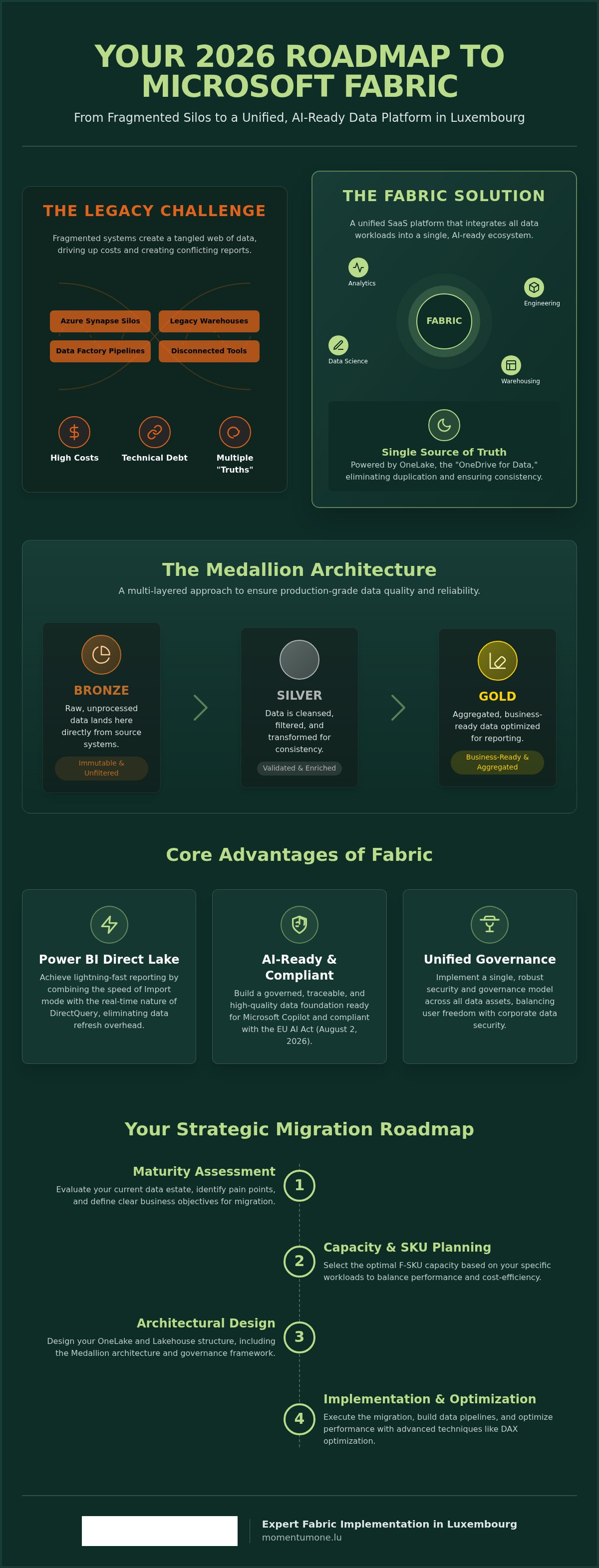
By August 2026, the standard for corporate intelligence has shifted. Microsoft Fabric Luxembourg has become the definitive SaaS-based data platform for organizations that want to move beyond the limitations of legacy systems. For too long, businesses in the region relied on fragmented Azure Synapse and Data Factory silos. This fragmentation created high maintenance costs and significant technical debt. The move toward a unified ecosystem isn't just a technical upgrade; it's a strategic decision to simplify how your team interacts with information.
Central to this new approach is OneLake, which acts as a "OneDrive for data." It removes the complexity of managing multiple storage accounts by providing a single, logical location for every byte of organizational information. OneLake is the central hub for all organizational data storage. By centralizing storage, you enable more effective data analysis across different business units without the need for constant data movement or duplication.
Consolidating Fragmented Data Estates
Disconnected reporting tools often result in "multiple versions of the truth," where different departments present conflicting figures for the same metrics. This lack of consistency erodes trust in your data. Microsoft Fabric creates a "Single Source of Truth" by integrating data engineering, warehousing, and real-time analytics into one environment. This consolidation is particularly vital for multi-departmental organizations that need a clear, real-time view of their performance. If you're currently managing a complex web of pipelines, a Fabric migration and modernization project can significantly reduce your operational overhead.
- Retire expensive, siloed ETL pipelines that are difficult to maintain.
- Implement a unified security model that applies across all data assets.
- Empower business users with direct access to curated datasets without compromising quality.
The Role of AI-Ready Analytics in 2026
With the EU AI Act's high-risk obligations coming into effect on August 2, 2026, governed data is no longer optional. It's the essential prerequisite for any successful AI adoption. Microsoft Fabric prepares your foundation for Microsoft Copilot and custom AI models by ensuring your data is traceable and high-quality. In the Luxembourgish financial and corporate sectors, the ability to run real-time analytics on governed data allows for faster, more confident decision-making. We act as a steady hand during this transition, helping you build an infrastructure that is both compliant and ready for the next wave of AI innovation.
Understanding the Microsoft Fabric Architecture: OneLake and Lakehouses
The architecture of Microsoft Fabric Luxembourg is built on a "one copy" principle that simplifies how your organization stores and accesses information. It integrates core components like Data Engineering, Data Factory, and Synapse Real-Time Analytics into a single, cohesive SaaS experience. OneLake eliminates data duplication through "Shortcuts," which allow you to reference data across different domains or cloud providers without moving it. This approach aligns with the broader European strategy for data by promoting accessibility and interoperability within a secure, governed framework.
To maintain production-grade quality, we implement a Medallion architecture within your lakehouses. Your raw, unprocessed data lands in the "Bronze" layer. It's then cleansed, filtered, and transformed in the "Silver" layer to ensure consistency. Finally, the "Gold" layer hosts aggregated, business-ready data optimized for reporting. This structured flow ensures that your downstream analytics are always based on verified, high-quality information, reducing the risk of conflicting reports across departments.
One of the most significant advantages is the synergy between Power BI and the Fabric ecosystem. Direct Lake mode enables lightning-fast reporting by loading Parquet files directly from OneLake into the Power BI engine. You don't need to choose between the speed of Import mode and the real-time nature of DirectQuery anymore. It's the best of both worlds, providing your decision-makers with up-to-the-second insights without the typical overhead of data refreshes.
Data Lakehouse vs. Data Warehouse Design
Traditional SQL warehousing offers strong relational capabilities, but a Lakehouse provides the flexibility of a data lake with the performance of a warehouse. Within the Fabric ecosystem, you can choose the path that fits your specific workload requirements. For many organizations, a successful Data Lakehouse vs Warehouse Design strategy involves using Lakehouses for big data processing and machine learning while retaining Warehouses for complex, SQL-based financial reporting. This hybrid flexibility is a core reason why Luxembourgish firms are modernizing their estates in 2026.
Optimizing for Performance and Scalability
Success in a unified environment depends on precise data modeling and proactive management. Performance bottlenecks often occur when large datasets aren't partitioned correctly or when DAX measures aren't optimized for the underlying storage. As your data volume grows, focusing on data architecture modernization ensures your system remains responsive and cost-effective. Our team acts as a steady hand to help you navigate these technical nuances, ensuring your infrastructure scales seamlessly with your business needs.
Strategic Migration to Microsoft Fabric: A 2026 Roadmap
A successful transition to Microsoft Fabric Luxembourg isn't just about moving files; it's about shifting your operational mindset. By 2026, the increasing complexity of data estates requires a methodical approach that balances immediate wins with long-term stability. We recommend a five-step roadmap to guide this journey and ensure your infrastructure remains a competitive asset rather than a maintenance burden.
First, perform a comprehensive data estate maturity assessment. This gap analysis reveals technical debt within your existing SQL warehouses or Synapse environments. Second, move into capacity planning. Choosing the right F-SKU is vital for cost control. For example, a 1-year reserved commitment can save you approximately 41% over pay-as-you-go pricing. Third, select a pilot project. Target a high-impact, low-complexity use case that demonstrates value to stakeholders early. Fourth, execute a phased migration of your pipelines. Finally, establish a robust governance framework and user enablement plan to ensure sustainable adoption across your teams.
Transitioning from Azure Synapse and Power BI
Many organizations worry about losing their existing investments during a platform shift. You don't have to choose a "big bang" migration that risks business continuity. Instead, a side-by-side approach allows you to run legacy Synapse workloads while building out new capabilities in Fabric. This strategy provides a safety net and allows for thorough testing before decommissioning old systems. For a deeper look at this process, explore our Microsoft Fabric Migration Services guide. It's about evolving your infrastructure without disrupting the flow of vital business insights.
Capacity Planning and Cost Optimization
Managing costs in a SaaS environment requires constant vigilance and a steady hand. Fabric capacity is billed based on Capacity Units (CUs), and over-provisioning can quickly lead to unnecessary expenses. As of August 2026, the break-even point for choosing reserved capacity over pay-as-you-go is roughly 58% of monthly utilization hours. We help you implement monitoring tools to track usage patterns and scale your capacity dynamically. Effective Workspace & Capacity Management ensures you only pay for what you actually use. This proactive stance prevents budget overruns while maintaining the high performance your business users expect.
Governance and Data Literacy: Ensuring Sustainable Adoption
Technical brilliance doesn't guarantee business value. Even the most advanced Microsoft Fabric Luxembourg setup can fail if your users don't trust the data or understand how to use it. A robust governance framework is the backbone of sustainable adoption; it ensures your unified ecosystem remains a "single source of truth" rather than a fragmented "data swamp." With the high-risk obligations of the EU AI Act coming into effect on August 2, 2026, the regulatory environment in Luxembourg has become more stringent. This makes data oversight a legal necessity rather than a technical preference.
Establishing a Center of Excellence (CoE) allows your organization to balance self-service BI freedom with corporate data security. This central body defines the standards for data lineage and quality across OneLake, ensuring every report is traceable and accurate. It's about creating a culture where data is treated as a strategic asset. When your teams know the "who, what, and where" of their data, they can innovate with confidence while staying within the guardrails of your corporate policy. This proactive approach reduces technical debt and ensures your AI-ready infrastructure remains reliable over time.
Establishing a Robust Fabric Governance Framework
A successful framework defines clear roles, responsibilities, and access controls tailored to your specific organizational structure. In 2026, Luxembourg transposed the EU Data Governance Act into domestic law, creating new obligations for data intermediaries. Your Fabric tenant must reflect these requirements through automated governance audits and strict metadata management. We provide specialized Power BI Consulting & Governance services to help you align your technical architecture with these evolving legal standards and CNPD guidelines.
Corporate Training for Luxembourgish Teams
Data literacy is the bridge between a powerful tool and actual business results. Technical developers often speak a different language than business users; training helps close this gap. We offer customized workshops designed to increase proficiency in both Fabric and Power BI, ensuring your staff can build their own insights without compromising data integrity. Investing in Corporate Data Fabric Training empowers your workforce to leverage the full potential of your modernization efforts while maintaining high standards of data quality.
Ready to secure your data estate and empower your team? Explore our governance and training solutions today to build a foundation that lasts.
Partnering with Momentum One: Expert Fabric Implementation in Luxembourg
Momentum One serves as a certified Microsoft Solutions Partner that understands the nuances of the local market. With over 8 years of experience in the Microsoft data ecosystem, we've developed a reputation as a steady hand for organizations navigating high-value transitions. Our approach to Microsoft Fabric Luxembourg goes beyond technical delivery; we focus on a collaborative partnership that empowers your internal teams to take ownership of their data future. Whether you require a complete architectural redesign or specialized DAX optimization, our experts are here to facilitate every step of your journey.
We provide end-to-end services that cover the entire data lifecycle. This includes initial discovery, lakehouse design, and the implementation of scalable analytics. Our goal is to ensure your infrastructure isn't just functional but highly performant. By working as an extension of your team, we simplify the complexity of the 2026 regulatory environment, allowing you to focus on strategic growth rather than technical troubleshooting. We're dedicated to your success and move steadily from broad value propositions to the specific technical capabilities your business needs.
Tailored Migration and Managed Services
Choosing a boutique consultancy offers a level of agility and senior-level attention that large global firms often struggle to match. We don't believe in one-size-fits-all solutions. Instead, we provide ongoing support for performance tuning and capacity management to keep your tenant running at peak efficiency. Our Managed Power BI Services ensure that your reporting environment remains governed and scalable long after the initial implementation is complete. This proactive care helps you avoid technical debt while maintaining the "single source of truth" your leaders rely on.
Why Local Expertise Matters for Global Standards
Operating in Luxembourg requires a deep understanding of local compliance and governance expectations. We bridge the gap between global technical standards and the specific requirements set by the CNPD and national data laws. You get direct access to senior experts who act as strategic facilitators, ensuring your data modernization project meets every benchmark for security and performance. It's time to move past the frustration of siloed systems and high maintenance costs. You can modernize your data stack with Momentum One to unlock the full potential of your corporate intelligence today.
Future-Proof Your Data Strategy in 2026
Modernizing your infrastructure through Microsoft Fabric Luxembourg represents a strategic shift toward organizational clarity and AI readiness. By centralizing your data estate within a unified OneLake ecosystem, you're not just retiring legacy silos; you're building a foundation that scales with your ambitions. Success depends on more than just a tool swap. It requires the right governance framework and a commitment to data literacy that empowers every department to make informed, real-time decisions.
Momentum One is here to act as your steady hand throughout this complex journey. As a certified Microsoft Solutions Partner with over 8 years of data ecosystem expertise, we specialize in high-performance DAX and Fabric architecture. We don't just implement software; we facilitate a collaborative partnership that ensures your team is ready for the future. Take the first step toward a more efficient, insight-driven organization today. Partner with Momentum One for your Microsoft Fabric Migration and let's unlock the full potential of your data together.
Frequently Asked Questions
What is the main benefit of moving to Microsoft Fabric for Luxembourgish companies?
The primary benefit is the consolidation of fragmented data silos into a single source of truth via OneLake. For many organizations in the region, Microsoft Fabric Luxembourg simplifies the move toward an AI-ready infrastructure. It eliminates the need to manage disparate Azure services separately, reducing technical debt and maintenance costs. This unified approach ensures your data is governed and ready for advanced analytics, helping you meet strict local compliance standards while accelerating your digital transformation.
Do we need to replace our entire Azure infrastructure to use Fabric?
You don't need to replace your entire infrastructure to start benefiting from this platform. Fabric uses a feature called "Shortcuts" to logically link your existing data in Azure Data Lake Storage or other clouds without moving it. This allows for a phased evolution rather than a risky rip-and-replace migration. You can continue leveraging your current investments while slowly transitioning workloads to the Fabric environment at a pace that suits your internal resources.
How is Microsoft Fabric different from Power BI Premium?
Power BI Premium is primarily a visualization and reporting tool, whereas Fabric is a complete, end-to-end data analytics platform. While Power BI is a core component of the ecosystem, Fabric adds integrated workloads for data engineering, lakehouse design, and real-time analytics. It provides a shared storage layer (OneLake) and a unified security model that spans across all these functions. Essentially, Fabric expands the capabilities of Power BI into a full-scale data estate management solution.
What are the typical costs associated with a Fabric migration in 2026?
Costs are based on Capacity Units (CUs) through various F-SKUs, providing flexibility for different workload sizes. As of August 2026, an entry-level F2 SKU costs approximately $262.80 per month on a pay-as-you-go basis in the West Europe region. You can achieve significant savings, roughly 41%, by opting for a 1-year reserved capacity. Storage in OneLake is billed separately, typically around $0.023 per GB per month for hot storage, allowing for precise budget management.
Can we use Microsoft Fabric for real-time analytics?
Yes, the platform includes a dedicated Synapse Real-Time Analytics workload specifically designed for high-volume, streaming data. It allows your team to ingest, analyze, and visualize data from sensors, logs, or transactions with extremely low latency. This capability is vital for Luxembourgish firms in the financial and logistics sectors that require up-to-the-second insights. By using the KQL database within Fabric, you can query massive datasets instantly without complex ETL processes or data movement.
How long does a standard Microsoft Fabric implementation roadmap take?
A standard implementation roadmap typically spans three to six months, depending on the complexity of your existing data estate. This timeline includes the initial maturity assessment, pilot project execution, and the phased migration of legacy pipelines. We focus on delivering immediate value through high-impact use cases while building a sustainable governance framework. This structured approach ensures a smooth transition that minimizes business disruption and sets a clear path for long-term scalability and user adoption.
What role does DAX optimization play in a Fabric environment?
DAX optimization is essential for maintaining high performance, especially when using the Direct Lake mode for reporting. Well-structured DAX measures reduce the load on your Fabric capacity, ensuring that reports remain responsive even with large datasets. Inefficient calculations can lead to performance bottlenecks and increased operational costs. Our experts focus on refining your data models and optimizing DAX to ensure your analytics environment runs at peak efficiency without unnecessary resource consumption.
How does Momentum One support Fabric governance and training?
We provide specialized training and governance consulting to ensure your internal teams can manage the new ecosystem confidently. Our approach involves establishing a Center of Excellence (CoE) that aligns your technical architecture with CNPD guidelines and the EU AI Act. Through customized workshops and project-based consulting, we bridge the literacy gap between developers and business users. We act as a steady hand, providing the expert facilitation needed to maintain a secure, compliant, and high-performing data environment.