Microsoft Fabric Migration Guide: Modernize Your Data
Use our Fabric migration guide to modernize your data estate. Learn to move from Azure Synapse, cut costs by 40-70%, and build a future-proof lakehouse.
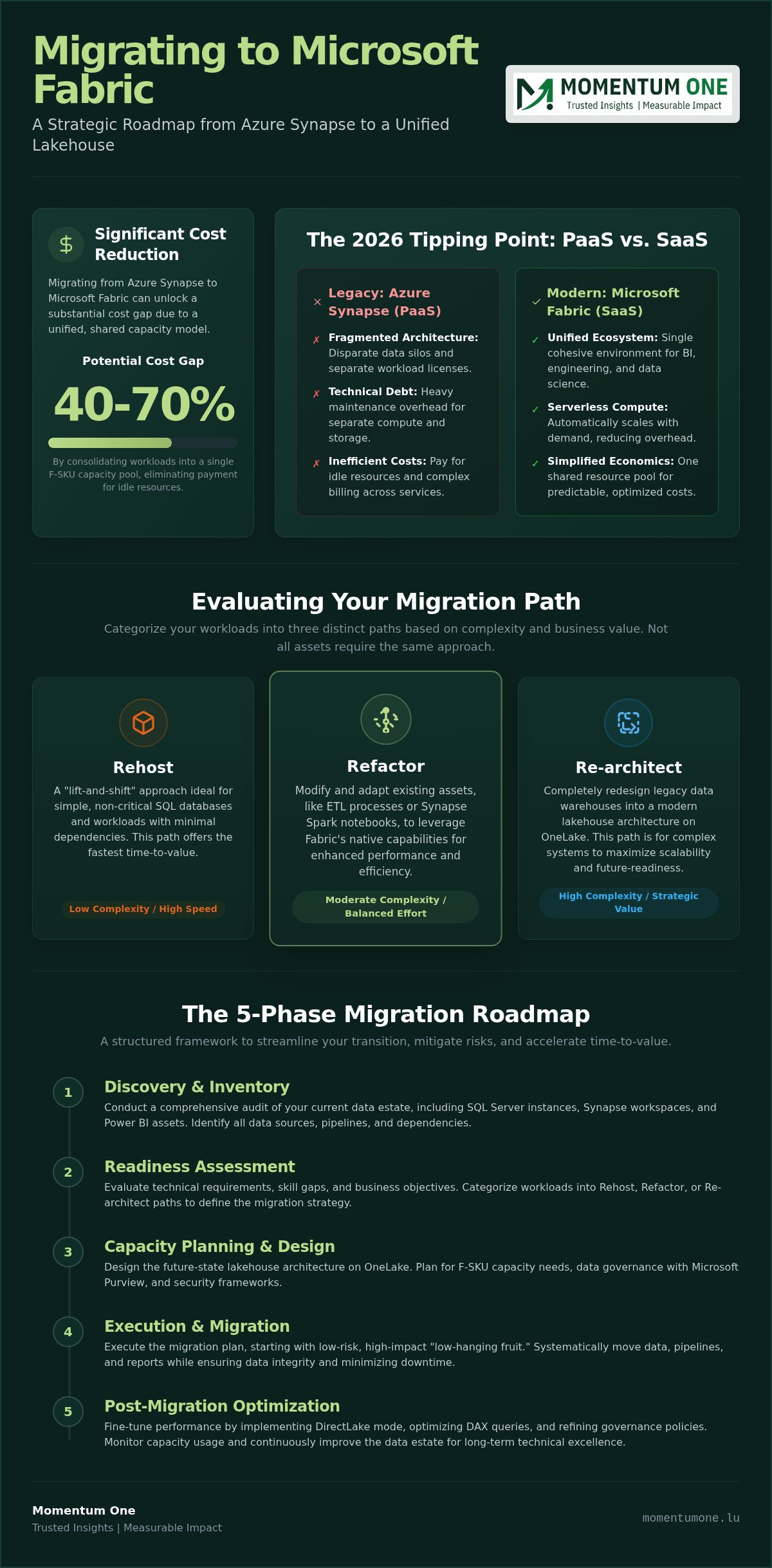
- Identify why 2026 represents a critical tipping point for shifting from legacy PaaS to a unified SaaS data ecosystem.
- Use this fabric migration guide to determine if your environment requires a rehost, refactor, or a complete architectural re-design.
- Execute a structured 5-phase roadmap that streamlines discovery, readiness assessments, and capacity planning.
- Enhance report speed and data freshness by implementing DirectLake mode and advanced DAX optimization strategies.
- Mitigate technical risks and accelerate time-to-value by aligning your migration with strategic governance and expert-led design.
Migrating from Azure Synapse to Microsoft Fabric can lead to a cost gap of 40 to 70 percent because Fabric shares a single capacity across every workload. Using this fabric migration guide, you can turn that potential efficiency into a reality without the typical headaches. We understand that moving away from legacy SQL pools feels risky, especially when you're already managing technical debt and the complexity of disparate data silos. It's a lot to handle when your team's productivity and your organization's AI readiness are on the line.
Master the transition to a unified data ecosystem with our comprehensive framework for planning, executing, and optimizing your move. We'll show you how to modernize your architecture into a scalable lakehouse that improves DAX efficiency and eliminates the uncertainty of capacity planning. We're moving beyond a simple lift-and-shift to ensure your data estate is truly future-proof. This guide provides a clear, risk-mitigated path to a high-performance environment that supports long-term growth and technical excellence.
Understanding the Microsoft Fabric Migration Landscape in 2026
The data ecosystem has reached a definitive turning point. As we move through 2026, the shift from Platform-as-a-Service (PaaS) to Software-as-a-Service (SaaS) is no longer a luxury for early adopters; it's a requirement for competitive performance. Microsoft Fabric represents the unified SaaS evolution of the entire Microsoft data stack. It brings together data engineering, data science, and business intelligence into a single, cohesive environment. This fabric migration guide serves as your roadmap for navigating this shift, helping you move away from fragmented architectures toward a streamlined, future-proof model.
The business case for migrating now is compelling. Organizations moving from Azure Synapse to Microsoft Fabric frequently see a cost gap of 40 to 70 percent because Fabric consolidates billing into one shared pool of resources. Instead of managing separate licenses for every workload, you leverage F-SKU capacities that scale with your needs. This transition allows you to move from "siloed data" to a "data mesh" architecture, where data is accessible, governed, and ready for AI-driven insights without the friction of constant data movement.
The Cost of Delay: Legacy vs. Modern Infrastructure
Sticking with legacy SQL Server or Azure Synapse environments often creates a heavy burden of maintenance overhead. Managing separate compute clusters and storage accounts leads to significant technical debt. Fabric eliminates this by utilizing a serverless compute model that automatically adjusts to demand. For 2026 architectures, Microsoft Fabric represents a single, AI-infused SaaS platform that integrates data engineering, warehousing, and real-time analytics into one cohesive environment. By choosing Fabric migration and modernization, you stop paying for idle resources and start investing in performance.
OneLake: The Foundation of Your New Data Strategy
OneLake acts as the "OneDrive for Data" within your enterprise. It provides a single, unified logical storage layer for your entire organization, which is a massive leap forward in understanding data warehousing and modern lakehouse design. OneLake storage is cost-effective, priced at approximately $0.023 per GB per month, or $23 per TB. This centralized approach eliminates data duplication by allowing different engines to work on the same data through shortcuts. Preparing your data governance framework for this environment ensures that while data is accessible, it remains secure and compliant under a single management umbrella.
Evaluating Your Migration Path: From Legacy to Lakehouse
Before moving a single row of data, you need a clear inventory of your current technical estate. This audit should cover your SQL Server instances, Azure Synapse workspaces, and Power BI Gen1 assets. A successful fabric migration guide strategy doesn't treat every workload the same. Instead, it categorizes them into three distinct paths based on complexity and business value. You might rehost simple SQL databases, refactor existing ETL processes for better performance, or completely re-architect legacy warehouses into a modern lakehouse. Understanding the broader data fabric architecture provides the necessary context for why these choices matter; it's about creating a flexible, interconnected layer rather than just another storage silo.
Identifying "low-hanging fruit" is essential for building early momentum. Start with smaller, non-critical Power BI datasets or development environments where the impact of a brief transition window is minimal. During this phase, managing data residency and compliance is a top priority. Since Fabric integrates with Microsoft Purview, you can maintain strict governance standards while consolidating your data into OneLake. If you're looking for a structured way to begin this journey, our data architecture modernization services provide the strategic oversight needed to avoid common pitfalls.
Migrating from Azure Synapse Analytics
Transitioning from Synapse requires a methodical approach to compute and orchestration. Dedicated SQL Pools generally move to the Fabric Data Warehouse, while Synapse Spark notebooks can often be imported directly into Fabric Spark environments. You'll also need to migrate your legacy pipelines. Fabric Data Factory offers a familiar interface but adds enhanced capabilities that simplify how you handle complex orchestrations. Reviewing your code during this move often uncovers opportunities to reduce technical debt that has accumulated over years of PaaS management.
Modernizing Power BI Workloads
Modernizing your reporting layer involves more than just changing licenses. Upgrading Dataflows Gen1 to Dataflows Gen2 is a critical step for improving performance and unlocking new destination features. As you move from Power BI Premium capacities to Fabric F-SKUs, you'll find new ways to optimize costs. For example, for organizations with over 50 users, a Fabric F8 Reserved capacity at approximately $661 per month is more cost-effective than paying $1,000 per month for Power BI Premium Per User licenses. To ensure your reporting environment remains secure and efficient, consider exploring specialized Power BI Consulting & Governance to guide your team through the transition.
The 5-Phase Fabric Migration Roadmap
A successful transition to a unified data platform isn't a single event. It's a series of controlled movements that align technical execution with business goals. This fabric migration guide utilizes a five-phase roadmap to ensure your move is predictable and low-risk. By following a structured path, you avoid the common pitfalls of unmanaged data moves, such as broken dependencies or unexpected cost spikes. We treat each phase as a building block for a more resilient architecture.
- Phase 1: Discovery & Readiness Assessment. We begin by auditing your existing data lineage. This involves mapping every SQL pool, Spark job, and Power BI report to understand how they interact.
- Phase 2: Environment Setup and Capacity Planning. Here, we configure your Fabric tenant, establish OneLake organizational structures, and select the appropriate F-SKU capacity for your workloads.
- Phase 3: Pilot Migration. We select a non-critical workload to test our migration pipelines. This allows us to refine our ETL processes and validate performance in the Fabric environment before a full-scale move.
- Phase 4: Full Scale Migration and Data Validation. This is the primary execution phase. We move production data and logic while maintaining a rigorous successful data migration protocol to ensure zero data loss.
- Phase 5: Post-Migration Optimization and User Enablement. Finally, we focus on refining DAX measures, optimizing storage, and training your team to ensure high internal adoption.
Strategic Capacity Planning
Right-sizing your Fabric capacity is vital for balancing performance and cost. Fabric uses F-SKUs, where an F2 capacity starts at approximately $0.36 per hour on a pay-as-you-go basis. To maximize ROI, we often recommend a 1-year reservation, which can result in savings of approximately 41 percent. Understanding "Bursting" and "Smoothing" is equally important. Bursting allows your workloads to consume more compute than your base capacity during peak times, while Smoothing spreads that consumption over a longer period to prevent throttling. Our Workspace & Capacity Management services help you navigate these mechanics to ensure consistent performance.
Validation and Data Quality Assurance
You can't trust your insights if you don't trust your data. During the migration, we automate reconciliation between your legacy sources and OneLake to verify row counts and aggregations. This is especially critical when moving to DirectLake mode, where DAX measure consistency must be perfect to provide near-real-time performance. We establish a "single source of truth" audit protocol that remains in place long after the migration is complete. This ensures that as your data estate grows, your governance remains airtight and your reports stay accurate.
Post-Migration Success: Optimizing Performance and Governance
The technical transfer of your datasets is a major milestone, but it's not the finish line. This fabric migration guide emphasizes that post-migration optimization is where you truly unlock the platform's potential. Without a focus on performance tuning and governance, you risk carrying over the same inefficiencies that plagued your legacy environment. We treat the post-migration phase as a strategic opportunity to refine your data's performance and ensure your team can use it effectively. Moving beyond the "move" means ensuring your new environment is faster, cheaper, and more reliable than the one you left behind.
One of the most powerful tools at your disposal is DirectLake mode. It allows Power BI to access data directly from OneLake without the need for traditional data refreshes or the latency of DirectQuery. Achieving this level of speed requires rigorous DAX optimization. If your measures are overly complex or unoptimized, the system may fall back to DirectQuery mode, which significantly slows down report performance. We help you audit these measures to keep your reports running at peak efficiency while maintaining a clear governance framework for self-service BI.
Advanced Performance Tuning
Optimizing your storage layer is just as important as refining your queries. By applying V-Order to your Delta Parquet files, you can achieve faster query execution and reduced storage footprints. This technical refinement ensures that your Fabric capacity is used for high-value processing rather than struggling with unoptimized files. For organizations looking for long-term stability, our Managed Power BI Services provide the ongoing monitoring needed to maintain these gains as your data volume grows. Reducing compute pressure on your Fabric capacity directly translates to lower operational costs over time.
Automating Data Pipelines
Modernizing your ETL processes involves moving beyond static schedules to dynamic, automated workflows. Fabric Data Factory provides a unified interface for managing these pipelines, making it easier to implement CI/CD for your data deployments. This automation reduces manual errors and ensures that changes are tested before they reach production. If you want to streamline your operations further, consider exploring our solutions for pipeline and dataflow automation to build a more resilient data infrastructure. This approach ensures your data remains fresh and your pipelines stay manageable as your business requirements evolve.
Maintaining this level of performance requires a steady hand and a proactive approach to capacity management. By monitoring your Fabric usage through the Capacity Metrics app, you can prevent unexpected cost overruns and ensure that your resources are allocated to the most critical business functions. If you're ready to secure your data's future and maximize your ROI, partner with us for workspace and capacity management to ensure your environment remains optimized 24/7.
Partnering for a Seamless Microsoft Fabric Transition
Migrating to a unified SaaS platform is a significant undertaking that requires more than just technical scripts. An expert-led transition reduces the risk of operational disruption and ensures your organization realizes a faster return on investment. Our approach at Momentum One combines strategic architectural design with precise technical execution. We don't just move your tables; we review your entire data estate to ensure it supports your long-term business goals. This fabric migration guide has outlined the technical steps, but the final piece of the puzzle is the partnership that guides you through the complexities of the 2026 data landscape.
We bridge the gap between back-end data engineering and front-end business intelligence. By aligning these two often-siloed departments, we create a seamless flow of information that empowers decision-makers. As a certified Microsoft Solutions Partner with over 8 years of experience in ecosystem modernization, we act as a steady hand for teams navigating these changes. We help you move beyond the uncertainty of capacity planning and technical debt into a streamlined, high-performance future. Our goal is to simplify the complexity rather than hiding behind it, ensuring your transition is both transparent and effective.
Corporate Training and Adoption
Technology is only as effective as the people who use it. Transitioning to a "OneLake" mindset requires your data team to rethink how they store, share, and govern information. We facilitate this shift through technical workshops and corporate data fabric training designed to build a strong data-driven culture. This upskilling process ensures that your internal teams aren't just observers of the migration but active participants in your new data ecosystem. By focusing on the human element, we help you secure long-term adoption and maximize the value of your Fabric investment.
Continuous Support and Managed Services
Peak performance requires constant vigilance. Our managed services provide the ongoing monitoring and architectural reviews needed to maintain your Fabric environment at its best. We ensure your critical workloads remain available and your capacity usage stays optimized as your data needs evolve. This proactive support model prevents performance bottlenecks before they impact your business operations. If you're ready to start your journey with a partner invested in your success, schedule a Fabric migration consultation today to begin your modernization journey.
Securing Your Data's Future in the Fabric Era
Transitioning to Microsoft Fabric is more than a technical shift; it's a strategic move toward a unified, AI-ready data estate. By following this fabric migration guide, you've seen how a structured 5-phase roadmap and a focus on post-migration optimization can eliminate technical debt and reduce operational costs. The journey from legacy SQL pools to a modern Lakehouse architecture requires careful capacity planning and a commitment to team upskilling to ensure long-term success. With the right foundation, your organization can move beyond data silos and embrace a truly integrated experience.
As a certified Microsoft Solutions Partner, Momentum One brings deep expertise in enterprise-scale Data Lakehouse design and high-performance DAX optimization. We don't just facilitate the move; we partner with you to ensure your architecture is scalable and your reports are faster than ever. If you're ready to eliminate complexity and accelerate your ROI, modernize your data stack with Momentum One’s Fabric Migration Services. Let’s build a future-proof data ecosystem together.
Frequently Asked Questions
What is the first step in a Microsoft Fabric migration guide?
The first step is a comprehensive Discovery and Readiness Assessment of your existing data estate. You need to map out your current SQL databases, Synapse workspaces, and Power BI reports to identify dependencies and technical debt. This phase ensures you understand the scope of the move before any technical execution begins. Using a structured fabric migration guide approach at this stage prevents unexpected roadblocks during the actual data transfer.
Can I migrate from Azure Synapse to Microsoft Fabric without downtime?
You can achieve a near-zero downtime transition by implementing a side-by-side migration strategy. This involves keeping your legacy Synapse environment active while you build and test your new Fabric architecture. By leveraging OneLake shortcuts, you can reference existing data without immediate movement. This allows for a graceful cutover once your validation tests confirm that the new pipelines and reports are performing exactly as expected.
How does Microsoft Fabric capacity planning differ from Power BI Premium?
Fabric capacity planning centers on F-SKUs, which provide a shared pool of compute resources for every workload in the tenant. Unlike the older Power BI Premium per-user or P-SKU models, Fabric capacity is highly flexible. It utilizes "Bursting" to handle peak demands and "Smoothing" to average out consumption over time. This model often leads to significant savings, especially when you utilize 1-year reservations to reduce costs by approximately 41 percent.
Is it necessary to rewrite my SQL scripts when moving to Fabric Data Warehouse?
While Fabric Data Warehouse supports a high degree of T-SQL compatibility, some refactoring is usually required. Scripts originally written for Synapse dedicated SQL pools might need updates to align with Fabric’s serverless compute model and its specific handling of distributed tables. We view this as a strategic opportunity to clean up legacy code. Refactoring during migration often results in better query performance and lower resource consumption in the new environment.
What are the main benefits of migrating to a Lakehouse architecture in 2026?
Migrating to a Lakehouse architecture in 2026 provides a unified, AI-ready foundation that eliminates traditional data silos. You benefit from OneLake storage, which is cost-effective at approximately $23 per TB per month. This architecture allows data engineers and data scientists to work from the same "single source of truth" without duplicating files. It simplifies your governance framework while providing the scalability needed for modern machine learning and real-time analytics workloads.
How does DirectLake mode impact report performance after migration?
DirectLake mode significantly boosts report performance by allowing the Power BI engine to load Delta Parquet files directly from OneLake. This eliminates the need for time-consuming data refreshes and avoids the latency issues common with DirectQuery. For this to work effectively, your DAX measures must be highly optimized. If the queries are too complex, the system might fall back to DirectQuery, so keeping your model lean is essential for maintaining near-real-time speed.
Should I migrate all my data at once or use a phased approach?
A phased approach is almost always the safer and more efficient choice for enterprise environments. Start with a pilot migration of non-critical workloads to test your pipelines and validate your capacity requirements. This incremental method allows your team to learn the nuances of the platform without risking production stability. Once the initial phase is successful, you can scale the migration to include your most critical business intelligence and data warehousing assets.