Microsoft Fabric Readiness: Strategic Guide for 2026
Prepare for 2026 with our strategic guide. A Microsoft Fabric readiness assessment is key to a smooth migration, better performance, and lower costs. Get you...
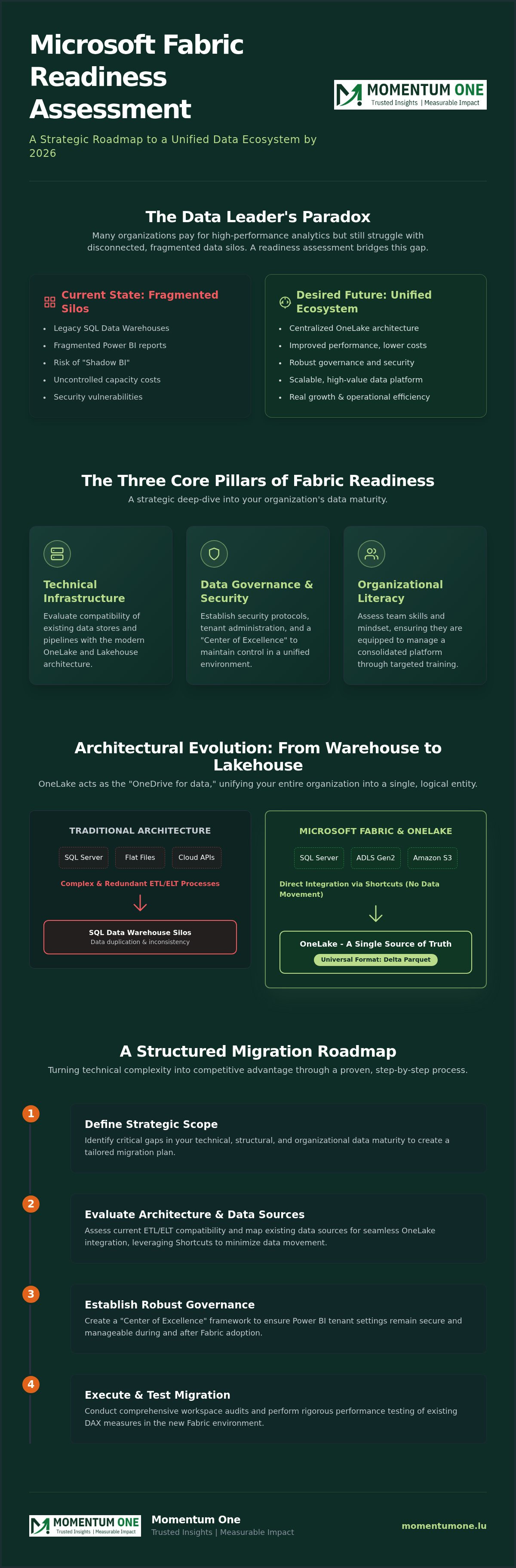
- Define the strategic scope of a Microsoft Fabric readiness assessment to identify critical gaps in your technical, structural, and organizational data maturity.
- Evaluate your transition from traditional SQL Data Warehouses to the Fabric Lakehouse by assessing current ETL/ELT compatibility for seamless OneLake integration.
- Establish a robust governance framework and a "Center of Excellence" mindset to ensure your Power BI tenant settings remain secure and manageable during Fabric adoption.
- Execute a structured migration roadmap that includes comprehensive workspace audits and rigorous performance testing of existing DAX measures in the new environment.
- Leverage expert facilitation to turn technical complexity into a competitive advantage, ensuring a seamless modernization journey that improves performance while lowering operational costs.
Could your organization be paying for high-performance analytics while still struggling with fragmented data silos? Many data leaders in Luxembourg face this exact paradox as they eye a transition to a unified ecosystem. The complexity of moving away from legacy structures while maintaining the integrity of existing Power BI reports can feel overwhelming. Conducting a comprehensive Microsoft Fabric readiness assessment isn't just a technical box to tick; it's a strategic necessity to ensure your architecture, governance, and team skills are aligned for the 2026 landscape.
It's natural to feel uncertain about the shift from per-user licensing to capacity-based pricing or to worry about the learning curve of Lakehouse architecture. We understand that you need more than just a software upgrade. You need a roadmap that guarantees improved performance and lower costs. In this guide, you'll discover how to evaluate your current infrastructure and build a secure governance framework. We provide a clear checklist for technical readiness and a strategic plan to help your team transition with confidence. This approach ensures your migration results in a high-value, scalable data platform that drives real growth and operational efficiency.
What is a Microsoft Fabric Readiness Assessment?
Adopting a unified data platform is a significant milestone for any data-driven organization. A Microsoft Fabric readiness assessment acts as a comprehensive audit of your technical, structural, and organizational data maturity. It isn't merely a checklist of hardware requirements. Instead, it's a strategic deep dive designed to uncover the specific gaps between your current Azure or Power BI setups and the streamlined requirements of the Fabric ecosystem.
As we move through 2026, the urgency for this evaluation has intensified. Microsoft is increasingly prioritizing the consolidation of analytics services. This makes 2026 the critical year for decommissioning legacy Azure Synapse instances or fragmented Power BI silos that no longer serve your growth. Without a formal assessment, organizations risk the rise of "shadow BI," where departments create unofficial data solutions that lead to security vulnerabilities and uncontrolled capacity costs.
The Core Pillars of Fabric Readiness
A successful transition rests on three foundational areas. First, we evaluate your technical infrastructure to ensure compatibility with OneLake. This involves analyzing how your existing data stores will integrate with a modern data lakehouse architecture. Second, we focus on data governance. This pillar establishes the security protocols and tenant administration necessary to maintain control in a unified environment. Finally, we assess organizational literacy. Moving to Fabric requires a shift in mindset; your team must be equipped to manage a consolidated platform through targeted corporate data fabric training.
Why a Readiness Assessment Saves Costs
Financial efficiency is a primary goal of any modernization project. By identifying redundant data pipelines early, you can eliminate unnecessary processes that inflate compute expenses. Fabric Capacity is the primary cost driver in 2026. Understanding how to manage this resource is vital for maintaining a healthy ROI. A thorough assessment also prevents the high costs associated with failed migrations by spotting architectural bottlenecks before they cause downtime. Our approach to Fabric migration and modernization ensures that your transition is both technically sound and fiscally responsible.
Evaluating Your Data Architecture for OneLake Integration
OneLake represents the "OneDrive for data," centralizing your entire organizational footprint into a single, logical entity. During a Microsoft Fabric readiness assessment, we analyze how your current architecture translates into this unified environment. The shift from traditional SQL Data Warehouses to a Fabric Lakehouse is more than a simple name change. It's a fundamental transition to a more flexible, open-source storage standard that reduces silos and improves accessibility.
Mapping your existing data sources is the first step in this architectural evaluation. We examine how data currently enters your system, whether through on-premises SQL servers, cloud-based APIs, or flat files. Fabric supports multiple ingestion methods, but the primary goal is to minimize unnecessary data movement. This is where "Shortcuts" become a strategic advantage. They allow you to reference data stored in Azure Data Lake Storage (ADLS) Gen2 or even Amazon S3 without copying it. This approach reduces storage costs and ensures a single version of truth across the enterprise.
Lakehouse vs Warehouse: Deciding Your Foundation
Choosing the right foundation is critical for long-term performance and scalability. A Lakehouse uses Spark-based engines for big data processing, while a Warehouse provides a familiar T-SQL experience for structured data. We help you determine when to use the SQL Analytics Endpoint for reporting versus Spark for complex data engineering. Central to this decision is the use of Delta Parquet. This universal storage format ensures that your data remains accessible across all Fabric engines without the need for translation. If you're struggling to decide which path fits your specific needs, our team provides expert data warehouse and lakehouse design to ensure your architecture is future-proof.
Assessing Data Pipeline Automation
Your existing ETL and ELT processes are the lifeblood of your analytics. We review your current orchestration tools, such as Azure Data Factory or SSIS, to see how they fit into the new ecosystem. Fabric Data Factory offers a low-code environment that simplifies many of these tasks, yet not every legacy pipeline is a candidate for a direct "lift and shift." We identify which processes need refactoring to take advantage of pipeline and dataflow automation. This assessment also highlights opportunities for real-time analytics integration, allowing your business to react to data as it happens rather than hours later.
If you're unsure about your current state, a strategic Fabric migration and modernization plan can clarify your path forward and ensure a seamless transition.
Governance and Security: Preparing Your Tenant
Governance is the bedrock of a scalable data culture. During a Microsoft Fabric readiness assessment, we shift the focus from simple report management to comprehensive tenant administration. This process begins with a meticulous audit of your Power BI tenant settings. It's vital to enable Fabric features selectively, ensuring that only authorized users can create high-compute items like Lakehouses or Data Warehouses. This controlled rollout prevents resource sprawl and keeps your environment manageable from day one.
Establishing a "Center of Excellence" (CoE) mindset is equally important. Rather than acting as a centralized bottleneck, your CoE should guide decentralized business units. By defining domain-based governance, you empower local teams to own their data while maintaining global standards for security and quality. This proactive approach ensures that your transition to Fabric is a catalyst for organizational growth rather than a source of administrative friction. It's about building trust in the data before the first dashboard is even published.
Managing capacity requires a strategic shift in financial thinking. As Microsoft retires Power BI Premium P-SKUs in favor of Fabric F-SKUs, organizations must adapt to a more granular consumption model. F-SKUs offer the flexibility of pay-as-you-go or reserved instances, but they demand robust cost-tracking readiness. The F64 capacity represents a critical threshold, as it eliminates the need for individual Power BI Pro licenses for content viewers, fundamentally changing your licensing ROI. Our assessment helps you map your current usage to the most efficient capacity size, ensuring you don't overspend on idle resources.
Tenant Administration and Workspace Strategy
A successful Fabric deployment relies on a well-defined workspace strategy. We help you implement Workspace and Capacity Optimization techniques to balance performance and cost. This includes establishing clear naming conventions and automated deployment pipelines. By standardizing how Fabric items are moved from development to production, you reduce the risk of manual errors. This structure ensures a consistent experience across all business domains while protecting the integrity of your production environment.
Compliance and Data Sovereignty
For enterprises in Luxembourg, data residency and sovereignty are non-negotiable. While OneLake provides a unified view, we must ensure that your data residency requirements are strictly met within the global infrastructure. We audit user access levels to prevent unauthorized use of "Discovery" features that could expose sensitive metadata. This deep dive is often part of a broader Power BI Architectural Review, providing you with the peace of mind that your unified platform remains fully compliant with local regulations and internal security protocols.
The Migration Roadmap: From Power BI to Fabric
A structured roadmap turns the theoretical findings of a Microsoft Fabric readiness assessment into a series of logical, low-risk execution phases. Moving from a Power BI-centric environment to a unified Fabric ecosystem requires a methodical approach to ensure continuity. We don't recommend a "big bang" migration. Instead, we advocate for a phased transition that prioritizes stability and early wins. This process begins with a comprehensive inventory and audit of your existing Power BI workspaces, datasets, and report dependencies to identify what should move, what should be retired, and what needs refactoring.
Once the landscape is clear, the next step involves rigorous performance testing of existing DAX measures within the Fabric environment. This technical validation ensures that your logic holds up under new engine architectures. We then select a pilot project, choosing a high-impact but low-risk use case that demonstrates the platform's value to stakeholders without jeopardizing critical operations. Finally, we execute a phased rollout, accompanied by user enablement training to ensure that the transition is supported at every level of the organization.
Optimizing DAX and Data Models for Fabric
Transitioning to Fabric introduces DirectLake mode, a revolutionary storage technology that provides the performance of Import mode with the real-time capabilities of DirectQuery. However, achieving this speed depends on your model's health. Professional DAX optimization is critical because complex or inefficient measures can cause a "fallback" to DirectQuery, significantly slowing down report performance. During the assessment, we evaluate your current data models to identify complex structures that require refactoring to leverage high-performance analytics effectively.
User Enablement and Corporate Training
A unified platform bridges the traditional gap between business users and data engineers, but this synergy only happens if both groups speak the same language. We emphasize the need for corporate data fabric training to help your team navigate new tools like Lakehouses and Data Factory pipelines. Technical readiness is nullified without widespread user adoption. By investing in literacy early, you ensure that your staff can manage the platform independently. If you're ready to start your journey, our team provides the expert guidance needed for a successful Fabric migration and modernization project.
Partnering with Momentum One for Fabric Excellence
Technical complexity shouldn't be a barrier to your organization's growth. At Momentum One, we act as a steady hand during complex migrations, ensuring that your transition to a unified data environment is both seamless and strategic. As a certified Microsoft Solutions Partner, we bring a high level of technical expertise and a genuine commitment to your success. Our tailored approach to Fabric migration and modernization prioritizes your business outcomes, turning a software upgrade into a foundation for long-term performance.
Effective migration doesn't end when the data moves. We provide ongoing support through managed services to maintain governance and stability post-migration. This dedication ensures that your new ecosystem remains secure, compliant, and optimized as your data volumes grow. By partnering with us, you gain a proactive ally that simplifies the intricacies of the Microsoft Fabric landscape, allowing your team to focus on extracting value from your data rather than managing infrastructure.
Our Assessment Methodology
We believe that clarity is the first step toward modernization. Our Microsoft Fabric readiness assessment begins with deep-dive technical audits of your current environment. We don't just look at your datasets; we analyze your entire architecture to identify bottlenecks and opportunities for efficiency. This technical phase is followed by an executive-level strategic roadmap that aligns your technology with your business goals. We focus on performance, scalability, and predictable cost management to ensure your investment delivers a clear ROI.
Our methodology integrates perfectly with our existing Power BI Consulting and Governance frameworks. This ensures that while we build for the future, we protect the integrity of your current reporting assets. We evaluate every workspace and capacity setting to ensure your tenant is ready for the high-performance demands of 2026. This holistic view prevents "shadow BI" and ensures that your governance protocols are robust enough to handle a decentralized, unified platform.
Next Steps: Securing Your Data Future
The data landscape of 2026 will be defined by AI-driven analytics and real-time insights. Ensuring your infrastructure is ready for these advancements starts with a clear plan today. We help you initiate a pilot program with our expert facilitators to test high-impact use cases in a controlled environment. This approach allows you to validate the platform's benefits while minimizing risk to your daily operations. It's time to move beyond fragmented silos and embrace a future of unified data excellence. Schedule your Microsoft Fabric readiness assessment with Momentum One to secure your competitive advantage in the Luxembourgish market.
Secure Your Competitive Edge with Strategic Data Modernization
Transitioning to a unified data ecosystem represents a fundamental shift in how your organization handles intelligence. Success requires more than just a technical migration; it demands a synergy between architecture, governance, and user literacy. By auditing your current Power BI tenant and optimizing data models for DirectLake, you ensure your platform is built for the performance demands of 2026. This proactive approach turns technical complexity into a distinct operational advantage.
A formal Microsoft Fabric readiness assessment serves as your strategic blueprint, helping you avoid uncontrolled capacity costs and architectural bottlenecks. As a Certified Microsoft Solutions Partner and specialists in DAX and data modeling, Momentum One provides the technical precision needed for high-value migrations. Our comprehensive managed BI services ensure your governance remains stable and scalable long after the initial setup. We're dedicated to helping you turn today's challenges into tomorrow's growth.
Book Your Microsoft Fabric Readiness Assessment
Let's build a future where your data works as hard as you do.
Frequently Asked Questions
What is the difference between a Power BI audit and a Fabric readiness assessment?
A Power BI audit focuses on existing reports, workspace settings, and user access. In contrast, a Microsoft Fabric readiness assessment evaluates your entire data architecture. It examines OneLake integration, capacity scaling, and end to end governance across engineering and analytics workloads. This broader scope ensures your technical foundation is prepared for a unified platform rather than just a reporting tool.
Do we need to move all our data to OneLake immediately?
You don't need to migrate every dataset at once. Fabric allows you to use "Shortcuts" to link existing data in Azure Data Lake Storage Gen2 or Amazon S3 directly into OneLake. This strategy lets you leverage Fabric features without the cost and risk of a full scale data relocation. It's a pragmatic way to modernize your architecture while maintaining operational continuity.
How does Microsoft Fabric readiness impact our current Power BI Premium licensing?
Microsoft is retiring Power BI Premium per capacity SKUs in favor of Fabric Capacity F-SKUs. An assessment helps you determine if an F64 capacity is the right threshold for your organization. This specific level is critical because it maintains free viewer access for users without individual Pro licenses. We help you map your current usage to the most cost effective capacity model.
Can we keep our existing Azure Synapse Spark pools during the transition?
While you can maintain existing pools for a time, Fabric offers integrated Spark engines optimized for the Lakehouse architecture. We typically recommend migrating these pools to Fabric during the modernization phase. This allows you to take advantage of superior performance and unified billing within a single capacity model. It also simplifies your management overhead by consolidating disparate compute resources.
What are the most common technical blockers found during an assessment?
Common blockers include complex legacy DAX measures that don't support DirectLake "fallback" efficiently. Fragmented tenant settings and incompatible on-premises gateway configurations also frequently cause delays. Identifying these specific hurdles early is a primary goal of a Microsoft Fabric readiness assessment. Addressing these issues before migration prevents performance degradation and ensures a smoother transition for your end users.
How long does a typical Microsoft Fabric readiness assessment take for an enterprise?
A typical Microsoft Fabric readiness assessment for a Luxembourgish enterprise takes between three to six weeks. This timeframe depends on the complexity of your existing architecture and the number of stakeholders involved. The process includes technical deep dives, data modeling audits, and the delivery of a comprehensive migration roadmap. This structured timeline ensures we capture all requirements without rushing the strategic planning phase.
Is corporate training included in the readiness phase?
We treat training as a vital component of the readiness journey. Technical infrastructure is only half the battle; your team must understand how to manage Lakehouses and Data Factory pipelines. Investing in literacy early ensures the long term stability of your new data ecosystem. We provide targeted sessions to bridge the gap between business users and data engineers, ensuring everyone can use the platform effectively.
What happens to our existing DAX measures when moving to Fabric?
Your DAX measures will continue to work, but they may need optimization to leverage the speed of DirectLake storage. We audit complex measures during the assessment to prevent performance issues. If a measure is too complex, it might cause a fallback to slower query modes. Our goal is to refactor these models so you get the maximum performance benefit from the new architecture.