Microsoft Fabric vs Azure Synapse: The 2026 Comparison and Migration Guide
Microsoft Fabric and Azure Synapse both support modern analytics, but they differ in architecture, user experience, AI integration, and operational simplicity. This guide compares the two platforms, outlines migration strategies, and helps organizations choose the right path for scalable, cost-effective, and AI-ready data modernization.
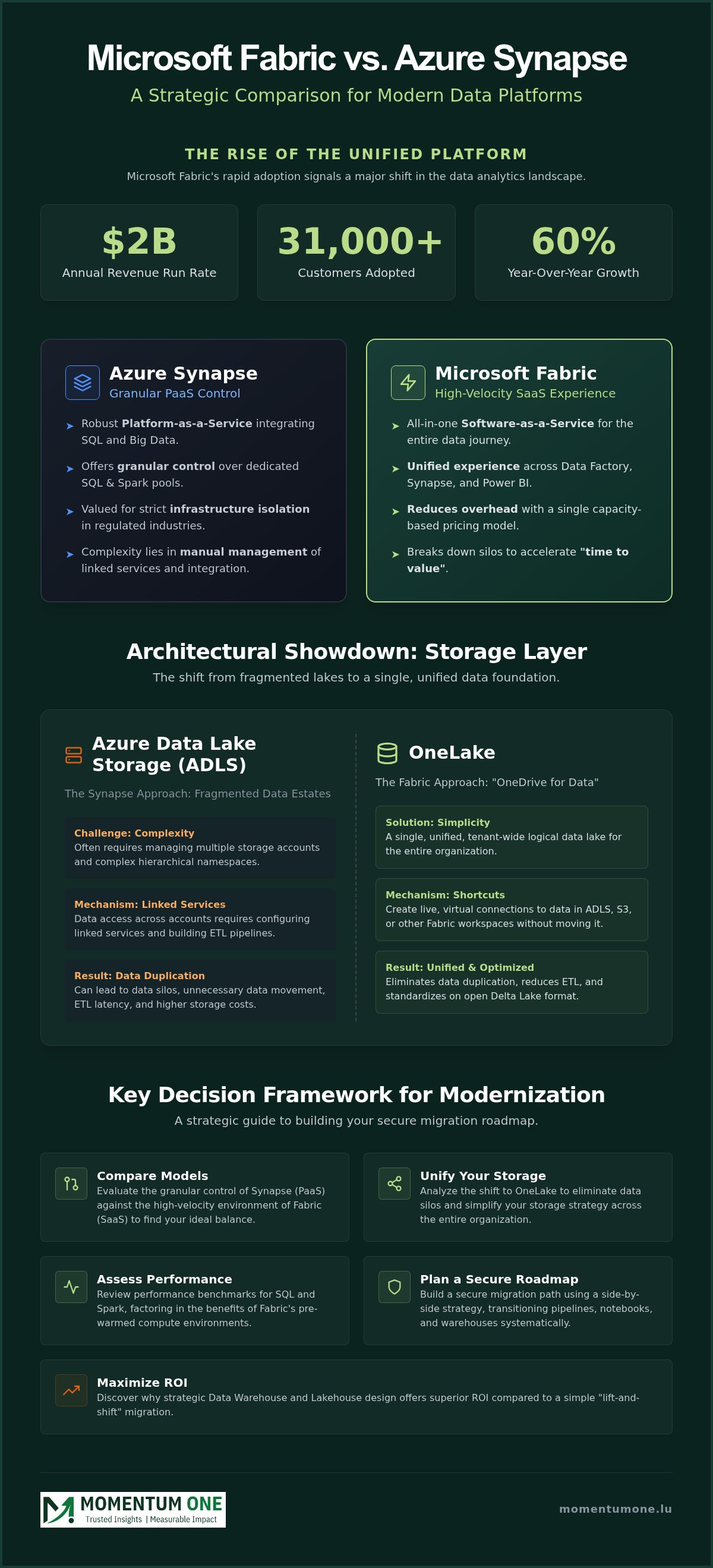
- Compare the granular control of Azure Synapse PaaS with the high-velocity SaaS environment of Microsoft Fabric to find your ideal balance.
- Analyze the architectural shift to OneLake to eliminate data silos and simplify your storage strategy across the entire organization.
- Assess 2026 performance benchmarks for SQL and Spark workloads, including the benefits of pre-warmed compute environments.
- Build a secure modernization roadmap using a side-by-side strategy for your Microsoft Fabric vs Azure Synapse transition.
- Discover why strategic data warehouse and lakehouse design offers superior ROI compared to a simple lift-and-shift migration.
By mid-2026, Microsoft Fabric has reached a $2 billion annual revenue run rate, with over 31,000 customers already making the leap to this unified platform. This rapid adoption highlights a significant shift in how organizations manage their data. You've likely spent years fine-tuning your Azure Synapse environment, yet you're still facing the complexity of managing multiple PaaS services and the rising operational costs of legacy SQL pools. It's exhausting to bridge the gap between your data engineers and BI teams when silos keep appearing despite your best integration efforts.
This article provides a definitive 2026 comparison of Microsoft Fabric vs Azure Synapse to help you decide when and how to modernize. We'll explore the fundamental shift from PaaS control to SaaS velocity and explain how Fabric's capacity-based pricing can simplify your budget. You'll gain a clear decision framework for migration timing and a structured roadmap to transition your pipelines, notebooks, and warehouses into a high-performance Lakehouse architecture. Whether you're staying on Synapse for stability or eyeing the 60% year-over-year growth of Fabric, we're here to guide your strategy with technical expertise and a focus on your long-term success.
The Evolution of Microsoft Data Analytics: From Synapse to Fabric
Microsoft's approach to data has undergone a fundamental transformation. For years, Azure Synapse Analytics served as the heavy-duty engine for enterprise data warehousing. It provided the high-performance "Lego blocks" of Microsoft's cloud ecosystem, allowing architects to assemble complex, customized environments tailored to specific needs. However, as we evaluate the Microsoft Fabric vs Azure Synapse landscape in 2026, the focus has shifted from assembly to outcomes. Microsoft Fabric represents an evolution into a Software-as-a-Service (SaaS) model, where the burden of infrastructure management is replaced by a unified, high-velocity experience.
The core philosophy driving this shift is the move from fragmented PaaS services to an "all-in-one" solution. In the traditional Synapse model, teams had to provision, scale, and secure individual components separately. Fabric changes this by offering a single capacity that powers everything from data integration to business intelligence. This transition isn't just about technical features; it's about reducing the "time to value" for organizations that can no longer afford the overhead of manual system integration.
Azure Synapse: The Power of Granular PaaS Control
Azure Synapse established itself as a robust Platform-as-a-Service (PaaS) solution by integrating SQL warehousing and big data processing. Its architecture relies on dedicated SQL pools and Spark pools, offering granular control that many highly regulated industries still value for strict infrastructure isolation. The trade-off for this control is complexity. Teams often spend significant time managing linked services and integration runtimes across disparate components. It's a powerful system, but it requires constant manual effort to maintain the underlying plumbing.
Microsoft Fabric: The SaaS Revolution for Data Teams
Microsoft Fabric changes the cultural dynamic of data teams by removing the technical friction of environment setup. It centralizes Data Factory, Synapse engineering, and Power BI into a single user interface. This structural shift breaks down the historical silos between data engineers and business analysts. By adopting a SaaS model, Fabric eliminates the need to stitch together separate services. Teams can move directly from ingestion to insight without the traditional overhead of provisioning and scaling individual resources.
Enterprises are re-evaluating their Synapse investments now because the market has reached a tipping point. By mid-2026, Microsoft Fabric has surpassed a $2 billion annual revenue run rate, serving more than 31,000 customers. While Synapse remains a stable platform, Microsoft's development focus has clearly moved to the SaaS model. For organizations looking to maximize agility and reduce management overhead, a strategic Fabric Migration & Modernization roadmap is no longer a luxury but a necessity for staying competitive in a data-driven market.
Architectural Showdown: OneLake vs. Azure Data Lake Storage (ADLS)
The primary architectural difference between these platforms lies in the storage layer. Azure Synapse relies on Azure Data Lake Storage (ADLS) Gen2, which often requires managing multiple storage accounts and complex hierarchical namespaces. This can lead to fragmented data estates where engineers spend more time managing permissions and path structures than analyzing data. In contrast, Microsoft Fabric introduces OneLake, a single, unified data lake for the entire organization. This "OneDrive for Data" concept significantly reduces data duplication by providing a logical storage layer where every workspace stores its data in a standardized Delta Lake format.
OneLake Shortcuts vs. Synapse Linked Services
In the Synapse world, accessing data across different accounts usually requires configuring Linked Services and building ETL pipelines to move or copy data. OneLake Shortcuts revolutionize this by allowing you to create a "live" connection to data in ADLS, Amazon S3, or even other Fabric workspaces without actually moving the files. This approach eliminates unnecessary ETL latency and storage costs. For organizations looking to streamline their infrastructure, our Data Warehouse & Lakehouse Design services help implement these shortcuts effectively to ensure a clean, performant architecture.
Fabric doesn't just store data; it optimizes it. By using V-Order, a proprietary write-optimization for Parquet files, Fabric ensures that data is structured for lightning-fast reads by all compute engines. This is a step beyond the standard Delta Lake implementation found in many Synapse environments. When reviewing the technical comparison of Fabric and Synapse Spark, it's clear that Fabric's integrated approach to storage and compute provides a more seamless performance profile than the manual tuning required in Synapse.
Compute Management: PaaS Flexibility vs. SaaS Simplicity
Managing compute in Synapse involves scaling individual SQL and Spark pools, which often leads to underutilized capacity or delays during "cold starts." Microsoft Fabric simplifies this through Unified Capacity (F-SKUs). With F-SKUs, your compute power is shared across all workloads. If your data warehouse is idle while a Spark job is running, the Spark job can "burst" and use the available capacity. This elasticity is a hallmark of the Microsoft Fabric vs Azure Synapse debate in 2026. For those struggling to balance performance with cost, our experts provide Workspace and Capacity Management guidance to help you navigate these tiers, starting from approximately $262.80 per month for an F2 SKU.
If you're ready to move beyond the constraints of legacy storage, a Fabric modernization can help you consolidate your data estate into a single, manageable source of truth.
Performance and Workload Support in 2026
In the high-stakes world of enterprise analytics, performance isn't just about raw speed. It's about availability and the removal of technical friction. When comparing Microsoft Fabric vs Azure Synapse in 2026, the most striking difference is how each platform handles resource readiness. Azure Synapse relies on traditional provisioning where SQL and Spark pools require manual scaling or suffer from "cold starts" that can delay processing by several minutes. Fabric, however, operates on a serverless, pre-warmed architecture that ensures your compute is ready the moment your code hits the engine.
For T-SQL workloads, Synapse Dedicated Pools offer a familiar, locked-down environment. Yet, recent independent price-performance validation suggests that the Fabric SQL Endpoint provides comparable, and often superior, results for modern analytical queries. On the big data side, Fabric Spark clusters spin up in seconds rather than minutes. This allows engineers to iterate faster without the drain of idle wait times. Real-time analytics have also evolved; while Synapse Link provides a solid bridge for operational data, Fabric Eventhouse offers a native, SaaS-driven experience for high-velocity streaming data. This is further amplified by 2026's Copilot integrations, which act as a productivity multiplier for teams writing complex KQL or Python scripts.
Direct Lake Mode: The Power BI Game Changer
Direct Lake mode is perhaps the most significant reason to favor Fabric over Synapse for Power BI-heavy environments. Historically, architects had to choose between the speed of 'Import' mode and the freshness of 'DirectQuery.' Direct Lake renders this debate obsolete. It allows Power BI to read Delta tables directly from OneLake, achieving sub-second performance on billion-row datasets without requiring a single data refresh. To fully leverage this capability, our DAX Optimization Experts can help you refine your models to handle this massive scale efficiently.
Data Integration: Pipelines and Dataflows
Data integration has also seen a major upgrade. While both platforms utilize Data Factory engines, Fabric introduces Dataflow Gen2. This low-code tool allows analysts to perform complex transformations that previously required deep engineering knowledge. It's a more approachable way to handle data prep without sacrificing the power of the engine. For those transitioning from older systems, our guide on Modernizing Legacy Data Warehouses provides a strategic framework for shifting these integration patterns without disrupting your business operations.
The 2026 Migration Roadmap: When to Move?
As of mid-2026, the strategic choice between Microsoft Fabric vs Azure Synapse has become a question of timing rather than just technical preference. While Azure Synapse remains a stable and supported platform for enterprise data warehousing, the innovation curve has shifted decisively toward the SaaS model. A successful roadmap begins with a thorough assessment of your current Synapse footprint. You need to identify which workloads are ready for the velocity of Fabric and which legacy dedicated SQL pools require a more gradual transition to maintain stability.
We often recommend a "Side-by-Side" strategy to our partners. This approach involves keeping your existing Synapse production environment running while building new data products directly in Fabric. It minimizes risk and allows your team to validate Fabric's performance without a high-pressure "big bang" migration. This period is also the ideal time to evaluate cost structures. Synapse relies on DWU consumption, which can be difficult to predict. Fabric's F-SKU pricing offers a more transparent model, starting at approximately $262.80 per month for an F2 SKU, allowing you to scale up as your adoption grows.
Governance and security also require a translation of logic. Moving to Fabric means shifting from granular Azure RBAC and Synapse-specific roles to a simplified workspace-based permission model. This change reduces management overhead but requires a steady hand to ensure data remains secure during the transition. If you're ready to evaluate your estate, our experts can design a tailored Fabric Migration & Modernization strategy that aligns with your specific business goals.
Key Migration Triggers for Enterprises
There are three primary signs that it's time to move. First, if you're hitting the performance limits of your Power BI Premium capacity, Fabric's unified compute can provide the necessary breathing room. Second, high maintenance costs for complex Synapse ETL pipelines often signal a need for Fabric's more integrated Data Factory experience. Finally, when business units demand democratized data access, the OneLake architecture becomes the clear winner for breaking down organizational silos.
Challenges to Watch Out For
Migration isn't without its hurdles. You must identify any specific Synapse features that haven't reached full parity in the Fabric environment yet. There's also a significant learning curve for engineers moving from a PaaS control mindset to a SaaS outcome mindset. It's a shift in how they view infrastructure, moving away from manual tuning toward strategic data modeling. For a deeper dive into these tactical steps, follow our Microsoft Fabric Deployment Roadmap.
Maximising Business Value with a Fabric Implementation Partner
Successfully navigating the Microsoft Fabric vs Azure Synapse transition requires more than just technical reconfiguration. It demands a fundamental shift in how your organization perceives and utilizes data. A simple "lift-and-shift" migration often fails to capture the true value of the SaaS model because it merely replicates legacy inefficiencies in a modern environment. As a certified Microsoft Solutions Partner, we focus on strategic modernization. This ensures your new architecture is built for performance and scalability rather than just moving existing technical debt to a new platform.
Our role as a reliable strategist is to simplify this complexity. We guide you through the process of moving from managing infrastructure to delivering high-impact business outcomes. By focusing on high-performance technical implementations, we help your team spend less time on the "plumbing" of data engineering and more time on high-level analysis and growth. This partnership approach positions us as a steady hand, ensuring that your migration is both methodical and outcome-focused.
Momentum One’s Fabric Modernization Framework
We utilize a structured framework to accelerate adoption while minimizing operational risk. This methodical approach is divided into three distinct phases:
- Phase 1: Architectural audit and migration feasibility study. We perform a deep dive into your existing Synapse footprint to identify dependencies and determine the most efficient migration path.
- Phase 2: Pilot implementation of high-impact Lakehouse use cases. We prove the value of the platform quickly by delivering a functional prototype that addresses a specific business challenge.
- Phase 3: Enterprise-wide rollout and governance establishment. We scale the solution across your organization while ensuring strict compliance and security protocols are in place.
Bridging the Data Literacy Gap
Governance in a unified SaaS environment is different from the traditional PaaS model. OneLake requires a proactive strategy to prevent it from becoming a disorganized data swamp. We help you translate complex Synapse RBAC into efficient Fabric workspace roles, maintaining the balance between data accessibility and enterprise control. This ensures that your data remains a secure asset even as you democratize access across business units.
Empowering your team is the final piece of the puzzle. Moving from technical management to data value creation requires new skills and a mindset shift. Our Corporate Microsoft Fabric Training provides customized workshops for both developers and business users. This ensures that your investment in Fabric translates into actual business growth and faster decision-making. We also offer managed services to provide ongoing support, ensuring long-term success as your data estate continues to evolve.
Charting Your Path to a Modern Data Estate
The choice between Microsoft Fabric vs Azure Synapse represents a turning point for your data strategy. You've seen how the shift from PaaS management to SaaS velocity can eliminate silos and reduce operational friction. By embracing OneLake and the breakthrough performance of Direct Lake mode, your organization can finally move at the speed of your business needs. Successful modernization isn't about a simple lift-and-shift; it's about re-engineering your workflows for a more agile and collaborative future.
As a Luxembourg-based expert consultancy and Certified Microsoft Solutions Partner, Momentum One leverages over 8 years of enterprise data experience to guide your transition. We specialize in high-performance implementations that turn complex data estates into streamlined assets. Our team is dedicated to your long-term success, providing the steady hand you need in a rapidly evolving ecosystem.
Ready to modernise? Explore our Microsoft Fabric Migration Services. We're here to help you build a data architecture that drives real value today and scales for tomorrow.
Frequently Asked Questions
Is Azure Synapse being retired in 2026?
Azure Synapse Analytics is not officially retired as of July 2026, but Microsoft has clearly shifted its development focus to Microsoft Fabric. While your existing Synapse dedicated pools and pipelines will continue to function, you won't see significant new features or architectural updates. Most organizations are now treating Synapse as a legacy platform and are actively planning their transition to ensure they remain on a supported innovation path.
What is the biggest difference between Microsoft Fabric and Azure Synapse?
The fundamental difference lies in the service model; Synapse is a Platform-as-a-Service (PaaS) solution, while Fabric is a Software-as-a-Service (SaaS) platform. In the Microsoft Fabric vs Azure Synapse debate, this means moving away from manually stitching together storage, compute, and integration services. Fabric provides a unified environment with OneLake at its core, eliminating the need to manage individual linked services or complex infrastructure plumbing.
Can I use both Azure Synapse and Microsoft Fabric at the same time?
You can certainly run both platforms simultaneously, and many enterprises use this "side-by-side" approach during their migration. By using OneLake Shortcuts, you can even access data stored in your existing Azure Data Lake Gen2 accounts directly from Fabric without moving any files. This allows you to maintain your stable Synapse production environment while building new, high-velocity analytical products in the Fabric workspace.
How does the pricing model of Fabric compare to Synapse?
Fabric uses a shared capacity model where a single pool of compute power is shared across all workloads, whereas Synapse requires separate billing for SQL pools, Spark pools, and data pipelines. This consolidation often leads to better resource utilization. For example, a pay-as-you-go F2 SKU starts at approximately $262.80 per month, providing a predictable entry point for organizations looking to simplify their cloud spending across different data tasks.
Do I need to rewrite my Spark code when moving to Fabric?
Most of your Spark notebooks will migrate with minimal changes because both platforms support open-source Delta Lake formats. However, you should review your code for specific library dependencies or custom configurations used in Synapse. Since Fabric utilizes pre-warmed clusters and supports modern Spark versions like 3.5+, you'll likely see faster execution times and better performance without needing a complete rewrite of your core data engineering logic.
Is Microsoft Fabric secure enough for highly regulated industries?
Microsoft Fabric provides enterprise-grade security features, including private links, encryption at rest, and row-level security. While it simplifies governance through workspace-based roles, it maintains the rigorous compliance standards expected by highly regulated sectors. It's important to translate your existing Synapse RBAC into the Fabric security model carefully to ensure your data remains protected throughout the modernization process.
How does OneLake handle data residency and sovereignty?
OneLake respects data residency by allowing you to specify the geographic region for each workspace's underlying storage. Even though it appears as a single logical lake for your organization, the physical data stays within the boundaries you define. This ensures you can meet strict sovereignty requirements while still benefiting from a unified data experience across different global business units without violating local data laws.