Microsoft Sovereign Cloud: A Guide to Data Governance in LU
Discover how the Microsoft Sovereign Cloud helps Luxembourg firms balance Azure innovation with strict data governance and residency. Your guide to complianc...
- Learn how the microsoft sovereign cloud provides a secure foundation for balancing high-level innovation with strict data residency requirements in 2026.
- Understand the three pillars of sovereignty to ensure your sensitive workloads remain protected from unauthorized administrative access and foreign jurisdiction.
- Discover how to leverage advanced AI and Fabric capabilities without compromising on compliance, proving that sovereignty and innovation can coexist.
- Gain a clear roadmap for implementing a Sovereign Landing Zone (SLZ) that aligns your technical architecture with national regulatory standards.
- See how partnering with a local expert bridges the gap between complex cloud features and the ongoing requirements of national data governance.
What if you could harness the massive innovation of Azure without ever losing the keys to your most sensitive national data? For highly regulated organizations in Luxembourg, the tension between cloud adoption and strict compliance often feels like an impossible trade-off. You've likely worried about foreign government access under the Cloud Act or the daunting complexity of managing sovereign controls for financial and health data. The microsoft sovereign cloud provides the architecture to solve these challenges, ensuring that digital sovereignty is a core part of your governance rather than an afterthought.
We understand that you need more than just a storage location. You need a clear framework that supports your migration goals and offers total operational transparency. This guide explores how to leverage the Sovereign Landing Zone (SLZ) to achieve full data control while using the latest public cloud innovations. We'll examine how to transition sensitive workloads with confidence and bridge the gap between technical features and national compliance requirements. By the end, you'll have a roadmap to balance your regulatory duties with the high-level performance your team demands in 2026.
What is Microsoft Sovereign Cloud in 2026?
As of July 2026, the microsoft sovereign cloud represents a significant shift in how regulated sectors approach digital transformation. Formerly known as the Microsoft Cloud for Sovereignty, this framework has matured into a comprehensive solution for organizations that require strict data residency and operational control. It isn't a separate, isolated cloud. Instead, it's a specialized layer of governance and security built directly into the public cloud infrastructure. This allows entities in Luxembourg to leverage massive hyperscale innovation while maintaining the guardrails required by national law.
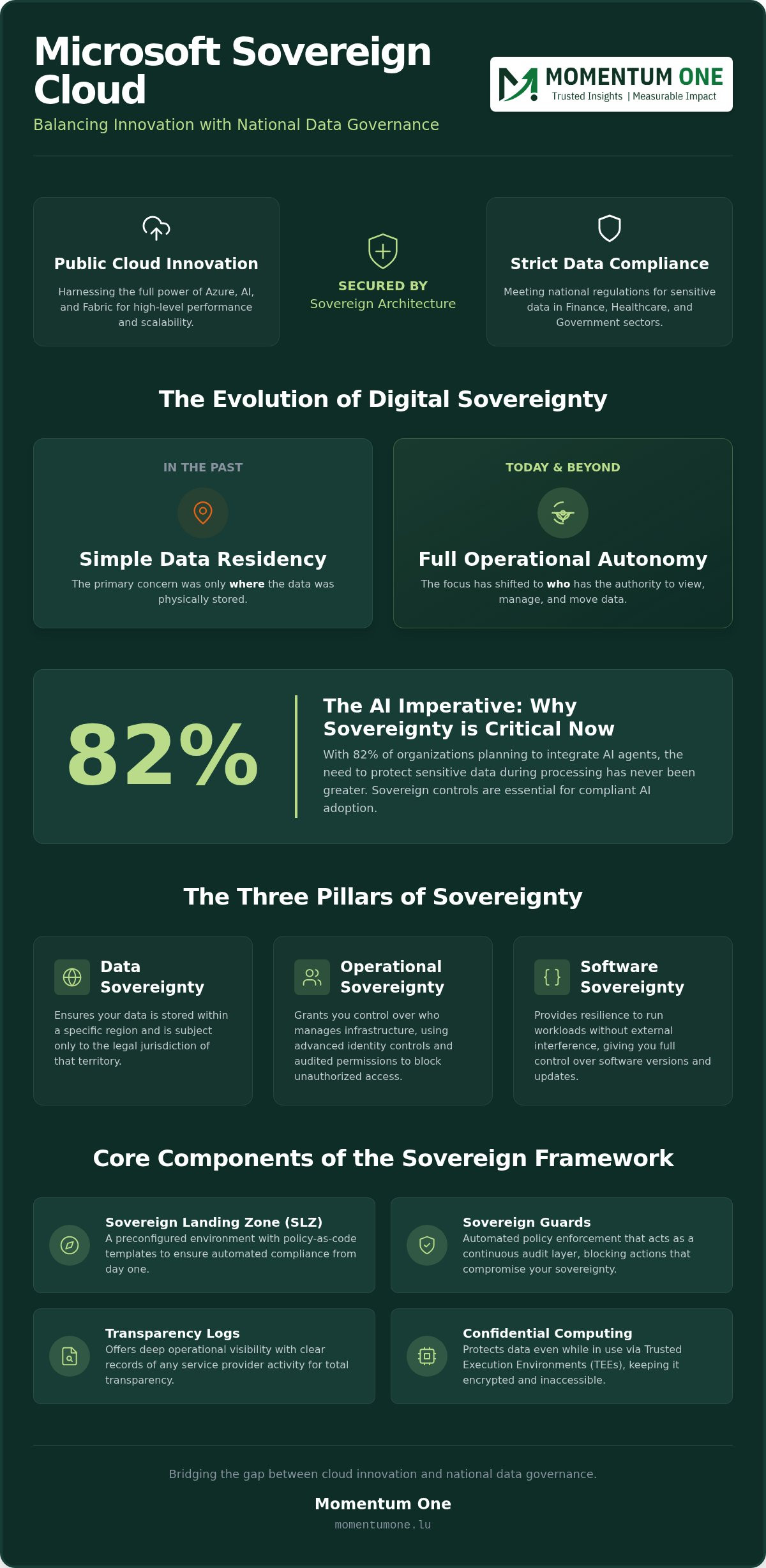
2026 has become a pivotal year for this technology. With the rapid expansion of AI workloads, 82% of organizations now plan to integrate AI agents within the next few years. For industries like healthcare, finance, and government, this creates a massive compliance hurdle. These sectors handle sensitive citizen data that cannot be exposed to foreign jurisdictions or unauthorized administrative access. The sovereign-by-design architecture ensures that these specific needs are met from day one.
The Evolution of Digital Sovereignty
The conversation has moved far beyond simple data residency. In the past, knowing your data was stored in a specific European datacenter was enough. Today, the focus has shifted toward full operational autonomy. It's no longer just about where the data sits, but who has the authority to view, manage, or move it. Digital sovereignty is the ability to control data destiny. Microsoft has adapted to these national regulatory pressures by offering a multi-layered approach that includes sovereign public cloud, private cloud, and national partner clouds. This flexibility is essential for Fabric Migration and Modernization projects where data sensitivity varies across different business units.
Key Components of the Sovereign Framework
Implementing this level of control requires specific technical tools that work together to create a secure environment. The microsoft sovereign cloud relies on several core pillars to maintain its integrity:
- Sovereign Landing Zone (SLZ): This provides a preconfigured Azure environment with policy-as-code templates. It ensures that every resource deployed follows your specific compliance rules automatically.
- Sovereign Guards: These features provide automated policy enforcement. They act as a continuous audit layer, blocking any actions that might compromise your sovereignty posture.
- Transparency Logs: These offer deep operational visibility. You get a clear record of any service provider activity, ensuring total transparency into how your infrastructure is being managed.
- Confidential Computing: This technology protects data even while it's in use. By using Trusted Execution Environments (TEEs), you can process highly sensitive financial or health data with the confidence that it remains encrypted and inaccessible to the cloud provider.
By integrating these components, organizations can bridge the gap between technical cloud features and national compliance requirements. It's a structured approach that simplifies the path to cloud adoption for even the most cautious stakeholders.
The Three Pillars: Data, Operational, and Software Sovereignty
Achieving true control in the cloud requires looking past the physical server. The microsoft sovereign cloud framework rests on three distinct pillars that ensure your organization remains the ultimate authority over its digital assets. These pillars work together to provide a robust defense against unauthorized access, legal overreach, and operational disruptions. It's a structured approach that transforms the public cloud into a private, protected environment tailored to your specific regulatory needs.
Data sovereignty is the first and most recognized pillar. It ensures that your data is not only stored within a specific region but is also subject to the legal jurisdiction of that territory. Operational sovereignty follows, focusing on who can manage the underlying infrastructure. It uses advanced identity controls to ensure that no cloud provider employee can access your systems without your explicit, audited permission. Finally, software sovereignty provides the resilience you need to run workloads without external interference, giving you full control over the software versions and updates that impact your services.
Data Residency vs. Data Sovereignty
It's easy to confuse these two terms, but the difference is critical for compliance. Data residency refers simply to the physical location of the data centers. Sovereignty, however, involves the legal protections and jurisdiction governing that data. In 2026, staying compliant with national financial or health laws requires more than just local storage. You must ensure that your data remains shielded from foreign legal requests, such as those under the Cloud Act. By managing your own encryption keys and using tools like Customer Lockbox, you maintain a "need-to-know" access model that protects your citizen data from being accessed by foreign governments.
Confidential Computing and Encryption
Confidential computing serves as the technical engine for the entire sovereign framework. Traditional encryption protects data while it's sitting on a disk or moving across a network. Confidential computing goes a step further by protecting data while it's actually being processed. Using Hardware Security Modules (HSM) and Trusted Execution Environments (TEEs), your workloads are isolated in hardware-encrypted enclaves. This means even the host system cannot "see" the data while it's in use. For those managing complex reporting environments, our Power BI Consulting & Governance experts can help you implement these protections to ensure your analytics remain private and compliant.
Implementing "Always Encrypted" for sensitive SQL workloads is another vital step. This technology ensures that your database administrators can manage the system and perform their duties without ever viewing the actual content of the records. It's this level of granular control that allows highly regulated organizations to move their most sensitive workloads to the cloud with total peace of mind.
Sovereign Cloud vs. Public Cloud: Addressing Security Misconceptions
Many decision makers hesitate to adopt the microsoft sovereign cloud because they fear it's a "lite" version of Azure. There is a common worry that strict controls mean sacrificing performance or losing access to the latest digital tools. This is a fundamental misunderstanding of how the architecture works. You aren't moving to a slower, isolated network. Instead, you're applying a sophisticated governance layer over the same global infrastructure that powers the standard public cloud. You get the same low-latency connections and high-speed processing, but with the added peace of mind that your data remains under your exclusive control.
The cost-benefit analysis of a sovereign deployment often comes down to risk management. While there is an initial investment in setting up a Sovereign Landing Zone, the potential cost of non-compliance is far higher. In 2026, regulatory fines and the reputational damage of a data breach can be catastrophic for financial or healthcare institutions. Sovereignty doesn't restrict your security; it enhances it by providing deeper visibility and more granular control than a standard public cloud environment ever could.
Innovation in a Controlled Environment
One of the biggest myths is that sovereignty kills innovation. Some believe that you can't use AI if you have strict data residency requirements. The reality is quite the opposite. With 82% of organizations planning to integrate AI agents by 2028, staying competitive requires these tools. You can run Azure OpenAI and Copilot within your sovereign boundaries, ensuring that your prompts and data never leave the protected enclave. This allows you to modernize your Data Warehouse & Lakehouse Design while maintaining the rigid isolation required by national law. You get the agility of the cloud without the exposure.
The Role of the Cloud Act and National Law
The Cloud Act often creates anxiety for organizations worried about foreign government subpoenas. The microsoft sovereign cloud directly addresses this by using technical barriers that prevent unauthorized access, even by the cloud provider. When you manage your own encryption keys and use confidential computing, you create a legal and technical shield. This makes it significantly harder for foreign jurisdictions to compel the disclosure of your data without your knowledge or consent.
Sovereign Guards act as a 24/7 compliance officer, continuously monitoring your environment to prevent any drift from national regulatory standards. They provide automated reporting that you can share with national regulators, proving your compliance in real-time. This automation reduces the administrative burden on your IT team, allowing them to focus on high-value tasks rather than manual audit logs. It's a proactive way to manage your data destiny in an increasingly complex legal world.
Building Your Sovereignty Roadmap: Compliance and Governance
Implementing the microsoft sovereign cloud requires more than just toggling a few security switches. It's a methodical process that aligns your technical architecture with the specific legal mandates of your industry. A successful roadmap moves from discovery to automation, ensuring that your data remains protected even as your cloud footprint expands. You don't have to tackle this transition all at once. By following a structured approach, you can maintain operational stability while steadily enhancing your compliance posture.
Your roadmap should follow these four critical stages:
- Step 1: Data Classification and Audit. You can't protect what you haven't identified. Start by categorizing your data based on its sensitivity and regulatory requirements. This audit determines which workloads belong in a sovereign environment and which can stay in the standard public cloud.
- Step 2: Designing the Sovereign Landing Zone. This is the foundation of your secure environment. While Microsoft provides the initial templates, you must tailor the SLZ to reflect your unique organizational structure and risk appetite.
- Step 3: Implementing Policy-as-Code. Automation is your best ally. By defining your compliance rules as code, you ensure that every new resource follows your sovereign standards from the moment it's created.
- Step 4: Continuous Monitoring and Managed Governance. The threat landscape in 2026 is dynamic. You need ongoing oversight to handle new regulations and emerging security challenges without disrupting your daily operations.
Establishing an Effective Governance Framework
A robust framework defines exactly who has access to your data and why they need it. This isn't just an IT task; it's a core business responsibility. Integrating these principles into your Power BI governance framework is essential for maintaining a single source of truth that regulators can trust. An architectural review helps identify potential gaps where data might accidentally leak across sovereign boundaries. We recommend a proactive approach that treats governance as a strategic asset rather than a checklist.
Automating Compliance with Sovereign Guards
Sovereign Guards provide the technical teeth for your governance strategy. By setting up real-time alerts for policy violations, your team can catch and fix issues before they become compliance breaches. Automated remediation goes a step further, instantly correcting non-compliant resources without human intervention. This level of automation is vital for generating audit-ready reports that satisfy national authorities. It replaces manual spreadsheets with dynamic, verifiable data that proves your commitment to digital autonomy. If you want to ensure your environment remains compliant as you scale, consider our specialized workspace and capacity management services to maintain optimal control.
Strategic Implementation with Momentum One
Choosing the right partner for your microsoft sovereign cloud journey is just as important as the technology itself. Large, generic consultancies often lack the specialized focus required to handle the nuances of national regulatory environments. At Momentum One, we operate as a boutique ally, providing the high-level technical expertise of a certified Microsoft Solutions Partner with the personalized attention of a dedicated strategist. We don't just perform migrations; we build resilient architectures that respect national data laws while pushing the boundaries of what your data can do. Our role is to act as the bridge between complex technical features and the practical requirements of your compliance office.
Our approach is rooted in a deep understanding of both governance and performance. We recognize that highly regulated organizations can't afford downtime or security gaps. By positioning ourselves as a proactive facilitator, we help you simplify the complexity of sovereign controls. We focus on creating a steady, reliable path to the cloud that prioritizes your long-term success and digital autonomy.
Sovereign Data Modeling and Fabric Integration
Modernizing your data stack shouldn't mean compromising your security posture. We specialize in migrating sensitive workloads using Microsoft Fabric migration services, ensuring that every element of your new environment remains within sovereign boundaries. This involves more than just moving data; it's about designing robust Data Lakehouses that offer the flexibility of a lake with the strict governance of a warehouse. Our team also focuses on the fine details of technical performance, such as optimizing DAX logic for secure, large-scale datasets. This ensures your reports are both lightning-fast and fully compliant with national standards.
Your Partner in Digital Autonomy
Sovereignty is an ongoing commitment, not a one-time setup. To help your team stay ahead in 2026, we offer tailored workshops for Corporate Data Fabric training. These sessions empower your internal staff to manage and evolve your sovereign environment with confidence. For organizations that prefer a hands-off approach, our Managed Power BI services provide continuous oversight, ensuring long-term scalability and governance. We act as your steady hand, simplifying the complexity of modern cloud architecture while you focus on your core mission. Contact us today to start your sovereignty architectural review and take the first step toward true digital autonomy.
Taking Control of Your Digital Destiny in 2026
Navigating the intersection of innovation and compliance doesn't have to be a struggle. We've explored how the microsoft sovereign cloud bridges the gap between public cloud power and the strict requirements of national law. By focusing on the three pillars of data, operational, and software sovereignty, your organization can leverage advanced AI and Fabric capabilities while maintaining absolute control over its sensitive assets. You now have the framework to move beyond simple data residency and embrace a truly sovereign-by-design architecture.
Transitioning to this high level of governance requires a steady hand and deep local expertise. As a Certified Microsoft Solutions Partner, Momentum One offers the specialized technical support and national experience needed to manage highly regulated data environments. We act as your proactive ally, simplifying complex cloud features into actionable strategies that drive growth. Secure your data future with a Sovereign Cloud Architectural Review and ensure your infrastructure is ready for the challenges of tomorrow. The path to digital autonomy is clear, and we're ready to help you lead the way.
Frequently Asked Questions
What is the difference between Azure and Microsoft Sovereign Cloud?
Azure is the global public cloud platform, while the microsoft sovereign cloud is a specialized governance layer built on top of it. It adds specific controls for data residency, operational transparency, and sovereign-by-design architecture. You get the same innovation and scalability of the public cloud but with technical guardrails that meet strict national regulatory requirements. It's a tailored environment for highly sensitive workloads within the broader Azure ecosystem.
Can I use Microsoft Fabric within a Sovereign Cloud environment?
Yes, you can integrate Microsoft Fabric into your sovereign architecture to modernize your data operations. This allows you to build Data Lakehouses and perform advanced analytics while remaining within your defined geopolitical boundaries. By applying Sovereign Landing Zone policies to your Fabric workspaces, you ensure that even your most complex reporting and data modeling projects stay compliant with national laws. It's the ideal way to balance powerful innovation with rigid data control.
How does Microsoft Cloud for Sovereignty handle data residency?
Data residency is managed through the EU Data Boundary and specific region-based storage policies. The microsoft sovereign cloud ensures that your data remains physically stored within European datacenter regions. Beyond just storage, it uses policy-as-code to prevent data from being moved or processed outside these boundaries. This provides a verifiable record of where your information sits at all times, which is critical for meeting national financial or health data regulations in 2026.
Does the Microsoft Sovereign Cloud protect against the US Cloud Act?
It provides technical and legal layers of protection that significantly mitigate Cloud Act risks. By using customer-managed encryption keys and confidential computing, you ensure that the cloud provider cannot access or decrypt your data without your consent. This creates a technical barrier that prevents foreign jurisdictions from compelling the disclosure of your information. It transforms your cloud environment into a digital enclave where you, not the provider, hold the ultimate keys to your data.
Is there a performance penalty when using sovereign controls?
No, there is no significant performance penalty when using these sovereign features. Since these controls are built into the native Azure infrastructure, your workloads benefit from the same low-latency connections and high-speed processing as standard public cloud resources. While features like confidential computing involve a specialized hardware layer, the impact on speed is negligible for most enterprise applications. You can maintain high performance while satisfying your most stringent security and compliance requirements.
Who is responsible for compliance in a sovereign cloud model?
Compliance remains a shared responsibility between you and the cloud provider. Microsoft is responsible for the security and sovereignty of the underlying infrastructure; you are responsible for how you configure your environment and manage your data. This is why using a Sovereign Landing Zone is so important. It provides the policy-as-code templates that help you automate your end of the responsibility, ensuring your configurations always align with national regulatory standards.
What industries in Luxembourg benefit most from sovereign cloud?
The industries that benefit most are those handling highly sensitive citizen or financial information. This includes government agencies, healthcare providers, and financial services institutions that must comply with strict national data governance laws. In 2026, as these sectors adopt more AI-driven tools, the need for a sovereign environment becomes even more critical. It allows these organizations to innovate with confidence, knowing their workloads are protected by the highest levels of operational and software sovereignty.
How do I start a migration to a sovereign environment?
The best way to start is with a comprehensive data classification audit and an architectural review. You need to identify which sensitive workloads require sovereign protection and then design a Sovereign Landing Zone to house them. Partnering with a certified expert helps bridge the gap between technical features and national compliance needs. We recommend a phased approach that prioritizes your most critical data assets, ensuring a steady and secure transition to your new environment.