Modern Data Lakehouse Design with Azure Databricks
Modern Data Lakehouse Design with Azure Databricks
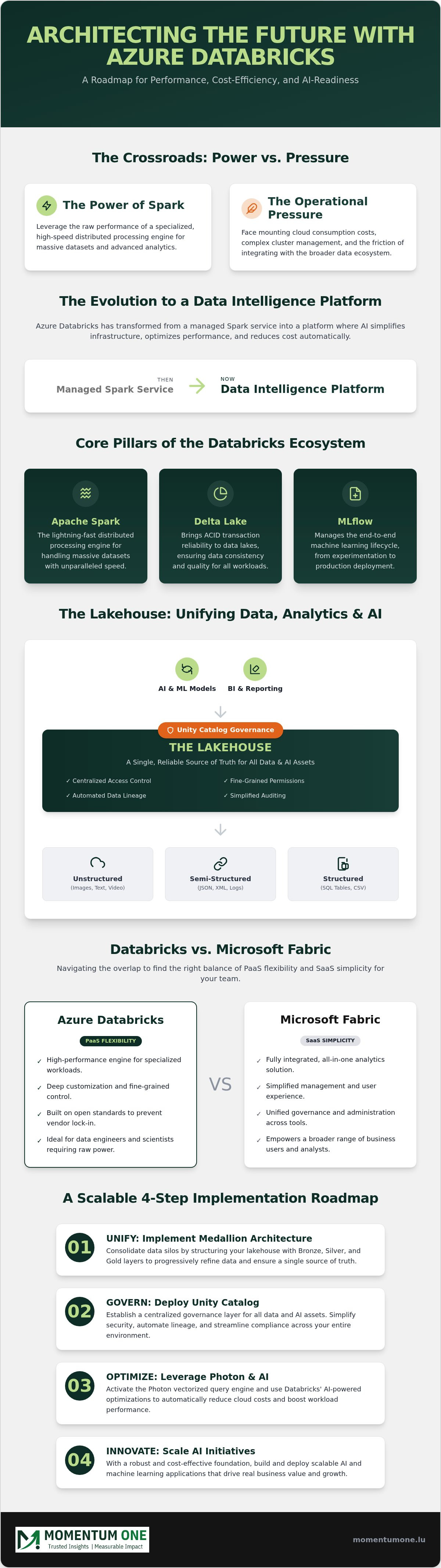
- Understand the evolution of Azure Databricks into a data intelligence platform where AI simplifies infrastructure management and enhances performance.
- Learn to unify your data silos by implementing a medallion architecture that handles both structured and unstructured data within a single environment.
- Clarify the overlap between Databricks and Microsoft Fabric to determine the right balance of PaaS flexibility and SaaS simplicity for your team.
- Establish a practical roadmap for building a scalable lakehouse that reduces cloud consumption costs while supporting future AI initiatives.
- Discover how expert architectural guidance can bridge the gap between raw data processing power and actionable business intelligence.
Is your investment in Azure Databricks becoming a strategic asset or a source of operational friction? Many engineering teams today find themselves at a crossroads, balancing the undeniable power of Spark with the mounting pressure of high cloud consumption costs and the perceived complexity of cluster management. It's easy to feel stuck between the raw power of a specialized engine and the integrated simplicity of Microsoft Fabric.
We understand that you need a solution that doesn't force a compromise between performance and cost. You can master the complexities of Azure Databricks to architect a high-performance data intelligence platform that serves as a future-proof foundation for AI and analytics. This article provides a clear architectural roadmap to help you achieve cost-effective data processing while ensuring your environment integrates seamlessly with the broader Microsoft ecosystem. We'll explore how to optimize your workloads, reduce management overhead, and position your data lakehouse as the engine of your organization's growth. Let's build a foundation that lasts.
What is Azure Databricks? The 2026 Data Intelligence Platform
Azure Databricks is a first-party Microsoft service purpose-built for the modern lakehouse architecture. It represents the high-performance layer of the Azure data estate, providing the speed and flexibility required for advanced analytics. If you've been searching for What is Azure Databricks?, you'll find it has evolved significantly from its roots as a managed Spark service. By 2026, the platform has transitioned into a true Data Intelligence Platform. AI is no longer just something you build with the tool. AI now manages the infrastructure itself, optimizing clusters and storage automatically to drive down costs and boost efficiency.
The platform creates a unified, collaborative environment where data engineers, scientists, and analysts work on the same live data. This eliminates the friction of moving data between disparate tools, fostering a culture of shared goals and faster delivery. It's a supportive space where technical expertise meets practical business application.
The Core Components of the Databricks Ecosystem
To understand the platform's power, we look at its foundational pillars. These technologies work in tandem to create a robust data environment.
- Apache Spark: The distributed processing engine that handles massive datasets with lightning speed across clusters.
- Delta Lake: This layer brings reliability to your data lake by introducing ACID transactions, ensuring your data remains consistent and high-quality.
- MLflow: A framework for managing the end-to-end machine learning lifecycle, from experimentation to production deployment.
Why Luxembourg Enterprises Choose Databricks
In our local market, particularly within the financial and corporate sectors, reliability is non-negotiable. Azure databricks offers the scalability needed for national-scale corporate data environments while maintaining strict compliance. Using open standards is a key advantage, as it prevents vendor lock-in for sensitive financial data. This flexibility, combined with seamless integration into the existing Azure security stack, makes it a cornerstone of data warehouse and lakehouse design for firms prioritizing growth and security. We see it as a steady hand for organizations managing complex, high-stakes data estates.
The Lakehouse Architecture: Unifying Data Warehousing and AI
The traditional divide between data warehouses and data lakes often forced teams into rigid silos. You had one team managing structured SQL data and another handling unstructured files for machine learning. This separation created friction, data duplication, and inconsistent results. Azure databricks solves this by unifying these worlds into a single Lakehouse model. It allows you to store and process structured tables, semi-structured JSON, and unstructured images in one reliable location. This isn't just about storage; it is about creating a single source of truth for your entire organization.
This unification is particularly valuable for downstream reporting. When your data is refined within a lakehouse, your Power BI dashboards become more reliable. High-quality data at the source leads to high-performance insights at the finish line. We see the lakehouse as a steady hand for organizations that need to move fast without losing accuracy. If you're looking to refine your current setup, our data warehouse and lakehouse design services can help you bridge this gap.
Unity Catalog: Governance for the Modern Data Estate
Managing security across multiple regions and clouds used to be an administrative burden. Unity Catalog acts as the single governance layer for all your data and AI assets within the Azure databricks environment. It provides centralized access control, ensuring that only the right people see sensitive information. This centralized approach simplifies management as your data estate grows.
For firms operating in Luxembourg, automated data lineage is a game-changer for regulatory compliance. It tracks the journey of every data point from its origin to the final report. This visibility is essential for meeting strict financial reporting standards. Unity Catalog provides a transparent, single-pane view of who accessed what and when, which simplifies the audit process for data architects and ensures every requirement is met with minimal manual effort.
Photon: The Engine Driving 2026 Performance
Performance shouldn't come at the cost of your cloud budget. Photon is the vectorized query engine designed to make SQL workloads run significantly faster. In simple terms, it changes how the computer processes data, allowing it to handle more information in less time. It is the engine that makes the "Data Intelligence" promise a reality by optimizing how queries are executed at the hardware level.
By speeding up processing, Photon directly reduces your Azure consumption costs. Since your clusters finish tasks sooner, they can shut down earlier, preventing unnecessary billing. This high-speed execution translates into real-time business intelligence, allowing your team to react to market changes as they happen. It’s about getting more value out of every second of compute time while maintaining a lean, efficient infrastructure.
Azure Databricks vs. Microsoft Fabric: Navigating the Overlap
Choosing between Microsoft Fabric and Azure Databricks is not a zero-sum game. Fabric offers a streamlined Software-as-a-Service (SaaS) experience, perfect for organizations that prioritize integrated business intelligence and ease of use. In contrast, Azure databricks provides the Platform-as-a-Service (PaaS) flexibility that technical teams require for deep customization and control. For Luxembourg firms transitioning from Azure Synapse, the decision depends on your team's existing skill set and the complexity of your data workloads. If you rely heavily on T-SQL and want a managed experience, Fabric is a strong contender. However, if your roadmap involves high-performance data engineering, Databricks remains the industry standard.
One of the most significant advancements in 2026 is the "OneLake" integration. This allows Azure databricks to read from and write to the same storage layer used by Fabric. You don't have to pick one and abandon the other. Instead, you can use the right tool for the right job, ensuring that your data architecture remains fluid and responsive to new requirements. This interoperability ensures that your investment in one platform enhances the value of the other.
When to Choose Azure Databricks
Databricks excels when your requirements push beyond standard business reporting. It is the preferred choice for complex ETL or ELT pipelines that require custom Python or Scala code to handle intricate transformations. If your strategy focuses on building advanced Machine Learning models or developing Generative AI applications, the specialized tools within the Databricks ecosystem are essential. Additionally, for large-scale data processing that might exceed the current capacity limits of a SaaS environment, the dedicated compute power of Databricks provides the necessary headroom for national-scale growth.
The "Better Together" Architecture
Many successful enterprises adopt a hybrid approach. They use Databricks as the high-performance engine for heavy data engineering and Fabric as the primary layer for business consumption. This "Better Together" strategy leverages the strengths of both platforms without creating new silos. To maintain governance across this landscape, you can link the Databricks Unity Catalog with Microsoft Purview, creating a unified view of your entire data estate. For those considering this path, exploring Microsoft Fabric Migration Services can provide a structured roadmap for your modernization journey. We act as your guide, ensuring these technologies work in harmony to drive your business forward.
Building a Scalable Roadmap: Implementation and Optimization
Transitioning from a conceptual design to a functional data estate requires a methodical approach. We start by conducting a thorough architectural review of your existing data silos. This process identifies where data is trapped and where unnecessary duplication occurs. Next, we design a medallion architecture to refine that data into usable assets. Reliability comes from implementing robust CI/CD pipelines for notebook deployment, ensuring every change is tested and tracked. Finally, we establish cost monitors and auto-scaling policies to manage your Azure spend proactively. This structured path ensures your investment in Azure databricks delivers measurable value from the first day.
The Medallion Architecture Explained
This framework organizes your data into layers of increasing quality and structure. It provides a clear path for data refinement that supports both engineering and analytics teams.
- Bronze: This is your raw ingestion layer. Data arrives here in its original format without any transformations. It serves as the historical record of your data estate.
- Silver: In this refinement layer, data is cleaned, filtered, and augmented. It is the middle ground where data becomes reliable enough for deep analysis and data science.
- Gold: These are business-ready aggregates. This layer is optimized for performance and is the primary source for Power BI consumption and executive reporting.
Cost Optimization Strategies for 2026
Managing Azure databricks efficiently involves more than just turning clusters off. We focus on regional nuances, ensuring your configuration aligns with Azure’s European availability zones to minimize latency and transfer costs. Leveraging Serverless SQL Warehouses is a primary tool for ad-hoc querying because they remove the need to manage underlying infrastructure while providing instant compute power. Right-sizing your clusters based on workload intensity prevents over-provisioning during quiet periods. If you are debating the right path for your firm, see our guide on Data Lakehouse vs Warehouse Design for a deeper comparison.
Building this roadmap alone can be a significant undertaking. Our team at Momentum One provides the expertise needed to navigate these technical hurdles and ensure your architecture is built for growth. If you are ready to transform your infrastructure, explore our data architecture modernization services to get started.
Maximizing Your Data ROI with Momentum One
Building a high-performance data intelligence platform is a significant milestone, but the true measure of success lies in its long-term impact on your business operations. As a boutique consultancy based in Luxembourg, Momentum One acts as the expert architect for firms managing these complex environments. We understand that technical implementation is only half the battle. The real goal is transforming raw data into a strategic asset that drives growth and accuracy. By positioning ourselves as your proactive partner, we help you bridge the gap between technical complexity and tangible business value.
We prioritize clarity and predictability by offering project-based fees for migrations and modernizations. This removes the uncertainty often associated with shifting from legacy systems to Azure databricks, allowing you to budget with confidence. Our approach ensures that your transition is not just a technical upgrade, but a structured move toward a more efficient future. We focus on outcomes, ensuring that every architectural choice supports your specific goals for performance and cost management. This reliability is what makes us a steady hand in a complex field.
Tailored Managed Services for Azure Databricks
Maintaining a lakehouse requires constant vigilance to prevent cost overruns and performance bottlenecks. Our managed services remove the burden of platform maintenance, providing continuous monitoring of cluster health and cost performance. We don't just watch the infrastructure; we also provide ongoing DAX optimization for reports connected to your data lakehouse. This holistic view ensures that your insights remain fast and reliable. For a deeper look at how we support your environment, explore our Managed Power BI Services.
Training Your Team for Self-Service Success
A powerful platform is only effective if your team knows how to use it. We help bridge the literacy gap between data engineering and business users through customized workshops focused on Unity Catalog and Lakehouse management. These sessions are tailored to your specific environment, empowering your staff to take ownership of their data assets. Our role is to act as a knowledgeable guide, simplifying complexity so your team can innovate with confidence. If you're ready to secure your foundation, you can Schedule a Data Architecture Review with Momentum One to begin your journey.
Transforming Your Data Architecture into a Strategic Asset
Building a future-proof data estate requires more than just the right tools. It demands a clear vision and a steady hand to navigate the technical complexities of modern architecture. We've explored how the lakehouse model unifies AI and warehousing, the specific roles of Databricks and Fabric, and the practical steps needed to optimize your cloud spend. By refining your environment into a high-performance engine, you position your organization for sustainable growth and accuracy.
As a Certified Microsoft Solutions Partner, Momentum One provides the specialized expertise needed to master Azure databricks within the unique context of the Luxembourg market. Our dedicated consultancy excels in Fabric and Databricks integration, ensuring your platform is built for scalability. You don't have to manage these complexities alone. We're here to act as your reliable strategist and expert facilitator, ensuring your technology aligns with your business goals.
Partner with Momentum One for your Databricks Strategy and turn your data challenges into competitive advantages. Your journey toward a data-driven future starts with a solid foundation, and we're committed to ensuring every step you take is a confident one.
Frequently Asked Questions
What is the difference between Azure Databricks and standard Apache Spark?
Azure databricks is a managed first-party service on Azure that includes optimized runtimes and proprietary engines like Photon. Unlike open-source Apache Spark, it provides automated cluster management, tighter security integration, and specialized tools like Unity Catalog. It is built to handle enterprise-scale workloads with higher performance and lower management overhead. This managed environment allows organizations to focus on insights rather than infrastructure, providing a more reliable choice for complex data engineering tasks.
Is Azure Databricks part of Microsoft Fabric?
No, Azure Databricks is a distinct Platform-as-a-Service (PaaS) offering, whereas Microsoft Fabric is a Software-as-a-Service (SaaS) platform. While they are separate products, they integrate seamlessly through the OneLake storage layer. You can use Databricks for specialized data engineering while leveraging Fabric for broader business intelligence. This hybrid approach allows your team to create a unified data ecosystem that utilizes the best features of both platforms for your organization.
How does Unity Catalog improve data governance in Luxembourg enterprises?
Unity Catalog centralizes access control and provides automated data lineage across your entire estate. For firms in Luxembourg, this is essential for meeting strict regulatory compliance and audit requirements. It allows data architects to see exactly who accessed what data and when, simplifying the governance of sensitive financial or corporate information within the Azure databricks environment. This transparency ensures that your data remains secure and fully compliant with national standards.
Can I use Azure Databricks with Power BI for real-time reporting?
Yes, you can connect Power BI directly to Databricks SQL warehouses for high-performance reporting. By using DirectQuery or the specialized connector, you can access live data stored in your lakehouse without moving it. This setup ensures that your dashboards reflect the most current information, which is vital for making fast, data-driven decisions. It's a powerful way to bridge the gap between heavy data processing and actionable business insights for your team.
What is the Medallion Architecture and why is it recommended?
The Medallion Architecture is a data design pattern that organizes data into Bronze, Silver, and Gold layers. It's recommended because it provides a clear, scalable roadmap for data refinement. This structure ensures that data is consistently high-quality before it reaches your Power BI reports. By moving through these stages, you reduce errors and improve the reliability of your analytics, making it easier for business users to trust the insights they see every day.
How do I manage costs in Azure Databricks effectively?
Effective cost management involves using auto-scaling policies and Serverless SQL warehouses to match compute power with actual demand. You should also implement cluster tagging and automated shutdown schedules to prevent unnecessary spend. By monitoring your consumption patterns regularly, you can right-size your environment and ensure you only pay for the resources your team actually uses. This proactive approach helps maintain a lean infrastructure while supporting your organization's growth without surprising expenses.
Does Azure Databricks support Python and R for data science?
Yes, the platform offers first-class support for multiple languages, including Python, R, Scala, and SQL. This flexibility allows your data scientists to use their preferred tools and libraries within a collaborative, managed environment. It is an ideal space for building advanced machine learning models or performing complex statistical analysis on massive datasets. Your team can innovate quickly without the burden of managing the underlying infrastructure, allowing them to focus on delivering value to the business.
What is the role of a Microsoft Solutions Partner in a Databricks implementation?
A Certified Microsoft Solutions Partner like Momentum One acts as a knowledgeable guide and technical facilitator throughout the design and deployment process. We provide the expertise needed to bridge the gap between raw technical power and practical business outcomes. Our team ensures that your architecture is secure, cost-effective, and fully integrated with your existing Microsoft tools. We're dedicated to helping you achieve long-term success by providing tailored support and strategic oversight for your data journey.