Modernizing Legacy Systems for Scalable Data Success
Unlock scalable data success with legacy system modernization. Learn to slash costs and eliminate silos using Microsoft Fabric for a future-proof advantage.
- Define the scope of your legacy system modernization by identifying the rigid schemas and manual ETL processes that currently limit your team's agility.
- Utilize the 7 Rs framework to select the right path for your data stack, choosing between cloud-optimized replatforming or a direct rehost strategy.
- Explore how Microsoft Fabric acts as a catalyst for growth, using OneLake to simplify data storage and create a single source of truth.
- Follow a structured, phased roadmap that begins with dependency mapping and a thorough data audit to minimize operational risks during your migration.
- Transition from traditional warehouses to modern lakehouse architectures to enable real-time analytics and improved data literacy across your organization.
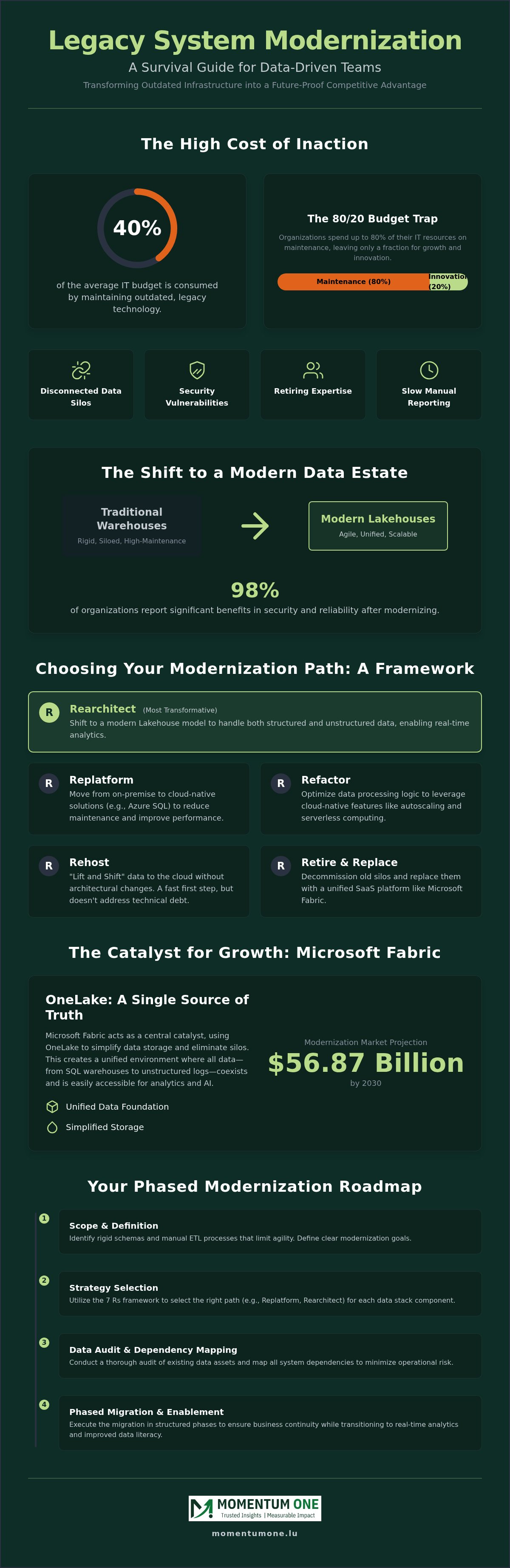
Did you know that over 40% of the average IT budget is currently swallowed by the cost of maintaining outdated technology? For many organizations, the burden of technical debt creates a ceiling on growth, trapping valuable information in disconnected silos. This relentless drain on resources makes legacy system modernization less of a choice and more of a survival strategy for data-driven teams. It's frustrating to watch your most talented engineers spend their days patching old infrastructure instead of building new insights. We understand the pressure of manual data preparation and the slow crawl of reports that should be instantaneous.
You'll learn how to transform these rigid environments into agile, scalable assets using modern Microsoft Fabric and Power BI architectures. Research shows that 98% of organizations undertaking these updates report significant benefits in security and reliability. This article explores the shift from traditional warehouses to high-performance lakehouses. We'll show you how to slash operational costs, eliminate silos, and foster real-time analytics that improve data literacy across your entire organization. By the end, you'll have a clear roadmap for turning your legacy data into a future-proof competitive advantage.
What is Legacy System Modernization in the Data Era?
In 2026, a legacy system isn't defined just by its age. Even a cloud-based application can become a legacy burden if it relies on rigid schemas and manual ETL processes that slow down your team. True legacy system modernization focuses on removing these barriers to create a fluid data environment. It's about moving away from the constant struggle of "maintaining systems" toward a strategy that prioritizes "empowering data." To grasp the full scope of this transition, understanding What is software modernization helps clarify the risks and strategies involved in updating these foundational structures.
We've reached a tipping point because the cost of inaction is now higher than the cost of change. The legacy modernization market is projected to reach $56.87 billion by 2030, reflecting a massive global shift toward agility. Organizations across the country are realizing that they can't leverage AI or real-time analytics while tethered to 20th-century infrastructure. This shift is driven by the need for speed, accuracy, and the ability to scale without linear cost increases.
The Hidden Costs of Stagnant Data
Many IT leaders find themselves caught in the 80/20 budget trap. Statistics show that some organizations spend up to 80% of their IT budget simply maintaining existing systems. This leaves only a fraction of resources for innovation. Beyond the financial drain, stagnant data environments harbor security vulnerabilities that unpatched legacy architectures can't defend against. There's also a looming "talent gap" as the original architects of these systems retire, leaving a void in expertise that's increasingly difficult to fill with new hires who prefer working with modern stacks.
Modernization vs. Replacement: Finding the Balance
The "rip and replace" approach often sounds appealing but frequently fails in complex data environments. It's high-risk and can lead to massive business disruptions. A more effective path involves incremental legacy system modernization, where we update components of your architecture in phases. This ensures business continuity while you transition to a modern data architecture. The ultimate goal isn't just a new software version; it's establishing a foundation of governance and scalability. By focusing on Fabric migration and modernization, you can transform rigid silos into a unified, agile lakehouse that grows with your business.
The 7 Rs Framework for Data System Modernization
The 7 Rs framework provides a structured lens for evaluating your legacy system modernization journey. While originally designed for general software applications, its application to data stacks requires a more nuanced approach. You aren't just moving code; you're moving the lifeblood of your decision-making process. Identifying which "R" fits each component of your architecture prevents the "big bang" failures that often plague large-scale transitions.
- Rehost: Often called "Lift and Shift," this involves moving data to the cloud without changing the underlying architecture. It's fast but often fails to address technical debt.
- Replatform: This adds a layer of optimization, such as moving from an on-premise SQL Server to an Azure SQL Managed Instance to reduce maintenance.
- Refactor: Here, we optimize the data processing logic to take advantage of cloud-native features like autoscaling.
- Rearchitect: This is the most transformative step, involving a shift toward a modern Lakehouse model to handle both structured and unstructured data.
- Retire and Replace: Sometimes, the most cost-effective path is to decommission old silos entirely and replace them with a unified SaaS platform like Microsoft Fabric.
Strategic Replatforming: Moving to the Cloud
Moving from on-premise SQL to Azure-native solutions is a critical step for organizations seeking better performance and lower maintenance overhead. During this transition, the focus shifts toward automated data pipelines Fabric provides. These tools help streamline the ingestion process and reduce the manual effort typically associated with migration. By automating these workflows, you can significantly minimize downtime. This ensures your business operations continue without interruption while the underlying infrastructure evolves into a more resilient, cloud-optimized state.
Rearchitecting for a Single Source of Truth
To truly unlock the value of your data, you must move beyond simple migration toward a holistic Lakehouse architecture design. This approach breaks down silos by combining the flexibility of a data lake with the structured management of a data warehouse. It allows your team to maintain a single source of truth, ensuring every department works from the same numbers.
Modernizing the semantic layer is equally vital for Power BI performance. When we refactor these layers, we focus on DAX optimization and efficient data modeling to ensure reports load in seconds rather than minutes. Throughout this legacy system modernization process, our priority is maintaining data integrity while building a foundation for real-time analytics. If you're ready to start this evolution, our team can help you design a scalable roadmap tailored to your specific needs.
Microsoft Fabric: The Catalyst for Modernization in 2026
Microsoft Fabric has emerged as the definitive destination for legacy system modernization because it solves the fragmentation problem that has plagued IT departments for decades. It isn't just another data tool; it's a unified SaaS platform that collapses the distance between data engineering, science, and analytics. At the heart of this shift is OneLake, often described as the "OneDrive for Data." It provides a single, logical location for all your organizational data, eliminating the need to maintain multiple storage silos or manage complex data movement between different cloud services.
By integrating Power BI, Synapse, and Data Factory into a single environment, Fabric streamlines the entire data lifecycle. The performance benefits are particularly striking when compared to traditional setups. Fabric's Direct Lake mode represents a massive leap forward, allowing Power BI to read Parquet files directly from OneLake. This removes the frustrating trade-off between the speed of Import mode and the real-time freshness of DirectQuery. Your users get the best of both worlds: lightning-fast report performance on the most current data available.
Fabric vs. Legacy Data Warehouses
Traditional data warehouses often come with high maintenance overhead and rigid scalability limits. Moving to Fabric changes the financial equation by shifting from fixed, expensive capacity to a consumption-based model using "F" SKUs. For instance, the F2 SKU starts at approximately $0.36 per hour, allowing organizations to start small and scale their compute power as demand grows. OneLake storage is also highly cost-effective, priced at roughly $23 per terabyte per month. This transition simplifies your architecture by replacing a dozen disconnected tools with one cohesive platform, significantly reducing the technical debt that often stalls legacy system modernization projects.
Modernizing the BI Layer with Power BI
Updating your reports is about more than just a new visual interface. We help organizations upgrade their legacy reporting environments to modern Power BI consulting & governance standards. This ensures that as you enable self-service BI, you don't lose control over data quality or security. A critical component of this process is DAX optimization. By refining your measures and data models, we reduce the load on your Fabric capacity and ensure that your reports remain responsive even as your data volumes grow. This methodical approach empowers your team to explore data independently while maintaining a stable, governed foundation.
Building Your Modernization Roadmap: A Phased Approach
Success in legacy system modernization isn't accidental. It requires a methodical, phased approach that balances technical ambition with business continuity. By breaking the journey into manageable stages, you reduce the risk of "analysis paralysis" and ensure each step delivers measurable value. This structured path allows your organization to evolve without disrupting the daily operations that keep your business running.
- Phase 1: Discovery and Dependency Mapping: We conduct a thorough data audit to uncover the "why" and "how" of your current environment.
- Phase 2: Defining the Target Architecture: We decide between a Lakehouse or Warehouse model based on your specific needs for structured and unstructured data.
- Phase 3: The Pilot Implementation: We select a high-impact use case to prove the new architecture's value quickly and build internal buy-in.
- Phase 4: Incremental Migration and Validation: We move data in waves, using GenAI-powered tools that can reduce project timelines by 40% to 50% through automated code analysis.
- Phase 5: Governance and Decommissioning: We establish long-term rules for data usage and safely turn off outdated silos.
Step 1: The Modernization Audit
Every successful transition begins with a deep-dive audit. We focus on identifying the technical debt hidden within your existing DAX measures and complex ETL scripts. Mapping data lineage is a non-negotiable step to prevent broken reports during the move. We then score your systems based on their modernization impact and business value. This scoring ensures you prioritize the projects that offer the highest ROI, turning your legacy system modernization into a series of visible wins rather than a hidden IT cost.
Ensuring Long-Term Success with Governance
Moving your data is only half the battle. Post-migration, the focus must shift toward sustainability. Establishing a Power BI governance framework is essential to prevent the return of fragmented data silos. User adoption is the ultimate metric of success, which is why corporate Power BI training plays a vital role in the transition. It ensures your team has the data literacy needed to use modern tools effectively. For ongoing stability, many organizations utilize managed BI services to monitor performance and maintain the architecture. If you're ready to define your path forward, we can help you start your modernization audit today.
Why Partner with Momentum One for Your Modernization Journey?
Choosing the right partner for your legacy system modernization determines the speed and stability of your data evolution. At Momentum One, we don't just act as service providers; we position ourselves as reliable strategists and expert facilitators. Our team understands that for Luxembourgish corporate clients, data isn't just a technical asset. It's the foundation of operational excellence and competitive advantage. We provide a national focus, ensuring that our solutions align with the specific performance standards required by organizations across the country.
As a certified Microsoft Solutions Partner with over 8 years of experience in high-value technical implementations, we bring deep technical authority to every engagement. We specialize in the nuances of Microsoft Fabric and DAX optimization, ensuring that your data models are built for speed and accuracy. Our outcome-focused approach is designed to reduce the risks inherent in large-scale data transitions, providing a steady hand through every phase of the project. We pride ourselves on being a proactive ally, simplifying complexity rather than hiding behind it.
Our Modernization Methodology
We begin every journey with a collaborative assessment and roadmap design. This initial discovery ensures that your path to a modern data stack is tailored to your unique business goals rather than a generic template. Our Microsoft Fabric migration services are built on a foundation of proven success in complex environments. We handle the hands-on implementation, focusing on data architecture modernization to turn rigid silos into agile lakehouses. Once the migration is complete, we provide post-migration support and managed services to ensure your new system continues to perform at its peak without increasing your internal maintenance burden.
Empowering Your Internal Teams
A modernized system is only as effective as the people who use it. We believe in building a sustainable data culture together. This is why our delivery model includes mentorship-based guidance to ensure your internal proficiency grows alongside your technology. We offer customized data literacy and technical workshops that translate complex technical concepts into practical business skills.
By focusing on training and hands-on facilitation, we help your team take full ownership of the new environment. We don't just hand over a finished product; we empower your staff to drive innovation independently. This collaborative spirit ensures that your legacy system modernization delivers lasting value, fostering improved data literacy and confidence across your entire organization.
Empowering Your Data Evolution
Transitioning away from rigid infrastructure is the first step toward becoming a truly data-driven organization. We've explored how a structured approach to legacy system modernization allows you to shed technical debt while embracing the power of Microsoft Fabric and a unified OneLake environment. This strategic evolution replaces slow, manual processes with real-time analytics and a single source of truth for your entire team. By following a phased roadmap, you can ensure business continuity while building a foundation that scales with your growth.
As a Certified Microsoft Solutions Partner with specialized expertise in Microsoft Fabric and Power BI, Momentum One is dedicated to being your reliable strategist. We provide more than just technical implementation; we deliver tailored corporate workshops that empower your internal teams to thrive in their new environment. Our collaborative methodology ensures that your transition is smooth, governed, and focused on long-term results. You don't have to navigate this complexity alone. Modernize your data stack with Momentum One today. Let's work together to turn your data into your greatest competitive advantage.
Frequently Asked Questions
What are the main risks of legacy system modernization?
Data loss, downtime, and budget overruns are the primary risks involved in these transitions. We mitigate these challenges by mapping every dependency and using a phased rollout. Without a detailed audit, organizations risk breaking downstream reports or losing data integrity. We focus on incremental changes to ensure business continuity. This methodical approach helps your team avoid the high-risk failures often seen in complex, unguided IT projects.
How long does a typical Microsoft Fabric migration take?
Timelines vary based on data volume, but a pilot implementation usually takes 4 to 8 weeks. A full-scale migration for a mid-sized organization often spans 3 to 6 months. We prioritize high-impact use cases first to deliver value early. This allows your team to experience the benefits of a modern architecture while we incrementally transition the remaining legacy assets in the background without disrupting operations.
Can we modernize our data warehouse without moving everything to the cloud?
Yes, you can adopt a hybrid approach by keeping sensitive data on-premise while leveraging cloud-native tools for analytics. Microsoft Fabric supports shortcuts and gateways that connect directly to on-premise SQL servers. This allows for legacy system modernization at your own pace. You don't have to commit to a full cloud migration immediately to start benefiting from centralized governance and improved report performance in Power BI.
What is the difference between rehosting and rearchitecting data?
Rehosting is a lift and shift where you move data to the cloud without changing its structure. Rearchitecting involves a deeper transformation, such as moving from a traditional SQL warehouse to a modern Lakehouse. While rehosting is faster, rearchitecting unlocks better scalability and real-time analytics. It's the difference between moving an old problem to a new location and actually solving the underlying technical debt for long-term growth.
How do we measure the ROI of a modernization project?
We measure ROI by tracking reductions in IT maintenance costs and improvements in report processing speed. Organizations often see a shift in budget from maintenance to innovation. Other metrics include a decrease in manual data preparation time and an increase in data literacy across the company. When reports load faster and data is more accurate, decision-making becomes more efficient, leading to measurable business growth and better resource allocation.
Why is Power BI governance critical during a system modernization?
Governance ensures that as you modernize, you don't recreate the same silos you're trying to eliminate. It establishes rules for data access, security, and report quality. Without a strong framework, self-service BI can lead to conflicting versions of the truth. We help you implement governance standards that maintain a single source of truth while empowering your team to explore data independently and securely within the Fabric environment.
What happens to our existing reports during the migration process?
We run existing reports in parallel with the new system to ensure complete data validation. This dual-run phase prevents service interruptions while we verify that the modernized data models produce accurate results. Once the new environment is validated, we incrementally point your Power BI reports to the new Fabric backend. This ensures a seamless transition for end-users without losing historical insights or breaking vital business dashboards during the move.
How does Microsoft Fabric handle legacy SQL data?
Fabric uses Data Factory and OneLake shortcuts to link to legacy SQL data without complex movement. This allows legacy system modernization to feel like an evolution rather than a disruption. You can mirror your SQL databases directly into Fabric, providing a real-time replica for analytics. This approach minimizes the impact on your operational systems while giving your data scientists and analysts immediate access to modern, high-performance tools.