Power BI Training: 2026 Guide for National Enterprises
Bridge the data skills gap with our 2026 guide to Power BI training for employees. Learn to build a secure, scalable data culture and achieve measurable ROI.
- Bridge the widening data literacy gap by shifting your workforce from passive reporting to proactive data storytelling that drives executive decisions.
- Implement comprehensive Power BI training for employees that balances foundational Power Query skills with advanced DAX optimization for business-critical calculations.
- Compare the long-term impact of live, expert-led workshops versus on-demand learning to determine which format maximizes your team's knowledge retention.
- Secure your national enterprise data by embedding workspace management and Row-Level Security (RLS) directly into your workforce development roadmap.
- Achieve measurable ROI by tailoring training programs to your specific data environment, ensuring business units become self-sufficient and reporting remains standardized.
Did you know that 60% of enterprise leaders report a significant data skills gap within their organizations despite investing heavily in modern analytics tools? It is a frustrating reality for national enterprises where Power BI licenses are active, yet departments still lean on IT for basic dashboard updates or struggle with complex DAX formulas. Implementing effective Power BI training for employees is no longer just an optional perk. It is the foundation of a secure, scalable data culture in 2026.
We understand the pressure to turn raw data into clear, actionable stories while keeping your sensitive information governed and secure. You want your business units to be self-sufficient, not stuck waiting for technical support. This guide will show you how to move beyond basic tutorials toward a structured, governance-first training program that delivers measurable ROI. We will explore how to standardize reporting across your entire organization, master the latest AI-driven Copilot features, and ensure every employee feels confident enough to drive decisions with data.
The Data Literacy Gap: Why Power BI Training for Employees is Essential in 2026
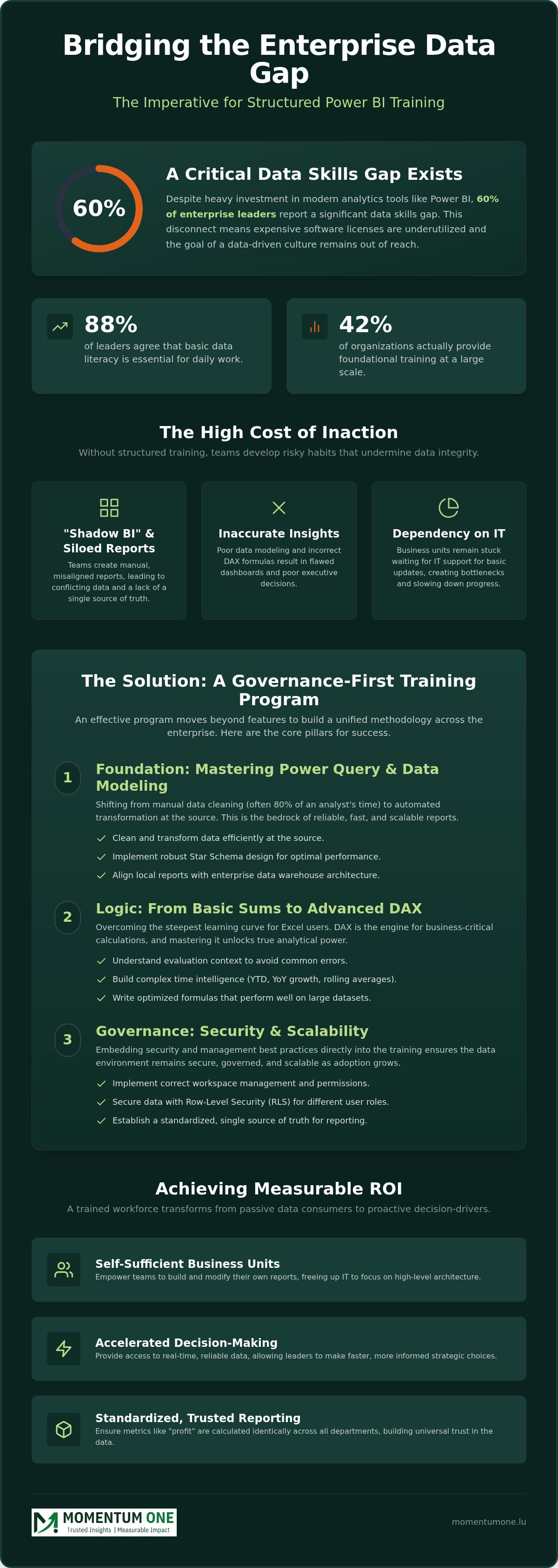
A survey of over 500 enterprise leaders in February 2026 found that 60% of organizations still face a significant data skills gap. While 88% of leaders agree that basic data literacy is essential for daily work, only 42% provide foundational training at a large scale. This creates a "Data Literacy Gap" where high-value licenses for Microsoft Power BI sit underutilized. Data literacy is the ability to read, work with, and argue with data.
In 2026, the shift from passive reporting to proactive data storytelling is no longer a luxury. It's a necessity for survival. When your team lacks formal Power BI training for employees, they often resort to "shadow BI." They create siloed, manual reports that don't align with corporate standards, leading to inaccurate insights and potential data leaks. We see this often in national enterprises where departments act as islands rather than a unified, data-driven powerhouse.
The technological environment has also evolved rapidly. With the retirement of the Q&A visual scheduled for December 2026, the focus has shifted entirely toward AI-assisted authoring through Copilot. Employees must now be capable of navigating conversational dashboards and near-real-time BI. Without structured guidance, your workforce won't just fall behind the competition; they'll struggle to use the very tools meant to simplify their daily tasks.
Moving Beyond Excel: The Psychological Shift
Many employees cling to spreadsheet-based reporting because it feels safe. It's the "comfort zone" of manual entry and local files. However, this old-school approach is slow and prone to human error. Moving to a modern BI environment requires a psychological shift toward trusting automated data flows. Instead of spending days "cleaning" data in a spreadsheet, your team can use that time to interpret trends and predict outcomes. We help facilitate this transition by showing users how much easier their work becomes when the data updates itself and the manual "grunt work" disappears.
The Business Value of a Trained Workforce
The true ROI of Power BI training for employees is found in the acceleration of decision-making cycles. When business units are self-sufficient, they don't have to wait for IT to build every minor dashboard update. This reduces the burden on your specialized data teams, allowing them to focus on high-level architecture and governance. Standardized training ensures a single source of truth across the nation, meaning a "profit" metric in one department matches the "profit" metric in another. This alignment builds trust in the data and the decisions based on it.
Essential Components of a High-Impact Power BI Training Program
Effective Power BI training for employees moves beyond a simple feature-by-feature walkthrough. It focuses on the logic behind the data architecture. For a national enterprise, this means ensuring every team member follows a unified methodology. When everyone speaks the same technical language, the risk of misinterpretation vanishes. We build training programs that prioritize these core pillars to ensure your investment translates into real-world capability.
Mastering Power Query and Data Modeling
Employees often spend 80% of their time cleaning data before they can even begin an analysis. High-impact training teaches them to move that logic upstream using Power Query. By cleaning and transforming data at the source, reports become faster and significantly more reliable. We emphasize the importance of star schema design. This structure organizes data into facts and dimensions, which is critical for report performance. Understanding these principles provides the necessary context for more advanced Data Warehouse & Lakehouse Design, ensuring your local reports align with broader enterprise architecture.
DAX Training: From Basic Sums to Advanced Logic
DAX is often the steepest hurdle for users transitioning from Excel. While basic sums are intuitive, business-critical calculations require a deeper understanding of evaluation context. A robust training program should cover practical scenarios such as time intelligence and filter context. This allows employees to calculate year-over-year growth or rolling 12-month averages with confidence. Complex enterprise datasets often reach a point where standard formulas aren't enough; in these cases, DAX optimization experts are needed to refine performance and ensure your dashboards remain responsive as data volumes grow.
Data visualization is the final bridge between analysis and action. Training must teach employees how to design for the end-user by choosing the right visuals for the specific narrative. Once a report is polished, the focus shifts to the Power BI Service. Your team needs to know how to share reports securely within workspaces and how to consume data through apps rather than raw files. This ensures that sensitive information stays protected while remaining accessible to those who need it most.
If you're ready to build these essential skills across your organization, our corporate Power BI training is designed to meet your specific data environment and business goals.
Evaluating Training Formats: Interactive Workshops vs. On-Demand Learning
Choosing how to deliver Power BI training for employees often involves a trade-off between scale and depth. On-demand video libraries offer flexibility and low initial costs. However, they often feel like static academic courses that lack immediate practical application to your specific company data. Without the ability to ask questions in real-time, employees frequently get stuck on a single DAX error and abandon the course entirely. This leads to low completion rates and a poor return on your licensing investment.
Live, expert-led workshops solve this by providing a collaborative environment where retention is naturally higher. The most effective method we've seen is the "Bring Your Own Data" (BYOD) approach. Instead of working with generic sample datasets, employees use their actual departmental reports during the sessions. This makes the training immediately relevant and solves real business problems in real-time. For large national organizations, we often implement a train-the-trainer model. This identifies internal champions who can scale knowledge across the workforce while maintaining a centralized standard of excellence.
The Power of Hands-On Workshops
Live sessions allow for real-time troubleshooting of the specific challenges your team faces daily. Whether it is a complex join in Power Query or a visual that just won't display correctly, an expert facilitator can provide instant clarity. This builds the confidence needed to move from being a report consumer to a report creator. We customize these curriculums for specific functions like Finance, HR, or Logistics, ensuring the examples used resonate with the audience's professional reality. This tailored approach ensures that your team isn't just learning a tool, but learning how to improve their specific workflows.
Blended Learning Strategies for 2026
The ideal approach for 2026 is a hybrid model. You can use foundational videos to establish basic terminology, followed by deep-dive technical sessions to tackle advanced modeling. Sustaining this knowledge requires more than a one-off event. Internal "Power BI User Groups" create a community where employees share tips and solve problems together. By using Corporate Data Literacy and Technical Training, you bridge the gap between initial learning and long-term mastery. This structured path ensures that the skills gained aren't lost once the workshop ends, fostering a culture of continuous improvement.
Implementing a Governance-First Adoption Roadmap
Training without governance is a recipe for internal friction. For national enterprises, the goal is to empower users while maintaining strict control over data integrity and security. A governance-first roadmap ensures that every step of your Power BI training for employees aligns with corporate policy. This structured approach prevents the common pitfalls of report sprawl and inconsistent data that often plague large-scale deployments.
Our recommended roadmap begins with four essential steps. First, establish clear workspace management rules to define who can create, publish, and share content. Second, integrate training on Row-Level Security (RLS) so employees understand how to restrict data access based on specific user roles. Third, implement a system for 'Certified' versus 'Sandbox' reports. This allows users to experiment in safe areas while ensuring that executive-level dashboards are verified for absolute accuracy. Finally, monitor usage and performance metrics. By analyzing which reports are underperforming or which features are rarely used, you can identify specific training gaps and address them before they impact productivity.
Balancing User Freedom and Data Security
Empowering self-service analytics is vital, but it shouldn't create a 'wild west' data environment. Employees need the freedom to explore data without the risk of accidental leaks or breaking production reports. We help organizations build this balance by establishing an effective Power BI governance framework that sets the guardrails for innovation. This includes technical techniques for workspace and capacity management, ensuring your environment remains performant as more users join the platform.
The Role of the Power BI Center of Excellence (CoE)
A Center of Excellence (CoE) acts as the heartbeat of your data culture. It provides the support and standards that keep your Power BI training for employees relevant and effective. By standardizing themes, templates, and KPIs, the CoE ensures that a dashboard created in one department looks and feels like a dashboard created in another. This consistency builds trust across the business. A well-run CoE also ensures alignment with broader enterprise goals, providing a steady hand as your data needs evolve throughout 2026.
Ready to secure your data environment while empowering your team? Explore our Power BI consulting and governance services to build a roadmap tailored to your enterprise.
Partnering for Success: Tailored Training with Momentum One
Success in business intelligence is not about the software you buy; it's about the people who use it. At Momentum One, our philosophy centers on training that solves real business problems rather than just explaining buttons and menus. As a Certified Microsoft Solutions Partner with over 8 years of expertise in the Microsoft data ecosystem, we understand the technical nuances that make or break an enterprise implementation. We don't just teach the tool; we facilitate a cultural shift toward data literacy across your entire organization.
We provide flexible delivery options to suit the specific needs of national enterprises. Whether you prefer high-energy, on-site workshops or interactive remote sessions, we ensure the experience is engaging and productive. Our training spectrum is broad, moving from foundational Power BI training for employees to advanced Technical Microsoft Fabric Training. This ensures your team is prepared for the architectural shifts occurring in 2026, such as the move toward Direct Lake and near-real-time analytics, which we discussed in previous sections.
Bespoke Curriculum Design
Every organization has a unique data stack and specific internal challenges. Before the first session begins, we analyze your current environment to ensure our curriculum hits the mark. We focus heavily on DAX Optimization and efficient data modeling, which are the two most common areas where enterprise reports fail to scale. This targeted approach means your employees learn exactly what they need to improve their daily workflows. We also offer post-training support and managed services to ensure continuous improvement as your team grows more sophisticated and your data requirements evolve.
Ready to Empower Your Team?
The journey toward a data-driven workforce starts with a clear understanding of where you stand today. We begin by conducting a comprehensive data literacy assessment for your workforce to identify specific skills gaps. This allows us to tailor the training levels to different departments, ensuring no one is left behind and the content remains challenging for advanced users. By partnering with a dedicated facilitator, you gain a steady hand to guide your team through the complexities of modern analytics and governance.
You can take the first step toward transforming your organization today. Book a discovery call with our team to discuss your specific goals and environmental needs. We are here to act as your proactive ally in this journey. Contact Momentum One to discuss your corporate training needs and discover how we can help you build a data-driven powerhouse that delivers measurable ROI from your Power BI training for employees.
Building Your Data-Driven Future in 2026
The transition from manual reporting to a sophisticated analytics culture requires more than just software licenses. It demands a workforce that is truly data literate. By prioritizing structured Power BI training for employees, you bridge the gap between technical capability and business value. You move away from inconsistent "shadow BI" and toward a governed, scalable environment where every department speaks the same language.
We understand that every national enterprise has a unique journey. As a certified Microsoft Solutions Partner, Momentum One provides the steady hand needed to navigate these complexities. Our approach focuses on high-value technical implementations, from DAX optimization to Fabric migration, ensuring your team is ready for the future of near-real-time intelligence. We customize our workshops using your own company data, making the learning process immediately practical and impactful.
It's time to stop reacting to data and start driving decisions with it. We are ready to help you facilitate this transformation and ensure your team becomes a self-sufficient powerhouse. Empower your team with expert Power BI training from Momentum One. We look forward to partnering with you on your journey toward excellence.
Frequently Asked Questions
Ready to Empower Your Team?
The journey toward a data-driven workforce starts with a clear understanding of where you stand today. We begin by conducting a comprehensive data literacy assessment for your workforce to identify specific skills gaps. This allows us to tailor the training levels to different departments, ensuring no one is left behind and the content remains challenging for advanced users. By partnering with a dedicated facilitator, you gain a steady hand to guide your team through the complexities of modern analytics and governance. You can take the first step toward transforming your organization today. Book a discovery call with our team to discuss your specific goals and environmental needs. We are here to act as your proactive ally in this journey. Contact Momentum One to discuss your corporate training needs and discover how we can help you build a data-driven powerhouse that delivers measurable ROI from your Power BI training for employees. The transition from manual reporting to a sophisticated analytics culture requires more than just software licenses. It demands a workforce that is truly data literate. By prioritizing structured Power BI training for employees, you bridge the gap between technical capability and business value. You move away from inconsistent "shadow BI" and toward a governed, scalable environment where every department speaks the same language. We understand that every national enterprise has a unique journey. As a certified Microsoft Solutions Partner, Momentum One provides the steady hand needed to navigate these complexities. Our approach focuses on high-value technical implementations, from DAX optimization to Fabric migration, ensuring your team is ready for the future of near-real-time intelligence. We customize our workshops using your own company data, making the learning process immediately practical and impactful. It's time to stop reacting to data and start driving decisions with it. We are ready to help you facilitate this transformation and ensure your team becomes a self-sufficient powerhouse. Empower your team with expert Power BI training from Momentum One. We look forward to partnering with you on your journey toward excellence.
What is the ideal group size for corporate Power BI workshops?
We recommend keeping workshop groups between 8 and 12 participants. This size ensures that every individual receives direct support from the facilitator while still benefiting from peer-to-peer learning. For national enterprises, we can run multiple sessions to cover larger departments. This boutique approach allows us to address specific data challenges in real-time, ensuring that no one gets left behind during the more complex technical exercises.
Can Power BI training be customized for non-technical employees?
Absolutely. We customize Power BI training for employees specifically to bridge the data literacy gap for non-technical staff. The focus shifts from complex coding to intuitive data storytelling and basic report consumption. By simplifying the interface and focusing on high-value business insights, we help employees who don't have a technical background feel confident navigating dashboards and making data-driven decisions in their daily roles.
How long does it take for employees to become proficient in Power BI?
Most employees gain foundational confidence after a structured three-day workshop. However, true proficiency usually develops over a period of three to six months of consistent practice. We find that a blended learning approach, combining initial intensive sessions with ongoing managed support, accelerates this timeline. This ensures that the initial training translates into long-term mastery as users apply their new skills to actual departmental data rather than just theoretical examples.
Do you provide training for Microsoft Fabric as well as Power BI?
Yes, we offer comprehensive training for Microsoft Fabric alongside our Power BI programs. As a Microsoft Solutions Partner, we specialize in Fabric migration and modernization. Our training covers the entire ecosystem, including OneLake, Data Factory, and the move toward Direct Lake architecture. This ensures your team is prepared for the unified data environment that 2026 demands, rather than just learning a single reporting tool in isolation.
What prerequisites should employees have before starting Power BI training?
The primary prerequisite is a basic familiarity with data concepts, typically gained through regular use of Microsoft Excel. We don't require advanced programming skills to start. Before the first session, we conduct a data literacy assessment to understand the current skill level of your workforce. This allows us to tailor the starting point so that the curriculum is challenging but achievable for everyone involved, regardless of their technical background.
Is on-site training available for companies across the nation?
We provide on-site Power BI training for employees across the entire nation. Our facilitators travel to your offices to deliver hands-on workshops that use your own data environment. For teams with a hybrid structure, we also offer interactive remote sessions that maintain the same level of engagement and technical depth. This national coverage ensures that your entire workforce receives a standardized education regardless of their physical location.
How do we measure the success of our Power BI training program?
Success is measured through a combination of technical adoption and business impact. We look at the increase in published "Certified" reports and the reduction in ad-hoc IT support requests for dashboard updates. Additionally, we track the ROI of your Power BI licenses by evaluating how many employees are actively creating and consuming data. High engagement rates usually indicate that the training has successfully shifted the company culture.
Does training cover advanced topics like DAX and data modeling?
Yes, advanced analytics are a core part of our curriculum. We specialize in DAX optimization and complex data modeling, which are often the biggest hurdles for enterprise users. Our training teaches employees how to build efficient star schemas and write performant calculations for business-critical KPIs. This technical depth ensures your reports remain fast and reliable, even as your data volumes grow within the Microsoft Fabric ecosystem during your 2026 digital transformation.