Power BI Training for Corporate Teams: Scaling Data Literacy in 2026
Corporate Power BI training is essential for building a data-driven culture and improving decision-making across the organization. This guide explains how structured, role-based training programs increase data literacy, accelerate adoption, strengthen governance, and enable teams to maximize the value of Power BI and Microsoft Fabric.
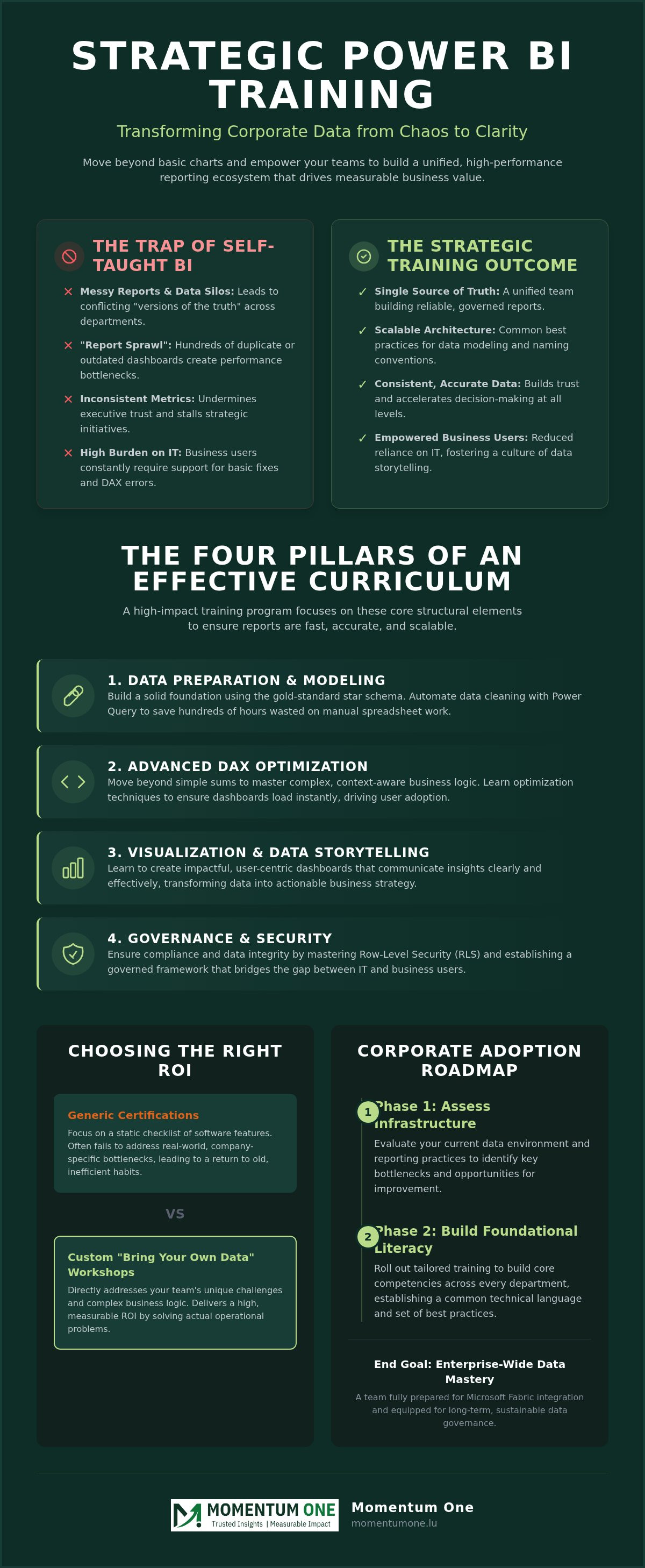
- Identify the limitations of self-taught reporting and why strategic Power BI training for corporate teams is essential for eliminating data silos and inconsistent metrics.
- Explore the core pillars of an enterprise-grade curriculum, focusing on advanced DAX optimization and scalable data modeling to handle complex business logic.
- Evaluate the high ROI of customized "Bring Your Own Data" workshops compared to generic certifications that often fail to address real-world bottlenecks.
- Follow a structured two-phase roadmap designed to assess your current infrastructure and build foundational literacy across every department.
- Learn how a collaborative partnership approach ensures your team is prepared for successful Microsoft Fabric integration and long-term data governance.
What if the biggest bottleneck in your organization isn't your technology, but the way your people interact with it? Even with the most advanced tools, many departments find themselves drowning in messy reports and conflicting versions of the truth. This is exactly why specialized Power BI training for corporate teams has evolved from a simple skill-up into a critical strategic pillar for 2026. It's no longer enough to just know where the buttons are; your team needs to understand the underlying architecture that drives real business value.
We understand the frustration of investing in generic workshops only to see your staff return to old, inefficient habits. You need a unified team capable of building high-performance, governed reports without constantly leaning on external consultants for basic fixes. This guide explores how to bridge the gap between basic tool knowledge and advanced capabilities like DAX optimization and Microsoft Fabric. You'll discover a roadmap to scale data literacy across your enterprise, ensuring every dashboard serves as a single, reliable source of truth for your leadership.
Beyond Basic Charting: Why Corporate Teams Need Strategic Power BI Training
Many organizations fall into the trap of assuming that because their staff can create a basic bar chart, they've mastered business intelligence. This surface-level proficiency often masks a chaotic underlying reality. Without strategic Power BI training for corporate teams, businesses frequently end up with a collection of "messy" reports that rely on fragile data connections and inconsistent logic. This isn't just a technical annoyance; it's a financial drain. When three different departments present three different "Total Revenue" figures during a board meeting, the cost of self-taught BI becomes painfully clear.
Generic online courses often fail because they treat Microsoft Power BI as a static checklist of features rather than a dynamic ecosystem. In a complex enterprise environment, your team doesn't just need to know how to use the tool. They need to understand how to build for scale, security, and governance. The shift toward the 2026 data environment requires moving away from tool-centric learning toward outcome-oriented data literacy that aligns perfectly with your specific corporate objectives.
The Trap of Unstructured Self-Service BI
Unstructured adoption leads to "report sprawl", where hundreds of duplicate or outdated dashboards clutter your workspace. This creates performance bottlenecks that slow down decision-making and frustrate users. Effective training establishes a common technical language, ensuring that every developer follows the same best practices for naming conventions and data modeling. The risk of ungoverned Power BI adoption in a corporate setting is the creation of a fragmented data environment where inconsistent metrics undermine executive trust and stall strategic initiatives. Our workshops focus on eliminating these silos before they become institutionalized.
Bridging the Gap Between IT and Business Users
A major friction point in many companies is the constant tug-of-war between IT and business units. Business users want speed; IT wants security. Structured training empowers your business users to build their own reports without compromising the integrity of the underlying data warehouse. It significantly reduces the support burden on internal IT departments by teaching users how to troubleshoot their own DAX errors and refresh issues. When your team masters these skills, they stop asking "How do I fix this?" and start asking "What does this data tell us about our growth?" This shift fosters a culture where data storytelling drives actual business value.
The Four Pillars of an Effective Corporate Power BI Curriculum
A robust curriculum doesn't just list features; it builds a mental framework for solving business problems. High-impact Power BI training for corporate teams focuses on the structural elements that ensure reports remain fast and accurate as they scale. While official Microsoft Power BI training offers a solid technical baseline, complex corporate environments demand a curriculum built around four specific pillars:
- Data Preparation and Modeling: Building the foundation for scalable reports.
- Advanced DAX Optimization: Moving beyond simple sums to complex business logic.
- Visualization and Data Storytelling: Creating impactful, user-centric dashboards.
- Governance and Security: Ensuring compliance and Row-Level Security mastery.
Mastering the Data Model and Power Query
The data model is the engine room of your reporting environment. We've found that the star schema remains the gold standard for enterprise reporting because it balances performance with usability. By teaching teams to use Power Query for automated data cleaning, organizations can save hundreds of man-hours annually that were previously wasted on manual spreadsheet manipulation. This structural foundation is often the bridge to more advanced Data Warehouse & Lakehouse Design strategies.
DAX Optimization for Enterprise Performance
Nothing kills report adoption faster than a dashboard that takes thirty seconds to load. Effective training must move beyond simple sums to teach context-aware business logic. Teams need to write efficient measures that don't lag when hitting large datasets. Common DAX pitfalls, like improper use of FILTER or CALCULATE, often lead to inaccurate financial reporting that can have serious consequences. For those looking to dive deeper into technical specifics, our guide on optimizing DAX for high-performance reports covers these nuances in detail.
Visualization and storytelling transform raw numbers into actionable insights. It's about creating user-centric dashboards that answer the "so what?" within seconds of opening. Scaling data literacy through Power BI training for corporate teams ensures that every department speaks the same language. Finally, governance and security ensure that the right people see the right data. Mastering Row-Level Security (RLS) is non-negotiable for teams handling sensitive corporate information. If you're looking to establish these standards across your entire organization, exploring Power BI Consulting & Governance can help solidify your team's new skills into a permanent framework.
Custom Workshops vs. Generic Certifications: Choosing the Right ROI
When evaluating the return on investment for technical education, many leaders default to generic certifications. While these programs provide a structured path to a badge, they often leave a significant gap between theoretical knowledge and practical application. Choosing Power BI training for corporate teams that prioritizes custom workshops over passive video modules ensures that your staff isn't just learning how to use a tool, but how to solve your specific business challenges. In a landscape as complex as 2026, the ability to apply logic to your own unique datasets is far more valuable than passing a multiple-choice exam.
A "Bring Your Own Data" (BYOD) approach is the most effective way to eliminate the friction of moving from a classroom to a production environment. When teams work with their actual data during training, they encounter and solve real-world bottlenecks immediately. This interactive method significantly boosts long-term retention compared to passive learning. Instead of watching a video about a generic retail dataset, your team works through the nuances of your own SQL databases or SAP extracts, ensuring the skills stick long after the session ends.
Tailoring Content to Your Industry and Data Stack
A finance team in Luxembourg has very different requirements than a manufacturing unit in the same region. Tailoring the curriculum to specific industry scenarios ensures that the logic being taught is immediately relevant. Whether you're integrating legacy Excel files or connecting to modern cloud-based data warehouses, the training sandbox should reflect your actual data stack. We define success not by the number of completion certificates issued, but by the number of high-quality, governed reports successfully deployed to your workspace following the session.
The Role of an Expert Facilitator
The difference between a standard teacher and a consultant-trainer lies in their ability to navigate complexity. An expert facilitator brings years of implementation experience to the room, allowing them to address organizational hurdles like poor data quality or outdated systems on the fly. This level of insight is what transforms a simple lesson into a strategic asset for any Power BI training for corporate teams. By choosing specialized Corporate Power BI Training, you're partnering with a strategist who understands the broader Microsoft ecosystem. This localized expertise is vital for teams that need more than just a tutorial; they need a steady hand to guide them through the nuances of enterprise-level data architecture.
Step-by-Step: Designing Your Corporate Power BI Adoption Roadmap
Successful data transformation doesn't happen by accident. It requires a structured, multi-phase approach that moves beyond simple tool access. A well-designed roadmap ensures that your investment in Power BI training for corporate teams translates into long-term organizational change. This journey begins with a clear understanding of your current state and ends with a self-sustaining culture of data excellence. By following a logical progression, you can avoid the common pitfalls of fragmented adoption and inconsistent reporting standards.
- Phase 1: Assessment. Evaluate your current technical infrastructure and identify existing skill gaps across different departments.
- Phase 2: Foundational Literacy. Roll out broad training to ensure every business user can navigate reports and interpret key metrics accurately.
- Phase 3: Advanced Development. Conduct deep-dive technical workshops for your "Power Users" to master complex DAX and data modeling.
- Phase 4: Center of Excellence (CoE). Establish a dedicated internal group to provide ongoing support, manage governance, and share best practices.
- Phase 5: Unified Management. Transition your team toward Microsoft Fabric to integrate data engineering and business intelligence into one cohesive environment.
Assessing the Data Maturity of Your Team
You can't build a high-performance team on a shaky foundation. Before any classroom sessions begin, it's vital to identify "Data Champions" within your departments. These are the individuals who already show an interest in analytics and can lead the charge during the adoption phase. We recommend conducting a baseline technical audit to understand how data currently flows through your organization. This is often the best time to perform a comprehensive Power BI Architectural Review to ensure your backend can support the increased demand that follows successful training.
The Future-Proofing Layer: Microsoft Fabric Training
The 2026 data landscape is rapidly shifting toward unified platforms. Preparing your staff for the move from standalone Power BI to a comprehensive Fabric environment is a critical step in future-proofing your operations. This involves expanding the training scope to include OneLake, Lakehouses, and Data Factory. When your team understands these components, they stop viewing data in silos and start seeing the entire lifecycle of information. Our specialized Corporate Data Fabric Training is designed to bridge this specific gap, ensuring your developers are ready for the next generation of Microsoft analytics.
Ready to move beyond generic workshops and build a custom path for your staff? We've spent over 8 years helping organizations navigate these complexities as a certified Microsoft Solutions Partner. If you're looking for Power BI training for corporate teams that delivers measurable results, explore our tailored training solutions to start your adoption roadmap today.
Empowering Your Team with Momentum One’s Tailored Training Solutions
At Momentum One, we don't believe in one-size-fits-all education. Our approach to Power BI training for corporate teams blends deep technical authority with a supportive partnership. We've spent over 8 years navigating the Microsoft ecosystem, specializing in everything from DAX optimization to complex Fabric migrations. This history allows us to act as a steady hand for your department, simplifying technical complexity rather than hiding behind it. We understand that your goal isn't just to learn a tool; it's to drive measurable business growth through better data.
Our methodology moves steadily from broad value propositions to specific technical capabilities. We don't just teach the "how"; we explain the "why" behind every architectural choice. This ensures that your team doesn't just follow a tutorial but develops the critical thinking skills needed to maintain a high-performance BI environment. By positioning ourselves as a reliable strategist, we help you bridge the gap between basic reporting and advanced enterprise analytics.
A Partnership Built on Reliability and Results
We take pride in our status as a certified Microsoft Solutions Partner. This certification is more than just a badge; it's a reflection of our commitment to maintaining the highest standards of technical implementation. As a boutique consultancy, we offer a level of focus and local expertise that larger, generic training providers simply can't match. We understand the specific nuances of the Luxembourgish corporate landscape, including regional data standards and industry-specific requirements. We invite you to discuss your specific team challenges with us so we can design a curriculum that directly addresses your unique organizational hurdles.
Ready to Scale Your Data Capabilities?
Transitioning from training to production can be a daunting phase for any organization. To solve this, we offer a bridge from initial learning to full-scale managed services. This ensures your team has a reliable facilitator to turn to long after the workshop ends. We've seen how this continuity prevents the "skill fade" that often follows generic courses, allowing your staff to confidently deploy reports that adhere to your internal governance frameworks. We provide the flexibility your organization requires through three distinct delivery models:
- On-site Workshops: Intensive, face-to-face sessions held at your office for maximum collaboration.
- Virtual Classrooms: Interactive, remote training sessions designed for distributed or hybrid teams.
- Hybrid Learning: A blend of both formats to suit your specific scheduling and location needs.
The path to a scalable, governed, and high-performance BI environment starts with a single strategic step. By investing in a partnership that values accuracy and efficiency, you're future-proofing your organization for the 2026 data economy. If you're ready to transform your staff into a data-driven powerhouse, book a customized Power BI training session for your team and let's start building your foundation for success.
Building a Sustainable Data Culture for 2026
Transforming your organization into a data-driven powerhouse requires more than just software access. It demands a shift from fragmented, self-taught reporting to a unified, governed framework where every team member speaks the same technical language. By prioritizing specialized Power BI training for corporate teams, you ensure that your staff can navigate the complexities of advanced DAX and the upcoming transition to Microsoft Fabric with confidence.
As a certified Microsoft Solutions Partner with over 8 years of specialized data consultancy experience, Momentum One is here to facilitate this journey. We design customized curricula using your real-world business data, ensuring that every workshop solves actual bottlenecks rather than theoretical problems. This approach bridges the gap between basic tool knowledge and the high-performance reporting your leadership expects.
Empower your team with expert Power BI training today. Your journey toward enterprise-wide data literacy starts with a single, strategic partnership. Let's build a future where data isn't just a resource, but your most significant competitive advantage.
Frequently Asked Questions
What is the ideal team size for a corporate Power BI training workshop?
We've found that groups of 8 to 12 participants offer the best balance for interactive learning. This size allows our facilitators to provide personalized attention during technical exercises while maintaining a collaborative environment. Keeping sessions focused ensures that every team member can ask specific questions about their unique workflows without slowing down the group's overall progress.
Do we need Power BI Premium licenses to benefit from corporate training?
No, you don't need a Premium license to see significant results from professional training. Most core concepts, including advanced data modeling and DAX optimization, apply perfectly to Power BI Pro environments. We always tailor the curriculum to the specific features available within your current licensing tier, ensuring your team learns to maximize the tools they already have at their disposal.
Can the training be customized to use our own company’s data?
Yes, we highly recommend using your actual business data for our workshops. This "Bring Your Own Data" approach makes Power BI training for corporate teams far more impactful because it addresses your real-world bottlenecks immediately. Working with familiar datasets helps your staff bridge the gap between theory and practice, leading to much higher retention rates than generic sample files.
How long does it take for a team to become proficient in Power BI?
Basic proficiency usually takes two to three days of intensive training, but true mastery is an ongoing process. Most teams can build and manage governed reports independently within a few months of consistent application following our workshops. We structure our roadmap to move your staff from foundational literacy to advanced technical development in a methodical, logical sequence.
What is the difference between standard Power BI training and Microsoft Fabric training?
Standard training focuses on visualization, DAX logic, and data modeling within the Power BI ecosystem. Microsoft Fabric training expands this scope to include the entire data engineering lifecycle, covering components like OneLake and Data Factory. While Power BI is the presentation layer, Fabric training prepares your team to manage the unified backend architecture that supports modern enterprise analytics.
Does Momentum One provide post-training support or managed services?
Yes, we act as a long-term partner by offering managed services that extend far beyond the initial classroom sessions. Our team provides ongoing support for governance, complex troubleshooting, and environment optimization to ensure your data culture remains stable. This supportive partnership prevents "skill fade" and helps your organization maintain a high-performance BI environment as your data needs evolve.
Is the training suitable for both business users and technical developers?
Yes, our curriculum is intentionally designed to support a wide range of skill levels. We often separate sessions into foundational literacy for business users and deep-dive technical workshops for your "Power Users" and developers. This ensures that every participant receives Power BI training for corporate teams that's relevant to their specific role and daily responsibilities.
How do we measure the ROI of corporate Power BI training?
You can measure ROI through tangible outcomes like reduced report turnaround times and a significant decrease in reliance on external consultants for basic fixes. Success is also reflected in improved data accuracy and the elimination of conflicting metrics across departments. When your team can build governed, high-performance reports internally, the efficiency gains directly contribute to faster, more confident executive decision-making.