Self-Service BI Governance: Busting the Myths of Data Freedom vs. Control
Master self-service BI governance to end data chaos. Learn to balance user freedom and control for fast, accurate insights without multiple versions of the t...
- Identify why total data freedom often backfires and how to replace "Excel hell" with a structured framework of people, processes, and technology.
- Reframe self-service BI governance as an accelerator that provides the guardrails your team needs to move quickly and safely.
- Differentiate between enterprise-level reporting and collaborative departmental insights to ensure the right level of control for every use case.
- Follow a practical, five-step roadmap to audit your tenant and establish clear standards for workspace ownership and access.
- Leverage Microsoft Fabric and OneLake to centralize your data while giving departments the autonomy they need within a unified environment.
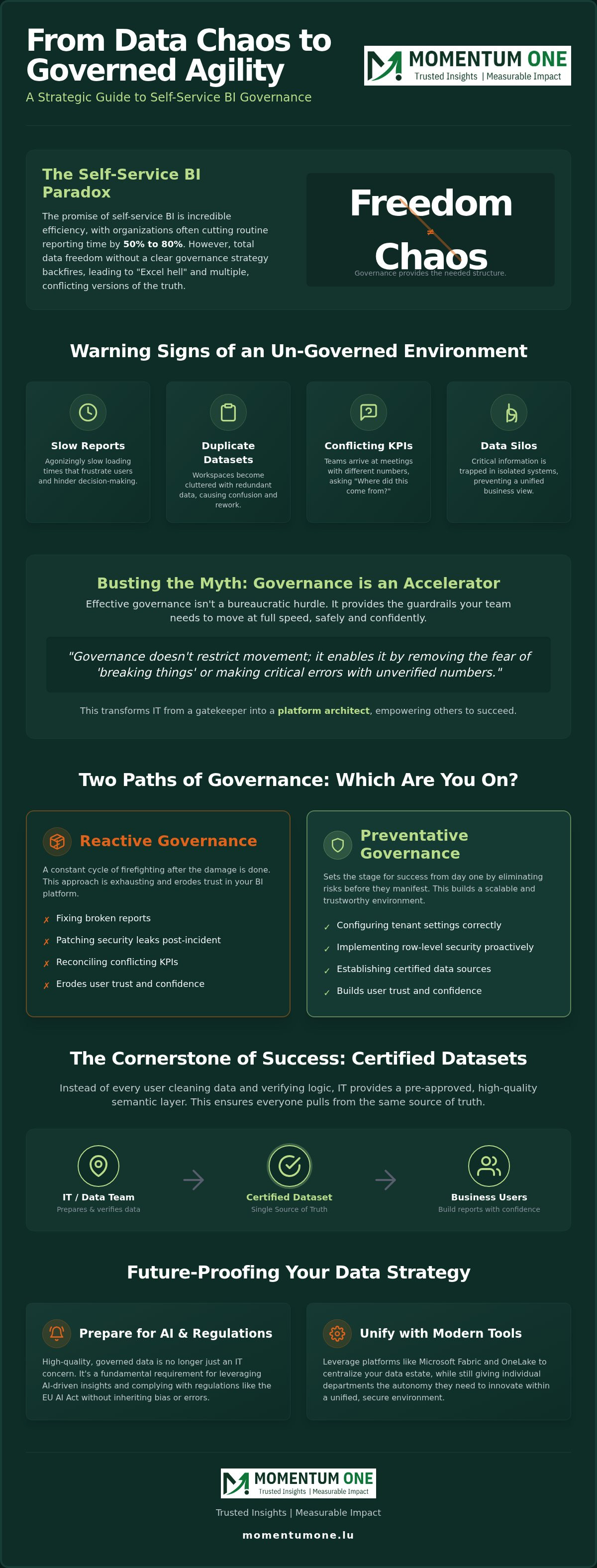
Organizations often see a 50% to 80% reduction in routine reporting time after implementing self-service BI, yet without a clear strategy for self-service BI governance, that efficiency is often overshadowed by the fear of "multiple versions of the truth." You want your team to have the freedom to build their own reports, but you've likely seen the fallout of unmanaged exports and conflicting results. It's frustrating when different departments show up to a meeting with different revenue figures, leaving you to wonder which data is actually accurate.
We understand that the tension between data freedom and control feels like a zero-sum game. In reality, modern governance isn't a policing function; it's the infrastructure that makes high-speed discovery possible. You'll learn how to empower your business users with the tools they need while maintaining strict data integrity, security, and performance. We'll walk through the practical steps to establish certified data sources and technical guardrails, ensuring your environment remains scalable and your users stay confident in the numbers they present.
The Self-Service BI Paradox: Why Total Freedom Leads to Data Chaos
The promise of modern Business intelligence (BI) is simple: give everyone the power to analyze data, and better decisions will follow. However, without a structured framework, this freedom quickly dissolves into a "Wild West" environment. We define self-service BI governance as the essential framework of people, processes, and technology that ensures your data remains accurate, secure, and discoverable. It's the difference between a high-performing analytics culture and "Excel hell," where teams spend hours debating conflicting KPIs instead of driving growth.
The Myth of the "Self-Sufficient" User
Even your most skilled power users need a managed semantic layer to be effective. Without it, departments often drift into "shadow BI," where they source their own tools and create isolated pockets of logic. This doesn't grant "freedom to create." Instead, it grants the "freedom to fail" by building complex reports on top of unverified or outdated data. We've found that users are most productive when they don't have to worry about the plumbing. They need a reliable foundation so they can focus on what they do best: finding insights that move the needle.
Signs Your BI Environment is Out of Control
You can usually spot a failing governance strategy by the symptoms in your daily workflow. Common red flags include agonizingly slow report loading times, duplicate datasets that clutter your workspace, and the frequent, frustrated question: "Where did this number come from?" A "Data Silo" occurs when critical information is trapped within isolated systems or departments, preventing a unified view of your business performance. If these issues sound familiar, a Power BI Architectural Review is an excellent diagnostic tool to pinpoint exactly where your technical guardrails are breaking down.
Busting the Policing Myth: Governance as a Catalyst for Agility
The most common misconception about self-service BI governance is that it exists to slow people down. Many business users view governance as a series of bureaucratic hurdles designed to keep them away from their data. In reality, effective governance acts as the guardrails on a high speed highway. Without those lines and barriers, you'd have to drive with extreme caution, constantly fearing a collision. With them, you can move at full speed because the environment is predictable and safe. Governance doesn't restrict movement; it enables it by removing the fear of "breaking things" or making a critical error with unverified numbers.
A cornerstone of this agile approach is the "Certified Dataset." Instead of every user spending hours cleaning data, writing complex DAX, and verifying logic, IT provides a pre-approved, high-quality semantic layer. This saves business users significant time and ensures everyone is pulling from the same source of truth. When users can trust the foundation, they spend less time on data prep and more time on analysis. Adopting data governance best practices transforms IT from a traditional gatekeeper into a platform architect, building the infrastructure that empowers others to succeed.
Preventative vs. Reactive Governance
Reactive governance is a cycle of firefighting. It involves fixing broken reports, patching security leaks, and reconciling conflicting KPIs after the damage is done. This approach is exhausting and erodes trust in the BI platform. Preventative governance, however, sets the stage for success from day one. By configuring tenant settings and row-level security (RLS) correctly at the start, you eliminate risks before they manifest. If you want to move away from constant troubleshooting, our team can help you implement Power BI Data Security best practices to protect your enterprise assets proactively.
Data Literacy: The Human Element of Control
Technical guardrails are only half the battle. Even the best security settings can't prevent a user from misinterpreted a complex metric. As of 2026, 68% of privacy professionals now have responsibilities related to AI governance, highlighting how human oversight is becoming more complex. This is why Corporate Data Training is a vital component of any governance strategy. It builds a data-driven culture where users understand their role as data stewards within their own departments. When people understand the "why" behind the rules, they're more likely to follow them. If you're looking to bridge the gap between technical control and user freedom, exploring specialized Power BI Consulting & Governance can provide the steady hand your organization needs.
The Three Tiers of Governed Self-Service
A one size fits all approach to data access rarely works in a complex organization. To balance the need for speed with the necessity of control, we recommend a tiered structure for self-service BI governance. This model allows you to apply different levels of oversight based on the data's reach and its impact on the business. By categorizing your reports and datasets into three distinct tiers, you provide a clear roadmap for how information moves from a rough idea to a certified corporate standard.
- Tier 1: Enterprise BI (Highly Regulated) – This tier covers your most critical assets, such as financial statements, public disclosures, and core KPIs used by the board. These must be 100% accurate and are strictly managed by IT or a Center of Excellence.
- Tier 2: Collaborative BI (Departmental) – Here, ownership is shared between IT and business units. Marketing might manage their own campaign performance dashboards, using data that has been partially vetted but remains specific to their team's needs.
- Tier 3: Personal/Sandbox BI (Experimental) – This is the innovation lab where users can prototype new ideas. It's a low risk environment where speed is prioritized over long term stability.
The secret to a scalable environment is the "Promotion and Certification" workflow. When a report in the Tier 3 sandbox proves its value, it shouldn't stay there. It should move through a formal review process to Tier 2 or Tier 1, ensuring the logic is sound and the DAX is optimized before it reaches a wider audience. This progression prevents your production environment from being cluttered with "draft" versions of reports.
Tier 1: The Single Source of Truth
In this tier, the focus is on robust Data Warehouse Design and absolute precision. A "Golden Dataset" is a validated, single source semantic model that serves as the definitive reference for corporate KPIs across the entire organization. For large scale deployments, organizations often utilize Microsoft Fabric F64 capacity, which as of July 2026 starts at approximately $8,410 per month for pay-as-you-go, to provide the necessary performance and unlimited free viewing for these mission critical enterprise reports.
Tier 3: The Innovation Sandbox
Operationalising Strategy: 5 Steps to Secure and Scalable BI
- Step 1: Conduct a Tenant Audit – You can't govern what you don't understand. Start by identifying high-risk sharing settings, orphaned reports, and datasets with excessive refresh failures to pinpoint where your immediate risks lie.
- Step 2: Define Workspace Standards – Implement clear naming conventions and ownership roles. Every workspace should have a designated business owner and a technical lead responsible for its maintenance.
- Step 3: Implement Automated Guardrails – Use Power BI and Fabric tenant settings to restrict risky actions. For example, disabling "Publish to Web" ensures sensitive data never accidentally enters the public domain.
- Step 4: Establish a Certification Process – Define the exact technical and business criteria a report must meet to be deemed "Official." This creates a clear distinction between experimental drafts and trusted enterprise assets.
- Step 5: Monitor and Iterate – Use built-in usage metrics to see which reports are driving value. If a certified report hasn't been viewed in 90 days, it's time to investigate why or retire it to save capacity.
If you're ready to move from chaos to a structured, scalable environment, our Power BI Consulting & Governance experts are here to facilitate the transition.
Automating the Boring Parts
Scaling a BI environment manually is a losing battle. We recommend using Pipeline and Dataflow Automation to ensure data freshness without constant human intervention. Automation also plays a critical role in Capacity Management, helping you monitor compute usage and prevent unexpected cost overruns. In the 2026 landscape, AI-driven tools can even assist in auto-tagging sensitive data, ensuring that your self-service BI governance policies are applied consistently across thousands of reports.
Building the BI Center of Excellence (CoE)
Future-Proofing Governance with Microsoft Fabric and Momentum One
Microsoft Fabric is fundamentally changing how we approach self-service BI governance by addressing the root causes of data fragmentation. At the heart of this shift is OneLake, which operates on the "One Copy" principle. Earlier, we explored how data duplication leads to conflicting KPIs and technical debt. OneLake solves this by allowing multiple analytical engines to work on the same physical data without creating redundant copies. This means your data remains in its original location while staying accessible to everyone who needs it, ensuring a consistent version of the truth across the entire organization.
Domain-based governance within Fabric takes this a step further by allowing you to delegate administrative control to specific departments. Your marketing or finance teams can manage their own workspace settings and certifications while remaining within the global guardrails established by your Center of Excellence. This structure provides the departmental autonomy we discussed in our tiered model while maintaining the centralized oversight required for enterprise security. It's a balanced approach that makes self-service BI governance sustainable as your organization grows and your data needs become more complex.
Fabric: The Governance Game-Changer
The introduction of "Direct Lake" mode is a technical breakthrough for both performance and security. It allows Power BI reports to query massive datasets directly from OneLake, bypassing the need for traditional data refreshes that often lead to performance bottlenecks. This ensures that your Data Architecture Modernization efforts result in real-time, accurate insights. By centralizing security at the data layer, you apply row-level security once, and it persists across every tool in the Fabric ecosystem, from SQL endpoints to notebooks, creating a truly secure and unified environment.
How We Help: From Strategy to Managed Support
Establishing a sophisticated governance framework is a journey that requires technical expertise and cultural change. As your Microsoft Solutions Partner, Momentum One simplifies this complexity by designing architectures that balance user freedom with rigorous security. We don't just set up the tools; we empower your people through custom workshops and Corporate Power BI Training, ensuring your team has the literacy to use data responsibly and effectively.
For many growing enterprises, Managed BI Services are the most logical conclusion. They provide the peace of mind that comes with professional oversight without the internal overhead of building a dedicated team. We offer continuous monitoring and 24/7 Support Services to keep your environment optimized and reliable. Whether you're migrating to Fabric or optimizing an existing tenant, we're here to ensure your data journey is stable, secure, and built for long-term success.
Building a Culture of Trust and Scalable Insight
As a Luxembourg based National Strategic Partner and Certified Microsoft Solutions Partner, we specialize in bridging the gap between technical control and user freedom. Our team brings deep expertise in DAX and performance tuning to ensure your tenant remains fast and efficient as it grows. Whether you are navigating a Fabric migration or refining your workspace standards, we provide the steady hand and technical guardrails required for long term success.
Ready to transform your analytics? Secure your data ecosystem with Momentum One’s Power BI Governance services. Your journey toward a truly data driven culture starts with a reliable foundation and a partner dedicated to your progress.
Frequently Asked Questions
What is the main difference between self-service BI and managed BI?
Managed BI involves a central IT or data team building and maintaining every report for the organization. In contrast, self-service BI empowers business users to create their own visualizations and insights using pre-approved data sources. While managed BI ensures high consistency for corporate reporting, self-service BI offers the agility needed for fast paced departmental decisions and rapid prototyping.
Does self-service BI governance restrict user creativity?
Governance actually enhances creativity by providing a safe environment where users don't fear breaking production systems or using incorrect data. Effective self-service BI governance removes the technical guesswork by offering certified datasets and clear templates. When users don't have to worry about data prep or accuracy, they can focus entirely on innovative analysis and finding unique business insights.
How do we handle data security in a self-service environment?
Security is maintained through a combination of technical guardrails like Row-Level Security (RLS) and sensitivity labels. You should configure tenant settings to restrict high risk actions, such as external sharing or public publishing. By implementing these controls at the data layer, you ensure that security policies follow the data regardless of which user builds the final report.
What are the first steps to take when our Power BI tenant becomes messy?
Start by running a comprehensive audit of your existing workspaces to identify duplicate datasets and unused reports. You'll likely find that a small percentage of assets drive the majority of your organization's value. Once you've identified the "noise," you can begin migrating critical reports into a structured framework while archiving obsolete content to reclaim capacity and improve performance.
Can Microsoft Fabric help with data governance and silos?
Microsoft Fabric directly addresses data silos through OneLake, which centralizes data storage while allowing different departments to maintain their own analytical tools. Its "One Copy" architecture eliminates the need for constant data movement and duplication. This ensures that every department works from the same physical data, significantly reducing the risk of conflicting KPIs and redundant storage costs.
How often should we audit our BI governance framework?
You should perform a technical audit of tenant settings and usage metrics at least once a quarter. This helps you catch performance bottlenecks or security gaps before they become critical issues. A broader strategic review of your self-service BI governance policies should happen annually to ensure they still align with your evolving business goals and any new regulatory requirements.
Who is responsible for data quality in a self-service model?
Data quality is a shared responsibility between the IT team and departmental data stewards. IT is typically responsible for the integrity of the underlying data warehouse and "Golden Datasets." Business users and stewards, however, are responsible for the logic used in their specific departmental reports. Training acts as the bridge that ensures both teams understand their role in maintaining accuracy.