Solve Common Issues With Different Data Types Efficiently
Facing issues with different types of data? Learn to fix data quality problems, automate cleanup, and restore trust in your reports and AI models. Get your g...
- Understand the "Garbage In, Garbage Out" principle and how it directly impacts the reliability of your modern predictive analytics.
- Learn a clear framework to identify and resolve specific issues with different types of data across structured, semi-structured, and unstructured formats.
- Discover how to eliminate performance bottlenecks in Power BI reports by addressing the root causes of analytics drift.
- Build a roadmap to transition from manual, time-consuming cleanup to a scalable model of automated data governance and clear ownership.
- Explore how migrating to Microsoft Fabric can modernize your infrastructure and provide a permanent cure for legacy data integrity challenges.
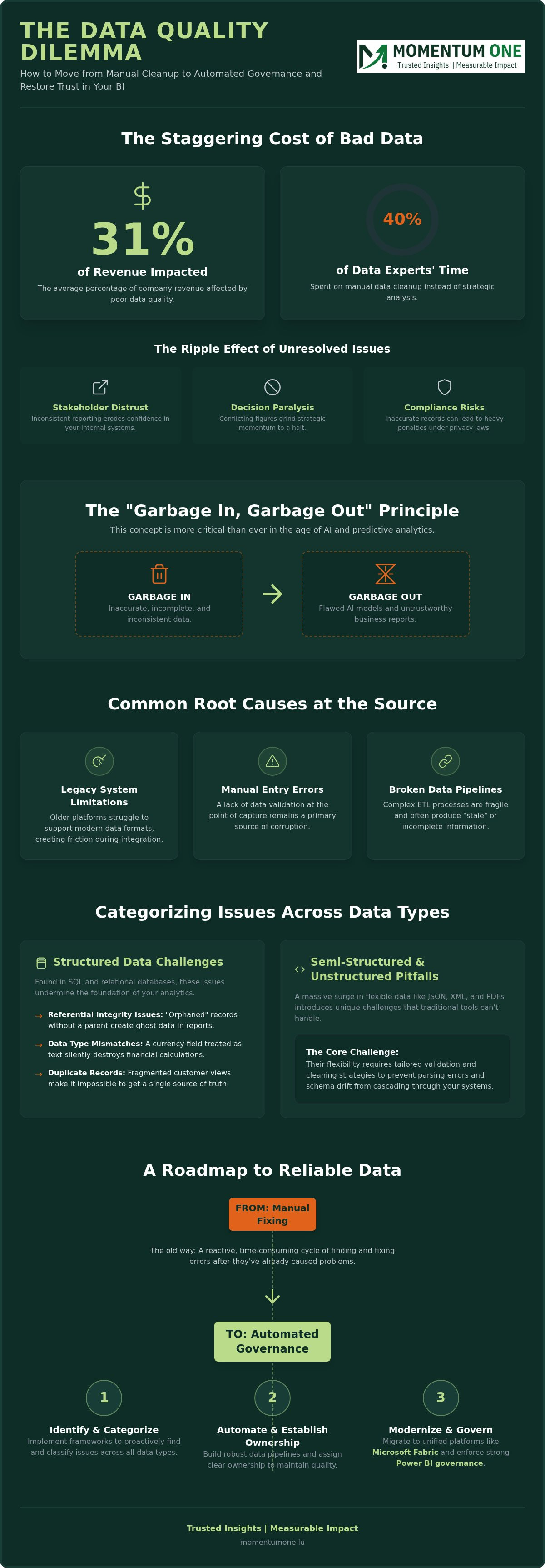
Did you know that the average percentage of revenue impacted by data quality issues has jumped to 31%? It's a staggering figure that highlights why your team feels like they're constantly underwater. You're likely all too familiar with the frustration of inconsistent reporting that leads to stakeholder distrust. It's exhausting when your data experts spend 40% of their time on manual cleanup instead of driving strategy. You're right to worry that these issues with different types of data are quietly poisoning your AI and machine learning models.
We're here to help you turn that tide. In this guide, you'll learn to identify, categorize, and resolve critical data quality issues across both structured and unstructured formats. Our goal is to help you reclaim your business intelligence as a reliable single source of truth. We'll provide a clear framework for categorizing these hurdles and a roadmap to move from manual fixing to automated governance. By the end, you'll have the tools to improve report accuracy and restore confidence in your data ecosystem.
The Landscape of Data Quality: Why Issues Occur in 2026
In the current business environment, data quality is no longer a technical checkbox; it's the fit-for-purpose reliability of your datasets for making critical decisions. When we talk about Data quality, we're measuring how well your information reflects reality across your entire organization. Research shows that the average percentage of revenue impacted by data quality issues has reached 31%. This isn't just about small errors. It's about systemic issues with different types of data that prevent your leadership from moving forward with confidence.
The "Garbage In, Garbage Out" (GIGO) principle has never been more relevant than in the era of predictive analytics and large language models. If your foundation is cracked, your AI outputs will be hallucinations rather than insights. We've seen data problems evolve from simple manual typos to complex architectural misalignments. These structural problems often stem from how data is ingested, stored, and transformed across modern platforms, making it difficult to maintain a single version of the truth.
The Hidden Costs of Unresolved Data Issues
Poor data hygiene creates a ripple effect throughout your entire operation. Data teams often spend nearly half their day just preparing and cleaning sets before they can even begin analysis. This operational drag is a silent killer of productivity that keeps your best talent from high-value tasks. When stakeholders see conflicting figures in different reports, strategic momentum grinds to a halt. This decision paralysis erodes trust in your internal systems. In regulated industries, these errors also introduce significant compliance risks, especially with the strict enforcement of global privacy laws that carry heavy penalties for inaccurate record-keeping.
Common Root Causes at the Source
Identifying why these problems persist is the first step toward a permanent solution. Most organizations face a combination of these challenges:
- Manual Entry Errors: A lack of validation at the point of capture remains a primary source of corruption in relational databases.
- Legacy System Limitations: Older platforms often struggle to support modern data formatting, creating friction during integration.
- Broken Data Pipelines: Complex ETL processes are fragile. Without robust data warehouse design, these pipelines often fail or produce "stale" information.
Solving these root causes often requires a shift toward Fabric migration and modernization to unify your data estate. By centralizing your logic and establishing Power BI governance, you can eliminate the silos that breed inconsistency and reclaim control over your business intelligence.
Categorizing Issues Across Different Types of Data
Effective data management starts with recognizing that your information isn't a monolith. Modern organizations juggle three primary categories: structured, semi-structured, and unstructured. Structured data is highly organized information typically found in relational databases. While this format is easier to query, treating it the same as a raw JSON file or an unparsed PDF is one of the most common data quality misconceptions. Each category requires a tailored validation and cleaning strategy to prevent errors from cascading through your systems. We're seeing a massive surge in the importance of semi-structured data like JSON and XML as businesses move deeper into cloud environments. This shift introduces unique issues with different types of data that traditional SQL-based tools aren't always equipped to handle.
Structured Data Challenges: SQL and Relational Databases
Relational databases rely on rigid schemas, but complexity often breeds errors. Referential integrity issues occur when orphaned records exist without a corresponding parent, leading to broken reports and "ghost" data. Data type mismatches, such as a currency field being treated as a generic string, can silently destroy calculation accuracy in your financial models. Additionally, duplicate records across disparate business units remain a persistent headache. These duplicates create a fragmented view of the customer, making it impossible to establish a true single source of truth without significant manual intervention.
Semi-Structured and Unstructured Data Pitfalls
Semi-structured data offers flexibility, but that freedom comes with the risk of schema drift. This happens when JSON structures change at the source without warning, instantly breaking downstream pipelines and stalling your analytics. Unstructured files like PDFs and images present even greater hurdles due to inconsistent metadata. Extracting reliable KPIs from social media feeds or system logs is notoriously difficult because the "signal" is often buried in "noise." Without sophisticated parsing, these issues with different types of data can lead to missed opportunities and skewed sentiment analysis.
Streaming and Real-Time Data Issues
In real-time analytics, timing is everything. Late-arriving data can disrupt dashboards, causing visual flickers or inaccurate totals as the system tries to reconcile past events with current time windows. Sudden data volume spikes often lead to ingestion failures if your architecture hasn't been scaled for elasticity. Ensuring consistency when data is processed "on the fly" requires a robust framework to handle out-of-order events. If your current setup feels fragile under these pressures, exploring pipeline and dataflow automation can stabilize your real-time insights and provide the reliability your stakeholders demand.
The Technical Impact: From Analytics Drift to Performance Bottlenecks
When issues with different types of data go unaddressed at the source, they don't stay confined to the database. They eventually crawl into your reporting layer, manifesting as frustrating performance bottlenecks. In Power BI, this often looks like spinning wheels on a dashboard or visuals that take ages to load. These delays are rarely just a hardware problem; they're frequently symptoms of poor data hygiene that forces the system to work harder than necessary to render a single insight.
We often see a phenomenon called "Analytics Drift." This occurs when your reports gradually lose alignment with business reality. It's a subtle process where underlying data structures change, but the reporting logic remains static. Over time, the gap between what the dashboard shows and what's actually happening in the business widens. This makes strategic decisions risky because you're essentially flying blind with stale or misinterpreted information.
Data modeling plays a critical role in either masking or exacerbating these quality problems. A poorly designed model might hide errors for a few months, but it eventually makes them much harder to untangle. Establishing robust Power BI Consulting & Governance acts as a corrective measure. It ensures your data architecture is built on a foundation of clarity rather than a patchwork of quick fixes.
DAX Optimization and Data Quality
Poor data modeling forces your team to write overly complex DAX measures just to get a simple answer. If your data is "dirty," the calculation engine has to work twice as hard to filter out errors, handle null values, or reconcile mismatched types. It's far more efficient to clean your data at the source than to attempt a fix within the report layer. Fixing it in Power BI is like putting a band-aid on a structural crack; it might look better for a moment, but the underlying instability remains.
The AI and Machine Learning Complication
AI systems are notoriously sensitive to the quality of their inputs. Biased, incomplete, or inconsistent data leads directly to "hallucinations" in AI models, where the system provides confident but entirely incorrect answers. For organizations adopting Microsoft Fabric AI features, data observability is a vital prerequisite. High-quality training data is the only roadmap to predictive success. Without it, your AI initiatives will struggle to provide any real ROI, as the models will be trained on a distorted version of your business truth.
A Strategic Framework for Resolving Data Quality Challenges
Resolving recurring issues with different types of data requires more than ad-hoc patches. It demands a structured approach that tackles both the technical and cultural roots of the problem. Your first move is conducting a comprehensive data audit. This isn't just a list of errors; it's a deep dive into where silos exist and why certain datasets consistently fail. Once you've mapped the terrain, you must establish a robust Data Governance framework. Quality improves when there's clear ownership and accountability for every data asset across the organization.
Automation is your best ally in this journey. By implementing automated validation at the point of entry, you prevent the "garbage in" cycle from ever starting. The next logical step is to centralize your assets using a modern Data Lakehouse or Warehouse Design. This architecture provides the flexibility to handle varied formats while maintaining strict control. Finally, you need to move toward continuous data observability. Monitoring your pipelines in real-time allows you to catch and iterate on issues before they reach a stakeholder's desk.
Building a Single Source of Truth
Achieving a single source of truth is the ultimate goal for any business intelligence initiative. Master Data Management (MDM) plays a vital role here by reconciling conflicting records and resolving inconsistencies across departments. When you centralize your business logic, you eliminate the risk of "siloed truths" where Marketing and Finance look at the same KPI but see different numbers. If your current setup feels fragmented, our Data Architecture Modernization services can help you build the unified foundation necessary for scalable growth.
Automating Data Pipelines for Integrity
Human error is often the weakest link in data integrity. By leveraging Pipeline and Dataflow Automation, you remove the manual friction that leads to typos and missed updates. Within the Microsoft Fabric ecosystem, you can implement automated quality checks that flag anomalies as they happen. This marks a significant shift from manual review to exception-based monitoring. Instead of checking every row, your team only intervenes when the system detects a deviation from the norm. This proactive stance ensures that issues with different types of data are caught long before they impact your bottom line.
Ready to stop manual cleanup and start scaling? Explore how our Fabric Migration and Modernization solutions can transform your data quality today.
Modernizing Data Integrity with Momentum One
Momentum One serves as a proactive ally in the Microsoft data ecosystem. We don't just fix errors; we architect environments where issues with different types of data are systematically eliminated. As a certified Microsoft Solutions Partner with over 8 years of technical implementation experience, we provide the steady hand needed to navigate complex migrations. We've seen how legacy systems trap valuable insights in silos, and we use Fabric Migration and Modernization as a primary motivator to reset your data quality standards across your entire organization.
A boutique consultancy like Momentum One offers the specialized focus that large, generic firms often lack. We simplify complexity rather than hiding behind it, acting as a knowledgeable guide for your digital transformation. Our team is deeply invested in your journey, emphasizing shared goals and mutual progress. By positioning ourselves as a supportive partner, we ensure that your transition to modern analytics is both smooth and high-performing. We focus on results that matter: efficiency, accuracy, and sustainable growth.
Our Methodology: From Troubleshooting to Transformation
We believe in delivering immediate value while planning for long-term scalability. Our process often begins with specialized technical tasks like DAX optimization to resolve performance-related data issues in your existing reports. Once we've stabilized the immediate environment, we scale our efforts toward full-scale data warehouse and lakehouse design. This methodical rhythm ensures that your overarching governance strategy is established before we dive into the granular technical details. Our managed services then provide the ongoing dedication needed to maintain peak performance and reliability as your business grows.
Empowering Your Team through Training
Technical solutions are only half the battle; the other half is human proficiency. We prioritize technical training to improve internal data literacy and technical skills. Through Corporate Power BI Training, we empower your team to identify and resolve issues with different types of data at the source. Building this culture of proficiency prevents future quality drift and ensures that your stakeholders remain confident in the reports they receive. We don't just hand over a system; we invest in the development of your team to ensure long-term success.
If you're ready to move from manual fixing to automated governance, we're here to facilitate that transition. Contact Momentum One for a Data Architectural Review to begin your roadmap toward a single source of truth across Luxembourg.
Reclaiming Your Data Integrity for Scalable Growth
Mastering your data ecosystem is the first step toward unlocking the full potential of your business intelligence and AI initiatives. We've explored how identifying root causes and implementing a strategic governance framework can eliminate recurring issues with different types of data. By shifting from manual cleanup to automated pipelines within Microsoft Fabric, you don't just fix reports; you build a foundation for reliable, real-time decision-making. High-quality data is no longer a luxury; it's the prerequisite for competitive performance in 2026.
As a Certified Microsoft Solutions Partner, Momentum One brings deep expertise in Power BI Governance and modern data architecture. We operate as a boutique consultancy with a national-level strategic impact, providing the steady hand you need for complex technical migrations. We're dedicated to your success and ready to help you move from analytics drift to a single source of truth. Our team simplifies the complex, ensuring your roadmap is clear and your results are measurable.
It's time to stop letting bad data poison your models and erode stakeholder trust. Partner with Momentum One to resolve your data challenges today and ensure your organization stays ahead in an increasingly complex landscape. You've got the vision; we've got the technical roadmap to help you reach it.
Frequently Asked Questions
What are the most common issues with different types of data?
Common problems include referential integrity breaks, duplicate records, and data type mismatches. These issues with different types of data often stem from a lack of validation during manual entry or fragmented storage across departments. When your source information isn't standardized, it creates a ripple effect that compromises every downstream analysis. Addressing these hurdles early ensures your business intelligence remains reliable and fit for purpose.
How does poor data quality affect Power BI report performance?
Poor data quality forces the Power BI engine to perform heavy lifting during every refresh. If your model contains "dirty" data, you'll likely need complex DAX measures to filter out errors or reconcile mismatched types. This extra processing leads to slow visuals and spinning wheels on dashboards. By optimizing your data at the source, you reduce the computational load, resulting in faster load times and a better user experience.
Can Microsoft Fabric help resolve data silos and inconsistencies?
Microsoft Fabric acts as a powerful unifier by providing a single storage layer known as OneLake. This architecture eliminates silos by allowing different departments to access the same underlying data without creating redundant copies. It helps resolve inconsistencies by centralizing your transformation logic and governance standards. Moving to a unified environment ensures that everyone in the organization works from the same verified facts, which is essential for accurate reporting.
Is it better to fix data issues in the source system or the reporting layer?
You should always aim to fix data problems as close to the source as possible. While it's tempting to apply quick fixes in the reporting layer, this approach creates technical debt and slows down performance. Cleaning data at the source ensures that the fix benefits every tool and user connected to that system. It's a more efficient strategy that maintains the integrity of your single source of truth.
What is schema drift and why does it matter for my data pipelines?
Schema drift occurs when the structure of your source data changes unexpectedly, such as a new field being added or an existing one being renamed. This matters because it can instantly break your automated pipelines and stop the flow of information to your dashboards. For organizations handling issues with different types of data, especially semi-structured formats like JSON, monitoring for schema drift is critical to maintaining business continuity and preventing ingestion failures.
How much time should my data team spend on cleaning data vs. analysis?
Ideally, your team should spend the vast majority of their time on high-value analysis rather than manual cleanup. Current industry trends show many teams lose 40% of their day to data preparation. By implementing automated governance and modern architecture, you can flip this ratio. The goal is to move toward a model where 80% of effort goes into driving strategy and only 20% is spent on maintaining data hygiene.
What is the role of data governance in ensuring report accuracy?
Data governance provides the rules and accountability needed to maintain high standards over time. It establishes clear ownership for datasets and defines the standards for accuracy, completeness, and consistency. Without a governance framework, reports often drift away from reality as different teams apply their own logic. A steady hand in governance ensures that your business intelligence remains a reliable asset for every stakeholder in the company.
How can I establish a single source of truth for my national operations?
Establishing a single source of truth across national operations requires a centralized data lakehouse design and robust master data management. You need to unify your disparate data streams into a single environment where business logic is standardized. This approach removes the "siloed truths" that often plague large organizations. By partnering with a specialist to modernize your architecture, you can ensure that your reports are consistent across every branch and department.