Sovereign Cloud Luxembourg: Secure Data Strategy Guide
Master your sovereign cloud luxembourg strategy. Our guide helps you meet NIS2 & DORA rules, satisfy CSSF, and use tools like Azure without compliance risk.
- Understand how the 2026 NIS2 and DORA regulations redefine data sovereignty from simple hosting to comprehensive governance.
- Learn how to implement Microsoft Fabric’s OneLake architecture within Luxembourg’s borders without sacrificing analytical power.
- Discover the five-step framework for deploying a sovereign cloud luxembourg strategy that aligns with CSSF compliance and your long-term business goals.
- Identify the critical difference between local hosting and "Analytic Sovereignty" to ensure your team maintains full control over data logic and modeling.
- Explore how a structured migration path from legacy on-premise systems to modern cloud environments reduces operational risk and enhances BI performance.
If you're still treating data localization as a simple checkbox exercise, you're missing the true scope of the 2026 regulatory environment. With the transposition of the NIS2 Directive into Luxembourg law this past May, the stakes for data governance have never been higher. You likely feel the constant pressure of CSSF oversight and the fear that a single compliance gap could lead to fines reaching up to €10 million. It’s a common frustration; you want the power of modern analytics, but the complexity of a sovereign cloud luxembourg implementation feels like a barrier to progress.
We understand that bridging the gap between strict sovereignty and high-performance tools like Microsoft Fabric requires more than just technical skill; it requires a steady hand. This guide provides a clear, strategic roadmap to help you transition from legacy on-premise systems to a compliant cloud environment. You'll learn how to maintain total strategic autonomy over your data operations while unlocking the high-level business intelligence your organization needs to thrive. We’ll break down the architecture of "Azure Local" and show you exactly how to build a data stack that satisfies both regulators and your internal stakeholders.
What is Sovereign Cloud in Luxembourg? Defining the 2026 Landscape
The concept of cloud computing in the Grand Duchy has moved beyond simple efficiency. In 2026, trust is the primary currency. For organizations handling sensitive workloads, a sovereign cloud luxembourg strategy isn't a luxury; it's the baseline for digital existence. This shift from "public-only" to "sovereign-first" reflects a maturing market that prioritizes control over convenience. For the Luxembourgish financial sector, Sovereign Cloud is defined as a resilient infrastructure that guarantees data residency under national jurisdiction while ensuring the CSSF maintains full oversight and audit capabilities.
True sovereignty rests on three distinct pillars. Data sovereignty ensures you control where information resides and who accesses it. Operational sovereignty grants you authority over the personnel and processes managing the systems. Finally, software sovereignty allows you to run applications without being forced into updates or configurations that compromise your security posture. Balancing these three pillars is what allows a business to innovate without exposing itself to external dependencies.
The Regulatory Drivers: CSSF and DORA Compliance
The legal framework in Luxembourg has tightened significantly. The "Law of 5 May 2026," which transposed the NIS2 Directive, introduced administrative fines of up to €10 million for essential entities. Alongside this, the Digital Operational Resilience Act (DORA) demands that financial institutions manage third-party cloud risks with extreme precision. CSSF circulars continue to mandate that critical data remains within national borders. Implementing a sovereign cloud luxembourg solution helps firms meet these stringent residency requirements without losing the scalability of modern platforms. This environment makes "disconnected" cloud solutions, which can operate independently of global internet traffic, essential for high-security public and financial services.
Jurisdictional vs. Operational Autonomy
Local hosting is just the first step. You might have servers in Cloche d'Or, but if a foreign entity holds the encryption keys, your data isn't truly sovereign. Jurisdictional autonomy protects your data from extraterritorial laws like the US CLOUD Act, ensuring that local courts, not foreign governments, decide on data access requests. Operational autonomy goes further. It ensures your business continuity doesn't break if a global provider faces a regional outage or a geopolitical shift. Achieving this level of independence often requires a deep data architecture modernization to decouple your logic from the underlying infrastructure. By focusing on both jurisdictional and operational layers, you build a stack that is truly resilient against global volatility.
Architecting Your Data: Microsoft Fabric and Power BI in a Sovereign Environment
Building a high-performance analytics stack within a sovereign cloud luxembourg framework requires a shift in how we view the "cloud." You don't have to sacrifice the collaborative power of Microsoft Fabric to stay compliant. By utilizing OneLake architecture, you can centralize your data while ensuring the physical storage remains within the Grand Duchy's borders. This setup allows for real-time collaboration without the risk of data crossing jurisdictional lines. It's about creating a logical center for your data that respects physical boundaries.
The journey often starts with moving away from aging on-premise silos that no longer meet the demands of modern BI. Our Microsoft Fabric migration services help you bridge this gap by mapping your legacy structures to a modern, sovereign-ready environment. We focus on ensuring that your migration doesn't just move data, but actually optimizes it for the specific constraints and opportunities of the Luxembourgish market. It's a supportive partnership designed to reduce migration anxiety while delivering high-level results.
Sovereign Data Lakehouse Design
When deciding between data lakehouse vs warehouse design in a restricted environment, the lakehouse approach offers distinct advantages for sovereignty. It allows you to maintain a single source of truth, which is vital for the "Once Only" principle established by Luxembourg's Law of 19 December 2025. By automating data pipelines with sovereign-compliant flows, you ensure that every byte of information is accounted for and traceable. This level of transparency is exactly what the ILR and CSSF look for during audits. A well-designed lakehouse ensures that your data remains structured, accessible, and, most importantly, under your total control.
Power BI Governance and Security
Governance is where your sovereign strategy meets the end user. To maintain compliance, you must configure Power BI tenant settings to restrict data movement and ensure residency. Implementing Row-Level Security (RLS) ensures that even within a sovereign environment, users only see the data they're authorized to access. We also utilize Service Tags and Private Links to keep traffic off the public internet, ensuring your analytics stay behind sovereign firewalls. Effective workspace management is key; it prevents the sprawl that leads to unintentional data leaks. If you need assistance setting up these guardrails, our team provides specialized Power BI consulting and governance to keep your operations secure and efficient.
Infrastructure vs. Intelligence: Why Sovereignty Requires More Than Local Hosting
Many organizations fall into the trap of believing that sovereignty is purely a hardware problem. While placing your servers in a Tier IV data center in Luxembourg is a vital first step, it isn't the finish line. True digital independence requires what we call "Analytic Sovereignty." This framework ensures that your team, rather than your service provider, maintains absolute control over the business logic and data transformations. If your data residency is local but your analytical logic is managed through external, non-sovereign channels, you haven't fully mitigated your risk. Achieving this balance requires a steady hand and a commitment to Power BI consulting & governance to ensure your strategic autonomy remains uncompromised.
Poor data modeling is one of the most common causes of unintentional data leakage. When models are inefficient, analytics engines may move data to temporary regional caches outside of Luxembourg to complete complex calculations. This happens silently but can lead to significant compliance breaches under NIS2 or CSSF oversight. By building a sovereign cloud luxembourg strategy that prioritizes the intelligence layer, you ensure that every calculation stays within your jurisdictional boundaries. It’s about creating a system where flexibility and security coexist without one undermining the other.
The Hidden Risks of Generic Cloud Migrations
Generic cloud migrations often overlook the necessity of data reversibility. If your contract doesn't guarantee a clear path to move your data back on-premise or to another provider, you've traded one form of dependency for another. This vendor lock-in is a direct threat to your operational sovereignty. We also see "shadow BI" as a major risk factor. This occurs when individual departments set up their own reporting tools outside of the central sovereign framework. These unsanctioned tools often lack the rigorous security protocols needed to block extraterritorial data requests, leaving your sensitive enterprise workloads vulnerable to foreign legal reach.
DAX Optimization for Restricted Environments
In a sovereign environment, performance tuning is a financial and operational necessity. Sovereign cloud resources often come with a premium, sometimes 15-25% higher than standard public regions, due to the specialized governance and staffing required. Inefficient DAX queries don't just slow down your reports; they drive up your compute costs and strain local infrastructure. By focusing on precision tuning, you can deliver high-level results while keeping resource consumption lean. Engaging with DAX optimization experts allows you to maximize the accuracy of your reports without blowing your budget. This methodical approach ensures your sovereign stack is both performant and sustainable over the long term.
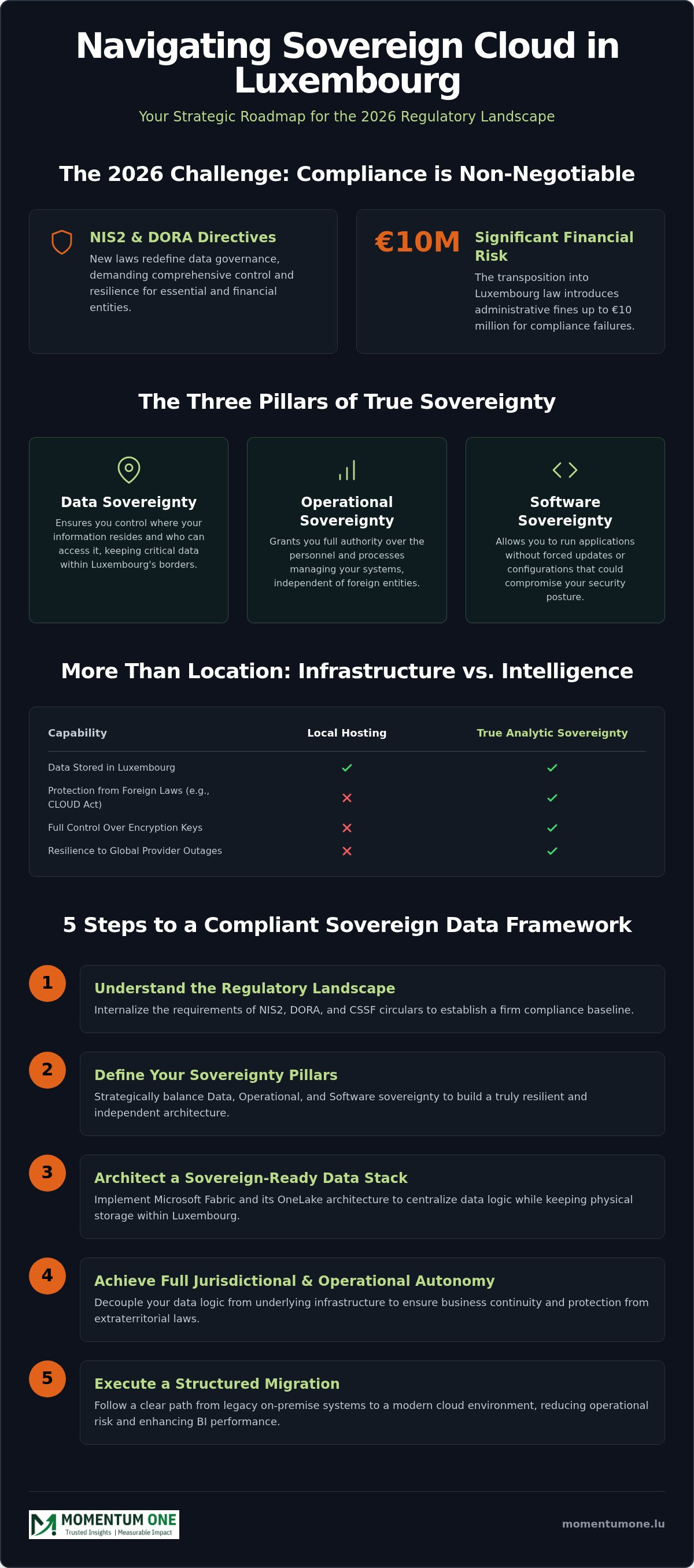
5 Strategic Steps to Implementing a Sovereign Data Framework
Implementing a sovereign cloud luxembourg strategy requires a methodical approach that moves beyond theoretical compliance. It's about building a resilient, future-proof environment that empowers your team while satisfying the strictest regulators. We've developed a five-step framework designed to take you from legacy complexity to sovereign clarity. This journey ensures that your data remains an asset, not a liability, by aligning your technical capabilities with the Grand Duchy's unique legal landscape. By following these steps, you can bridge the gap between high-performance analytics and total data autonomy.
Step 3 in this process involves designing a compliant Data Architecture Modernization. This phase is critical because it translates your regulatory needs into technical blueprints. We focus on building a stack that respects the "Once Only" principle of the Law of 19 December 2025, ensuring that your data is shared securely across your organization rather than being siloed or duplicated. This architectural foundation allows you to scale your operations without the fear of outgrowing your compliance framework.
Step 1 & 2: Assessment and Infrastructure Selection
The first step is Data Classification. You must identify your "Crown Jewel" datasets—the sensitive information that requires the highest level of protection under CSSF or DORA. Once classified, Step 2 involves selecting the right infrastructure. You'll need to evaluate local providers like Clarence or DEEP against global hyperscalers that offer dedicated sovereign regions. Before committing to a move, we recommend conducting a Power BI architectural review. This assessment identifies potential bottlenecks and ensures your existing reporting logic is ready for a sovereign environment.
Step 4 & 5: Governance and Implementation
Step 4 focuses on the human element. You need a robust Power BI governance framework to manage how internal users interact with your newly sovereign data. We pair this with corporate Power BI training to ensure your staff understands the nuances of sovereign-compliant data handling. Finally, Step 5 is the execution. We advocate for a phased, iterative migration rather than a "big bang" approach. This strategy ensures zero downtime for your critical business reports and allows for real-time adjustments as your data moves to its new home. If you're ready to secure your data's future, our team can help you design a sovereign-ready architecture tailored to your specific needs.
Momentum One: Navigating the Intersection of Compliance and Analytics
Positioning your organization at the forefront of the digital economy requires more than just a sovereign cloud luxembourg provider. It requires a partner who understands that data is only valuable when it’s both secure and actionable. We act as the essential bridge between Luxembourg’s high-security infrastructure and the analytical power of the Microsoft ecosystem. While local providers offer the "white space" and connectivity, we provide the intelligence layer that ensures your data remains compliant without becoming a bottleneck for your business. Our role is to simplify the complex, acting as a steady hand while you navigate the rigors of CSSF and NIS2 oversight.
Our commitment to a supportive partnership means we don't just migrate your data; we empower your people. We provide tailored managed services that offer ongoing oversight, ensuring your sovereign strategy evolves as fast as the regulations do. This includes proactive support for workspace and capacity management to prevent resource sprawl and maintain peak performance. By focusing on the long-term health of your data stack, we ensure your transition to the cloud is permanent and profitable. We take the anxiety out of migration by providing clear roadmaps and transparent communication at every stage.
Why a Microsoft Solutions Partner is Essential
The complexity of the 2026 regulatory landscape leaves no room for trial and error. As a certified Microsoft Solutions Partner, we bring deep technical expertise in Microsoft Fabric and Power BI directly to the Luxembourgish market. We’ve spent years mastering the nuances of CSSF-compliant data modeling and DAX optimization, allowing us to turn technical constraints into competitive advantages. Our focus is always on outcomes. We don't just check boxes for the ILR; we turn your sovereign data into an engine for growth. This ensures that your reports are accurate, your pipelines are resilient, and your costs stay predictable even within premium sovereign environments.
Getting Started with Your Sovereign Journey
Every successful migration begins with clarity. We offer a comprehensive discovery workshop for Microsoft Fabric migration services to map your current environment and identify the most efficient path forward. This workshop isn't just about technical specs; it’s a strategic alignment session where we ensure your data strategy scales with your specific business goals. We help you navigate the choice between disconnected "Azure Local" setups and hybrid sovereign models, providing expert facilitation through every phase of the implementation. If you’re ready to bridge the gap between compliance and performance, Partner with Momentum One for sovereign data excellence.
Empowering Your Data Future in the Grand Duchy
Achieving true digital autonomy in 2026 is no longer just about where your servers sit. It's about a sophisticated blend of jurisdictional control and high-level analytical performance. We've explored how a robust sovereign cloud luxembourg strategy allows you to leverage Microsoft Fabric and Power BI while remaining firmly within the guardrails of CSSF and NIS2. By focusing on the intelligence layer and following a structured migration path, you transform compliance from a burden into a competitive edge.
As a Certified Microsoft Solutions Partner, we specialize in bridging the gap between strict Luxembourgish regulatory compliance and technical excellence. Our team brings deep expertise in high-performance DAX and Fabric migration to ensure your data operations are as efficient as they are secure. We don't just provide services; we act as a steady hand to guide your digital transformation. Ready to modernize your stack without compromising on sovereignty? Secure your data strategy with Momentum One's Power BI and Fabric experts today. Let's build a resilient, future-proof data environment together.
Frequently Asked Questions
What is the difference between a private cloud and a sovereign cloud in Luxembourg?
A private cloud focuses on dedicated hardware and isolated resources for a single organization. A sovereign cloud adds a layer of legal and jurisdictional protection, ensuring that data remains subject only to Luxembourgish and EU laws. While a private cloud might still be subject to extraterritorial laws like the US CLOUD Act, a sovereign cloud luxembourg solution provides specific safeguards against foreign data requests.
Does CSSF allow the use of Microsoft Fabric for financial data?
Yes, the CSSF allows the use of Microsoft Fabric provided that the organization adheres to specific outsourcing circulars. You must conduct a thorough risk assessment and ensure that data residency and access controls meet national standards. We help financial entities configure Fabric tenants so that sensitive processing remains within compliant boundaries, satisfying the transparency and auditability requirements mandated by the regulator.
How does DORA impact my choice of a sovereign cloud provider?
DORA mandates high levels of digital operational resilience and strict third-party risk management. You must select a provider that allows for full auditing rights and demonstrates high availability. Choosing a sovereign cloud luxembourg provider often simplifies this process. These local providers are built to meet European resilience standards, making it easier to prove compliance during mandatory stress tests and regulatory reviews.
Can I use Power BI with data hosted on a sovereign Luxembourgish infrastructure?
You can definitely use Power BI with data residing on local infrastructure like Clarence or DEEP. By using on-premises data gateways or virtual network integration, Power BI can visualize data without it ever leaving the sovereign boundary. This setup allows you to benefit from world-class business intelligence while keeping the underlying datasets firmly within Luxembourg’s secure data centers.
What is a 'disconnected' cloud and when should my business use one?
A disconnected cloud is an environment that operates without a persistent connection to the public internet. It's the highest level of isolation available for cloud services. Your business should consider this for "Crown Jewel" datasets or critical public infrastructure where any risk of external exfiltration is unacceptable. It’s a common choice for government entities or financial institutions handling extremely sensitive national data.
How does Momentum One help with sovereign cloud migrations?
We facilitate the entire journey by acting as your technical and strategic partner. Our team handles the complexities of Fabric migration and modernization while ensuring your data models are optimized for performance. We don't just move your data; we provide the governance framework and training your staff needs to maintain a compliant environment. We focus on delivering a secure, high-performance analytics stack.
What are the costs associated with moving to a sovereign cloud in Luxembourg?
Costs generally involve infrastructure subscription fees and the professional services required for migration and architecture design. While sovereign solutions can carry a higher price point than standard public cloud regions, they act as an insurance policy against regulatory fines. Investing in a secure setup today prevents the much higher costs associated with data breaches or non-compliance penalties from the CNPD or CSSF.
How do I ensure data reversibility when using a sovereign cloud?
You ensure reversibility by adopting open data standards like Parquet and Delta Lake within your architecture. This approach prevents vendor lock-in by making it easy to move your data and logic back to on-premise servers or to another provider. We prioritize these "Analytic Sovereignty" principles in our designs, ensuring you always retain the ability to port your data assets whenever your business strategy evolves.