Tableau to Microsoft Fabric: 2026 Migration Guide
Planning a Tableau to Microsoft Fabric migration? Our 2026 guide helps you cut costs, unify data with OneLake, and preserve business logic for a seamless tra...
- Understand how consolidating your analytics on a unified platform reduces total cost of ownership by eliminating redundant licensing and fragmented data silos.
- Learn how to replace proprietary Tableau extracts with OneLake to create a high-performance "Single Source of Truth" for your entire organization.
- Follow a structured, phased roadmap for a successful Tableau to Microsoft Fabric migration that preserves your critical business logic and data integrity.
- Discover the process of mapping Tableau workbooks to the Medallion Architecture to optimize data flow and enhance report scalability.
- Identify how strategic governance and expert data modeling ensure your new Fabric environment remains organized and efficient as your data needs grow.
Is your Tableau environment becoming a "visualization tax" that keeps your data locked away from your AI strategy? You likely feel the pressure of rising licensing costs, which can reach $75 per month for a single Cloud Creator, alongside the frustration of managing data silos that separate insights from your warehouse. It's a common hurdle for teams trying to scale real-time analytics in a stack that feels increasingly fragmented.
We understand that a Tableau to Microsoft Fabric migration is a significant architectural shift, not just a simple report conversion. This guide shows you how to transition your ecosystem to Fabric's unified data platform while preserving your vital business logic. By moving to a OneLake architecture, you can establish a single source of truth and leverage Microsoft's integrated AI capabilities to drive better performance across your entire organization.
We'll walk through the practicalities of this evolution, including how to capitalize on the 41% discount available through reserved capacity. You'll learn about the critical F64 threshold for unlimited report viewers and the methodical steps needed to ensure your migration is both seamless and scalable for the long term.
Why Organizations are Shifting from Tableau to Microsoft Fabric in 2026
The analytics landscape has reached a tipping point. For years, businesses relied on a fragmented stack where data lived in one place and insights lived in another. In 2026, the Tableau to Microsoft Fabric migration trend is driven by a need for architectural harmony. Organizations are moving away from "visualization taxes" and toward a unified environment where data engineering and business intelligence exist on a single plane.
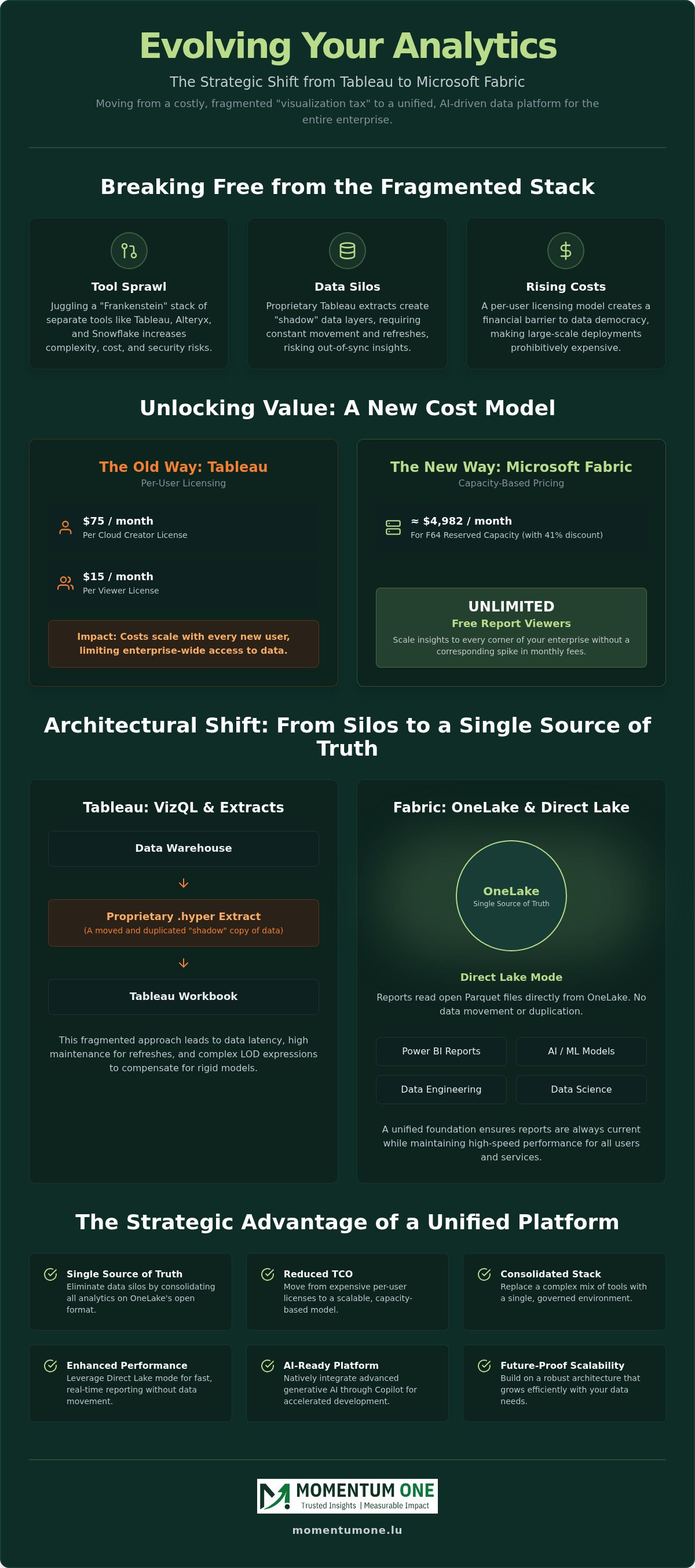
Cost remains a primary catalyst for this change. Tableau's per-user licensing model often creates a financial barrier to data democracy. With a Cloud Creator license costing $75 per month and Viewers at $15, large-scale deployments become prohibitively expensive. Microsoft Fabric offers a more inclusive alternative through capacity-based pricing. For example, an F64 reserved capacity costs approximately $4,982 per month and provides the significant benefit of unlimited free viewers. This shift allows you to scale your insights to every corner of the enterprise without a corresponding spike in monthly fees.
Beyond the balance sheet, Fabric solves the persistent problem of data silos. Tableau relies heavily on proprietary extracts to maintain performance. This creates a "shadow" layer of data that must be constantly refreshed and moved. Fabric's OneLake architecture functions as a single source of truth, storing data in an open format that every tool can access. Data movement stops being a requirement. Instead, your reports connect directly to the Lakehouse, ensuring that the numbers your executives see are always synchronized with the latest warehouse updates.
The Limitations of Viz-Centric Analytics
Since its inception, Tableau Software has championed a visualization-first philosophy. While this made data beautiful, it often led to significant technical debt in the data layer. Power users frequently find themselves trapped in a web of complex Level of Detail (LOD) expressions to compensate for rigid data models. These calculations are difficult to maintain and often degrade report performance at scale. Fabric's data-first approach encourages building logic into the Lakehouse itself. By moving the "heavy lifting" to the data layer, your reports become faster, more reliable, and easier for your team to manage over time.
Consolidating the Modern Data Stack
Many enterprises are currently juggling a "Frankenstein" stack of Snowflake for warehousing, Alteryx for preparation, and Tableau for visualization. This tool sprawl increases complexity and security risks. Transitioning to Fabric allows you to collapse these layers into a single, governed environment. You gain native integration with the broader Microsoft ecosystem, including advanced generative AI through Copilot that assists with everything from writing DAX to automating data pipelines. As a Microsoft Solutions Partner, we act as the steady hand for your Fabric Migration & Modernization, ensuring that your transition results in a streamlined, high-performance architecture that supports your 2026 growth goals.
Understanding the Architectural Shift: From VizQL to OneLake
A successful Tableau to Microsoft Fabric migration requires more than just redesigning dashboards. It demands a fundamental shift in how your team thinks about data storage and query logic. In the Tableau ecosystem, performance often relies on VizQL, a proprietary engine that translates visual actions into database queries, frequently resulting in fragmented .hyper extracts. Fabric replaces this siloed approach with a unified, open-source foundation that prioritizes accessibility and performance at the data layer.
The move to Fabric introduces Direct Lake mode, a feature that bridges the gap between traditional "Live" and "Extract" connections. In Tableau, you often have to choose between the speed of an extract or the freshness of a live connection. Direct Lake mode allows Power BI to read Parquet files directly from OneLake without the need to refresh or move data. This ensures your reports are always current while maintaining the high-speed performance your business users expect.
OneLake: The Foundation of Fabric
OneLake is the centralized, open-format data repository for the entire organization, functioning as a "OneDrive for Data" that eliminates the need for disparate storage silos. By utilizing the Medallion Architecture, you can structure your data into Bronze (raw), Silver (cleansed), and Gold (business-ready) layers. This logical progression ensures that data is governed and optimized before it ever reaches a report. The "Shortcut" feature further simplifies this by allowing you to connect to existing data in AWS or Azure without moving it, which significantly reduces storage costs and improves overall data accessibility.
DAX vs. VizQL: Translating Business Logic
Transitioning your business logic from Tableau's VizQL to Microsoft's DAX (Data Analysis Expressions) is often the most technical part of the journey. Calculated fields in Tableau must be re-architected as Power BI measures to ensure they perform well within the Fabric semantic model. This is especially true for complex Level of Detail (LOD) expressions. While Tableau uses "Fixed" or "Include" syntax, DAX achieves similar results through functions like CALCULATE and ALLEXCEPT.
Mapping these calculations correctly is essential for maintaining data integrity. If your current models feel sluggish or overly complex, working with DAX optimization experts can help streamline your logic during the migration process. We focus on building clean, performant models that serve as a reliable foundation for your future analytics. If you are ready to modernize your data structure, our team can guide you through a professional Data Warehouse & Lakehouse Design to ensure your new environment is built for scale.
Mapping Tableau Workbooks to Fabric Artifacts
Before moving a single pixel, you must understand what you own. Most Tableau environments suffer from years of "dashboard sprawl," where redundant or outdated workbooks clutter the server. A successful Tableau to Microsoft Fabric migration starts with a rigorous inventory phase. We recommend categorizing your assets by business impact, usage frequency, and technical complexity. This isn't just about moving files; it's about deciding what is worth the effort of modernization and what should be retired.
Once the inventory is clear, the focus shifts to data source mapping. In Tableau, you likely rely on the Tableau Data Server to manage shared connections. In Fabric, these are replaced by Dataflows and Pipelines. This transition allows you to centralize your ingestion logic within OneLake. Security mapping is equally critical. Tableau's row-level security (RLS) must be translated into Fabric's unified security model, ensuring that data access remains consistent across reports, notebooks, and SQL endpoints.
Automated vs. Manual Migration: The Reality
Tools like Pulse Convert can accelerate the visual conversion process by automating the "heavy lifting" of dashboard recreation. However, automation has its limits. While it can translate basic charts, it often struggles with complex VizQL logic or highly customized formatting. Strategic re-platforming is where the real value lies. By manually optimizing your logic into a Medallion structure (Bronze, Silver, Gold), you ensure that your Silver and Gold layers provide a clean, high-performance foundation that automation simply cannot build from scratch. This methodical approach turns a technical move into a strategic upgrade.
Handling Complex Visualization Requirements
Tableau users are often concerned about losing the creative flexibility they've enjoyed for years. While Power BI's core visuals cover the vast majority of business needs, complex requirements might require custom visuals from AppSource or advanced tools like Deneb. Our approach to Fabric Migration & Modernization focuses on preserving the essential user experience while improving the underlying data architecture. We don't just replicate charts. We enhance interactivity and ensure that your new dashboards are faster and more intuitive than the originals, providing a truly modernized analytics experience.
A Structured Roadmap for a Successful Migration
A successful Tableau to Microsoft Fabric migration requires a methodical sequence of milestones rather than a rushed "lift and shift" approach. It's a strategic journey that begins with a deep audit of your current environment. We break this process down into five distinct phases to ensure no business logic is lost and every performance gain is captured.
- Phase 1: Assessment & Inventory. We map every dependency and audit your Tableau Server to identify critical assets versus redundant workbooks.
- Phase 2: Architecture Design. This stage focuses on configuring your Fabric capacity and designing a OneLake structure that supports your specific operational needs.
- Phase 3: Data Engineering. Using Data Factory, we build robust pipelines to move data from legacy sources into your new Lakehouse.
- Phase 4: Semantic Modeling & Viz. We develop high-performance Power BI datasets and recreate your essential dashboards with enhanced interactivity.
- Phase 5: UAT & Training. Final validation ensures data accuracy matches your legacy systems while upskilling your users for the new platform.
The Role of Data Governance in Migration
Effective governance is the difference between a clean data lake and a cluttered data swamp. You must establish workspace management and capacity optimization from the first day of your migration. This includes defining clear ownership, setting up sensitivity labels, and ensuring full data lineage within the Fabric tenant. A well-governed environment ensures compliance and simplifies audits. If you need a partner to design this foundation, our Data Warehouse & Lakehouse Design services provide the structural expertise required for a secure, scalable ecosystem.
Upskilling Your Team for the Fabric Era
The technical shift from Tableau's VizQL to Microsoft's DAX and Power Query is a central part of any Tableau to Microsoft Fabric migration. Bridging this skills gap is essential for long-term adoption. We focus on fostering a data-driven culture by providing targeted, hands-on sessions that translate legacy knowledge into modern expertise. Our Corporate Power BI training is specifically designed to help your team master the nuances of the Microsoft ecosystem, ensuring they feel confident navigating the new stack.
Ready to start your journey? Contact us today to discuss your Fabric Migration & Modernization roadmap and secure your organization's data future.
Navigating Your Fabric Journey with Momentum One
Transitioning away from a legacy system requires more than just technical mapping. It requires a partner who understands the high stakes of enterprise data and the necessity of maintaining business continuity. Momentum One provides the "steady hand" needed for a complex Tableau to Microsoft Fabric migration. As a Microsoft Solutions Partner, we don't just convert reports. We act as strategic facilitators who simplify the inherent complexity of modernizing your data stack.
Our methodology is built on outcome-based performance. While many firms focus solely on the "lift and shift" aspect, we prioritize the long-term health of your analytics environment. This means ensuring that your data modeling is efficient and your governance is airtight. We believe that a successful move should result in a leaner, faster, and more transparent ecosystem. Once your migration is complete, our managed services provide ongoing support to ensure your capacity remains optimized and your environment continues to scale with your business needs.
Our Approach to Fabric Modernization
We understand that business disruption is not an option. Our approach focuses on minimizing downtime by running parallel environments during the transition. This allows for rigorous validation before any legacy system is retired. We also host customized workshops designed to align your technical team with Fabric best practices. By focusing on performance tuning and DAX optimization from the start, we eliminate the technical debt that often plagues older Tableau environments. We ensure that every measure and pipeline is built for speed and accuracy in the new Fabric era.
Ready to Modernize Your Data Stack?
The long-term ROI of migrating to a unified Microsoft Fabric platform is clear. You gain a single source of truth, lower total cost of ownership, and native access to advanced AI capabilities. Moving away from fragmented silos allows your team to focus on generating insights rather than managing infrastructure. We invite you to take the first step toward a more scalable future with a strategic assessment of your current Tableau environment. Our experts will help you identify the most efficient path forward, ensuring your data becomes a true competitive advantage.
Don't let legacy constraints hold your data strategy back. Contact Momentum One for a Fabric Migration Roadmap and discover how we can help you build a modern, high-performance analytics platform.
Building Your Unified Data Future
Transitioning to a unified data platform is a strategic evolution that goes far beyond simple report conversion. By moving to OneLake, your organization eliminates the persistent silos of proprietary extracts and moves toward a genuine single source of truth. A successful Tableau to Microsoft Fabric migration relies on a methodical approach that preserves your business logic while capitalizing on the scalability of the Microsoft ecosystem.
As a Microsoft Solutions Partner specialized in Fabric Modernization, we provide the technical expertise and strategic guidance needed to navigate this shift. Our team brings deep expertise in DAX performance tuning and Lakehouse design to ensure your new environment is optimized for high-speed performance from day one. We focus on creating a stable, governed foundation that empowers your team to innovate with AI and real-time analytics.
Take the next step in your data modernization journey. Request a Strategic Tableau-to-Fabric Assessment today. We look forward to partnering with you to unlock a more efficient and scalable future for your enterprise.
Frequently Asked Questions
Ready to Modernize Your Data Stack?
The long-term ROI of migrating to a unified Microsoft Fabric platform is clear. You gain a single source of truth, lower total cost of ownership, and native access to advanced AI capabilities. Moving away from fragmented silos allows your team to focus on generating insights rather than managing infrastructure. We invite you to take the first step toward a more scalable future with a strategic assessment of your current Tableau environment. Our experts will help you identify the most efficient path forward, ensuring your data becomes a true competitive advantage. Don't let legacy constraints hold your data strategy back. Contact Momentum One for a Fabric Migration Roadmap and discover how we can help you build a modern, high-performance analytics platform. Transitioning to a unified data platform is a strategic evolution that goes far beyond simple report conversion. By moving to OneLake, your organization eliminates the persistent silos of proprietary extracts and moves toward a genuine single source of truth. A successful Tableau to Microsoft Fabric migration relies on a methodical approach that preserves your business logic while capitalizing on the scalability of the Microsoft ecosystem. As a Microsoft Solutions Partner specialized in Fabric Modernization, we provide the technical expertise and strategic guidance needed to navigate this shift. Our team brings deep expertise in DAX performance tuning and Lakehouse design to ensure your new environment is optimized for high-speed performance from day one. We focus on creating a stable, governed foundation that empowers your team to innovate with AI and real-time analytics. Take the next step in your data modernization journey. Request a Strategic Tableau-to-Fabric Assessment today. We look forward to partnering with you to unlock a more efficient and scalable future for your enterprise.
Can we migrate Tableau's Level of Detail (LOD) expressions to Microsoft Fabric?
Yes, you can replicate Tableau's LOD expressions using DAX functions like CALCULATE, ALLEXCEPT, and SUMMARIZE. While the syntax differs, the underlying logic remains the same. It requires re-architecting your calculations to fit the Power BI semantic model, ensuring your "Fixed" or "Include" logic performs efficiently at scale within the Fabric environment.
How long does a typical Tableau to Microsoft Fabric migration take?
Most migrations range from three to nine months depending on the volume of workbooks and the complexity of the data architecture. A small-scale pilot project can often be completed in about 12 weeks. An enterprise-wide Tableau to Microsoft Fabric migration involves a phased approach that includes inventory, data engineering, and rigorous user acceptance testing to ensure a smooth transition.
Do we need to move all our data to OneLake to use Microsoft Fabric?
No, you aren't required to physically move every dataset into OneLake to benefit from Fabric. The "Shortcut" feature allows you to connect to existing data in AWS S3 or Azure Data Lake Storage Gen2 without moving it. This creates a virtualized unified view, allowing your team to query and analyze data where it currently resides while reducing storage redundancy.
Will our Tableau users find Power BI difficult to learn after the migration?
Most users find the transition intuitive, though developers should expect a mindset shift from Tableau's "marks" to Power BI's "measures." While the drag and drop interface feels familiar, mastering Power Query and DAX is essential for advanced report building. Targeted training sessions help bridge this gap by translating familiar Tableau concepts into their Microsoft equivalents.
Is it possible to automate the conversion of Tableau dashboards to Power BI?
Partial automation is possible through specialized migration tools, but manual refinement is almost always necessary. These tools can handle the visual layouts and basic query structures effectively. However, complex business logic and custom formatting require a steady hand to ensure the final reports meet your organization's performance and accuracy standards.
What are the hidden costs of migrating from Tableau to Microsoft Fabric?
The primary hidden costs usually involve refactoring technical debt and investing in staff upskilling. While the Tableau to Microsoft Fabric migration often results in lower licensing fees, organizations must account for the time spent optimizing inefficient legacy data models. Establishing a robust governance framework early in the process is also a critical investment that prevents long term sprawl and performance issues.
How does Microsoft Fabric handle row-level security compared to Tableau?
Fabric provides a more unified security model that applies across the entire data stack rather than just the report layer. Unlike Tableau's workbook-specific security, Fabric allows you to define rules at the Lakehouse or Warehouse level. This ensures that your security logic persists whether a user is viewing a dashboard or querying data directly through a SQL endpoint.
Should we migrate to Azure Synapse or go straight to Microsoft Fabric?
You should go straight to Microsoft Fabric to ensure your data stack is future proof and fully integrated. Fabric is the successor to Synapse, combining its best features with Data Factory and Power BI into a single SaaS platform. Starting with Fabric avoids a secondary migration later and provides immediate access to the performance benefits of OneLake architecture.