The 2026 Guide to Establishing a Power BI Data Governance Framework
Learn to build a 2026 Power BI data governance framework. Cut costs, reduce report sprawl, and create a single source of truth for your enterprise analytics.
- Shift your strategy from simple report management to a holistic approach that governs the entire data fabric for 2026.
- Establish a clear power bi data governance framework by defining roles within a Center of Excellence and standardizing your development lifecycles.
- Balance user agility with corporate control by implementing a "Certified" versus "Sandbox" content strategy to ensure data trust.
- Future-proof your analytics environment by integrating Microsoft Fabric and OneLake governance to manage data shortcuts and mirroring effectively.
- Leverage professional managed services to provide the steady oversight and technical optimization required for a scalable enterprise asset.
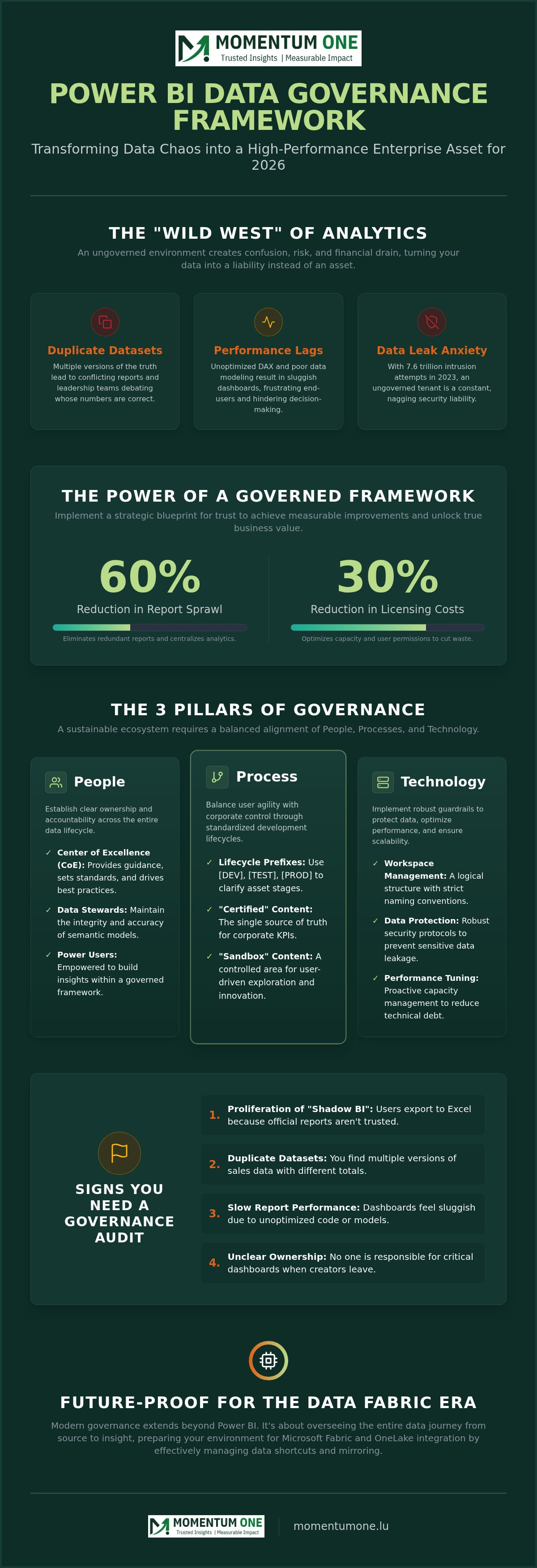
Did you know a properly implemented power bi data governance framework can reduce report sprawl by 60% and slash licensing costs by up to 30%? It's a staggering figure, yet many organizations still struggle with a "wild west" approach to analytics that creates more confusion than clarity. You've likely seen the symptoms: duplicate datasets leading to multiple versions of the truth, performance lags during peak hours, and the constant, nagging anxiety of a potential sensitive data leak.
We understand that you want your data to empower your team, not create a management nightmare. This guide promises to help you transform your current analytics setup from a chaotic collection of reports into a governed, high-performance enterprise asset. We'll show you how to establish a single source of truth for your corporate KPIs while ensuring clear accountability across the entire data lifecycle.
By following this methodical approach, you'll build a scalable environment that's fully prepared for Microsoft Fabric integration. We'll explore how to balance user productivity with rigorous security, moving from reactive troubleshooting to proactive, strategic oversight that supports your business growth throughout 2026 and beyond.
What is a Power BI Data Governance Framework in 2026?
A power bi data governance framework isn't a static document gathering dust on a digital shelf. It's the vital intersection of your people, your internal processes, and the Microsoft technology stack. In 2026, the scope of this framework has expanded significantly. We've moved beyond "Report Governance," where we simply managed who could see a dashboard. Today, we focus on "Data Fabric Governance." This means overseeing the entire data journey from OneLake storage to the final visual. A Power BI data governance framework is a strategic blueprint for trust.
Failing to implement this blueprint leads to "Data Chaos." This isn't just an inconvenience; it's a financial drain. Inconsistent KPIs mean leadership teams spend meetings debating whose numbers are right instead of making strategic moves. Security vulnerabilities are even more pressing. With 7.6 trillion intrusion attempts recorded in 2023, according to industry research, an ungoverned tenant is a liability. Gartner's 2026 Hype Cycle for Data and Analytics Governance identifies this as a "High" benefit area for a reason. Without a structured approach, your data becomes a risk rather than a resource.
The Core Objectives of Modern Governance
Modern governance focuses on three primary outcomes that turn your data into a high-performance enterprise asset:
- Ensuring a single source of truth: We work to ensure that "Revenue" or "Customer Churn" means the same thing in Marketing as it does in Finance.
- Protecting sensitive data: We implement robust security protocols to prevent leakage, especially as data moves through the Microsoft Fabric ecosystem.
- Optimizing tenant performance: By managing workspace and capacity management, we reduce technical debt and ensure reports load instantly for end users.
Signs Your Organisation Needs a Governance Audit
If you aren't sure where your environment stands, look for these common red flags. They often indicate that your power bi data governance framework needs a refresh or a complete overhaul:
- Proliferation of "Shadow BI": Users are exporting data to Excel or creating rogue workspaces because they don't trust the official reports.
- Duplicate datasets: You find five different versions of the same sales data, all with slightly different totals.
- Slow report performance: Dashboards feel sluggish because of unoptimized DAX measures or poor data modeling.
- Unclear ownership: No one knows who's responsible for updating a critical business dashboard when the original creator leaves the company.
At Momentum One, we see these challenges as opportunities to refine your strategy. Addressing these signs early prevents performance degradation and ensures your environment is ready for the next level of analytics maturity.
The 3 Pillars of an Enterprise-Grade Governance Strategy
Building a robust power bi data governance framework requires more than just flipping switches in an admin portal. It requires a balanced alignment of people, processes, and technology. If you neglect one, the others will eventually fail. Momentum One acts as an expert facilitator here, ensuring these three pillars support a unified and high-performing data strategy. We help you move beyond simple technical configurations to create a sustainable ecosystem where data is both accessible and secure.
Defining Roles: Who Owns the Data?
Data ownership is often the most contentious part of any framework implementation. To succeed, you need a Center of Excellence (CoE) to provide guidance and set standards. Data Stewards are the backbone of this structure. They maintain the integrity of semantic models, ensuring that metrics remain accurate as they flow into various reports. It's about empowering your Power Users to build their own insights while keeping administrative oversight tight enough to prevent data leakage. If your team lacks the internal bandwidth to design these roles, our Power BI Consulting & Governance services can help you map out a sustainable accountability model.
Tenant Administration and Workspace Management
Technology provides the guardrails for your strategy. Proper workspace management starts with strict naming conventions and a logical structure. Use prefixes like [DEV], [TEST], or [PROD] to clarify the lifecycle stage of every asset. This prevents users from accidentally relying on unfinished reports and keeps your environment clean. Without these standards, your tenant quickly becomes a graveyard of abandoned "Report_v2_Final" files.
Capacity management is equally critical for ROI in 2026. With Power BI Pro now at $14 per user and Premium Per User (PPU) at $24, choosing the right license is a major financial decision. Microsoft Fabric capacity pricing, such as the F64 SKU at approximately $8,409.60 per month, can actually save money for large organizations. This specific tier allows for unlimited read-only users, eliminating the need for individual per-user licenses for every viewer. We help you implement automated monitoring to track usage patterns and performance metrics, ensuring you don't pay for idle resources. For those looking to optimize their underlying infrastructure, exploring workspace and capacity management is a logical next step toward efficiency.
Momentum One bridges the gap between high-level strategy and technical execution. We ensure your framework isn't just a set of rules, but a functional system that drives business growth. By aligning your team, your workflows, and your technology stack, we transform your analytics into a reliable enterprise asset ready for the future.
Governed Self-Service: Balancing Freedom and Control
A common misconception in the analytics world is that governance is a restrictive set of rules designed to slow down innovation. In reality, a robust power bi data governance framework acts as an accelerator for user confidence. When users don't know which dataset is the "real" one, they hesitate to make decisions. By providing clear guardrails, you give your team the freedom to explore data without the fear of using an outdated or incorrect source. Governed self-service significantly reduces the repetitive ad-hoc request burden on IT teams, allowing them to focus on high-value architecture and modernization projects.
To achieve this balance, we recommend a "Certified" versus "Sandbox" content strategy. Sandbox environments are workspaces where users can experiment, mash up new data sources, and prototype ideas without strict oversight. This keeps the creative spark alive. However, once a report needs to be used for official business decisions, it must move into a governed, certified environment. This transition is supported by a Business Glossary, which standardizes KPI definitions across all departments so that "Gross Margin" means the same thing to every stakeholder.
The Promotion and Certification Workflow
Moving a report from a personal workspace to a corporate production environment shouldn't be a casual click of a button. It requires a methodical promotion workflow. We help organizations establish clear criteria for "Certified" datasets, ensuring they meet the highest standards of trust. To be certified, a dataset must pass through three specific gates:
- Accuracy: Data stewards must validate the numbers against the source system.
- Performance: The model must be optimized for speed, ensuring it doesn't waste capacity or frustrate users.
- Security: Proper access controls must be verified to prevent data leakage.
If your internal team struggles with these technical standards, our Corporate Power BI Training can bridge the skills gap, teaching your power users how to build models that meet enterprise-grade certification requirements.
Security and Role-Based Access Control (RBAC)
Security is the silent partner of effective self-service. We implement Row-Level Security (RLS) to ensure departmental data isolation. This means a regional sales manager only sees their own territory's performance, even if they are using a global sales report. It's a critical layer of your power bi data governance framework that protects sensitive information without requiring multiple versions of the same report.
Managing external sharing and guest user access is equally vital. In 2026, we lean heavily on Microsoft Purview integration to audit sensitive data and monitor how it's being shared. This provides a clear trail of who accessed what and when, ensuring compliance with evolving data privacy regulations. This proactive approach to security allows you to say "yes" to collaboration while maintaining absolute control over your corporate assets.
Modernizing Governance for Microsoft Fabric and OneLake
Microsoft Fabric has redefined the boundaries of a power bi data governance framework. In 2026, we're no longer just governing isolated reports; we're governing a unified data estate through OneLake. This "OneDrive for data" approach simplifies storage but introduces new complexities in how data is accessed and shared across the organization. It's a necessary evolution, especially as Microsoft moves to deprecate older file-saving and sharing methods from earlier Power BI Desktop versions in October 2026. If you're planning a move to this modern ecosystem, our Fabric Migration & Modernization services ensure your transition is secure and strategically sound.
Governing the Lakehouse requires a firm grip on features like Shortcuts and Data Mirroring. Shortcuts allow you to virtualize data across clouds without moving it, while Mirroring provides real-time replication from external databases. These tools are powerful, but they can lead to significant "Data Sprawl" if they aren't managed correctly within your power bi data governance framework. We advocate for a "Data Mesh" architecture. This approach allows individual departments to own their specific data domains while adhering to a central set of governance standards. It's about decentralizing ownership without losing control.
Unified Governance in the Fabric Ecosystem
One of the most significant shifts in 2026 is the ability to centralize security at the OneLake level. Instead of managing Row-Level Security (RLS) individually across dozens of separate reports, you can apply security once at the storage layer. This ensures consistency and dramatically reduces administrative overhead. You also need to watch your Fabric Capacities closely. With storage costs around $0.023 per GB for hot storage in OneLake, and F64 SKUs costing roughly $8,409.60 per month, unmonitored usage can quickly erode your ROI. For a deeper dive into this transition, read our Microsoft Fabric Migration Services: A Strategic Guide for 2026.
AI and Copilot Governance
Power BI Copilot is a standard tool in 2026, but it requires its own set of governance policies to be effective. You don't want AI-generated reports circulating without a "Human-in-the-loop" verification process to catch potential hallucinations or errors. We help you establish clear guidelines for when and how AI can be used for automated analytics. This includes ensuring data privacy remains intact when Copilot processes sensitive corporate information. It's about leveraging the speed of AI while maintaining the accuracy that only human oversight provides.
Implementing Your Framework with Momentum One
Generalist consulting firms often treat governance as a simple checklist of tenant settings. At Momentum One, we know that a successful power bi data governance framework requires a more nuanced approach. As a boutique Microsoft Solutions Partner, we focus on the specific performance bottlenecks and cultural hurdles that prevent your team from trusting their data. We don't just deliver a document; we build a living system that scales with your business. Our team acts as a steady hand, guiding you through the complexities of modern analytics with a focus on high-level results and operational efficiency.
Scaling your BI maturity is a journey, not a one-time event. We help you move from reactive data management to a proactive strategy where your analytics environment is a genuine enterprise asset. By partnering with a specialist, you gain access to deep technical expertise in DAX optimization and Fabric migration that generalists simply can't match. We're invested in your long-term success, ensuring your framework remains robust as your data volume and user base grow throughout 2026.
Our Governance Implementation Process
We follow a methodical three-step process to ensure your framework is both practical and effective. This structured approach minimizes disruption while maximizing the value of your data investment:
- Step 1: Current state audit: We identify performance bottlenecks, security gaps, and "Shadow BI" pockets that are currently draining your resources.
- Step 2: Custom framework design: Our team creates a governance blueprint tailored to your unique corporate structure, defining clear roles and promotion workflows.
- Step 3: Hands-on implementation: We don't leave you with just a plan. We implement the technical guardrails and provide team enablement to ensure everyone understands their responsibilities.
Managed Governance: Peace of Mind for Data Leaders
The biggest mistake many organizations make is assuming governance ends once the framework is live. Effective oversight requires continuous attention. This is where our managed services provide a critical advantage. We offer ongoing tenant health monitoring and security compliance checks to ensure your environment remains "clean" and performant. It's about providing data leaders with the peace of mind that their power bi data governance framework is being actively maintained by experts.
Our proactive approach includes continuous DAX optimization and data model tuning. As your datasets grow in 2026, unoptimized measures can quickly lead to performance degradation. We act as your dedicated partner, surfacing issues before they impact the end-user experience. For organizations that lack a dedicated internal BI team, this managed oversight is essential for maintaining a single source of truth. You can learn more about our approach in our guide on Managed Power BI Services: Ensuring Scalability and Governance in 2026.
Future-Proofing Your Enterprise Analytics for 2026
Transitioning your reporting environment into a strategic asset requires a shift from reactive management to proactive oversight. You've seen how balancing user agility with corporate guardrails creates a culture of trust and reliability. As Microsoft Fabric and OneLake become the standard for data estates in 2026, establishing a robust power bi data governance framework is no longer optional; it's the foundation for any scalable analytics strategy.
Momentum One is here to act as your steady hand in this complex field. As a certified Microsoft Solutions Partner with over 8 years of enterprise data experience, we bring deep technical expertise in Fabric migrations and DAX optimization to every project. We're dedicated to simplifying complexity and ensuring your data remains a high-performance asset rather than a source of anxiety. Our team focuses on your long-term success, providing the architectural stability you need to grow with confidence.
Secure your data and scale your insights with a professional Power BI Governance Framework
Your journey toward a more governed, efficient, and insight-driven future starts with a single step. We're ready to partner with you to make that vision a reality.
Frequently Asked Questions
Defining Roles: Who Owns the Data?
Data ownership is often the most contentious part of any framework implementation. To succeed, you need a Center of Excellence (CoE) to provide guidance and set standards. Data Stewards are the backbone of this structure. They maintain the integrity of semantic models, ensuring that metrics remain accurate as they flow into various reports. It's about empowering your Power Users to build their own insights while keeping administrative oversight tight enough to prevent data leakage. If your team lacks the internal bandwidth to design these roles, our Power BI Consulting & Governance services can help you map out a sustainable accountability model.
What are the essential components of a Power BI governance framework?
Essential components include people, processes, and technology aligned to support your data strategy. A successful power bi data governance framework defines roles like Data Stewards, establishes standardized development cycles, and configures tenant settings for maximum security. It's about creating a clear roadmap for how data is consumed across the organization. By focusing on these pillars, you ensure every semantic model has a dedicated owner responsible for its accuracy and performance.
How does data governance in Power BI differ from Microsoft Fabric governance?
Power BI governance traditionally focuses on workspaces, reports, and dashboards. Microsoft Fabric governance expands this scope to include the entire data lakehouse and OneLake storage layer. While Power BI manages the visualization layer, Fabric oversees the data from ingestion through transformation. This shift requires a more unified approach where security is often managed at the storage level rather than just the report level to maintain cross-departmental consistency.
Who should be responsible for managing the Power BI tenant settings?
Responsibility typically falls to a dedicated Power BI or Fabric Administrator working closely with IT and the Center of Excellence. These individuals manage tenant settings, capacity allocation, and security defaults. It's a strategic role that ensures global settings align with corporate security policies. They provide enough flexibility for departmental teams to innovate without hitting unnecessary roadblocks or performance bottlenecks that could slow down critical business decision-making.
Can we implement governance without slowing down our business analysts?
Yes, you can implement governance that actually accelerates your analysts' work by providing clear guardrails. By using a "Sandbox" versus "Certified" strategy, you allow analysts to experiment freely in safe, isolated environments. Once they need to share insights broadly, they follow a streamlined promotion process. This approach builds user confidence because analysts know they're working with validated data, which reduces the time they spend questioning the numbers.
What is the role of a Center of Excellence (CoE) in BI governance?
A Center of Excellence (CoE) acts as the strategic facilitator for your analytics maturity. It provides the training, best practices, and support needed to empower users across the business. Instead of acting as a restrictive force, the CoE fosters collaboration and knowledge sharing. It's responsible for defining the standards of your power bi data governance framework and ensuring that technical teams have the skills to meet enterprise requirements.
How do we secure sensitive data for external stakeholders in Power BI?
Securing data for external users requires a combination of Row-Level Security (RLS) and strict guest access policies. RLS ensures that external stakeholders only see the specific data rows they're authorized to view. Additionally, Microsoft Purview integration helps you audit access and track sensitive data labels. We recommend using Entra ID B2B collaboration to manage these guest identities securely while maintaining full control over your internal tenant and sensitive assets.
What are the most common governance mistakes in large-scale BI deployments?
The most frequent errors involve allowing "Shadow BI" to flourish without any naming conventions or ownership rules. Large-scale deployments often suffer from unoptimized DAX measures that degrade capacity performance and frustrate users. Another common pitfall is neglecting ongoing maintenance. Without managed services or periodic audits, a tenant quickly becomes cluttered with duplicate datasets and abandoned reports, which creates a "multiple versions of the truth" problem that undermines trust.