Architecture de données évolutive : un cadre stratégique pour 2026
- Posez les principes de la croissance en distinguant volume de stockage et vélocité de calcul, afin d'éviter une refonte future de votre architecture.
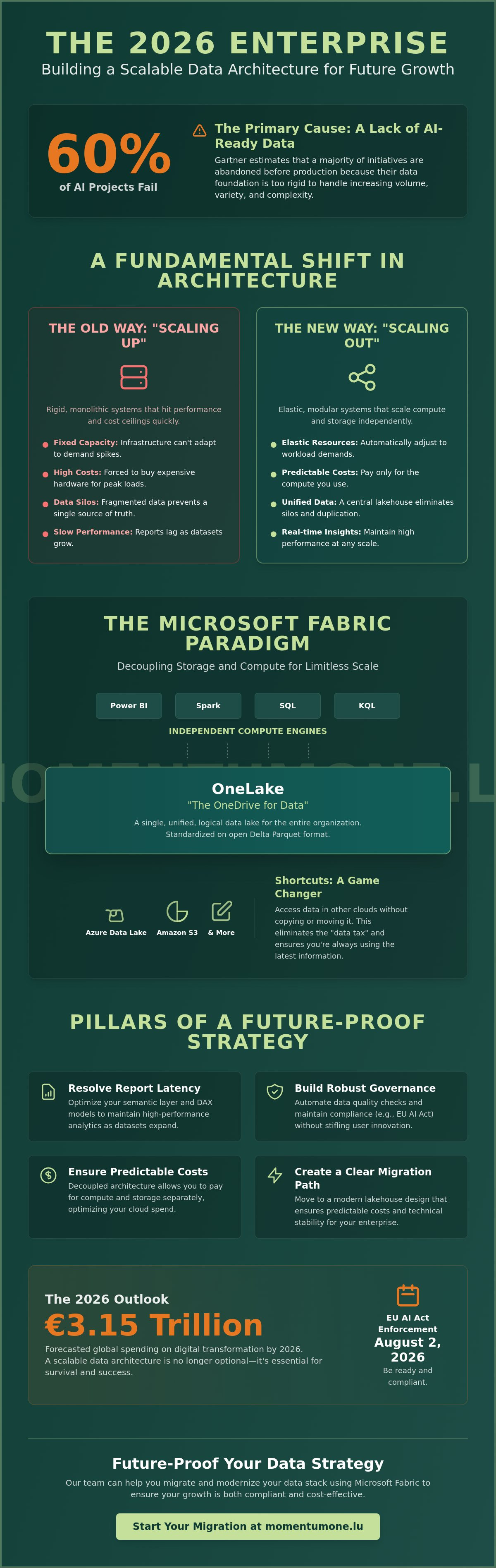
- Appuyez-vous sur OneLake dans Microsoft Fabric pour bâtir une architecture de données évolutive qui découple le stockage du calcul et offre une souplesse maximale.
- Réglez les problèmes de latence de vos rapports en optimisant votre couche sémantique et vos modèles DAX pour conserver des performances élevées malgré la croissance des données.
- Construisez un cadre de gouvernance robuste qui automatise les contrôles qualité et assure la conformité sans brider l'innovation des utilisateurs.
- Tracez un chemin de migration clair vers une conception lakehouse moderne, gage de coûts prévisibles et de stabilité technique.
Gartner estime que 60 % des projets d'IA dépourvus de données prêtes pour l'IA seront abandonnés avant même d'atteindre la production. Ce taux d'échec élevé commence généralement par des fondations rigides, incapables d'absorber la hausse des volumes et de la complexité. Mettre en place unearchitecture de données évolutiven'est plus une simple case technique à cocher : c'est le facteur déterminant de la réussite des entreprises tout au long de 2026.
Vous avez sans doute affronté les silos qui empêchent d'établir une source de vérité claire, ou vu vos rapports Power BI ralentir à mesure que les données grossissaient. Il est frustrant de se sentir prisonnier d'une infrastructure héritée, coûteuse à faire évoluer et lente à s'adapter. Nous vous proposons une autre voie. Vous apprendrez à bâtir une pile de données modulaire qui s'étend sans effort grâce à Microsoft Fabric et aux modèles de conception modernes. Ce guide couvre aussi bien l'optimisation des performances que la préparation à l'entrée en application du règlement européen sur l'IA le 2 août 2026, pour une croissance à la fois conforme et économique.
Définir l'architecture de données évolutivepour l'entreprise de 2026
Dans les systèmes d'entreprise modernes, l'évolutivitémesure la capacité d'un système à absorber des charges croissantes sans refonte complète du cadre sous-jacent. Pour l'entreprise de 2026, unearchitecture de données évolutivene se résume pas à ajouter du stockage : il s'agit de bâtir des fondations qui restent performantes lorsque votre logique métier se complexifie et que vos utilisateurs se multiplient. Quand on parle de croissance, il faut distinguer volume et vélocité. L'évolutivité en volume vous permet de stocker des pétaoctets à coût maîtrisé ; l'évolutivité en vélocité garantit une puissance de calcul suffisante pour traiter ces données assez vite et fournir des analyses en temps réel.
Le virage stratégique que nous observons à l'approche de 2026 consiste à quitter les pipelines rigides et linéaires au profit de lakehouses élastiques et modulaires. Beaucoup d'organisations ont longtemps « scalé verticalement » en achetant des serveurs toujours plus gros et plus chers. C'est un pansement : cette approche finit par heurter un plafond matériel. La conception moderne privilégie la montée en charge horizontale, qui répartit les traitements sur plusieurs nœuds. Dans un environnement serverless comme Microsoft Fabric, cela se produit en coulisses et laisse votre infrastructure respirer au rythme de la demande. Il s'agit d'être prêt pour un monde où les dépenses mondiales de transformation numérique devraient atteindre 3 150 milliards d'euros (environ 3 400 milliards de dollars) d'ici 2026.
Le coût de la rigidité des systèmes hérités
Les systèmes hérités enferment souvent les entreprises dans un cycle de plafonds de performance. Avec une infrastructure à capacité fixe, les heures de pointe au Luxembourg ou sur les marchés européens se traduisent par des rapports lents et des décideurs agacés. Les équipes appliquent alors des optimisations de fortune pour maintenir de vieux entrepôts à flot, ce qui crée une dette technique massive. En 2026, l'agilité exige une élasticité de calcul immédiate. Si votre système ne peut pas mobiliser des ressources supplémentaires lors d'une clôture mensuelle ou d'un lancement produit, vous perdez plus que du temps : vous perdez du terrain.
Dépasser les silos vers un data fabric unifié
La fragmentation des données est l'ennemie de l'innovation. Lorsque l'information est prisonnière de silos, établir une source unique de vérité devient impossible. Cette fragmentation explique en grande partie pourquoi 60 % des projets d'IA échouent faute de données prêtes. Unearchitecture de données évolutivecentralisée fournit l'environnement propre et gouverné qu'exigent le machine learning et l'adoption de l'IA. En mettant en place une couche de gouvernance unifiée, vous garantissez que vos données restent conformes à des réglementations comme le règlement européen sur l'IA à mesure qu'elles croissent. Cette approche structurée simplifie la complexité et fait de vos données un actif fiable plutôt qu'un risque.
Le paradigme Microsoft Fabric : découpler pour croître sans limite
Microsoft Fabric marque un changement de fond dans notre façon d'aborder unearchitecture de données évolutive. Il nous éloigne des installations complexes et fragmentées d'hier pour offrir une expérience unifiée. Voyez OneLake comme le « OneDrive de la donnée » : de la même façon que OneDrive centralise vos documents, OneLake fournit un lac de données unique et logique pour toute l'organisation. Fini la gestion de multiples comptes de stockage et les frictions liées au déplacement des données entre environnements.
La véritable rupture tient au découplage du calcul et du stockage. Dans les installations classiques, augmenter la puissance de traitement supposait souvent d'augmenter aussi le stockage, même sans besoin d'espace supplémentaire. Fabric rompt ce lien : vos données vivent dans OneLake tandis que le calcul est assuré par des capacités Fabric indépendantes. Vous ajustez donc la puissance à la hausse ou à la baisse sans jamais toucher aux données. C'est un niveau de souplesse que les systèmes hérités, y compris les anciennes configurations Azure Synapse, ne peuvent tout simplement pas offrir.
La technologie des « raccourcis » ajoute encore à cette puissance. Les raccourcis permettent d'accéder à des données stockées dans d'autres lacs ou d'autres clouds sans les déplacer physiquement. C'est un gain considérable en performance comme en coût : vous évitez la « taxe » liée au transfert d'octets sur le réseau et vos équipes travaillent toujours sur la version la plus récente. Si vous gérez aujourd'hui un paysage d'outils hétérogènes, notre équipe peut le rationaliser grâce à lamigration et modernisation Fabric.
Un stockage unifié avec OneLake
En adoptant le format Delta Parquet comme standard, Fabric fait parler la même langue à tous les moteurs, qu'il s'agisse de SQL, de Spark ou de Power BI. Les copies redondantes et les silos qui pénalisent les entreprises en croissance disparaissent. Sur le marché luxembourgeois, où efficacité et souveraineté des données sont déterminantes, cette approche unifiée change la donne. Le stockage OneLake coûte environ 0,021 € par Go et par mois (converti depuis le tarif de juin 2026 de 0,023 $). C'est un modèle prévisible et transparent, qui croît exactement au rythme de votre activité.
Faire évoluer le calcul avec les capacités Fabric
Fabric définit la puissance de calcul via les SKU F, pour un contrôle fin de vos coûts. Vous pouvez démarrer avec une capacité F2 à environ 240 € par mois et monter jusqu'à des déploiements F2048 à l'échelle de l'entreprise. Le « bursting » constitue un atout clé : votre capacité peut temporairement dépasser sa limite pour absorber un pic de traitement, par exemple une lourde actualisation matinale de rapports Power BI. Vos utilisateurs ne subissent ainsi aucune latence au moment de décider. Cettearchitecture de données évolutivepermet aux data scientists et aux analystes BI de travailler sur la même plateforme sans se disputer les ressources.
Le pilier performance : modélisation et optimisation DAX
Poser des fondations solides avec OneLake et les capacités Fabric constitue une première étape essentielle, mais aucune infrastructure, si avancée soit-elle, ne compense une couche sémantique mal conçue. Unearchitecture de données véritablement évolutiveexige un engagement de performance au point de consommation. Nous entendons souvent la même frustration : « pourquoi mon rapport Power BI est-il lent alors que notre base est très rapide ? » La réponse tient presque toujours à l'écart entre stockage et modélisation. Si votre modèle n'est pas optimisé, chaque interaction déclenche des requêtes inefficaces qui épuisent vos ressources et la patience de vos équipes.
La BI d'entreprise performante repose sur l'intégrité structurelle de vos jeux de données. Lorsqu'on passe de la donnée brute à l'analyse, l'organisation des tables détermine la vitesse à laquelle le moteur filtre et agrège des millions de lignes. En privilégiant une modélisation propre, vous garantissez des rapports réactifs à mesure que l'entreprise grandit. Ce n'est pas qu'une question de vitesse : c'est aussi une question de coût. Des modèles efficaces consomment moins de calcul et vous permettent de rester sur votre palier de capacité Fabric sans montées successives. Sur le marché luxembourgeois, où la précision opérationnelle constitue un avantage concurrentiel, cette discipline technique est essentielle.
Schéma en étoile ou fichiers plats : pourquoi la structure compte
La modélisation dimensionnelle, ou schéma en étoile, reste la référence pour unearchitecture de données évolutive. Les fichiers plats peuvent sembler plus simples sur de petits projets, mais ils cèdent sous le poids des données d'entreprise. Un schéma en étoile réduit l'empreinte mémoire en séparant les attributs descriptifs (tables de dimensions) des valeurs numériques (tables de faits). Cette structure permet au moteur de filtrer très rapidement sur des ensembles plus petits. Nous déconseillons fortement le filtrage bidirectionnel dans les grands modèles : il crée des chemins de requête complexes qui dégradent nettement les performances. Pour les relations plusieurs-à-plusieurs, préférez une table de liaison ou une relation plusieurs-à-un afin de préserver la stabilité du moteur.
Réglage DAX avancé pour les jeux de données d'entreprise
Écrire du DAX fonctionnel est simple ; écrire du DAX performant sur des millions de lignes exige une bonne compréhension du moteur VertiPaq. L'optimisation DAX consiste à limiter les scans du moteur pour réduire la latence des rapports. Des mesures coûteuses reposant sur des itérateurs ligne à ligne ou une logique imbriquée complexe épuisent vite les ressources de votre SKU F. En analysant le stockage de votre modèle et les plans de requête, vous identifiez les colonnes les plus gourmandes en mémoire et les mesures à l'origine des blocages. Optimiser ces éléments garantit que votrearchitecture de données évolutive offre une expérience fluide à chaque décideur de votre organisation.
Une feuille de route pour une gouvernance des données évolutive
La gouvernance apparaît souvent comme un arbitrage entre vitesse et sécurité. Elle ne devrait pas l'être. Dans unearchitecture de données évolutive, elle joue le rôle de garde-fou qui permet à vos équipes d'aller plus vite sans rompre la conformité. Nous construisons un cadre qui équilibre liberté des utilisateurs et contrôle nécessaire : les analystes disposent des outils pour innover tandis que les données restent exactes, auditées et sûres. La gouvernance n'est plus une couche à part : elle est tissée dans la circulation même des données.
L'automatisation est votre meilleure alliée pour garder un environnement propre. En intégrant des contrôles de qualité directement dans vos pipelines Fabric, vous détectez les erreurs avant qu'elles n'atteignent le tableau de bord de direction. Il est également essentiel de mettre en place une sécurité au niveau des lignes (RLS) qui passe à l'échelle : plutôt que de gérer des autorisations individuelles, nous utilisons une RLS dynamique capable de traiter des milliers d'utilisateurs selon leur rôle. La charge administrative diminue et les informations sensibles restent entre de bonnes mains. Si vous avez besoin d'aide pour structurer votre environnement, nos services deconseil et de gouvernance Power BIvous aident à bâtir un cadre durable.
N'oubliez pas d'auditer vos actifs. Analyser régulièrement votre environnement permet de repérer les actifs « zombies » : rapports et jeux de données sans valeur qui consomment pourtant de la capacité Fabric coûteuse. Les supprimer garde vos coûts prévisibles et votre environnement sobre. Un système bien gouverné est un système performant : il garantit que votrearchitecture de données évolutivereste un actif stratégique et non un passif grandissant.
Pipelines automatisés et orchestration
Fabric Data Factory simplifie l'ingestion depuis des sources variées, qu'elles soient locales au Luxembourg ou hébergées dans des clouds mondiaux. En appliquant l'intégration et le déploiement continus à vos projets data, vous obtenez des déploiements stables, reproductibles et évolutifs. Surveiller la santé des pipelines est essentiel pour éviter toute indisponibilité des données. Cette approche proactive maintient la fiabilité de votre source unique de vérité à mesure que les volumes augmentent.
Faire évoluer la sécurité et le contrôle d'accès
Centraliser la gestion via l'écosystème Microsoft Purview est la façon la plus efficace d'étendre la sécurité à toute l'entreprise. Vous administrez les autorisations d'espaces de travail sans créer de goulets administratifs. Avec l'entrée en application du règlement européen sur l'IA le 2 août 2026, anticiper la conformité n'est pas négociable. Notre équipe veille à ce que votre configuration respecte le RGPD et les exigences nationales de localisation des données, pour une tranquillité d'esprit durable.
Préparer l'avenir de votre stratégie avec Momentum One
Mettre en place unearchitecture de données évolutiveest un cheminement qui demande précision technique et vision stratégique. Les principes de Microsoft Fabric et les modèles de conception modernes fournissent le plan, mais l'exécution soulève souvent des défis propres à chaque entreprise. Nous jouons le rôle de facilitateur expert entre une infrastructure complexe et des résultats métier clairs. Notre statut de partenaire Microsoft signifie que nous apportons une expertise vérifiée à chaque projet, pour une transition fluide et des fondations durables. Nous simplifions le complexe afin que vos équipes se concentrent sur ce qu'elles font le mieux.
Passer de tâches data ponctuelles à une culture data mature et évolutive constitue l'objectif de toute organisation tournée vers l'avenir. Il s'agit de donner à vos équipes les moyens de faire confiance aux données et de les utiliser pour des décisions engageantes. Nous ne nous contentons pas d'installer des outils : nous vous aidons à créer un environnement où performance et exactitude sont la règle, non l'exception. Ce partenariat garantit que votre investissement dans l'analytique moderne produit une valeur mesurable année après année. Nous accompagnons nos clients d'une main sûre, avec la fiabilité qu'exige un paysage technique en constante évolution.
Notre approche s'ancre dans la réalité du terrain. Chaque entreprise part d'un point différent et poursuit des objectifs de croissance qui lui sont propres. En travaillant étroitement avec vos parties prenantes, nous veillons à ce que la feuille de route technique corresponde exactement à votre réalité opérationnelle. Cet effort collaboratif transforme des données cloisonnées en moteur unifié de croissance. Il s'agit de bâtir un héritage d'excellence data qui soutiendra votre entreprise bien au-delà de la migration initiale.
Un conseil expert pour les migrations complexes
Les migrations sont souvent des opérations à fort enjeu, où l'interruption n'est pas envisageable. Nous réduisons vos risques grâce à des feuilles de route de déploiement Fabric éprouvées et adaptées au marché luxembourgeois. Que vous quittiez des systèmes hérités ou que vous optimisiez une installation cloud existante, nous alignons votre architecture sur vos indicateurs métier essentiels. Notre équipe assure également une optimisation DAX sur mesure pour redonner vie à vos rapports existants, afin que vos anciens jeux de données soient aussi performants que les plus récents et que l'expérience reste homogène dans toute l'organisation.
Services managés : la performance comme standard
Un lancement réussi n'est que le début du parcours. Pour éviter l'érosion des performances, votre environnement demande une supervision continue et des réglages réguliers. Nos services managés assurent ce suivi et repèrent les blocages potentiels avant qu'ils n'atteignent vos utilisateurs. Nous menons des revues d'architecture régulières pour que votre socle reste pérenne face aux nouvelles fonctionnalités et réglementations. Cette maintenance proactive garde vos coûts prévisibles et vos rapports très rapides.Prêt à passer à l'échelle ? Contactez Momentum One pour une revue d'architecture complète.
Bâtir votre héritage data pour 2026 et au-delà
Passer à un environnement moderne et unifié ne consiste pas seulement à adopter de nouveaux outils : il s'agit d'adopter une vision tournée vers la stabilité technique de long terme. En découplant le calcul du stockage et en privilégiant le schéma en étoile, vous éliminez les goulets d'étranglement qui freinent la croissance. Unearchitecture de données évolutiverobuste garde votre entreprise agile et conforme à mesure que des exigences comme le règlement européen sur l'IA entrent en application au mois d'août. C'est le socle qui transforme l'information brute en actif fiable et performant pour toute votre organisation.
Vous n'avez pas à affronter seul ces mutations architecturales. Fort de plus de huit ans d'expertise en BI d'entreprise et d'une spécialisation poussée en Microsoft Fabric et en optimisation DAX, notre équipe est prête à vous accompagner. Partenaire Microsoft certifié, nous apportons la maîtrise nécessaire pour transformer la complexité technique en avantage concurrentiel.Construisez votre avenir data évolutif avec Momentum One et assurez-vous que votre infrastructure est prête pour la suite. Nous sommes là pour avancer avec vous, en confiance et en clarté.
Questions Fréquemment Posées
Quelle est la différence entre un entrepôt de données et un lakehouse dans une architecture évolutive ?
Un data lakehouse associe la performance structurée d'un entrepôt traditionnel à la souplesse et au faible coût du stockage d'un data lake. Dans une architecture de données évolutive, le modèle lakehouse permet d'exécuter à la fois des rapports de BI et des modèles de machine learning sur une seule copie de vos données. Vous évitez ainsi les déplacements entre systèmes, ce qui réduit la latence et garantit que tout le monde travaille sur la même source de vérité.
Comment Microsoft Fabric simplifie-t-il la montée en charge du stockage par rapport à une base SQL classique ?
Fabric s'appuie sur OneLake pour offrir une couche de stockage unique et logique, qui s'étend automatiquement sans intervention manuelle. Là où une base SQL traditionnelle exige de gérer des partitions et de provisionner des niveaux de stockage, OneLake grandit au rythme de vos fichiers. Cette approche « SaaS pour la donnée » vous évite de craindre le manque d'espace disque ou la gestion de comptes de stockage complexes à mesure que votre entreprise se développe.
Une architecture de données évolutive peut-elle réduire mes coûts de licence cloud mensuels ?
Oui : en découplant le calcul du stockage, vous ne payez plus des ressources que vous n'utilisez pas. Fabric permet de suspendre ou d'ajuster votre capacité selon la demande, ce qui est bien plus économique que de maintenir un serveur de taille fixe. En optimisant votre architecture, vous pouvez souvent exécuter des charges plus lourdes sur des paliers de capacité plus modestes, grâce à une meilleure gestion des ressources et au bursting.
Pourquoi le schéma en étoile reste-t-il pertinent dans un environnement cloud moderne ?
Le schéma en étoile demeure la façon la plus efficace pour le moteur Power BI de traiter de grands volumes. Même avec la puissance du cloud, la modélisation dimensionnelle réduit l'empreinte mémoire et accélère le filtrage dans vos rapports. Elle garantit des analyses réactives et des coûts de calcul prévisibles, même lorsque vos données atteignent des millions, voire des milliards de lignes.
Combien de temps prend la migration d'un entrepôt de données hérité vers Microsoft Fabric ?
Pour une entreprise de taille intermédiaire, la migration prend généralement de trois à six mois. Nous commençons par une évaluation structurée et une phase pilote qui établissent la feuille de route et identifient les points de blocage. Cette démarche méthodique assure une transition fluide, avec un minimum de perturbation pour vos opérations quotidiennes, et vous permet de basculer vos charges de production en toute confiance.
Quel rôle joue l'optimisation DAX dans l'évolutivité d'un environnement Power BI ?
L'optimisation DAX évite de gaspiller votre capacité de calcul sur des calculs inefficaces. Des mesures bien écrites allègent la charge de votre capacité Fabric et vous permettent de servir plus d'utilisateurs et de plus grands volumes à ressources égales. Sans cette optimisation, vos rapports ralentiront à mesure que les données augmentent et vous pousseront vers des paliers de licence plus coûteux, que du meilleur code aurait permis d'éviter.
Peut-on faire évoluer une architecture de données sans agrandir l'équipe informatique ?
Oui : les plateformes modernes réduisent les tâches de maintenance manuelle qui absorbent les ressources informatiques. En automatisant les pipelines d'ingestion et en confiant le réglage des performances à des services managés, votre équipe actuelle peut se consacrer à la production d'analyses plutôt qu'à l'administration de l'infrastructure. Vous absorbez ainsi des volumes bien supérieurs tout en gardant une charge opérationnelle maîtrisée.
Comment la gouvernance évolue-t-elle du modèle centralisé vers la BI en libre-service ?
La gouvernance passe d'une logique de « gardien » à une logique de « garde-fous » qui rend les utilisateurs autonomes tout en maintenant le contrôle. Des politiques automatisées et des jeux de données certifiés garantissent l'exactitude et la conformité des données utilisées. Cette transition libère l'innovation dans toute l'entreprise sans sacrifier la sécurité ni l'intégrité de vos actifs de données.