Power BI vs Tableau: 2026 Enterprise Strategic Comparison
Discover the best Tableau to Power BI migration strategy for 2026. Compare costs, AI integration, and architecture to see why Fabric gives Power BI the edge.
- Understand how the 2026 shift toward integrated data fabrics makes technical architecture a more critical differentiator than visualization features alone.
- Analyze the financial benefits of capacity-based licensing in Microsoft Fabric to significantly lower your organization's total cost of ownership.
- Execute a phased Tableau to Power BI migration strategy that re-architects your data into a high-performance semantic layer rather than just copying existing reports.
- Determine whether your business priorities favor the deep Microsoft 365 ecosystem synergy or the bespoke, design-heavy capabilities of Tableau Cloud.
- Establish a dedicated Center of Excellence to bridge the gap between user freedom and enterprise-grade governance for long-term project success.
What if the decision between Power BI and Tableau no longer rested on which tool produces the most polished visualizations? In 2026, the enterprise landscape in Luxembourg has shifted toward a more holistic view of data. It's no longer just about the dashboard; it's about how your analytics ecosystem integrates with your broader business strategy. Many organizations find that a comprehensive Tableau to Power BI migration strategy is the most effective way to break down data silos and align with a modern, Fabric-led architecture.
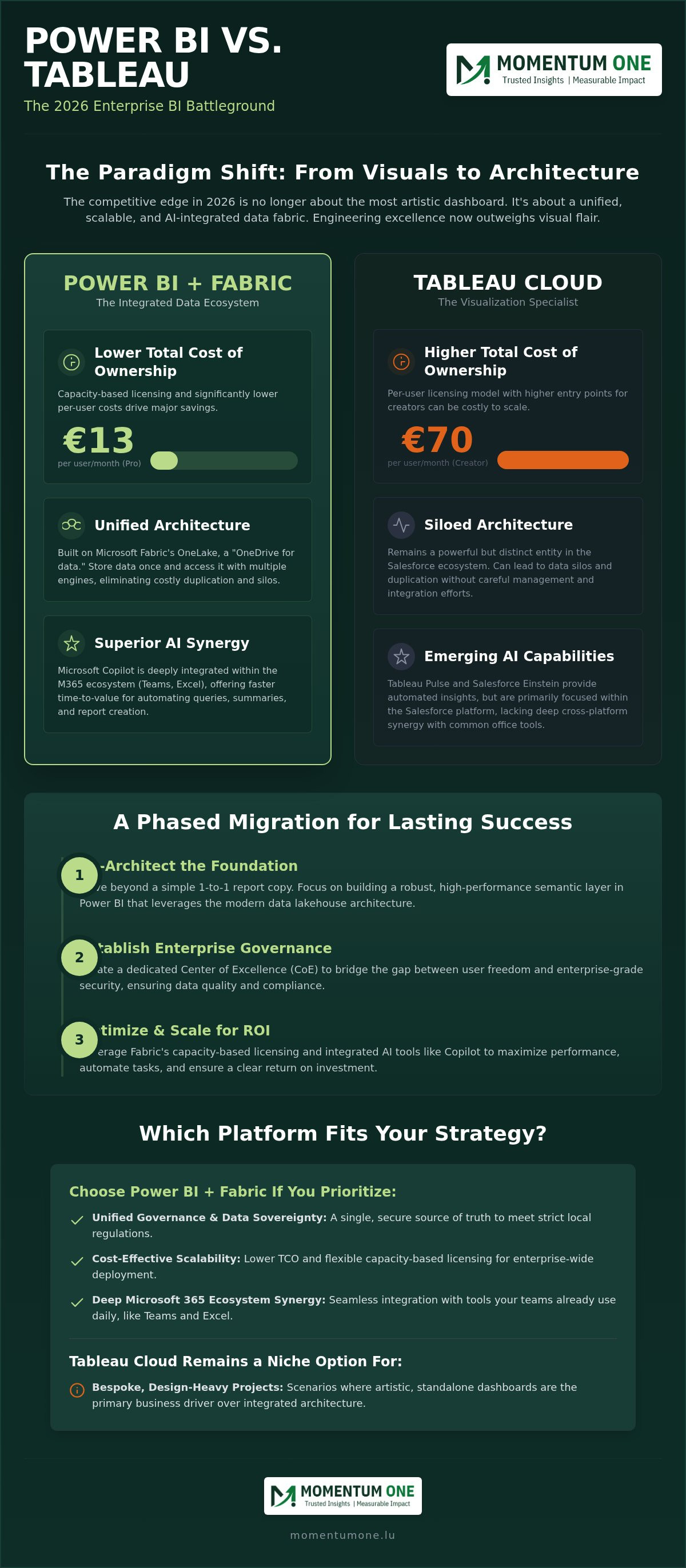
We understand the frustration of managing high licensing costs, such as Tableau Cloud Creator seats at roughly €70 per user, without seeing a clear return on that investment. You want a scalable data architecture that offers unified governance and seamless AI integration through tools like Copilot. This guide compares the architecture, total cost of ownership, and AI synergy of both platforms to help you decide which one wins the enterprise battle this year. We'll explore how Power BI Pro's €13 monthly cost stacks up against the competition and why the shift to Microsoft Fabric is a game changer for Luxembourgish firms.
The Enterprise BI Landscape in 2026: Beyond Simple Dashboards
By 2026, the definition of Business intelligence software has evolved from a tool that simply generates charts to a comprehensive system that manages organizational intelligence. Standalone tools are losing ground to integrated ecosystems that prioritize data flow over visual flair. For many C-level executives in Luxembourg, the shift isn't just about switching vendors; it's about moving toward a unified data fabric. While Tableau was once the gold standard for artistic visuals, visualization is now a commodity. Engineering is the differentiator. The real competitive edge lies in how effectively you can unify fragmented sources and automate the path from raw data to insight.
This shift is driving a surge in the development of a structured Tableau to Power BI migration strategy across the financial and industrial sectors. Enterprises are prioritizing data sovereignty and centralized governance to meet strict local regulations. Instead of fragmented silos, they're looking for a single source of truth that balances user flexibility with strict security. A modern ecosystem must do more than display numbers. It must provide a reliable, governed foundation for every department to build upon without creating technical debt.
The Rise of the Data Lakehouse
Traditional silos have become too expensive to maintain. In 2026, the Lakehouse architecture is the standard for high-performing organizations. Microsoft Fabric's OneLake acts as a "OneDrive for data," allowing files to be stored once and accessed by multiple engines without duplication. This architecture supports both legacy Tableau workloads and modern Power BI reports simultaneously, facilitating a smoother transition. Choosing between a Data Lakehouse vs Warehouse Design is now a foundational step in any modernization project. It ensures that your data remains accessible, performant, and ready for future scaling without the bottlenecks of the past.
AI-First Analytics: Copilot vs. Tableau Pulse
Generative AI has fundamentally changed how business users interact with information. Microsoft Copilot is now deeply integrated into the Power BI experience, automating everything from DAX query writing to executive summaries. Salesforce Einstein and Tableau Pulse offer similar automated insights, but the tight integration of Copilot within the Microsoft 365 environment often provides a faster time to value for teams already using Teams and Excel. While AI handles the heavy lifting of report creation, technical excellence remains vital. High-performing teams still focus on DAX optimization to ensure that AI-generated queries don't compromise system performance. Integrating these tools into a broader Tableau to Power BI migration strategy allows leaders to leverage the full power of a modern, AI-driven ecosystem.
Technical Architecture: Power BI (Fabric) vs. Tableau Cloud
In 2026, technical architecture is no longer just about how data looks; it's about where it lives and how it moves. Power BI has evolved into a native component of Microsoft Fabric, built on the foundation of OneLake. This means data doesn't actually move; it's simply accessed by different engines. In contrast, Tableau Cloud remains a powerful but distinct entity within the Salesforce ecosystem. When executives evaluate a Tableau to Power BI migration strategy, understanding this structural difference is vital. A standard Power BI vs Tableau comparison often overlooks the fundamental shift from data duplication to unified storage that Fabric provides.
Data modeling also reveals a significant divide. Power BI relies on a tabular model that demands technical precision to perform at scale. While Tableau’s relationship-driven approach is intuitive for smaller, artistic sets, it often struggles with the weight of enterprise-level complexity. This is why DAX optimization experts are essential for large-scale implementations. They ensure your calculations aren't just accurate, but performant enough to support thousands of concurrent users across a national enterprise. If you're concerned about your current architecture's efficiency, our team can assist with data architecture modernization to ensure a stable foundation.
Connectivity and Data Engineering
The introduction of Direct Lake mode in Power BI has changed the game for data freshness. It bridges the gap between Import and DirectQuery, providing the speed of in-memory performance without the need for traditional data refreshes. Tableau’s Hyper engine is still a powerhouse for handling complex, heterogeneous data sources, but it still requires data movement and extraction. Maintaining this freshness requires robust pipeline and dataflow automation. By automating these pathways, organizations reduce manual overhead and ensure that decision-makers are always looking at the most current figures available.
Scalability for Global Datasets
Scaling a BI platform to 10,000+ users requires more than just buying seats; it requires intelligent capacity management. Power BI Premium capacities allow organizations to isolate resources, preventing the performance degradation often seen in multi-tenant environments. Tableau Cloud has made strides in scalability, but managing massive, multi-tenant datasets often presents higher administrative hurdles. DAX optimization is the key to unlocking performance in multi-billion row datasets. Without a focused Tableau to Power BI migration strategy that prioritizes these performance benchmarks, even the most advanced architecture can become a bottleneck for growth.
Total Cost of Ownership (TCO) and Licensing Realities
Evaluating the financial impact of a Tableau to Power BI migration strategy requires looking far beyond the initial sticker price of a license. While the "Microsoft Tax" is a common industry term, the reality in 2026 is that Tableau often carries a significant premium. For instance, a Tableau Cloud Creator seat costs approximately €68 per month, whereas a Power BI Pro license sits at roughly €13 per month. This baseline difference means that migrating can reduce direct licensing costs by up to 60% for many organizations. However, the true value lies in how Microsoft Fabric bundles services. By integrating data engineering, warehousing, and analytics into a single capacity, enterprises can often eliminate redundant third-party tool subscriptions across their entire data stack.
Hidden costs often undermine the ROI of a BI platform if not managed proactively. These include infrastructure maintenance for legacy setups, specialized consulting fees, and the ongoing burden of ad-hoc support. Choosing managed Power BI services provides a more stable financial model than relying on reactive fixes. This approach ensures that your architecture remains performant and governed without the unpredictable costs of internal technical debt. A structured migration isn't just about saving on licenses; it's about optimizing the total cost of generating a single business insight.
Licensing Complexity: Pro, Premium, and Fabric Capacities
Navigating the 2026 licensing landscape requires a strategic approach to capacity planning. Microsoft has shifted focus toward Fabric F-SKUs, which offer pay-as-you-go flexibility starting at roughly €240 per month for an F2 SKU. In contrast, Tableau has moved closer to the Salesforce ecosystem, utilizing consumption-based models and Salesforce credits that can be difficult to forecast. To avoid unexpected overruns, enterprises must implement rigorous workspace and capacity management. This allows you to scale resources up or down based on actual usage, ensuring you only pay for the compute power your Luxembourgish operations truly require.
The Cost of Expertise and Training
The availability of talent in the Luxembourgish market heavily influences TCO. While Tableau specialists are highly skilled, the ubiquity of the Microsoft ecosystem means the pool of Power BI talent is often broader, though deep DAX expertise remains a rare and valuable commodity. Investing in corporate Power BI training is a prerequisite for successful platform adoption. It empowers your internal teams to handle day-to-day report development, reducing the need for expensive external interventions. Balancing internal growth with outsourced managed services for high-level technical maintenance creates a sustainable and cost-effective operational model for the long term.
The Selection Framework: Which Platform Fits Your Strategy?
Choosing the right analytics platform in 2026 requires a clear-eyed assessment of your organizational goals. It's no longer a simple feature-for-feature comparison. Instead, the decision hinges on how a tool aligns with your existing infrastructure and future growth. For many national enterprises in Luxembourg, a successful Tableau to Power BI migration strategy begins with identifying which scenario best describes their current state.
Scenario A covers organizations heavily invested in the Microsoft 365 and Azure ecosystem. Here, Power BI isn't just a reporting tool; it's a natural extension of the workflow. Scenario B applies to design-led teams where highly bespoke, artistic visualizations are the primary requirement. While Tableau still holds a slight edge in creative flexibility, the gap has narrowed significantly. Finally, Scenario C involves fast-growing enterprises that recognize the need for a unified data layer. These firms often seek a Microsoft Fabric migration services roadmap to move from fragmented systems to a cohesive environment. Staying on a legacy platform often incurs hidden technical debt that outweighs the initial cost of modernization.
Organizational Skillset and Adoption
Your team's current proficiency is a major factor in platform selection. While SQL remains a universal language, the shift from Tableau’s VizQL to Power BI’s DAX requires a dedicated learning curve. High adoption rates depend on how easily users can transition to new workflows. Implementing corporate data fabric training can drastically accelerate this process, moving your staff from hesitant beginners to confident power users. This investment ensures that self-service BI becomes a reality across departments rather than a bottleneck in IT.
Integration and Ecosystem Synergy
Synergy is the silent driver of ROI. Power BI offers native integration with Teams, SharePoint, and Power Automate, allowing data to flow directly into daily communications. Conversely, Tableau remains the preferred choice for sales-driven organizations deeply embedded in the Salesforce CRM and Slack ecosystem. Regardless of the tool, the foundation must be solid. A comprehensive data architecture modernization ensures that your chosen platform isn't just a window dressing for a broken data backend. If you're ready to evaluate your current setup, our team can help you design a Fabric Migration & Modernization plan tailored to your needs.
Implementation and Governance: Ensuring Long-Term Success
Industry research highlights a sobering reality: approximately 70% of business intelligence initiatives fail to deliver their promised value. This failure rarely stems from the software itself. Instead, it's the result of fragmented governance and a lack of organizational data literacy. A successful Tableau to Power BI migration strategy doesn't end when the last dashboard is published; it begins with a robust framework for long-term management. Establishing a Center of Excellence (CoE) is essential for bridging the gap between technical capability and business outcomes. This internal body ensures that data remains accurate, accessible, and aligned with corporate objectives.
Professional Power BI consulting & governance acts as the bridge between user freedom and enterprise security. By defining clear roles and responsibilities, organizations can empower their teams to explore data without compromising integrity. At Momentum One, we position ourselves as your strategic partner for Fabric migration & modernization. We don't just move your reports; we help you build a sustainable ecosystem that scales with your growth across Luxembourg.
Securing the Data Fabric
In 2026, security is more granular than ever. Implementing row-level security (RLS) and object-level security (OLS) ensures that sensitive financial or personal data is only visible to authorized personnel. Governing AI-generated reports is equally critical to prevent data leakage and ensure the accuracy of automated insights. For mission-critical BI environments, relying on incident and support services provides the peace of mind that your systems will remain operational when they're needed most. This proactive approach prevents small technical hitches from becoming major business disruptions.
Scaling Through Managed Services
Luxembourgish enterprises often find that boutique consultancies offer more value than large generalist firms. A specialized partner provides the focused expertise required for complex DAX optimization and local regulatory compliance. Building internal capability is just as important as external support. Our Advanced DAX training for analysts empowers your team to master the nuances of the Microsoft stack. This reduces your reliance on external contractors for daily maintenance. To start your journey, consider booking a strategic architectural review to audit your current BI environment and identify the most efficient path forward.
Future-Proofing Your Enterprise Analytics
Deciding between Power BI and Tableau in 2026 isn't just about comparing features; it's about choosing the foundation for your company's intelligence. We've seen how the shift toward integrated data fabrics and the significant cost advantages of Microsoft Fabric have redefined the competitive landscape. For many Luxembourgish enterprises, the path forward involves a comprehensive Tableau to Power BI migration strategy that prioritizes data engineering and centralized governance over simple visualization.
Success in this transition requires more than just new software. It demands a partner who understands the technical nuances of the Microsoft stack. As a Microsoft Solutions Partner and certified Fabric migration experts, we provide the specialized DAX performance tuning and architectural oversight needed to secure your corporate data. We're committed to helping you turn complex datasets into clear, actionable insights that drive real business value. Elevate your enterprise strategy with expert Power BI consulting and take the first step toward a unified, scalable future. Your team has the potential to lead with data; let's build the framework to make it happen.
Frequently Asked Questions
Is Power BI cheaper than Tableau for large enterprises in 2026?
Power BI is generally more cost-effective for large enterprises due to its integrated licensing model. A Power BI Pro license costs roughly €13 per user monthly, while a Tableau Cloud Creator seat is about €68. For a large workforce, this price gap scales rapidly. Additionally, Microsoft Fabric capacity pricing allows for consolidated billing across data engineering and analytics, which often reduces the total cost of ownership compared to Tableau’s per-user or consumption-based Salesforce credit models.
Can I run Tableau on top of Microsoft Fabric?
You can connect Tableau to data stored within Microsoft Fabric, but you won't get the native integration benefits. Tableau can access data in OneLake through standard connectors like SQL endpoints. However, you miss out on Direct Lake mode, which provides high-performance access without data duplication. While technically possible, this hybrid approach often adds architectural complexity that a unified Tableau to Power BI migration strategy is designed to eliminate for better performance and lower overhead.
What are the main advantages of Power BI Copilot over Tableau Pulse?
Power BI Copilot’s primary advantage is its deep integration with the Microsoft 365 ecosystem. It allows executives to generate summaries and insights directly within Teams or Outlook. While Tableau Pulse offers excellent automated metrics, Copilot assists in the actual development process by writing DAX queries and creating report pages from natural language prompts. This reduces the technical barrier for business users and speeds up the transition from raw data to board-ready insights across the organization.
How long does a typical migration from Tableau to Power BI take?
A typical enterprise migration usually spans three to nine months depending on the complexity of the existing report catalog. A successful Tableau to Power BI migration strategy follows a phased approach. We begin with an architectural audit, followed by the migration of high-impact executive dashboards. The timeline varies based on the volume of calculated fields and Level of Detail (LOD) expressions that require translation into optimized DAX measures to ensure performance parity with the original system.
Do I need a data lakehouse to use Power BI effectively at scale?
You don't strictly need a data lakehouse, but it's highly recommended for enterprise-scale performance in 2026. Microsoft Fabric is built on a Lakehouse architecture using OneLake, which simplifies data management by storing data once for all engines. This setup enables Direct Lake mode, giving you the speed of in-memory processing without the delays of traditional data refreshes. It’s the most efficient way to maintain a single, governed source of truth while supporting thousands of concurrent users.
Which tool is better for real-time streaming analytics in 2026?
Power BI holds a significant lead in real-time streaming analytics due to its integration with the Microsoft Fabric Real-Time Hub. It allows for the direct ingestion and visualization of streaming data from IoT devices or transaction logs with sub-second latency. While Tableau can display real-time data through frequent refreshes or specific extensions, it lacks the native, end-to-end streaming architecture that makes Power BI the preferred choice for mission-critical, live monitoring in industrial and financial sectors.
Does Momentum One provide support for Tableau environments?
Momentum One focuses exclusively on the Microsoft data ecosystem to ensure the highest level of technical expertise for our clients. We are a certified Microsoft Solutions Partner specializing in Power BI governance and Fabric modernization. While we don't provide ongoing support for legacy Tableau environments, we specialize in helping organizations transition away from them. Our team guides you through the entire migration process, from initial data modeling and warehouse design to advanced DAX optimization.
How does DAX optimization impact Power BI Premium costs?
DAX optimization directly influences your licensing costs by reducing the compute resources required to process queries. Inefficient calculations consume more memory and CPU, which can force an organization to upgrade to a higher, more expensive Fabric or Premium capacity SKU. By refining your data models and optimizing measures, you can maintain high performance on lower-tier capacities. This proactive approach ensures your system remains responsive while keeping your monthly operational expenses predictable and aligned with your budget.