Power BI Embedded in Luxembourg: A Strategic Guide
Master Power BI Embedded Luxembourg. This guide helps you cut licensing costs, white-label reports, and meet 2026 data laws for scalable, secure analytics.
- Transition to a scalable "Analytics-as-a-Service" model that eliminates the need for individual Power BI Pro licenses for your external customers.
- Select the right capacity plan by comparing Azure A-SKUs and EM-SKUs to achieve predictable monthly costs while maintaining peak performance.
- Create a fully branded, white-labeled analytics experience that integrates directly into your existing customer portal for a native application feel.
- Implement advanced Row-Level Security (RLS) and data isolation to meet the rigorous 2026 standards for Power BI Embedded Luxembourg.
- Optimize your DAX and data models to handle high-concurrency demands, ensuring your client-facing reports are always fast and available.
Why are so many firms across the country still paying for individual Power BI Pro licenses for every external client when a more scalable, white-labeled alternative is within reach? Scaling your analytics shouldn't mean watching your overhead spiral out of control. Many leaders feel the weight of high licensing costs and the technical headache of Azure capacity planning. When you add the pressure of the 2026 Luxembourg Data Protection Law, ensuring multi-tenant data isolation becomes more than just a preference; it's a necessity. We understand that you need a solution that balances sophisticated performance with ironclad security.
This strategic guide helps you master the technical and commercial nuances of Power BI Embedded Luxembourg to deliver world-class analytics directly to your customers. You'll learn how to move away from per-user constraints toward a predictable, capacity-based model that fits your budget. We'll walk through the practical steps of white-labeling your reports, securing your data architecture, and navigating the latest compliance requirements. By the end, you'll have a clear roadmap to transform your data into a secure, branded, and revenue-generating asset for your business.
What is Power BI Embedded and Why Does it Matter in 2026?
Power BI Embedded isn't just a reporting tool; it's a developer-focused Platform-as-a-Service (PaaS) that lets you inject powerful data visuals directly into your own applications. In 2026, the demand for Analytics-as-a-Service has surged across the region. Clients no longer want to switch between tabs or log into separate portals to see their data. They expect insights where they already work. For firms implementing Power BI Embedded Luxembourg, the goal is often to provide a seamless, white-labeled experience that feels like a native part of their own software. Unlike the standard Software-as-a-Service (SaaS) model, which typically requires each viewer to have a personal license, this PaaS model scales with your application's usage and capacity.
Understanding What is Power BI Embedded helps clarify that while the core engine remains the same as the standard version, the delivery method is fundamentally different. It empowers developers to build, manage, and deploy reports without forcing end-users to navigate the traditional Power BI interface. This shift is critical for Luxembourgish firms looking to maintain full control over the user journey, branding, and total cost of ownership. It's a strategic move from providing internal business intelligence to offering data as a premium, external-facing product.
The Business Value of Embedded Analytics
Monetizing your data becomes a practical reality when reports are a core feature of your product. Instead of offering static PDFs or basic spreadsheets, you provide interactive, real-time insights that drive higher customer retention. When your analytics feel like a native part of your portal, user adoption climbs significantly. It's about streamlining the experience; your customers stay within your brand's ecosystem, reinforcing your position as a tech-forward partner. By integrating these insights, you're not just showing data; you're providing a value-added service that justifies premium pricing tiers.
Embedded vs. Publish to Web
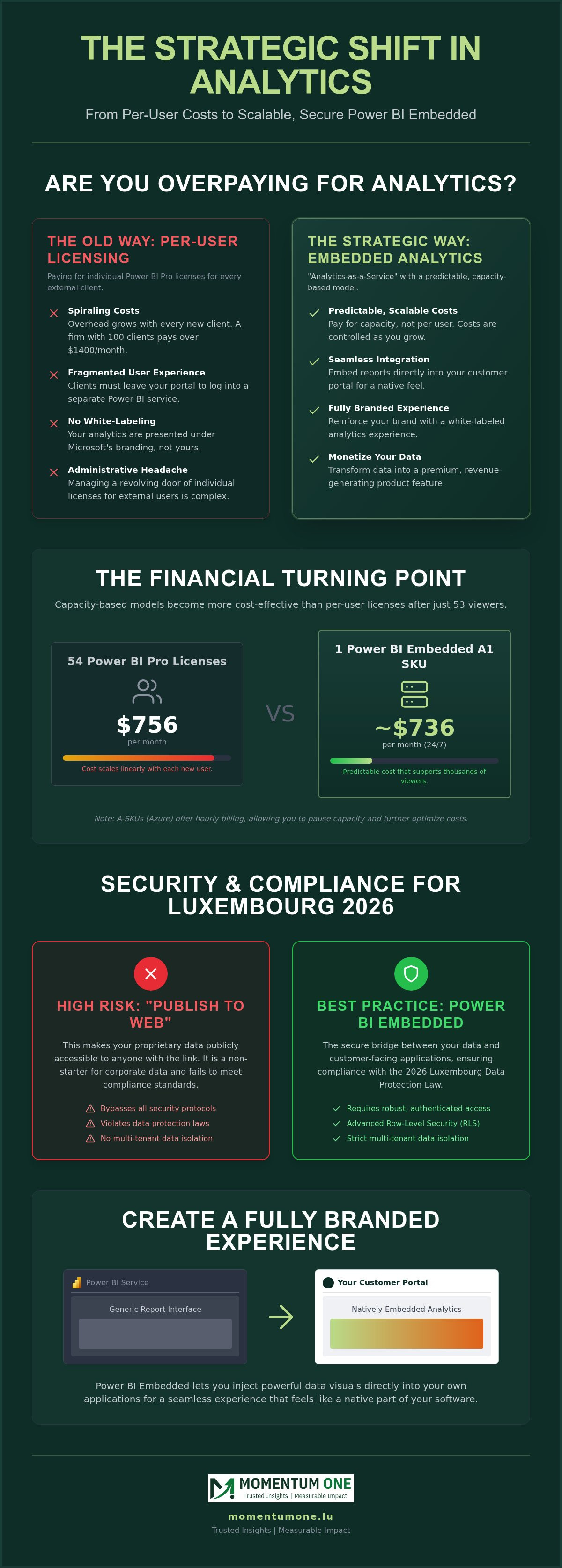
Choosing "Publish to Web" is a dangerous shortcut for any corporate data. It makes your proprietary information accessible to anyone with the link, completely bypassing security protocols and compliance standards. This is a non-starter for any business serious about privacy or the 2026 Luxembourg Data Protection Law. In contrast, Power BI Embedded Luxembourg requires robust, authenticated access. This ensures only authorized users see their specific data segments, maintaining strict multi-tenant isolation. Power BI Embedded acts as the secure bridge between raw data and customer-facing applications. If you're looking to scale securely, professional Power BI Consulting & Governance is the best way to ensure your architecture is both compliant and performant.
Licensing and Capacity Planning: Navigating A-SKUs and EM-SKUs
Licensing is often the most significant hurdle for Power BI Embedded Luxembourg projects. As of 2026, a single Power BI Pro license costs $14 per month, while Premium Per User (PPU) sits at $24. For a firm with 100 external clients, the per-user math quickly favors capacity-based models. Choosing the right Licensing and Capacity Planning strategy depends on whether you're building for external customers or internal stakeholders. It's about shifting from a "per-seat" expense to a "per-resource" investment that scales with your business growth.
The break-even point is a vital metric for your financial planning. If you have more than 53 active report viewers, the monthly cost of an A1 SKU, which runs approximately $736 when active 24/7, becomes more economical than paying for 54 individual Pro licenses at $14 each. This transition doesn't just save money; it simplifies administration. You no longer need to manage a revolving door of individual licenses as your client base expands. If these calculations feel complex, you can always reach out for a tailored licensing audit to ensure your architecture is cost-efficient.
A-SKUs: Flexibility for External Applications
A-SKUs are purchased through Azure and specifically target ISVs and developers building custom applications. They offer the unique advantage of hourly billing, starting at approximately $1.0081 per hour for an A1 SKU in 2026. This model allows you to pause your capacity during off-peak hours or weekends to significantly reduce overhead. Because they integrate with Azure Resource Manager, you can automate scaling to handle peak user demand across Luxembourg without manual intervention. It's the most elastic way to manage external-facing analytics.
EM-SKUs: Corporate Embedding within Teams and SharePoint
While A-SKUs focus on the "app owns data" model for external users, EM-SKUs were traditionally used for organizational embedding within Microsoft 365 environments like Teams or SharePoint. However, in the 2026 landscape, Microsoft Fabric F-SKUs have largely become the standard for new deployments due to their broader integration capabilities. If you're managing a distributed workforce or a partner network, understanding Power BI licensing for customer portals is essential to avoid the trap of legacy volume licensing that might not fit your current needs.
White-Label Analytics: Building a Branded Customer Portal
Your corporate identity shouldn't stop at the login screen. When you provide data to your clients, the interface should feel like a natural extension of your brand, not a third-party add-on. Achieving this level of polish requires more than just embedding a frame; it involves a deep integration where the Power BI chrome is completely removed. By stripping away the standard menus and logos, you create a native application experience that reinforces your firm's professional authority. This is a core advantage for companies leveraging Power BI Embedded Luxembourg to differentiate themselves in a competitive market.
Your developers can use the Power BI JavaScript API to build advanced UI interactions that go far beyond static charts. This API allows your web application to "talk" to the reports, enabling custom buttons, sophisticated filtering, and even write-back capabilities. Security remains invisible but robust. You can integrate the platform with your existing authentication providers, such as Azure AD or Auth0, ensuring that users enjoy a secure environment without ever seeing a Microsoft login prompt. It's a sophisticated way to deliver high-end tech while keeping your brand front and center.
Seamless User Experience
Friction is the enemy of adoption. With the "app owns data" model, your external users don't need their own Power BI accounts or licenses. They simply log into your portal, and through Single Sign-On (SSO) implementation, they gain immediate access to their specific dashboards. You can also customize report navigation within your own web application, replacing the standard Power BI page tabs with your own navigation menus. This ensures the user journey is logical, fast, and entirely consistent with the rest of your digital ecosystem.
Branded BI Strategy
A cohesive design strategy across all data touchpoints builds immense trust. When your analytics match your corporate colors, fonts, and layout, you signal that you've invested in a premium solution for your clients. High-quality branded Power BI customer portals enhance professional credibility by making data consumption feel effortless. White-labeling transforms a standard reporting tool into a proprietary digital asset that adds tangible value to your service offering. If you want to ensure your visual identity remains intact while scaling, our team provides expert Data Modeling and DAX Optimization to keep those branded reports running at peak performance.
Security, Governance, and Data Isolation in Luxembourg
Security is the cornerstone of any external-facing analytics platform. In the context of Power BI Embedded Luxembourg, this means moving beyond basic passwords to a sophisticated multi-tenant architecture. You must ensure that Client A never catches a glimpse of Client B's proprietary data. Implementing Row-Level Security (RLS) is the standard method for filtering data at the source based on the user's identity. However, for highly regulated industries, a deeper level of Power BI customer data isolation is required to prevent even accidental cross-tenant leaks. Trust is built on this technical certainty.
Data residency remains a top priority for local firms. While Azure doesn't currently offer a dedicated Luxembourg data center, most organizations rely on the "Germany West Central" or "France Central" regions to maintain low latency and legal compliance. With the new Luxembourgish data protection law that took effect on August 1, 2026, transparency in data processing is no longer optional. You need a governance framework that doesn't just protect data but also provides the audit trails necessary to prove compliance during a regulatory review. It's about being prepared for the scrutiny of both your clients and the authorities.
Multi-Tenancy Architecture
You have two primary paths for managing multiple clients: workspace-based or RLS-based isolation. Workspace isolation offers the highest level of security by physically separating reports and datasets into distinct containers. RLS is often more cost-effective for smaller datasets but requires meticulous DAX logic to remain secure. We often recommend using Power BI REST APIs to automate tenant provisioning. This reduces human error and ensures that service principals handle backend communication securely without ever exposing master account credentials to the public web.
Compliance and Data Protection
Aligning your platform with GDPR and CSSF standards is essential for long-term viability in the local market. Beyond standard encryption, you must implement active monitoring and audit logging to track who is accessing specific data points and when. This level of oversight is a core component of professional Power BI Consulting & Governance. It transforms security from a reactive chore into a proactive business advantage that you can market to your own customers. If you're ready to secure your environment against modern threats, contact our security team for a comprehensive architecture review.
Strategic Implementation: Why Partner with a Luxembourg Expert?
Launching a customer-facing portal is just the beginning of your data journey. Scaling Power BI Embedded Luxembourg requires more than just technical configuration; it demands a long-term strategy for performance and reliability. When dozens of external clients access complex reports simultaneously, the underlying architecture faces significant stress. Without expert oversight, minor inefficiencies in your data model can quickly escalate into costly performance bottlenecks. Choosing a dedicated partner allows you to bypass the trial-and-error phase and move straight to a stable, production-ready environment.
Hiring a single lead developer might seem like a cost-effective route, but it often leads to single-point-of-failure risks and slower development cycles. A specialized agency provides a collective depth of experience and proven roadmaps that accelerate your time-to-market. We focus on providing national-level support across Luxembourg, ensuring that your enterprise has a reliable ally that understands the local corporate landscape and regulatory expectations. This local presence means we're available when you need us, providing a level of dedication that offshore providers simply can't match.
Beyond Technical Setup: Managed BI
Maintaining a high-performance environment requires continuous performance tuning and DAX optimization. Our Managed Services ensure that your Azure capacity is proactively monitored to prevent unexpected cost spikes while maintaining 24/7 availability for your clients. We don't just build the solution and walk away; we train your internal teams to manage the environment effectively. This approach ensures that your analytics platform remains a robust, value-driven asset rather than a technical burden. We help you stay ahead of the curve by implementing the latest features as they are released in the 2026 ecosystem.
The Momentum One Advantage
As a certified Microsoft Solutions Partner with over 8 years of experience, we bring a wealth of expertise to every project. We provide a proactive partnership that spans the entire data lifecycle, from initial Data Warehouse Design to the final implementation of your embedded portal. Our solutions are tailored to the specific needs of firms in Luxembourg, balancing technical excellence with a genuine commitment to your business outcomes. We act as a steady hand in a complex field, helping you turn raw data into a strategic competitive advantage that drives real growth for your organization.
Elevate Your Customer Analytics Strategy for 2026
Mastering the technical and commercial nuances of your data environment is the key to delivering world-class insights. We've explored how transitioning to a capacity-based model can stabilize your costs while providing a premium, white-labeled experience for your clients. Implementing Power BI Embedded Luxembourg allows you to move beyond the constraints of per-user licensing, creating a secure and branded asset that sets your business apart. Whether you're navigating complex multi-tenant isolation or optimizing DAX for high-concurrency reports, the right architecture ensures long-term scalability and compliance.
Momentum One acts as your steady hand throughout this journey. As a certified Microsoft Solutions Partner with over 8 years of technical BI expertise, we provide the strategic oversight and Luxembourg-based managed services you need to succeed. We don't just set up the technology; we partner with you to ensure your data environment is a driver of growth and efficiency. Your journey toward sophisticated, integrated analytics starts with a clear plan and a dedicated ally.
Ready to transform your client portals? Book a Power BI Embedded Strategy Session with Momentum One to discuss your specific goals and technical requirements. Let's build a robust data-driven future for your organization together.
Frequently Asked Questions
What is the main difference between Power BI Pro and Power BI Embedded?
Power BI Pro is a Software-as-a-Service (SaaS) tool where every viewer needs a $14 monthly license. In contrast, Power BI Embedded is a Platform-as-a-Service (PaaS) offering that bills based on dedicated capacity rather than individual seats. This makes it the preferred choice for applications with large external user bases. It allows you to integrate reports directly into your own web environment without forcing every client to manage their own Microsoft account.
Do my external customers need a Power BI license to view embedded reports?
No, your external customers don't need their own Power BI licenses to view reports within your application. Under the "app owns data" model, your business provides the authentication and the underlying Azure capacity. You only need a Power BI Pro license for the developers who publish the content. This licensing structure is one of the primary reasons firms choose Power BI Embedded Luxembourg to scale their analytics cost-effectively across the country.
How much does Power BI Embedded cost for a typical Luxembourgish business?
Costs are based on the Azure SKU you select and how many hours the capacity is active. For example, an A1 SKU costs approximately $1.0081 per hour in 2026, which totals roughly $736 per month if left running continuously. Many businesses reduce these costs by pausing the capacity during off-peak hours. While third-party service fees vary, the infrastructure cost remains predictable based on your chosen performance tier and usage patterns.
Is Power BI Embedded secure enough for financial services in Luxembourg?
Yes, the platform is built to meet the rigorous security standards required by the Luxembourgish financial sector. By implementing multi-tenant data isolation and Row-Level Security, you ensure that sensitive information remains strictly partitioned. While Microsoft handles the core infrastructure security, your local governance framework ensures compliance with GDPR and CSSF transparency requirements. It's a robust solution for firms that prioritize data residency and secure access.
Can I white-label the reports to remove all Microsoft branding?
You can absolutely white-label your reports to create a native application experience. By using the Power BI JavaScript API, your developers can strip away all Microsoft branding, including the standard menus and action bars. This allows you to match the analytics interface perfectly with your corporate fonts, colors, and overall design language. The result is a professional portal where the reporting feels like a proprietary feature of your own software.
How does Row-Level Security (RLS) work in an embedded scenario?
Row-Level Security (RLS) acts as a gatekeeper that filters data at the database level based on the user's identity. When a client logs into your portal, your application passes a secure token to Power BI that specifies which data rows they are authorized to see. This ensures that even if multiple clients use the same report template, they only ever interact with their own proprietary information. It's the standard for maintaining multi-tenant isolation.
What Azure capacity (SKU) should I start with for my portal?
Most organizations start with an A1 SKU for development and initial testing. This tier provides enough power for low-concurrency scenarios and allows you to validate your architecture without a massive upfront investment. As your user base grows across Luxembourg, you can scale to A2 or A3 tiers through the Azure portal with minimal downtime. Monitoring your peak usage helps you decide exactly when a capacity upgrade is necessary for optimal performance.
Can Momentum One help with the initial setup and ongoing maintenance?
Momentum One provides comprehensive support for the entire Power BI Embedded Luxembourg lifecycle. We handle everything from the initial data warehouse design and environment setup to ongoing managed services and DAX optimization. Our team acts as a dedicated partner, ensuring your analytics platform remains available, secure, and performant 24/7. We also offer training solutions to help your internal staff manage the environment with confidence as your business scales.