Data & AI Governance in Luxembourg: A Strategic Guide
Data and AI governance is becoming a strategic priority for organizations operating in Luxembourg. This guide explains how to build trusted, compliant, and AI-ready governance frameworks by aligning data quality, security, compliance, and responsible AI practices with EU regulations and long-term business objectives.
- Align your corporate strategy with Luxembourg’s vision for human-centric AI to transform regulatory hurdles into drivers of operational performance.
- Identify where your AI use cases fall within the EU AI Act risk categories to ensure you meet specific technical documentation requirements for high-risk systems.
- Master the four pillars of governance—Quality, Security, Privacy, and Performance—to protect sensitive corporate data while maintaining reliable, high-performance insights.
- Learn how to centralize and automate your Data & AI Governance Luxembourg framework using Microsoft Fabric’s OneLake and Microsoft Purview.
- Establish a clear path for Fabric migration and DAX optimization that eliminates technical debt and builds a culture of data-driven decision-making.
What if the EU AI Act wasn't a checklist of restrictions but the blueprint for your most competitive year yet? It's natural to feel the pressure as the August 2, 2026, transparency obligations take effect, particularly when you're already navigating the technical debt of legacy Power BI setups. You want to innovate with AI, but data silos and the fear of compliance penalties often stall progress. We understand that establishing Data & AI Governance Luxembourg feels like a moving target, but it's actually your best opportunity to build a more reliable, high-performance organization.
This guide helps you master the complexities of the EU AI Act by integrating compliance directly into your Microsoft Fabric implementation. We're laying out a clear roadmap for Fabric migration that breaks down silos and prepares your team for the December 2027 high-risk system requirements. You'll discover how to move beyond AI experimentation to create a secure, scalable data ecosystem that drives real business value and fosters a true data-driven culture.
The 2026 Data & AI Governance Landscape in Luxembourg
Effective Data & AI Governance Luxembourg isn't just a legal checkbox. It's the strategic convergence of your internal policy, your technical stack, and your organizational culture. In 2026, we've reached a turning point where governance must be operationalized to drive performance. For corporate data leaders, this is the "year of enforcement." You can't rely on fragmented spreadsheets or siloed Power BI reports anymore. You need a Single Source of Truth. This foundation ensures that every AI-driven insight is rooted in accurate, compliant, and high-quality data.
The Role of the EU AI Act and the Digital Omnibus
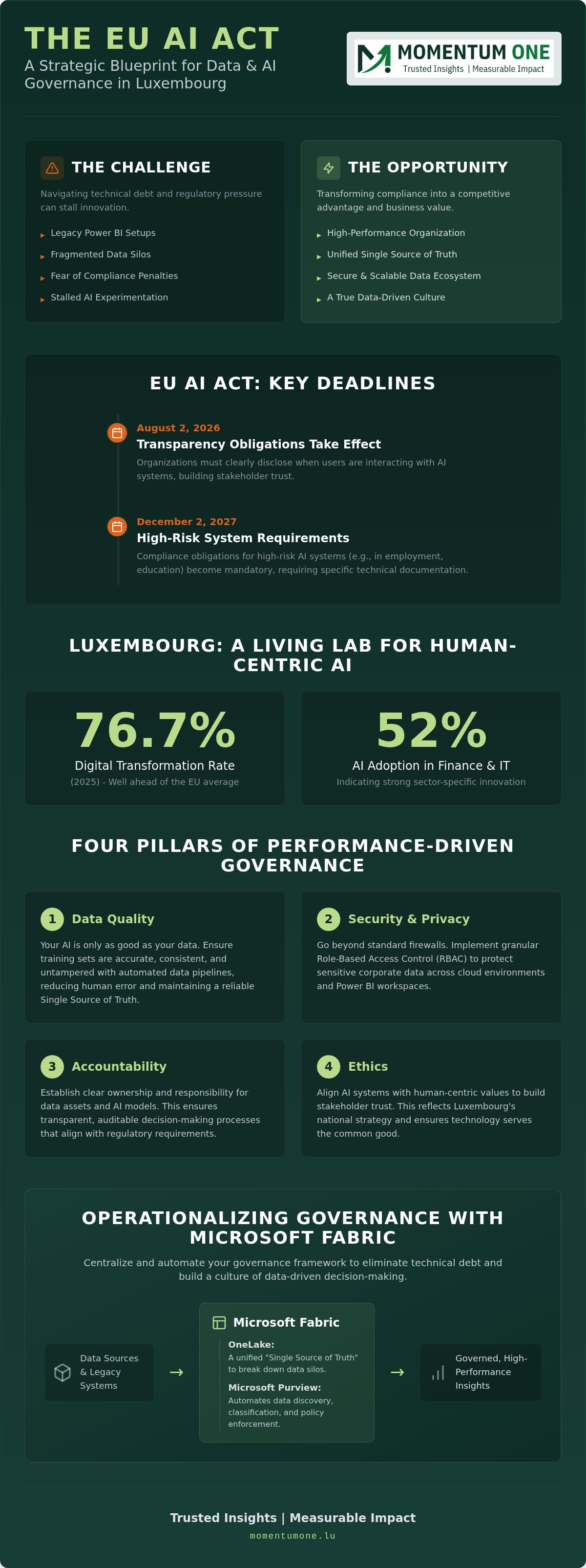
The regulatory landscape moved quickly this year. The Digital Omnibus Regulation entered into force on July 27, 2026, amending the AI Act and tightening local data protection rules. If your organization uses AI systems, you've likely already felt the impact of the August 2, 2026, deadline for transparency obligations. Organizations must now clearly disclose when users interact with AI systems. This isn't just about fine print; it's about building trust with your stakeholders.
The stakes get higher as we move toward 2027. By December 2, 2027, compliance obligations for stand-alone high-risk AI systems in sectors like employment and education will take effect. These regulations aren't just for tech giants. They affect any Luxembourgish firm using data to automate critical business decisions. To stay ahead, many leaders are revisiting their Power BI Consulting & Governance frameworks to ensure their reporting environments align with the EU Data Governance Act.
National Strategy: Luxembourg as a Living Lab for AI
Luxembourg isn't just following EU rules; it's leading with a human-centric vision. The "Digital Government Strategy 2026–2030" aims for fully interoperable public services, positioning the country as a living lab for innovation. With a digital transformation rate reaching 76.7% in 2025, the Grand Duchy sits well ahead of the EU average. However, adoption of cloud and advanced data analytics still lags in some sectors, creating a gap between vision and execution.
The government's commitment to the common good means local regulations prioritize people while enabling technical growth. For your business, this means cross-border collaboration is essential. Whether you're in finance or IT, where AI adoption sits at 52%, your governance framework must be flexible enough to handle international data flows while respecting local sovereignty. Building this Data & AI Governance Luxembourg infrastructure requires a proactive ally who understands both the legal deadlines and the technical nuances of modern data warehouses.
From Compliance to Performance: The Four Pillars of Governance
Transitioning from regulatory fear to operational excellence requires a shift in how we view Data & AI Governance Luxembourg. Instead of seeing it as a series of barriers, think of it as a framework built on four essential pillars: Data Quality, Security & Privacy, Accountability, and Ethics. When these pillars are strong, your organization doesn't just meet the EU AI Act standards; it gains a measurable performance advantage. High-quality data leads to faster decisions, while robust security builds the trust necessary for true AI adoption.
Data Quality Management as an AI Enabler
Your AI models are only as good as your Data Warehouse & Lakehouse Design. Even the most sophisticated machine learning algorithms will fail if they ingest "dirty" data. In 2026, Data Integrity is the verifiable assurance that your AI training sets remain accurate, consistent, and untampered throughout their entire lifecycle. To achieve this, we recommend moving away from manual data cleaning and toward automated data pipelines. These pipelines reduce human error and ensure that your "Single Source of Truth" remains reliable as your data volume grows. If you're looking to streamline this process, our team can help you with pipeline and dataflow automation to keep your insights sharp.
Security Best Practices: Beyond the Firewall
Security in a modern data ecosystem must be granular. Standard firewalls aren't enough when you're managing sensitive Luxembourgish corporate data across cloud environments. You need Role-Based Access Control (RBAC) within your Power BI workspaces to ensure users only see the data relevant to their specific functions. This minimizes the risk of internal data leaks and simplifies compliance with local privacy rules.
Auditing is the other half of the security equation. You should actively monitor sensitive data movements and access patterns within the Microsoft ecosystem. This proactive approach allows you to identify anomalies before they become breaches. For a structured look at your current environment, you can use our Power BI data security audit checklist to evaluate your workspace and capacity management.
Beyond technical security, accountability and ethics ensure your AI isn't a "black box." Defining who owns specific data assets and the resulting AI outputs is critical for long-term success. This human-centric approach aligns with the EU analysis of Luxembourg's AI Strategy, which emphasizes that innovation must serve the common good. By mitigating bias in your machine learning models today, you protect your brand's reputation and ensure your Data & AI Governance Luxembourg framework stands the test of time.
Navigating Risk: A Framework for Luxembourgish Enterprises
Establishing a robust Data & AI Governance Luxembourg framework requires a clear understanding of how the EU AI Act classifies risk. Not all AI is equal. The regulation categorizes systems based on their potential to impact individuals, and for many Luxembourgish firms, this classification determines the depth of technical documentation and oversight required. By categorizing your use cases early, you can avoid over-engineering compliance for low-risk tools while ensuring high-risk applications are fully audit-ready.
High-Risk vs. Minimal-Risk AI Applications
Most standard business intelligence reports and sales forecasting tools fall into the minimal-risk category. If you're using Power BI to visualize inventory levels or marketing performance, you likely won't face heavy regulatory burdens. However, the landscape changes when AI influences life-altering decisions. In Luxembourg's financial services sector, high-risk systems include AI used for credit scoring, recruitment automation, or insurance risk assessments. These applications must comply with strict obligations by December 2, 2027.
General-purpose AI (GPAI) models have their own timeline. Since August 2025, rules for GPAI governance have been applicable, requiring organizations to maintain technical documentation and respect copyright laws. If your enterprise is integrating these models into your Power BI Consulting & Governance strategy, you must ensure your providers are transparent about their training data. This proactive approach prevents technical debt and ensures your infrastructure scales alongside evolving EU standards.
Implementing Human Oversight and Transparency
Transparency is no longer optional. As of August 2, 2026, transparency obligations for AI systems enter into force across the EU. This means your users must be informed when they are interacting with an AI, such as a chatbot, or viewing AI-generated content. Implementing "Human-in-the-Loop" (HITL) methods is the most effective way to manage this. By ensuring a qualified professional reviews AI-driven outputs before they are finalized, you mitigate the risk of automated bias and maintain the high standards expected by Luxembourgish regulators like the CSSF.
To stay compliant, your technical documentation must be audit-ready at all times. This includes:
- Detailed logs of system performance and decision-making logic.
- Records of data training sets and validation processes.
- Clear protocols for human intervention and system overrides
Conducting a conformity assessment before deployment is the best way to verify these elements. This assessment acts as a final check, ensuring your Data & AI Governance Luxembourg strategy is both legally sound and operationally efficient. If your team needs to sharpen their technical skills to manage these requirements, our corporate Power BI training provides the practical knowledge needed to navigate these complex risk buckets with confidence.
Operationalizing Governance with Microsoft Fabric and Power BI
Technical implementation is where many Data & AI Governance Luxembourg strategies fail. You can have the best policies on paper, but if your technical stack doesn't enforce them, they're useless. Microsoft Fabric provides the unified environment needed to turn these policies into automated reality. By centralizing your data and AI assets, you reduce the risk of non-compliance while significantly boosting your team's performance. It's about building a system that works for you, not one that gets in the way.
Centralizing Data with Microsoft Fabric OneLake
OneLake acts as the "OneDrive for data," eliminating the need for multiple copies of sensitive information. When you implement a robust Data Warehouse & Lakehouse Design, you integrate security at the lakehouse level. This means every downstream Power BI report automatically inherits the same governance rules. It simplifies your architecture and ensures that your "Single Source of Truth" remains secure across the entire enterprise, regardless of how many users are accessing the data.
Automation is the key to managing data at scale. Microsoft Purview works alongside Fabric to handle automated data discovery and classification. It scans your environment to identify sensitive Luxembourgish corporate data, such as PII or financial records, and applies labels that restrict unauthorized access. This reduces the manual burden on your IT team and ensures your technical documentation is always audit-ready. You won't have to worry about missing a classification when the system handles the heavy lifting for you.
Managing Power BI Capacity and Governance
Effective governance doesn't mean slowing down. It means optimizing your Power BI Consulting & Governance framework to support high-performance reporting. This involves fine-tuning your DAX and data models to ensure they remain efficient even as governance layers are added. We also focus on tenant administration, where we monitor settings to prevent unauthorized external data sharing or unmanaged workspace sprawl. This keeps your environment clean and your costs under control.
Striking the right balance between self-service BI freedom and corporate guardrails is a cultural challenge. You want your business users to explore data and create their own insights, but they need to do so within a "governed sandbox." By establishing clear workspace management protocols, you empower your team without compromising the integrity of your Data & AI Governance Luxembourg framework. This approach fosters a data-driven culture while keeping your organization safe from technical debt and compliance penalties.
Ready to modernize your data stack? Start your Fabric Migration & Modernization journey with our expert team today.
The Momentum One Approach: Your Partner in AI Readiness
Implementing a robust framework for Data & AI Governance Luxembourg isn't a one-time project. It's a continuous commitment to excellence that requires a blend of technical mastery and strategic foresight. At Momentum One, we position ourselves as your proactive ally. As a certified Microsoft Solutions Partner with over 8 years of experience in the Luxembourgish market, we don't just deliver reports; we build scalable, high-performance ecosystems that grow with your business. Our outcome-based consulting focuses on removing technical debt and ensuring your data infrastructure is ready for the next wave of AI innovation.
We believe that governance should be an enabler, not a bottleneck. While many providers focus solely on the legal aspects of compliance, we bridge the gap between regulatory requirements and technical reality. By integrating governance directly into your Microsoft stack, we help you transition from fragmented data silos to a unified "Single Source of Truth." This approach ensures that your organization remains agile, compliant, and ready to leverage the full power of Microsoft Fabric and Power BI.
Building Internal Expertise through Training
A data-driven culture starts with people. Even the most advanced technical guardrails fail if your team lacks the skills to navigate them. We offer customized workshops designed to foster a data-literate culture within your organization. These sessions go beyond basic tool usage; they focus on improving staff proficiency in data quality management and governance best practices. By empowering your employees, you reduce the risk of manual errors and ensure that your governance policies are followed at every level.
Our training solutions are tailored to the specific needs of your team, whether they are business users or technical leads. From mastering DAX optimization to understanding the nuances of OneLake, we provide the practical knowledge required to maintain a secure environment. If you're ready to upskill your workforce, our Corporate Data Fabric Training provides a comprehensive roadmap for mastering the modern Microsoft data ecosystem.
Managed Services for Long-Term Stability
The complexity of modern data environments often exceeds the capacity of internal IT teams. Our managed services provide the continuous oversight and monitoring necessary for long-term stability. Through monthly retainers, we ensure your environment maintains peak performance, handling everything from troubleshooting to complex workspace and capacity optimization. We act as a steady hand, providing the reliability you need to focus on your core business goals.
Governance requirements evolve as quickly as the technology itself. Managed services act as a strategic insurance policy, reducing compliance anxiety for C-suite leaders by ensuring that every technical adjustment remains within the guardrails of the latest EU regulations. Our team provides ongoing support for DAX optimization and data modeling, ensuring your reports stay fast and accurate. With Momentum One as your partner, your Data & AI Governance Luxembourg strategy becomes a sustainable driver of growth and accuracy.
Secure Your Competitive Advantage in the AI Era
The 2026 regulatory shift isn't a hurdle to clear; it's a foundation to build upon. By aligning your technical stack with the EU AI Act, you transform compliance into a driver of operational performance. You've seen how centralizing your data in Microsoft Fabric and implementing automated classification with Purview creates a secure, high-performance ecosystem. Establishing a resilient Data & AI Governance Luxembourg framework ensures your organization is ready for the high-risk obligations arriving in 2027 while fostering a culture of data-driven decision-making today.
As a certified Microsoft Solutions Partner with over 8 years of experience in the Luxembourgish market, we specialize in Fabric migration and Power BI governance. We're here to act as your proactive ally, helping you simplify complexity and eliminate technical debt. Schedule a Data Governance Audit with Momentum One to verify your readiness and optimize your environment for the years ahead. Let's build a secure, compliant, and scalable future for your data together.
Frequently Asked Questions
What are the main requirements of the EU AI Act for Luxembourgish companies in 2026?
Luxembourgish companies must comply with transparency obligations starting August 2, 2026. This requires you to inform users whenever they interact with an AI system or view AI-generated content. Additionally, rules for general-purpose AI models have been applicable since August 2025, requiring firms to maintain technical documentation and respect copyright laws. These steps are essential for building trust and ensuring your systems meet the initial safety standards set by the EU.
How does Microsoft Fabric simplify data governance compared to legacy systems?
Microsoft Fabric simplifies governance by centralizing all your data into OneLake, which eliminates the need for unmanaged data copies. Unlike legacy systems that require manual tracking across disconnected silos, Fabric uses Microsoft Purview to automate data discovery and classification. This ensures that security policies and compliance labels are applied universally. It reduces the manual burden on your IT team while providing a clear audit trail for regulators.
Does our company need a dedicated Data Governance Officer?
Whether you need a dedicated officer depends on your organization's size and the risk level of your AI use cases. For firms in Luxembourg's financial sector using high-risk AI, a central point of accountability is often necessary to manage conformity assessments. Smaller firms can often manage these responsibilities through a cross-functional team. We can help you determine the right structure to maintain oversight without adding unnecessary overhead.
How can we ensure our Power BI reports are compliant with GDPR and the AI Act?
Ensuring compliance in Power BI requires a combination of role-based access control and strict tenant administration. You must monitor data lineage to prove where information originates and how it's processed by AI. Implementing these technical guardrails is a core part of establishing reliable Data & AI Governance Luxembourg. It prevents unauthorized sharing of sensitive corporate data while ensuring your reporting environment remains transparent and audit-ready at all times.
What is the difference between a Data Lakehouse and a Data Warehouse in terms of governance?
A Data Warehouse typically governs structured data through SQL-based permissions, while a Data Lakehouse extends this governance to semi-structured and unstructured data. In a Lakehouse environment, governance happens at the storage level using open formats like Delta Lake. This allows you to apply a single security model that covers both your raw data and your refined business intelligence reports. It provides a more flexible yet secure foundation for AI-driven insights.
Can Momentum One help with Microsoft Fabric migration and governance simultaneously?
Yes, we specialize in simultaneous Fabric migration and governance implementation. We treat migration as the perfect opportunity to clean up technical debt and establish a modern governance framework from day one. Our team ensures that your transition to the cloud is secure, compliant, and optimized for high-performance AI integration. We act as your proactive ally, guiding you through every technical and regulatory step of the journey.
How long does it take to implement a basic AI governance framework?
Implementing a basic AI governance framework typically takes between three to six months depending on your current data maturity. This timeline includes assessing your existing AI use cases, setting up technical guardrails in Microsoft Fabric, and training your staff. We focus on an outcome-based approach that delivers measurable progress early. This ensures your organization stays ahead of the EU AI Act deadlines while building a scalable data ecosystem.
What happens if a Luxembourgish company fails to comply with the AI Act by 2027?
Failing to comply with high-risk AI obligations by December 2, 2027, exposes your company to significant legal and financial risks. Regulators can impose heavy fines and mandate the immediate suspension of non-compliant AI systems. Beyond the financial penalties, non-compliance can lead to long-term reputational damage and a loss of trust within the Luxembourgish market. Proactive governance is the best way to protect your organization from these operational disruptions.