Microsoft Fabric GDPR Compliance in Luxembourg
Ensure Microsoft Fabric GDPR Luxembourg compliance. Learn key data residency, governance, and security controls needed to protect your data platform today.
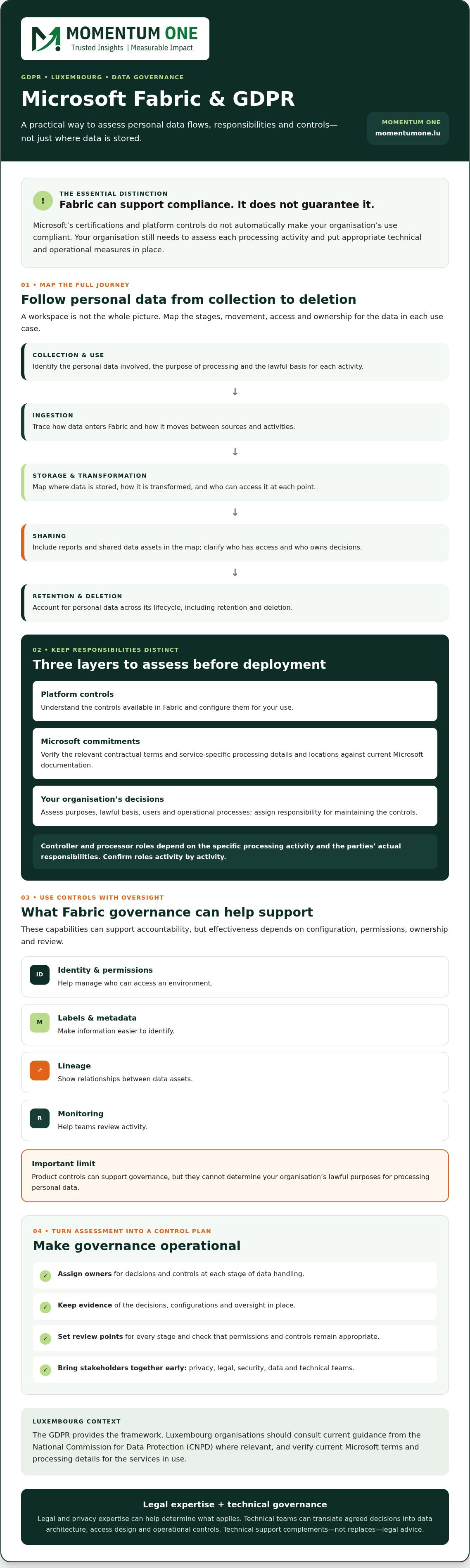
- Microsoft Fabric GDPR Luxembourg planning starts with mapping personal data across its full journey, not just checking where it is stored.
- Fabric’s governance and security controls can support accountability, but their effectiveness depends on configuration, permissions, and oversight.
- Separate Microsoft’s responsibilities from your organisation’s, and verify relevant contractual terms and service-specific processing locations before deployment.
- Build a practical control plan by assigning owners, keeping evidence, and setting review points for each stage of data handling.
- Bring privacy, security, data, and technical stakeholders together early; technical governance support can complement, but not replace, legal advice.
Can Microsoft Fabric be used in a GDPR-compliant way in Luxembourg without your organisation taking extra steps? The question behind Microsoft Fabric GDPR Luxembourg assessments isn’t just where data is stored. It’s also how service-related data is processed, who can access information, and whether controls match your actual use of the platform.
It’s reasonable to look to Microsoft’s security and compliance features for reassurance. Fabric can support important safeguards, but a provider’s certifications or platform controls don’t automatically make your organisation’s use compliant. Your team still needs to understand its responsibilities and put appropriate technical and operational measures in place.
This guide explains how to assess data location and processing, access management, and data lifecycle controls, while clarifying where Microsoft’s responsibilities end and yours begin. You’ll also find practical questions to bring to legal, privacy, security, and technical stakeholders before deployment. With a structured assessment, you can turn GDPR principles into clear decisions about configuration and governance, and identify where technical implementation support can complement your organisation’s legal expertise.
What GDPR compliance means when using Microsoft Fabric in Luxembourg
GDPR compliance depends on lawful, accountable handling of personal data across its lifecycle, from collection and use to retention and deletion. The General Data Protection Regulation (GDPR) sets the framework; Luxembourg organisations should also consult current guidance from the National Commission for Data Protection (CNPD) where relevant.
Fabric brings data and analytics activities into a unified environment. That can make it easier to work across sources, but it also means teams need to understand how personal data moves between them, who can access it, and who owns decisions at each stage. For example, a dataset used to build a report may pass through ingestion, storage, transformation, and sharing. A useful assessment maps those steps instead of treating the workspace as the whole picture.
Keep three layers distinct: the controls available in the platform, Microsoft’s contractual commitments for the services in use, and your organisation’s own decisions and processes. Verify the relevant terms and processing details against current Microsoft documentation. Technical controls can support GDPR compliance, but they are not a legal guarantee.
Does Microsoft Fabric make an organisation GDPR-compliant?
No. Fabric can provide controls that support responsible data handling, but using the platform doesn’t establish compliance by itself. Your organisation must assess the purpose and lawful basis for each processing activity, then configure the environment and operating processes to reflect those decisions. The right setup depends on the personal data involved, how it’s used, and who needs access. Avoid assuming one platform setting or general assurance covers every use case.
Who is responsible for data protection decisions?
Controller and processor roles depend on the specific processing activity and the parties’ actual responsibilities. Confirm those roles for each activity rather than assuming one label applies to every use of Fabric. Your organisation must assess its purposes, data, users, and operational processes, then establish how decisions and controls will be maintained. For broader cloud considerations, see this GDPR-compliant cloud guidance for Luxembourg.
This is a governance and technical assessment, not a substitute for advice from qualified privacy counsel. Legal and privacy expertise can help determine what applies; technical teams can translate agreed decisions into data architecture, access design, and operational controls. Momentum One’s Microsoft Fabric consulting in Luxembourg can complement that work through Fabric migration, governance, and data architecture support. For Microsoft Fabric GDPR Luxembourg planning, align those responsibilities before implementation, not after data flows are established.
How Microsoft Fabric governance supports GDPR controls, and where its limits are
Fabric governance capabilities can help make data handling more visible and controlled, but they work only when they’re configured, assigned to owners, and reviewed. Identity and permissions help manage who can access an environment; labels and metadata can make information easier to identify; lineage can show relationships between data assets; and monitoring can help teams review activity. These controls support accountability, but they don’t replace decisions about why personal data is being processed.
Product controls can support governance, but they can’t determine an organisation’s lawful purposes for processing personal data. For Microsoft Fabric GDPR Luxembourg planning, assess the control at the level where it operates, rather than treating one permission as protection across the full data estate:
- Tenant controls shape settings across the organisation’s Fabric environment.
- Workspace permissions govern access to groups of related content and data assets.
- Item permissions apply to particular assets, such as reports or models, where available.
- Data access controls need separate attention: a user’s ability to open a report doesn’t necessarily answer what underlying data they can access through other routes.
Validate how these layers interact in your tenant. Also trace governance beyond the workspace: source systems, ingested and transformed data, semantic models, reports, and exports can each create distinct access and oversight questions. Data minimisation, access restrictions, and review processes need to account for the whole path.
Which Fabric and Purview capabilities should teams assess?
Review identity and access management, auditability, metadata, sensitivity labelling, lineage, monitoring, and governance workflows against specific control objectives. For each, identify an owner and confirm what evidence the organisation can retain. Feature availability, configuration options, and licensing dependencies can change, so check current Microsoft documentation and your tenant’s settings before relying on a control. For a broader design discussion, see the Microsoft Fabric governance framework.
Why data residency is not the same as GDPR compliance
Choosing an EU data location may address an important location consideration, but it doesn’t resolve every privacy question. Check current contractual terms and service-specific processing locations for customer content and related service data. Review documentation for international transfers, support access, subprocessors, and backups, then consult Luxembourg’s data protection authority for relevant local guidance. Your legal and privacy advisers can interpret the implications for your processing activities.
If your team needs help translating agreed governance requirements into Fabric architecture and configuration, discuss your technical assessment with Momentum One as a complement to your legal and privacy expertise.
A Luxembourg-specific GDPR assessment for Microsoft Fabric data flows
Turn the governance principles into a documented technical assessment. For Microsoft Fabric GDPR Luxembourg planning, trace personal data from the original source through ingestion, OneLake storage, transformations, semantic models, reports, and exports. If upstream sources involve website analytics or visitor tracking, verifying consent at collection through tools like Conzent ensures the data pipeline begins on lawful grounds. At every step, record the purpose, access, relevant control, accountable owner, and evidence that shows how decisions are implemented.
This map supports discussions among data, security, and privacy teams. It doesn’t determine legal applicability or replace advice from qualified privacy counsel. Luxembourg’s National Commission for Data Protection (CNPD) is the national supervisory authority; check its current guidance rather than relying on assumptions. For migration planning that takes architecture into account, see the Fabric migration services guide.
What should a Fabric data-flow map include?
For each activity, record personal-data categories, source, purpose, recipients, transformations, and retention decisions. Include integrations, user access, exports, and relevant operational logs, since they may raise additional processing questions. Identify the applicable service locations and any transfer mechanisms by checking current Microsoft documentation and contractual terms. Microsoft’s Data Residency in Azure provides background on Azure residency, but verify the specific terms and processing locations for the Fabric services you use.
| Data activity | GDPR question | Fabric control | Owner | Evidence to retain |
|---|---|---|---|---|
| Source and ingestion | What data enters, from where, and for what purpose? | Review source permissions and ingestion configuration | Data owner | Data inventory and flow record |
| OneLake storage and transformation | What changes, who can access it, and how long is it retained? | Verify workspace and item permissions; document transformation and retention choices | Platform or data team | Access review and configuration records |
| Semantic models and reports | Who can view or reuse personal data? | Check model, report, and sharing permissions | Report or model owner | Permission review and approved-use record |
| Exports and integrations | Where can data go next, and who receives it? | Assess export paths and connected services | System or process owner | Recipient and transfer assessment |
Which Luxembourg and EU considerations need review?
Ask qualified privacy specialists to confirm which GDPR requirements and Luxembourg law apply to each activity. They can also assess whether processing presents elevated risks that may require further review, such as a data protection impact assessment (DPIA), and verify whether one is applicable. Record the conclusions alongside the technical map so the rationale, controls, and accountable owners remain connected.
A practical checklist for governing Microsoft Fabric personal data
Use this sequence to turn agreed privacy requirements into controls that teams can test and maintain. For Microsoft Fabric GDPR Luxembourg planning, document an owner, evidence artifact, and review cadence for each step. The cadence should reflect your organisation’s context and be agreed by the responsible teams.
What should teams verify before a Fabric workload goes live?
- Inventory the processing. Record the purpose, personal-data categories, sources, recipients, approved use cases, and accountable business owner. Keep a data-flow map or processing inventory as evidence.
- Confirm roles and decisions. Identify who owns the business purpose, privacy review, platform configuration, and day-to-day data operations. Have qualified privacy specialists assess legal questions, including whether a DPIA or transfer assessment is applicable.
- Design access and lifecycle controls. Define access groups and review workspace, item, and underlying data permissions. Document retention and deletion decisions, including how they apply to connected data flows and exports.
- Test before release. Check that permissions match approved use cases, labels and audit coverage work as intended, and data quality is acceptable. Test expected retention or deletion behaviour and retain test results, approvals, and configuration records.
- Verify the service setup. Have responsible technical and procurement teams confirm current licensing, tenant settings, Microsoft service terms, and applicable processing details. Record the documentation reviewed and any decisions that need follow-up.
Keep technical verification separate from legal approval. Configuration evidence can show how a control is set up; it doesn’t decide whether the purpose or processing is lawful.
How should compliance controls stay effective over time?
Assign named owners to review access, data flows, configuration changes, and governance exceptions. For each review, retain the date, scope, findings, decisions, and any remediation actions. Set the cadence internally, and review sooner when a material change warrants it, such as a new data source, recipient, or use of personal data.
- Document escalation paths for suspected incidents and route them to the organisation’s designated response team, whether managed internally or supported by Microsoft security specialists such as CyberOne.
- Define how data-subject requests are received, assessed, and coordinated with relevant data and system owners.
- Require review when processing purposes or approved use cases change, and update the supporting records and controls.
Make governance a repeatable cycle: document the processing, assign owners, configure and test controls, monitor changes, and review the evidence. The Fabric deployment roadmap can help connect these checks to rollout planning. To align Fabric governance and implementation planning, contact Momentum One about your technical requirements. Technical support can help operationalise controls alongside, not instead of, your organisation’s legal and privacy expertise.
Plan Microsoft Fabric GDPR governance with the right expertise
Good governance starts before implementation, when technical, security, data, and privacy stakeholders can agree how decisions will be made. For Microsoft Fabric GDPR Luxembourg planning, define who approves processing purposes, who interprets privacy requirements, who configures controls, and who maintains them. This prevents technical assumptions from being mistaken for legal decisions.
Legal interpretation and controller decisions remain with your organisation and its qualified advisers. A technical partner can help turn agreed requirements into practical architecture and operating processes, but can’t determine your lawful purposes or replace privacy counsel. Momentum One supports organisations in Luxembourg with Fabric migration, governance, data architecture, and managed services.
What can a Fabric consulting partner contribute?
A partner can review your current data architecture, integrations, access design, governance gaps, and migration dependencies. From there, technical support can translate requirements agreed with your privacy and security teams into design choices, implementation tasks, and operational handover materials. That might include documenting data flows, clarifying access ownership, or planning how governance controls fit a migration. Explore Microsoft Fabric consulting services in Luxembourg to understand how this technical work can support your wider plan.
How should an organisation start the conversation?
You don’t need every decision settled before beginning. A high-level view of your data sources, intended workloads, user groups, and existing controls gives technical and privacy stakeholders a useful starting point. Note open questions too, especially around processing locations, transfers, licensing, retention, and ownership. Those questions can then be assigned to the people best placed to resolve them.
Bring legal and privacy advisers into discussions where interpretation is needed, and involve technical owners to check what can be implemented and evidenced in Fabric. This keeps the work practical without blurring responsibilities. If you’re ready to explore how governance requirements could shape your Fabric architecture or migration, discuss your Fabric governance needs with Momentum One.
Move from GDPR questions to a governed Fabric plan
Microsoft Fabric can support stronger oversight of personal data, but compliance depends on how your organisation uses and governs the platform. The practical first step is to map data flows, assign clear owners, and check that access, retention, and monitoring controls align with approved purposes. Data location matters, too, but it’s only one part of the assessment.
For Microsoft Fabric GDPR Luxembourg planning, bring technical and privacy expertise together before deployment. Your organisation and qualified advisers remain responsible for legal interpretation and controller decisions; technical teams can translate those decisions into architecture, configuration, and review processes.
Momentum One is a certified Microsoft Solutions Partner, with relevant support in Fabric migration, governance, data architecture, and managed services. This work can complement your legal and privacy expertise by helping make agreed responsibilities operational. Discuss your Microsoft Fabric governance requirements and identify practical next steps for your environment. With clear ownership and a considered plan, your team can move forward with greater confidence.
Frequently Asked Questions
Does Microsoft Fabric make an organisation GDPR-compliant?
No. Fabric can provide controls that support responsible data handling, but using the platform doesn’t establish compliance by itself. Your organisation must assess the purpose and lawful basis for each processing activity, then configure the environment and operating processes to reflect those decisions. The right setup depends on the personal data involved, how it’s used, and who needs access. Avoid assuming one platform setting or general assurance covers every use case.
Who is responsible for data protection decisions?
Controller and processor roles depend on the specific processing activity and the parties’ actual responsibilities. Confirm those roles for each activity rather than assuming one label applies to every use of Fabric. Your organisation must assess its purposes, data, users, and operational processes, then establish how decisions and controls will be maintained. For broader cloud considerations, see this GDPR-compliant cloud guidance for Luxembourg. This is a governance and technical assessment, not a substitute for advice from qualified privacy counsel. Legal and privacy expertise can help determine what applies; technical teams can translate agreed decisions into data architecture, access design, and operational controls. Momentum One’s Microsoft Fabric consulting in Luxembourg can complement that work through Fabric migration, governance, and data architecture support. For Microsoft Fabric GDPR Luxembourg planning, align those responsibilities before implementation, not after data flows are established. Fabric governance capabilities can help make data handling more visible and controlled, but they work only when they’re configured, assigned to owners, and reviewed. Identity and permissions help manage who can access an environment; labels and metadata can make information easier to identify; lineage can show relationships between data assets; and monitoring can help teams review activity. These controls support accountability, but they don’t replace decisions about why personal data is being processed. Product controls can support governance, but they can’t determine an organisation’s lawful purposes for processing personal data. For Microsoft Fabric GDPR Luxembourg planning, assess the control at the level where it operates, rather than treating one permission as protection across the full data estate: Validate how these layers interact in your tenant. Also trace governance beyond the workspace: source systems, ingested and transformed data, semantic models, reports, and exports can each create distinct access and oversight questions. Data minimisation, access restrictions, and review processes need to account for the whole path.
Which Fabric and Purview capabilities should teams assess?
Review identity and access management, auditability, metadata, sensitivity labelling, lineage, monitoring, and governance workflows against specific control objectives. For each, identify an owner and confirm what evidence the organisation can retain. Feature availability, configuration options, and licensing dependencies can change, so check current Microsoft documentation and your tenant’s settings before relying on a control. For a broader design discussion, see the Microsoft Fabric governance framework.
What should a Fabric data-flow map include?
For each activity, record personal-data categories, source, purpose, recipients, transformations, and retention decisions. Include integrations, user access, exports, and relevant operational logs, since they may raise additional processing questions. Identify the applicable service locations and any transfer mechanisms by checking current Microsoft documentation and contractual terms. Microsoft’s Data Residency in Azure provides background on Azure residency, but verify the specific terms and processing locations for the Fabric services you use.
Which Luxembourg and EU considerations need review?
Ask qualified privacy specialists to confirm which GDPR requirements and Luxembourg law apply to each activity. They can also assess whether processing presents elevated risks that may require further review, such as a data protection impact assessment (DPIA), and verify whether one is applicable. Record the conclusions alongside the technical map so the rationale, controls, and accountable owners remain connected. Use this sequence to turn agreed privacy requirements into controls that teams can test and maintain. For Microsoft Fabric GDPR Luxembourg planning, document an owner, evidence artifact, and review cadence for each step. The cadence should reflect your organisation’s context and be agreed by the responsible teams.
What should teams verify before a Fabric workload goes live?
Keep technical verification separate from legal approval. Configuration evidence can show how a control is set up; it doesn’t decide whether the purpose or processing is lawful.
How should compliance controls stay effective over time?
Assign named owners to review access, data flows, configuration changes, and governance exceptions. For each review, retain the date, scope, findings, decisions, and any remediation actions. Set the cadence internally, and review sooner when a material change warrants it, such as a new data source, recipient, or use of personal data. Make governance a repeatable cycle: document the processing, assign owners, configure and test controls, monitor changes, and review the evidence. The Fabric deployment roadmap can help connect these checks to rollout planning. To align Fabric governance and implementation planning, contact Momentum One about your technical requirements. Technical support can help operationalise controls alongside, not instead of, your organisation’s legal and privacy expertise. Good governance starts before implementation, when technical, security, data, and privacy stakeholders can agree how decisions will be made. For Microsoft Fabric GDPR Luxembourg planning, define who approves processing purposes, who interprets privacy requirements, who configures controls, and who maintains them. This prevents technical assumptions from being mistaken for legal decisions. Legal interpretation and controller decisions remain with your organisation and its qualified advisers. A technical partner can help turn agreed requirements into practical architecture and operating processes, but can’t determine your lawful purposes or replace privacy counsel. Momentum One supports organisations in Luxembourg with Fabric migration, governance, data architecture, and managed services.
What can a Fabric consulting partner contribute?
A partner can review your current data architecture, integrations, access design, governance gaps, and migration dependencies. From there, technical support can translate requirements agreed with your privacy and security teams into design choices, implementation tasks, and operational handover materials. That might include documenting data flows, clarifying access ownership, or planning how governance controls fit a migration. Explore Microsoft Fabric consulting services in Luxembourg to understand how this technical work can support your wider plan.
How should an organisation start the conversation?
You don’t need every decision settled before beginning. A high-level view of your data sources, intended workloads, user groups, and existing controls gives technical and privacy stakeholders a useful starting point. Note open questions too, especially around processing locations, transfers, licensing, retention, and ownership. Those questions can then be assigned to the people best placed to resolve them. Bring legal and privacy advisers into discussions where interpretation is needed, and involve technical owners to check what can be implemented and evidenced in Fabric. This keeps the work practical without blurring responsibilities. If you’re ready to explore how governance requirements could shape your Fabric architecture or migration, discuss your Fabric governance needs with Momentum One. Microsoft Fabric can support stronger oversight of personal data, but compliance depends on how your organisation uses and governs the platform. The practical first step is to map data flows, assign clear owners, and check that access, retention, and monitoring controls align with approved purposes. Data location matters, too, but it’s only one part of the assessment. For Microsoft Fabric GDPR Luxembourg planning, bring technical and privacy expertise together before deployment. Your organisation and qualified advisers remain responsible for legal interpretation and controller decisions; technical teams can translate those decisions into architecture, configuration, and review processes. Momentum One is a certified Microsoft Solutions Partner, with relevant support in Fabric migration, governance, data architecture, and managed services. This work can complement your legal and privacy expertise by helping make agreed responsibilities operational. Discuss your Microsoft Fabric governance requirements and identify practical next steps for your environment. With clear ownership and a considered plan, your team can move forward with greater confidence.
Does Microsoft Fabric automatically make my organisation GDPR-compliant?
No. Fabric offers technical and governance capabilities that can support compliant data handling, but it can’t determine whether your processing has a lawful purpose or whether your organisation meets every applicable obligation. Assess the personal data, roles, configuration, contracts, and operating processes for each workload. Check current product details in Microsoft documentation, and consult qualified privacy advisers for legal decisions about your organisation’s responsibilities.
Can personal data be stored in Microsoft Fabric in Luxembourg?
It depends on the specific Fabric services, capacity, and related processing in scope. Review the applicable service terms and current Microsoft documentation rather than assuming that choosing an EU location means all data or service operations remain in one country. Assess customer content, service data, support access, backups, and transfers with your Microsoft representative and privacy specialists before deciding whether a particular setup fits your requirements.
How do I check where Microsoft Fabric data is processed?
Start with Microsoft’s applicable service terms, data protection documentation, and current information for each Fabric service your organisation uses. Record the relevant capacity and tenant configuration, then consider related processing through support, logs, backups, and integrations. Ask technical and legal owners to verify the findings together. Service details and regional availability can change, so document what you checked and revisit it when the setup changes.
Is Microsoft Fabric suitable for sensitive personal data?
Suitability depends on the data, purpose, risks, service configuration, access model, and contractual arrangements for the specific workload. Before onboarding sensitive information, assess data minimisation, permissions, monitoring, retention, and any risk review that may apply. Don’t treat a platform feature or general Microsoft assurance as a decision for your organisation. Ask privacy and security specialists to assess the actual use case and its controls.
Does data residency in the EU guarantee GDPR compliance?
No. Data location can be an important part of an assessment, but it doesn’t settle questions about purpose, data minimisation, security, accountability, individual rights, or retention. Consider transfers and access that may involve supporting services as well. Verify the actual processing arrangements for your Fabric services, then discuss their legal significance with qualified privacy advisers. An EU location alone doesn’t establish that every part of your organisation’s use complies.
What should a GDPR assessment for Microsoft Fabric include?
Map personal data from its source through ingestion, storage, transformation, reporting, and export. Record purposes, roles, access, processing locations, retention decisions, integrations, and evidence owners. Review relevant contracts and technical controls, then ask privacy specialists whether additional assessments are needed for the processing. Revisit the assessment if data sources, users, workloads, or service configurations change. This helps keep the documented view aligned with how the environment operates.
Does Microsoft Purview need an additional licence for Fabric governance?
Some Fabric governance capabilities may be available through the relevant platform experience, while others may depend on additional Microsoft Purview licensing. The answer varies by feature, tenant configuration, and current licensing terms. Check current Microsoft documentation and your organisation’s agreement before designing controls around a capability. Record which features are enabled, what requirements they support, and who is responsible for maintaining and reviewing them.