Modern governance isn't a restriction; it's the infrastructure that makes scalable self-service BI possible. In an era where security has officially surpassed efficiency as the top priority for BI users, a robust Power BI governance framework is no longer a luxury for the few. It's the essential foundation for every trusted decision your organization makes. Without it, your data ecosystem risks becoming a liability rather than a strategic asset.
You've likely felt the sting of report sprawl or the quiet anxiety that comes with duplicate sources of truth circulating in your executive meetings. It's exhausting to bridge the gap between technical administration and business value when stakeholders don't know which numbers to trust or how to stay compliant with GDPR. We're here to simplify that complexity. This guide provides a clear architecture for mastering trust and security within the evolving Microsoft Fabric ecosystem. You'll discover a practical roadmap to implement governance that protects your data, ensures regulatory compliance, and empowers your teams to use reports with total confidence. We'll preview how to transition from legacy setups to a modern, governed environment that scales alongside your enterprise goals.
What is a Power BI Governance Framework in 2026?
A modern Power BI governance framework is far more than a technical checklist or a set of security settings. It's the strategic intersection where people, processes, and technology meet to transform raw data into a reliable corporate asset. In 2026, the definition has expanded. It now encompasses the entire lifecycle of an insight, ensuring every report produced is accurate, compliant, and accessible to the right people at the right time. This isn't just about managing software; it's about managing trust.
At its core, this framework builds the foundation for a 'Single Source of Truth'. By establishing clear rules for data ingestion and report distribution, organizations can eliminate the 'data silos' that often lead to conflicting numbers in board meetings. This structured approach is rooted in the broader principles of data governance, which focuses on the availability, usability, and integrity of data across the enterprise. When you have a clear rulebook, you move from reactive troubleshooting to proactive strategy.
The Shift from Restriction to Enablement
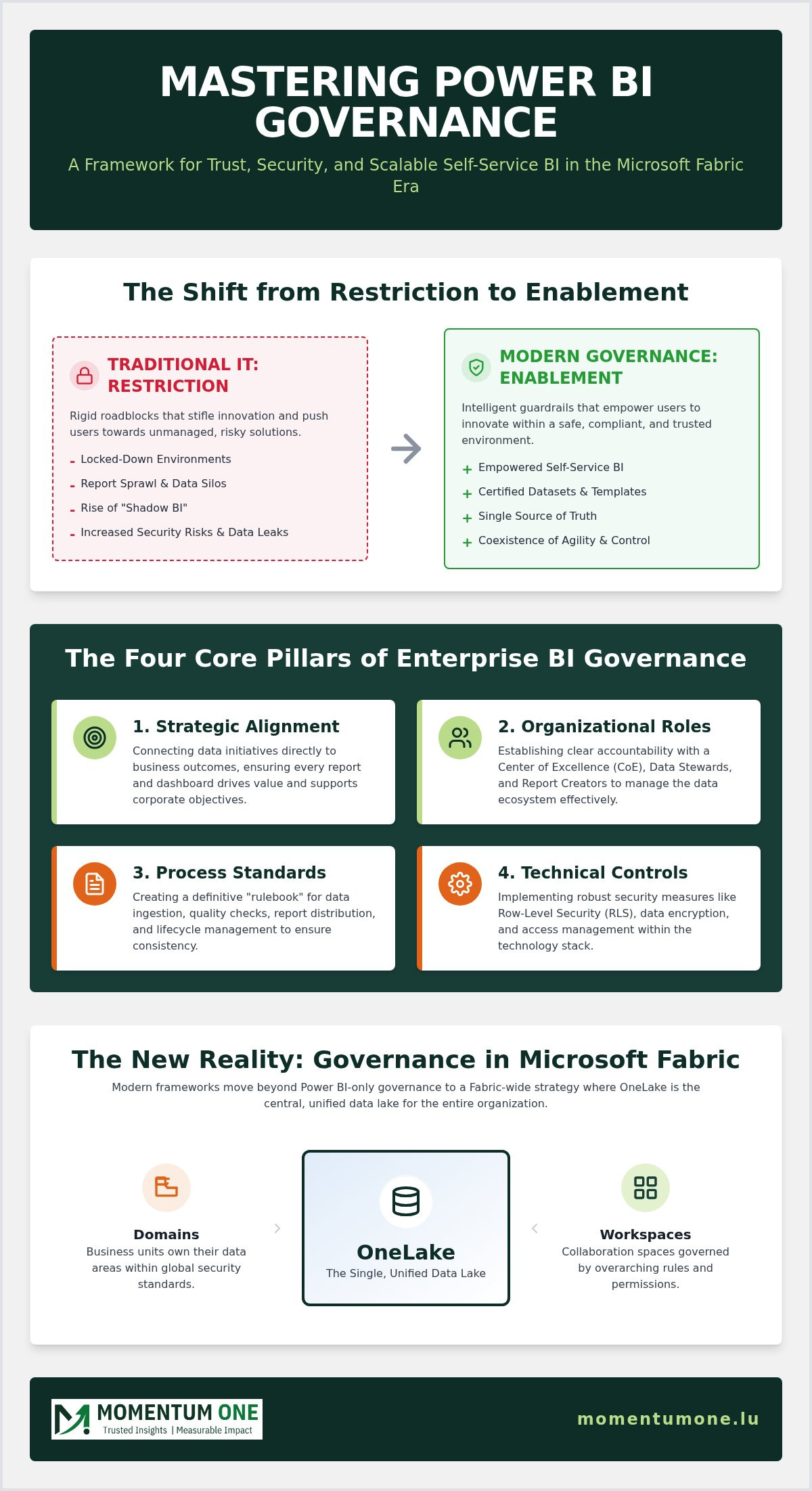
Traditional IT strategies often focused on 'locking down' the environment to prevent errors. These rigid roadblocks usually backfire in a modern business environment. When users find the official tools too restrictive, they turn to 'shadow BI', creating unmanaged spreadsheets that pose even greater security risks. It's a cycle that breeds confusion and data leaks.
A successful Power BI governance framework replaces these roadblocks with guardrails. Instead of saying 'no', the framework defines 'how'. This approach empowers users to explore data and build reports within a safe, pre-approved environment. By providing clear templates and certified datasets, you significantly reduce the cost of data errors and the time wasted on rework. It's about finding that optimal balance where agility and control coexist to drive growth.
Governance in the Era of Microsoft Fabric
The landscape changed significantly with the full integration of Microsoft Fabric. We've moved beyond 'Power BI-only' governance into a 'Fabric-wide' reality. In this new architecture, OneLake serves as the central point of governance. It acts as a single, unified data lake for the entire organization, simplifying how we track and secure information at the source.
Legacy frameworks must be modernized to account for new structures like 'Domains' and 'Workspaces'. Domains allow business units to take ownership of their specific data areas while staying within the global tenant's security standards. This decentralized management model ensures that governance stays relevant to local business needs without sacrificing enterprise-level compliance. Modernizing your framework for the Fabric ecosystem is no longer optional. It's a prerequisite for anyone looking to scale their data operations in 2026.
The Four Core Pillars of Enterprise BI Governance
Building a scalable data ecosystem requires more than just high-quality dashboards. It demands a structural foundation that ensures every byte of data serves a specific business purpose. A successful Power BI governance framework rests on four distinct but interconnected pillars: Strategic Alignment, Organizational Roles, Process Standards, and Technical Controls. When these pillars are in place, your data moves from being a chaotic resource to a precision tool for growth.
Strategic alignment is the first step. It involves mapping your data goals directly to business KPIs. If your reports don't help leaders make faster, better decisions, they are simply noise. By prioritizing data projects that move the needle on corporate objectives, often with the strategic guidance of michelboutinstudio, you ensure that governance isn't seen as a hurdle but as an accelerator for value. This alignment creates a culture where data is respected and utilized at every level of the organization.
People and Roles: Establishing Accountability
Governance isn't a part-time job or a side project for the IT department. It requires a dedicated Center of Excellence (CoE) to act as the bridge between technical architecture and business needs. In Luxembourgish firms, where regulatory compliance is often complex, a CoE provides the necessary oversight to maintain standards across different departments.
Clear roles are essential for accountability. Data Stewards oversee data quality and definitions, ensuring the "source of truth" remains untainted. Report Creators focus on building impactful visualizations within the established guardrails, while Consumers are trained to interpret and act on the insights provided. If you're struggling to define these roles within your current team, our Power BI consulting and governance experts can help you design a structure that fits your unique operational needs.
Process and Standards: Creating the Playbook
A comprehensive Power BI Governance Framework must include a clear playbook for every stage of the data lifecycle. This includes a report certification process that identifies "Gold" standard reports. When a user sees a certified badge, they know the data has been vetted for accuracy and follows corporate branding guidelines. This builds the trust necessary for widespread adoption.
Standardization extends to the technical organization of your tenant. Implementing consistent workspace naming conventions and sensitivity labels makes it easier to manage security and discoverability. Furthermore, rigorous guidelines for workspace and capacity management prevent resource bloat and ensure that your most critical reports always have the performance they need. These standards reduce the time wasted on rework and troubleshooting, allowing your team to focus on innovation instead of maintenance.
Technical controls serve as the final layer of protection. These include security settings like Row-Level Security (RLS), capacity audits, and automated monitoring. By automating these checks, you can maintain a high level of security without slowing down the pace of self-service BI. It's about creating a system that is secure by design, allowing your users to explore data with confidence.
Balancing User Empowerment with Security and Compliance
The most common objection we hear from business leaders is that a Power BI governance framework will kill innovation and slow down their teams. It's a valid concern. If the rules are too rigid, users will inevitably bypass official channels to create "shadow BI" solutions in unmanaged spreadsheets. However, the opposite is actually true. Without clear guardrails, your team spends more time arguing over which report is correct than they do making decisions. Governance doesn't exist to stop people; it exists to give them a safe space to move faster.
For specific departments like finance or HR, adopting a Lightweight Power BI Governance approach allows for rapid iteration within a protected environment. This balance is maintained through Row-Level Security (RLS), which ensures that users only see the data relevant to their role. In the context of Luxembourgish and European firms, this level of control is essential for GDPR compliance and meeting strict data residency requirements. When you secure data at the source, you create a foundation of trust that allows for true self-service at scale.
Tiered Workspace Strategy
To manage the "Wild West" of personal workspaces, we recommend a three-tiered strategy that categorizes content based on its reach and risk. A Personal Sandbox offers users high freedom with zero corporate visibility, perfect for testing new ideas. Team or Project Spaces serve as collaborative zones where internal peer reviews happen before any data is shared further. Finally, Enterprise Certified workspaces are reserved for executive-level reporting. These follow the strictest governance rules, ensuring that the most critical numbers in the company are always vetted and accurate.
Security Best Practices Audit
Regular audits are the only way to ensure your security settings haven't drifted over time. It's easy for content to become over-shared as teams grow and roles change. We encourage the use of sensitivity labels to automatically classify and protect intellectual property as it moves through the Microsoft Fabric ecosystem. These labels stay with the data even if it's exported to Excel or PowerPoint, providing a continuous layer of defense. For a technical deep-dive into these configurations, refer to our Power BI data security guide, which explores enterprise protection strategies for 2026.
By shifting the focus from restriction to enablement, you transform governance from a "policing" function into a business partner. You'll find that when users feel safe and supported by the technology, their adoption rates climb and the quality of their insights improves. It's about building a culture where security is seen as a shared responsibility rather than an IT-imposed burden.
A Phased Roadmap for Governance Implementation
Implementing a Power BI governance framework isn't a "one and done" project. It's a strategic evolution that requires a methodical approach to ensure long-term adoption. Moving too fast can alienate users, while moving too slowly allows data silos to harden. We recommend a phased roadmap that transitions your organization from reactive troubleshooting to proactive data excellence. This journey starts with understanding your current landscape and ends with a self-sustaining culture of trust.
Discovery: Uncovering the 'As-Is' State
You can't govern what you can't see. The first step is a deep dive into your existing tenant to identify report sprawl and potential security risks. We use the Power BI Activity Log to pinpoint which reports are actually being used and which have been abandoned. This telemetry reveals the "Shadow BI" experts within your departments. These are the individuals who have already built workarounds to solve their data needs. Instead of penalizing them, we identify them as your first potential Data Stewards. Their insights into departmental pain points are invaluable for building a rulebook that people will actually follow.
Our implementation roadmap follows five critical stages:
- Step 1: Discovery and Assessment. Audit your current tenant to find high-risk reports and duplicate sources of truth.
- Step 2: Define Policies and the CoE. Establish your Center of Excellence and document the "rules of the road" for data access and sharing.
- Step 3: Technical Configuration. Apply tenant-level settings and Fabric guardrails to enforce your new policies automatically.
- Step 4: Training and Launch. Roll out the framework to your users with clear documentation and support channels.
- Step 5: Monitor and Iterate. Use continuous telemetry to refine your framework as your business needs change.
Scaling Through Literacy and Training
Technical settings alone cannot stop bad data practices. Even the most secure environment can be undermined by a user who doesn't understand data sensitivity or how to interpret a complex DAX measure. This is why literacy is a core component of any scalable framework. You must empower your team to operate within the guardrails you've built. Without the right knowledge, users will revert to old habits, and your governance efforts will stall.
We believe in designing corporate Power BI training that goes beyond button-clicking. Effective sessions must include specific governance modules that explain the "why" behind the rules. By building a community of practice, you encourage users to share internal best practices and support one another. This peer-to-peer learning is often more effective than top-down mandates. If you're ready to move beyond the planning phase and start building, our team can guide you through every step of Power BI consulting and governance to ensure your framework is built for the realities of 2026.
Once the initial launch is complete, the focus shifts to sustainability. By monitoring usage patterns and performance metrics, you can identify where the framework is working and where it needs adjustment. This iterative process ensures that your governance remains an enabler for growth rather than a bottleneck for innovation.
Sustaining Success: Managed Governance and Support
Establishing a Power BI governance framework is a significant milestone, but the real work begins with its maintenance. Governance is a journey, not a destination. As your business grows and the Microsoft data ecosystem evolves, your framework must adapt to stay relevant. Many organizations find that maintaining this level of oversight with internal-only resources is a massive challenge. IT teams are often stretched thin, and without dedicated focus, the guardrails you've built can quickly turn back into roadblocks or, worse, be ignored entirely as users revert to old habits.
Objective oversight is critical for the long-term health of your tenant. A Microsoft Solutions Partner brings a fresh perspective and cross-industry experience that internal teams might lack. By integrating governance into your broader Power BI consulting and strategy, you ensure that technical updates never happen in a vacuum. Every configuration change is vetted against your strategic goals and compliance requirements. This partnership transforms governance from a burdensome task into a streamlined, automated part of your operations that actually supports growth.
The Role of Managed Services
Managed services provide the continuous monitoring necessary to prevent report sprawl and security drift. Instead of reacting to issues after they occur, you benefit from proactive tenant health checks and security compliance audits. This includes the technical heavy lifting of capacity optimization, ensuring that your Fabric F-SKUs or Power BI capacities are utilized efficiently without wasting budget. Exploring the benefits of managed Power BI services allows your internal data experts to focus on generating insights while we handle the technical rigour of the environment.
A managed approach also covers:
- Continuous auditing of over-shared content and guest user access.
- Regular updates to sensitivity labels as data regulations change.
- Performance tuning for datasets and DAX measures to keep reports fast.
- Dedicated support for your Center of Excellence to handle complex architectural questions.
Next Steps for Your Organization
Ready to secure your data future? The first step is often an initial architectural review of your Power BI environment. This assessment identifies immediate risks and provides a baseline for your roadmap. Following this, we recommend setting a date for your first Governance Workshop with key business and technical leaders. This session aligns stakeholders on the vision for data excellence and defines the specific pillars your organization needs most to thrive. Momentum One is the partner to bridge the gap between technical Fabric migration and strategic governance.
Build Your Foundation for Trusted Growth
Success in the 2026 data landscape requires a shift from rigid control to strategic enablement. We've seen how a modern Power BI governance framework provides the necessary guardrails to eliminate report sprawl and ensure compliance without stifling innovation. By focusing on the intersection of people, processes, and the new Microsoft Fabric architecture, you create an environment where stakeholders can trust the numbers they see every day. This transformation turns your data ecosystem into a precision tool for scalable excellence.
Momentum One is here to support your journey. As a certified Microsoft Solutions Partner with deep expertise in Microsoft Fabric migrations, we provide the objective oversight and technical training needed to bridge the gap between complex architecture and business value. We're specialists in tailored training for corporate data literacy to ensure your team is equipped for the road ahead. Our methodical approach ensures that your governance remains an enabler for growth rather than a bottleneck for your staff.
Secure your data and empower your team with a custom Power BI Governance Framework from Momentum One. We look forward to helping you master the architecture of trust and security with a solution built for your unique needs.


 Microsoft Power BI
 27.07.2026