By 2026, a poorly structured data model isn't just a technical inconvenience; it's a direct bottleneck to every AI and real-time analytics initiative in your enterprise. You've likely felt the frustration of a Power BI report that takes ages to load or the headache of reconciling conflicting numbers across different business units. Implementing advanced data modeling techniques is no longer optional if you want to maintain a competitive edge. It's the essential foundation that ensures your data remains accurate, accessible, and ready for the next generation of high-performance business intelligence.
We understand that migrating legacy models to Microsoft Fabric or managing complex multi-fact table relationships can feel like a daunting task. This article provides a clear roadmap to help you build a scalable single source of truth while significantly reducing technical debt. You'll learn how to master the architectural strategies required for future-proof environments and optimize DAX performance for sub-second results. We'll walk through the specific modeling patterns needed to ensure your data environment integrates seamlessly with OneLake and thrives in a modern lakehouse ecosystem.
Strategic Asset
Strategic decision-making in a modern enterprise relies on more than just raw information; it requires a structured blueprint that translates complex data into actionable insights. By mastering advanced data modeling techniques, organizations move beyond the limitations of flat tables and siloed spreadsheets. This evolution is essential for transitioning from self-service "quick" models, which often lack consistency, toward a governed enterprise architecture that scales with the business. When data is modeled correctly, it fosters higher data literacy across departments because users finally trust the numbers they see. It's not just about organization; it's about performance. A well-constructed model directly influences cloud consumption costs by reducing the compute power needed for complex query processing in environments like Microsoft Fabric.
The process of data modeling serves as the bridge between technical storage and business utility. It ensures that the logic used to calculate a "profit margin" in the finance department matches the logic used by sales. Without this alignment, adoption stalls, and the investment in expensive data platforms fails to deliver expected returns. We see modeling as the steady hand that guides a company through the noise of big data toward clarity and growth.
The High Cost of Poor Data Architecture
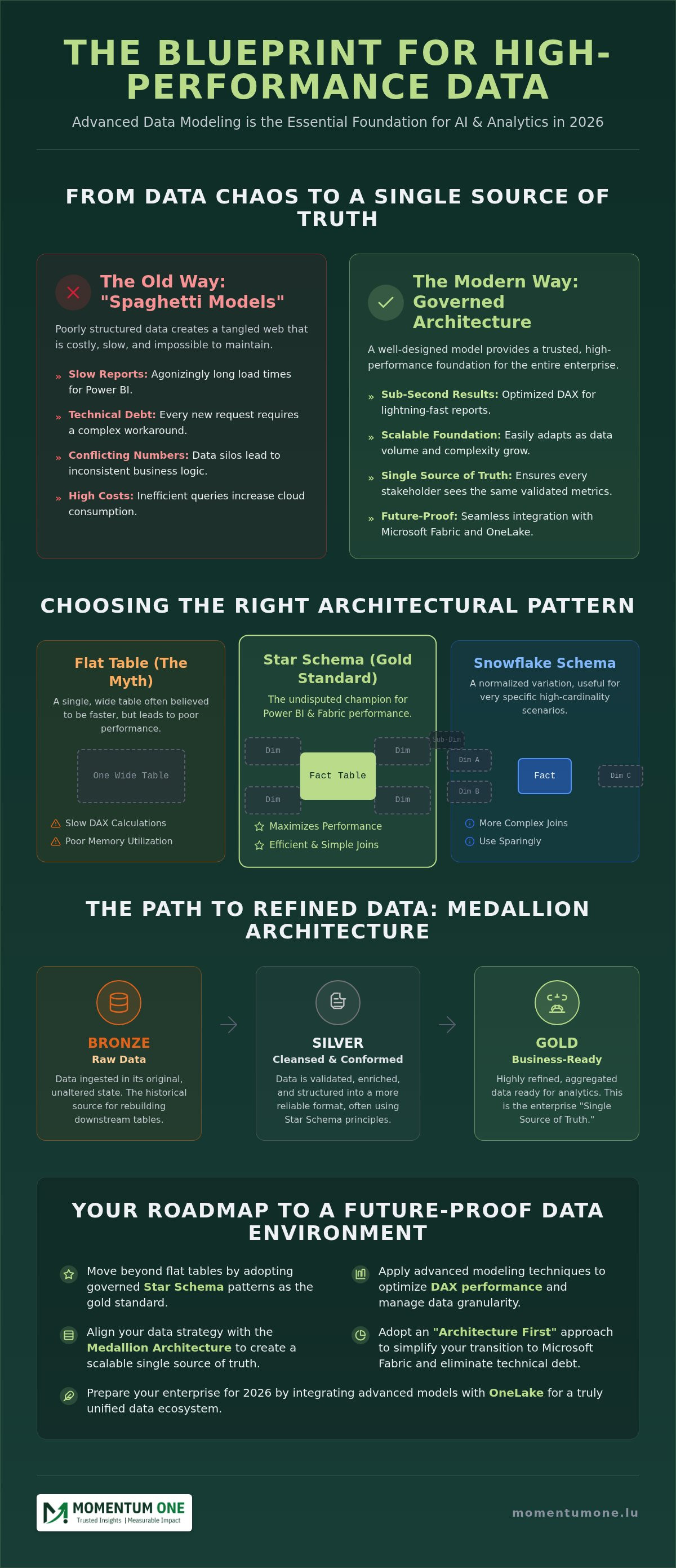
Poorly planned "spaghetti models" create a web of interconnected dependencies that are nearly impossible to maintain. These inefficient structures lead to significant technical debt, where every new report requires a workaround rather than a standard procedure. This complexity causes noticeable report latency, frustrating end-users and driving them back to manual Excel exports. These data silos prevent a holistic view of the company and lead to inconsistent business logic. In 2026, a Single Source of Truth is a unified, governed semantic layer that ensures every stakeholder sees the same validated metrics regardless of their entry point.
Data Modeling vs. Data Engineering: Defining the Boundary
It's vital to understand where data engineering ends and semantic modeling begins. Data engineering focuses on the "plumbing"—the ETL and ELT processes that move and transform data into a usable state. Semantic modeling is where that data receives its business meaning. This is the domain of the Analytics Engineer, a role that bridges the gap between raw data pipelines and the final report. This professional ensures that advanced data modeling techniques are applied to create a performant layer for end-users. For organizations looking to align their technical execution with long-term business goals, our Power BI Consulting & Governance services provide the strategic framework needed to manage this boundary effectively. We help you define clear roles and standards that prevent architectural drift and ensure your data stack remains lean and responsive.
Architectural Patterns: Star Schema, Snowflake, and Multi-Fact Environments
The Star Schema remains the undisputed gold standard for Power BI and Microsoft Fabric performance. While some argue that modern compute power makes schema design irrelevant, the reality is that the VertiPaq engine and Direct Lake mode thrive on clear, dimensional structures. A Star Schema minimizes the complexity of joins and maximizes the efficiency of columnar compression. We often encounter the "Flat Table" myth; the idea that putting everything into one wide table is faster because it avoids joins. In reality, wide tables often lead to poor memory utilization and slower DAX calculations because they force the engine to scan more data than necessary. By utilizing advanced data modeling techniques, you can ensure your architecture remains lean and responsive even as your data volume grows into the petabyte range.
There are instances where a Snowflake schema, which normalizes dimension tables, is acceptable or even necessary. This usually happens when dealing with very high cardinality dimensions or specific legacy requirements that demand strict normalization. However, for most enterprise scenarios, we aim for the simplicity of the Star. When your business logic spans multiple processes, such as sales, inventory, and shipping, you'll likely implement a "Galaxy Schema." This pattern connects multiple fact tables through shared, or conformed, dimensions. Understanding these modern data modeling approaches allows you to build a cohesive environment where different business units can report from a unified framework without creating redundant data silos.
Dimensional Modeling Mastery
Mastering the roles of Fact and Dimension tables is critical for high-scale environments. Fact tables capture quantitative metrics, while Dimensions provide the context. Managing how these change over time is equally vital. We use Slowly Changing Dimensions (SCD) to track history; Type 1 simply overwrites data, while Type 2 maintains a full history of changes. In cloud-native models, we strongly recommend using surrogate keys rather than natural keys. This decouples your analytical model from the volatility of source systems, providing a stable foundation for your data warehouse and lakehouse design.
Solving Complex Relationships
Handling many-to-many relationships requires a careful touch to avoid performance bottlenecks. While Power BI supports these relationships natively, they can lead to ambiguity if not managed correctly. We generally advise against bi-directional filtering because it can cause unexpected results and circular dependencies. Instead, use role-playing dimensions to handle multiple relationships between the same tables, such as "Order Date" and "Ship Date" in a single sales fact table. If you find your current architecture is becoming difficult to manage, our team can help you apply advanced data modeling techniques to simplify your relationships and restore sub-second report performance.
Modeling for the Modern Lakehouse: Microsoft Fabric and OneLake
The transition from traditional SQL Data Warehouses to Microsoft Fabric Lakehouses represents a fundamental shift in how we store and consume enterprise information. While the core principles of dimensional modeling still apply, the physical implementation has evolved to prioritize flexibility and speed. In this new environment, advanced data modeling techniques focus on optimizing the flow of data through the Medallion Architecture. This framework organizes data into three distinct layers: Bronze, Silver, and Gold. Bronze acts as the landing zone for raw data in its original format. Silver is where we apply cleaning and initial modeling, and Gold serves as the refined, business-ready layer where Star Schemas are fully realized for end-user consumption.
At the heart of this modernization is the use of Delta Parquet files as the universal storage foundation. This open-source format allows different compute engines to access the same data without proprietary locks. By standardizing on Delta Parquet within OneLake, you eliminate the need for redundant data copies and simplify your overall architecture. For organizations looking to navigate this transition, our Fabric Migration & Modernization services provide the technical roadmap needed to move legacy systems into this high-performance ecosystem without disrupting business operations.
Direct Lake Mode: The 2026 Modeling Paradigm Shift
Direct Lake mode is the breakthrough that defines the 2026 analytics landscape. It allows Power BI to read Delta Parquet files directly from OneLake, bypassing the traditional need for data refreshes or the performance lag of DirectQuery. To stay in Direct Lake mode, you must adhere to specific modeling constraints, such as ensuring your data types are compatible and your relationships are cleanly defined. Unlike Import mode, which requires memory-heavy refreshes, or DirectQuery, which often suffers from slow query response times, Direct Lake offers the performance of an in-memory model with the real-time nature of a live connection. It's the ideal choice for massive enterprise datasets where sub-second performance is a non-negotiable requirement.
The Gold Layer: Designing the Semantic Layer
Designing the Gold layer is about creating a seamless experience for self-service users. This layer should be the definitive source for all business metrics, structured to support intuitive exploration. We leverage OneLake shortcuts to link data from various sources without moving it, which significantly reduces data duplication and storage costs. This approach ensures that your semantic layer remains lean while providing a comprehensive view of the organization. If you're still deciding between different architectural paths, our guide on Data Lakehouse vs Warehouse Design offers deeper insights into choosing the right structure for your specific needs. By applying advanced data modeling techniques at this final stage, you transform raw data into a strategic asset that empowers every department to make faster, more accurate decisions.
Performance tuning is where a theoretical model meets the reality of enterprise scale. In a high-volume environment, advanced data modeling techniques must prioritize the efficiency of the VertiPaq engine. One of the most effective strategies is moving business logic as far upstream as possible. While DAX is powerful, performing complex transformations during the data load phase—either in SQL or via Fabric pipelines—is significantly more efficient than using calculated columns. This approach reduces the processing burden on the model at query time and ensures your environment remains snappy for end-users.
The secret to a lean model lies in managing column cardinality. High cardinality, or the number of unique values in a column, is the primary enemy of data compression. By removing unnecessary high-granularity columns like timestamps or unique IDs that aren't used in relationships, you can drastically reduce your model's memory footprint. Managing these technical details is essential for maintaining a healthy ecosystem. For organizations needing help with infrastructure tuning, our services in Workspace & Capacity Management ensure your underlying resources are perfectly aligned with your model's demands.
DAX Optimization for Large Datasets
Writing efficient DAX is critical when tables grow into the millions or billions of rows. You should avoid expensive iterators like SUMX or FILTER on large tables whenever a simpler aggregator will suffice. We also utilize Calculation Groups to simplify complex models. This technique allows you to apply the same logic, such as Year-over-Year growth, across multiple measures without creating "measure bloat." Understanding the core mechanics is vital: row context iterates through a table row by row, while filter context defines the specific set of data the calculation sees based on report slicers and filters. If your reports are lagging, our experts provide specialized Data Modeling & DAX Optimization to restore peak performance.
Granularity and Aggregation Strategies
Balancing the need for granular detail with the requirement for speed is a constant challenge. We implement User-Defined Aggregations (UDA) to solve this. This allows Power BI to query a small, pre-aggregated table for high-level visuals while seamlessly "drilling through" to the detailed data only when necessary. This structural approach keeps your reports fast without sacrificing the depth of analysis. For a deeper look at maintaining data quality throughout this process, refer to our guide on Improving Report Accuracy. By applying these advanced data modeling techniques, you create a system that is both comprehensive and incredibly fast.
Implementing a Scalable Framework with Momentum One
Building a data environment that scales requires more than just technical knowledge; it demands a strategic partner who understands the long-term implications of every architectural choice. We position ourselves as that steady hand, guiding enterprises through complex migrations with a focus on stability and performance. Our "Architecture First" approach ensures that advanced data modeling techniques aren't just applied as a patch, but are woven into the very fabric of your implementation. This method prevents the accumulation of technical debt and creates a resilient foundation that supports growth well into the future. We believe that a model is only as good as the strategy behind it, which is why we prioritize structural integrity from day one.
Managed services play a vital role in this journey. It's not enough to build a high-performance model; you must maintain its integrity as business requirements and data volumes evolve. We provide the ongoing oversight needed to ensure your semantic layer remains the single source of truth for your entire organization. By combining this managed support with specialized training, we help you build internal modeling excellence. This dual approach empowers your team to handle daily insights while ensuring the underlying architecture remains optimized for the latest Microsoft Fabric capabilities and Direct Lake requirements.
From Legacy Silos to Modern Fabric Architecture
Modernizing legacy Power BI or SQL environments often feels like untangling a web of outdated logic and slow-performing silos. We provide a clear roadmap for this transition, identifying and eliminating technical debt before it becomes a bottleneck in your new environment. Our team focuses on transforming these fragmented systems into a unified, governed architecture. For teams looking to master these shifts internally, our Corporate Data Fabric Training offers the hands-on expertise needed to upskill quickly. We don't just migrate your data; we modernize your entire approach to analytics using advanced data modeling techniques that are proven to work at scale.
Choosing a certified Microsoft Solutions Partner is critical for success in the 2026 landscape. With over 8 years of experience in complex data environments, we bring a level of precision and reliability that generic providers can't match. We're ready to help you conduct a comprehensive architectural review to identify performance gaps and scalability opportunities. Your next step is to move from reactive troubleshooting to a proactive data strategy. Let's work together to build a high-performance data environment that delivers the reliability and clarity your enterprise deserves.
Future-Proof Your Data Strategy for 2026 and Beyond
Mastering advanced data modeling techniques isn't just about technical tidiness; it's about building a reliable engine for enterprise growth. By transitioning to a governed Star Schema and embracing the Medallion Architecture in Microsoft Fabric, you create a scalable single source of truth. These structural choices, combined with precise DAX optimization, ensure your analytics environment remains fast and responsive even as your data volumes expand. You don't have to settle for slow reports or inconsistent logic when a better architecture is within reach.
As a Certified Microsoft Solutions Partner specializing in Fabric migration and performance tuning, Momentum One is dedicated to your success. We offer expert-led training and high-end consulting to help your team eliminate technical debt and adopt modern architectural standards. Let's work together to build an environment that delivers clarity and reliability for every business unit. Book an Architectural Review with Momentum One to start your transformation. Your journey toward a high-performance data environment is well within reach, and we're here to guide you every step of the way.


 Microsoft Power BI
 27.07.2026