In 2026, waiting for a batch process to finish isn't just a technical delay; it's a competitive failure. We've all felt the frustration of high latency and the exhaustion of managing a fragmented stack of Kafka, Spark, and disparate streaming tools. You shouldn't have to wait for yesterday's data to tell you how to run your business today. Mastering real-time analytics with Fabric is no longer a luxury for the tech elite; it's the central nervous system of the modern, AI-driven enterprise.
You're likely looking for a way to simplify your data landscape without sacrificing speed or accuracy. This article explores how Microsoft Fabric’s Real-Time Intelligence is fundamentally shifting the paradigm from reactive monitoring to proactive, instant action. You'll discover how a unified platform for all data in motion reduces your time-to-insight and automates reactions to critical business events. We'll examine the latest strategic trends, including the rise of Agentic AI and the new row-to-action patterns that turn live database feeds into immediate, automated results.
The Evolution of Real-Time Analytics with Microsoft Fabric in 2026
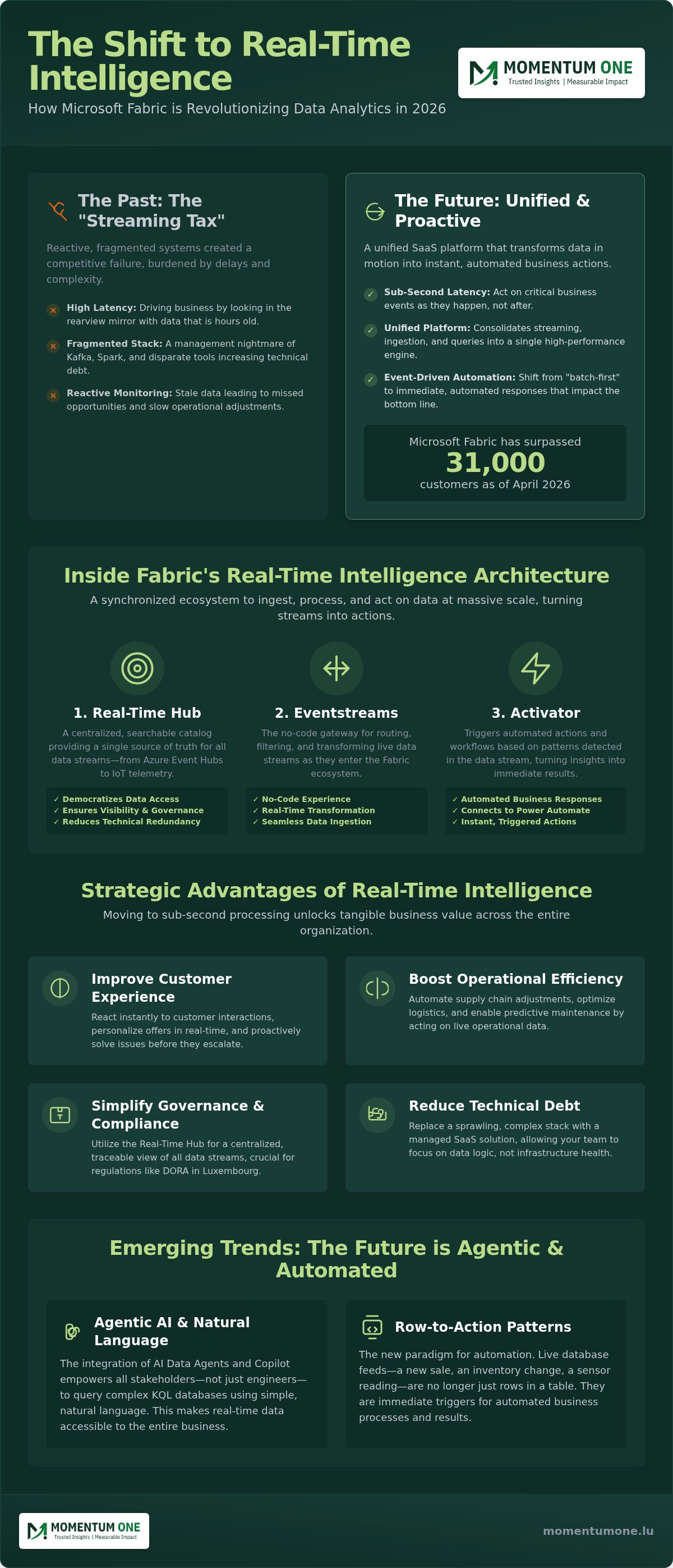
The year 2026 marks a definitive end to the era where "real-time" was a niche technical requirement. It's now the standard. Organizations have moved past the legacy constraints of Synapse Real-Time Analytics into a more cohesive ecosystem. Microsoft has rebranded and rebuilt this capability as Real-Time Intelligence (RTI). This isn't just a name change. It's a fundamental shift that consolidates streaming, ingestion, and query capabilities into a single, high-performance engine. As of April 2026, Microsoft Fabric has surpassed 31,000 customers, signaling a massive shift in how industries value integrated data platforms. We've reached the tipping point where sub-second latency is expected, not just requested.
Implementing real-time analytics with Fabric eliminates what many architects called the "streaming tax." In the past, achieving low latency required managing a sprawling mess of Kafka clusters, Spark jobs, and specialized databases. It was a management nightmare that drained resources and increased technical debt. Fabric changes this by offering a SaaS-based approach that handles the heavy lifting of infrastructure. This allows your team to focus on the logic of the data rather than the health of the servers. It's a more sustainable way to scale, ensuring that real-time analytics with Fabric remains accessible to businesses of all sizes.
Beyond Batch: Why Real-Time Intelligence Matters
Stale data is a liability in volatile markets. If your dashboard updates every six hours, you're essentially driving a car by looking in the rearview mirror. Traditional ETL processes introduce a gap between an event occurring and a decision being made. Real-time business intelligence bridges this gap, allowing companies to react to market shifts as they happen. Real-Time Intelligence is a unified SaaS experience for data in motion that empowers businesses to act on live signals without the traditional friction of batch processing. This shift from "batch-first" to "event-driven" allows for immediate operational adjustments that directly impact the bottom line.
The 2026 Data Landscape in Luxembourg
In Luxembourg, the trend toward unified data fabrics has accelerated. This is driven by a need to reduce technical debt and meet stringent regulatory requirements like DORA. Financial institutions and logistics hubs are leading the charge. They use the Real-Time Hub as a centralized catalog to discover and manage data streams across the enterprise. This visibility is crucial for compliance. It ensures that every stream is governed and every action is traceable. For many local firms, a structured Fabric migration and modernization plan is the first step toward this event-driven future. It's about building a foundation that supports both current regulations and future innovation.
Inside the Real-Time Intelligence Architecture: Hub, Streams, and Storage
Understanding the internal mechanics of Microsoft Fabric is essential for moving from theory to execution. The architecture isn't just a collection of tools; it's a synchronized ecosystem designed to ingest, process, and store data at massive scales. At the heart of this system is the Real-Time Hub, which acts as the primary discovery point for every stream entering your organization. By centralizing these assets, real-time analytics with Fabric isn't siloed within specific departments but accessible across the entire enterprise.
The Real-Time Hub: A Single Source of Truth
The Real-Time Hub democratizes access to live data by providing a searchable catalog of all available streams. It's where visibility meets governance. Whether you're pulling from Azure Event Hubs or managing complex IoT Hub telemetry, the Hub provides a clear view of your data's origin and status. We've found that successful data architecture modernization starts with this level of visibility. It allows your teams to discover existing data assets without reinventing the wheel, significantly reducing technical redundancy and speeding up the development of new analytical solutions.
Processing and Acting: Eventstreams and Activator
Once data is visible in the Hub, the next challenge is processing it without drowning in code. Fabric Eventstreams serves as the no-code gateway for this task. It allows you to transform data in flight, filtering out noise and enriching signals before they reach their destination. You don't need to write complex Scala or Python to handle data from logs or Change Data Capture (CDC) feeds. This simplicity extends to Fabric Activator, which functions as the digital nervous system of the platform. Activator monitors patterns and triggers immediate business workflows when specific thresholds are met. It's the difference between seeing a problem on a dashboard and having the system automatically notify the right team to fix it.
Storage is equally critical for performance. Eventhouse and its underlying KQL databases are optimized for high-speed telemetry and time-series data. This storage engine allows for sub-second queries even on massive datasets, ensuring that your real-time dashboards remain truly live. As detailed in the official Microsoft Fabric documentation, this architecture is built for scalability and ease of use. If you're ready to see how these components can work for your specific use case, our team can help you design a modernized data warehouse and lakehouse that supports live streaming at scale.
Strategic Advantages: Why Your Business Needs Real-Time Intelligence Now
Adopting real-time analytics with Fabric isn't just about keeping pace with technology; it's about fundamentally changing how your business creates value. For years, organizations have been trapped in a cycle of reactive decision-making, looking at reports that describe the world as it was 24 hours ago. In the fast-moving markets of 2026, that delay is a cost you can no longer afford. Moving to Real-Time Intelligence allows you to shift from passive observation to active, automated responses that drive operational efficiency and customer satisfaction.
Operational efficiency improves dramatically when you replace manual monitoring with automated event triggers. Instead of a team member constantly checking a dashboard for supply chain disruptions or system failures, Fabric Activator handles the oversight. It identifies patterns and initiates workflows in milliseconds. This proactive approach extends to risk mitigation, where real-time fraud detection can stop suspicious transactions before they're finalized. By the time a traditional batch report would have flagged a problem, a real-time system has already solved it.
Breaking the "Complexity Barrier"
Many leaders hesitate to adopt streaming data because they assume it requires a massive DevOps team and a bottomless budget. Fabric's SaaS model effectively shatters this complexity barrier. By providing a unified capacity, Microsoft simplifies the cost structure of high-performance analytics. For example, organizations can start with an F2 capacity for approximately $260 to $310 per month and scale up as their needs grow. Choosing a one-year reservation can even lead to savings of around 41% compared to pay-as-you-go rates. This predictable pricing model is a key component of Power BI cost optimization within the broader Fabric ecosystem, ensuring you don't pay a premium for agility.
Data-Driven Culture and Literacy
The true power of real-time analytics with Fabric is realized when it moves out of the IT department and into the hands of business users. Fabric empowers non-technical staff to build their own real-time alerts using natural language and no-code interfaces. This democratization changes the internal conversation from "What happened last week?" to "What is happening right now?" However, technology alone isn't enough. Investing in corporate data literacy is essential to ensure your team knows how to interpret live signals and act on them effectively. When your staff understands the "why" behind the data, they become proactive problem solvers rather than reactive observers.
Customer experience also sees a significant boost. In a world where users expect instant gratification, responding to behavior in milliseconds rather than hours can be the deciding factor in brand loyalty. Whether it's a personalized offer triggered by a mobile app interaction or an immediate support notification, real-time intelligence ensures your business remains relevant in every customer moment.
Emerging Trends: AI Agents and Event-Driven Automation
The conversation around real-time analytics with Fabric has moved beyond simple data ingestion. In 2026, the focus has shifted toward Agentic AI, where autonomous agents don't just display data; they reason over it. These AI Data Agents utilize the Model Context Protocol (MCP) to understand the nuances of live Eventhouse streams. They identify anomalies, suggest optimizations, and even execute corrective actions without human intervention. This level of automation was a highlight at FabCon 2026, which saw nearly 8,000 attendees exploring how these agents transform static databases into active participants in business strategy.
We are also seeing a significant move toward predictive real-time forecasting. Instead of merely monitoring what is happening, Fabric now allows organizations to model physical assets through the Digital Twin Builder. By mirroring real-world entities in a virtual environment, businesses can simulate "what-if" scenarios against live telemetry. This synergy between historical data and real-time streams enables a transition from descriptive analytics to prescriptive foresight, allowing you to anticipate system failures or supply chain bottlenecks before they manifest.
Implementing AI Agents in Real-Time
Deploying these advanced capabilities requires a methodical approach. It starts with a stream. First, you must connect your live data sources to the Real-Time Hub to ensure visibility and governance. Second, leverage Eventhouse to store both historical and live telemetry, providing the necessary context for AI models. Finally, deploy an AI agent to monitor patterns. These agents use specialized skills to reason over your KQL databases, identifying trends that traditional monitoring might miss. It's a structured path to turning raw signals into intelligent business outcomes.
The Future of Natural Language Querying
One of the most impactful shifts is the democratization of the Kusto Query Language (KQL) through Copilot. Business analysts no longer need to be coding experts to perform complex geospatial or time-series analysis. By using natural language, they can ask Copilot to "show all delivery delays in the last ten minutes across the northern region" and receive an immediate, accurate query. This reduces the barrier to entry for advanced analytics, making high-level insights accessible to every department. Mastering these AI tools is a journey that requires the right foundation; specialized corporate data fabric training is essential for teams looking to unlock the full potential of these emerging features.
As these technologies mature, the gap between data and action continues to shrink. If you are ready to move beyond basic reporting and start building an autonomous, event-driven enterprise, our experts can help you design a roadmap that fits your specific needs. Modernize your data architecture today to stay ahead of the 2026 trend curve.
Building Your Real-Time Roadmap with Momentum One
Transitioning to an event-driven architecture requires more than just technical configuration; it demands a clear vision of your business outcomes. As a Certified Microsoft Solutions Partner, Momentum One specializes in bridging the gap between legacy limitations and the future of real-time analytics with Fabric. We begin by assessing your current data maturity, identifying where latency is hurting your bottom line and where immediate improvements can yield the highest ROI. Our approach isn't about a total overhaul from day one but about building a sustainable foundation that empowers your team to act with confidence.
Collaboration is the cornerstone of our strategy. We host customized workshops designed to align your stakeholders on specific real-time business cases, ensuring that technical capabilities match your commercial goals. With over 31,000 organizations already adopting Fabric as of 2026, the ecosystem is maturing rapidly. We help you navigate this landscape as a reliable strategist, ensuring that your implementation follows best practices for governance, security, and performance from the very first stream.
From Legacy Synapse to Modern Fabric
Moving from legacy Synapse environments or siloed streaming tools to a unified platform is a significant step. We help you identify "low-hanging fruit" for your first pilot, such as high-value IoT streams or critical database change feeds. By following a structured Fabric migration strategy, you ensure that your scalable data architecture is prepared for the demands of sub-second processing. For a deeper dive into the commercial and technical considerations, our Microsoft Fabric implementation roadmap serves as a strategic guide for your 2026 investments.
Managed Services and Continuous Optimization
Real-time environments are dynamic and require continuous oversight to maintain peak performance. Governance isn't a one-time setup; it's an ongoing commitment to security and accuracy. We provide managed Power BI and Fabric services to ensure your capacity is optimized and your data remains compliant with evolving regulations. Our goal is to act as your steady hand, simplifying the complexity of live data so you can focus on growth.
Ready to transform your data from a historical record into a proactive asset? Our team is standing by to help you unlock the full potential of real-time analytics with Fabric. Contact us today to schedule a discovery session and begin building your roadmap for an event-driven future.
Embracing the Event-Driven Future of 2026
The shift toward event-driven architectures is no longer a future-state vision; it's the operational reality of 2026. By centralizing your streams within the Real-Time Hub and deploying AI agents to reason over live data, you're building a system that doesn't just report on the past but actively shapes the future. Mastering real-time analytics with Fabric allows your organization to respond to market volatility with sub-second precision, turning raw signals into immediate competitive advantages.
Navigating this transition requires a steady hand and deep technical expertise. As a certified Microsoft Solutions Partner, Momentum One is here to guide your journey. Our expert DAX and Fabric consultants help you move past legacy constraints with tailored corporate training programs and structured implementation strategies. We're dedicated to ensuring your data architecture is not only scalable but also deeply aligned with your strategic goals.
Ready to modernize your data stack? Explore our Fabric Migration services.
We look forward to partnering with you to unlock the full potential of your data in motion and ensuring your business stays ahead of the curve.


 Microsoft Fabric
 01.08.2026